
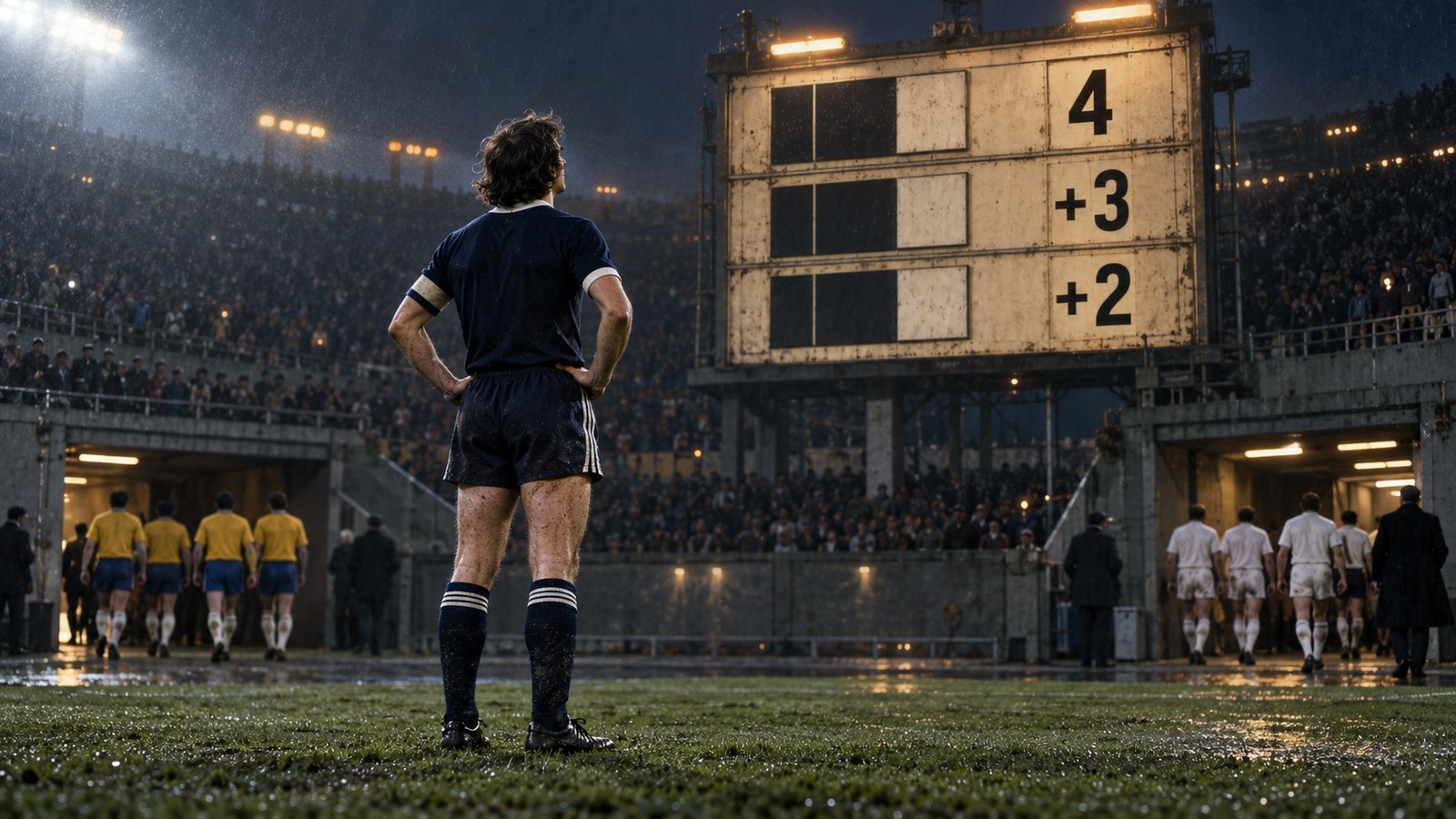
Joe Jordan’s equaliser arrived with two minutes left in Frankfurt. Scotland had rescued a 1–1 draw with Yugoslavia, completed three World Cup matches without defeat and conceded only once. The players still needed news from Gelsenkirchen. Brazil were facing Zaire there, and one more Brazilian goal would decide which unbeaten team advanced.
Brazil had already scored three. No fourth came, but the damage was sufficient. Yugoslavia, Brazil and Scotland all finished Group Two with four points. The first two went forward on goal difference; Scotland went home at +2, one goal behind Brazil. The margin had accumulated across an entire week, beginning with a comfortable opening win that felt large enough at the time.
Two Goals Put Scotland on Top
Scotland entered the 1974 finals as the only qualifier from the British Isles and the country’s first World Cup side since 1958. Willie Ormond’s squad mixed experience from Leeds United, Celtic, Rangers, Manchester United and other leading clubs. Billy Bremner captained it. Davie Hay and Joe Jordan would play every group match.
The preparation had already supplied a story stranger than anything in the tactical plan. During a night out in Largs, winger Jimmy Johnstone took a rowing boat without oars and drifted out to sea. Hay and Eric Schaedler tried to help in another boat, discovered that theirs had a hole and rowed back. The coastguard rescued Johnstone. Scotland then responded to the headlines by beating England 2–0 in its next warm-up, with Johnstone heavily involved.
The incident made the camp look chaotic from outside, but Ormond took a balanced squad to West Germany. Bremner organised midfield; Lorimer brought a fierce shot; Jordan offered a direct centre-forward target; Kenny Dalglish and Denis Law gave the forward group different kinds of experience. The question was less whether Scotland possessed talent than whether three short group games would give that talent enough room for error.
Johnstone never appeared in the finals. Jordan later wondered whether Ormond might have used him against Brazil or Yugoslavia, while acknowledging that he did not know whether discipline explained the omission. It remains an unresolved selection question rather than a simple answer to the exit. Scotland created enough against Brazil to come within inches, and it recovered late against Yugoslavia; the missing margin had several possible sources.
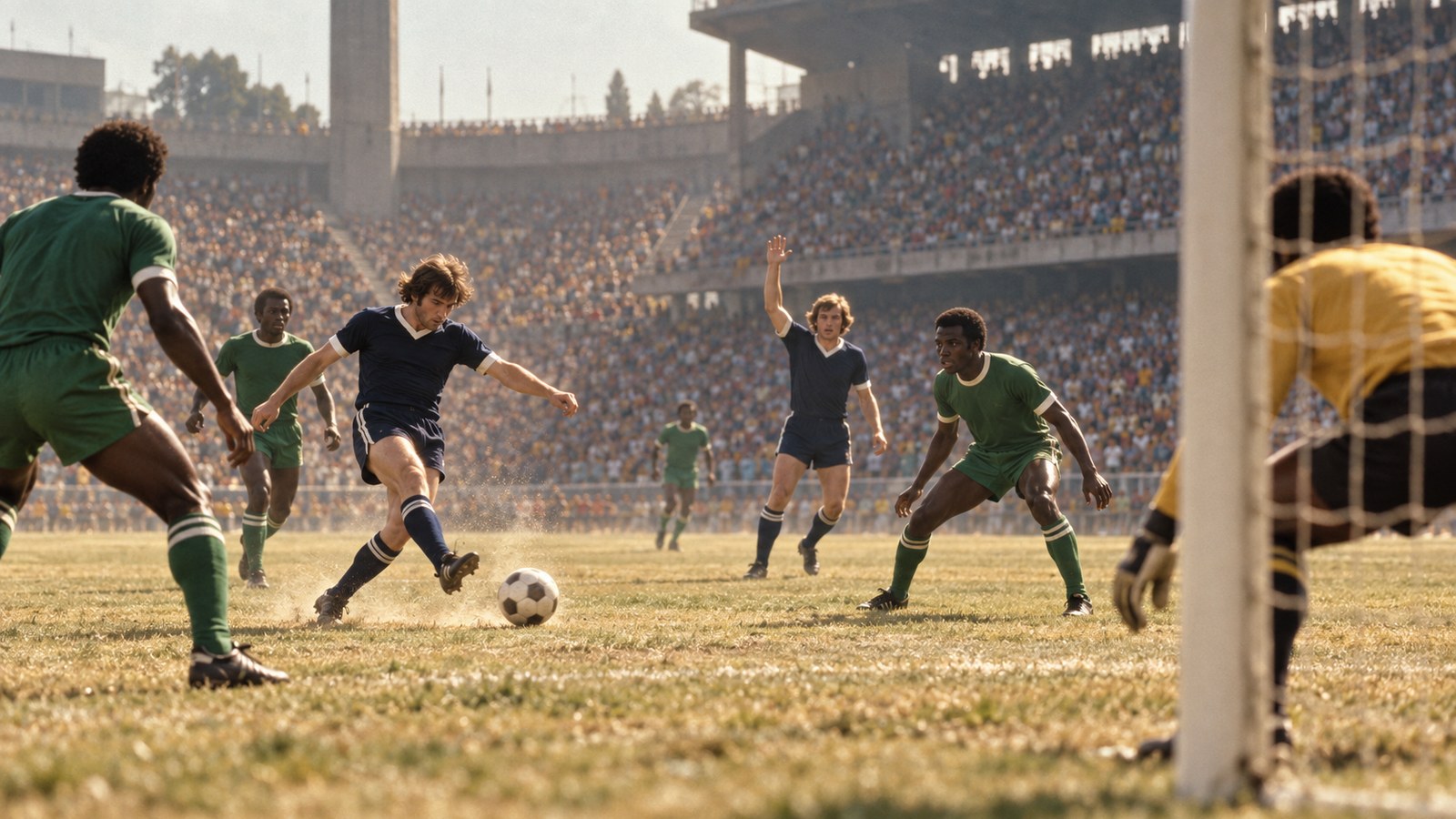
The first assignment was Zaire in Dortmund on 14 June. Brazil and Yugoslavia had drawn 0–0 the previous day, so a victory would send Scotland to the top of the group. Peter Lorimer and Jordan both scored before half-time. At 2–0, in exceptional warmth, the match appeared under control.
Years later, Hay remembered Scotland taking its foot off the gas. Jordan called the approach naïve and said the team should have tried to score more. Those reflections can sound like hindsight imposing knowledge on the players, because Scotland could not yet know that every goal against Zaire would become decisive. On the night, two goals delivered the required win and first place.
A Rebound Passed Billy Bremner by Inches
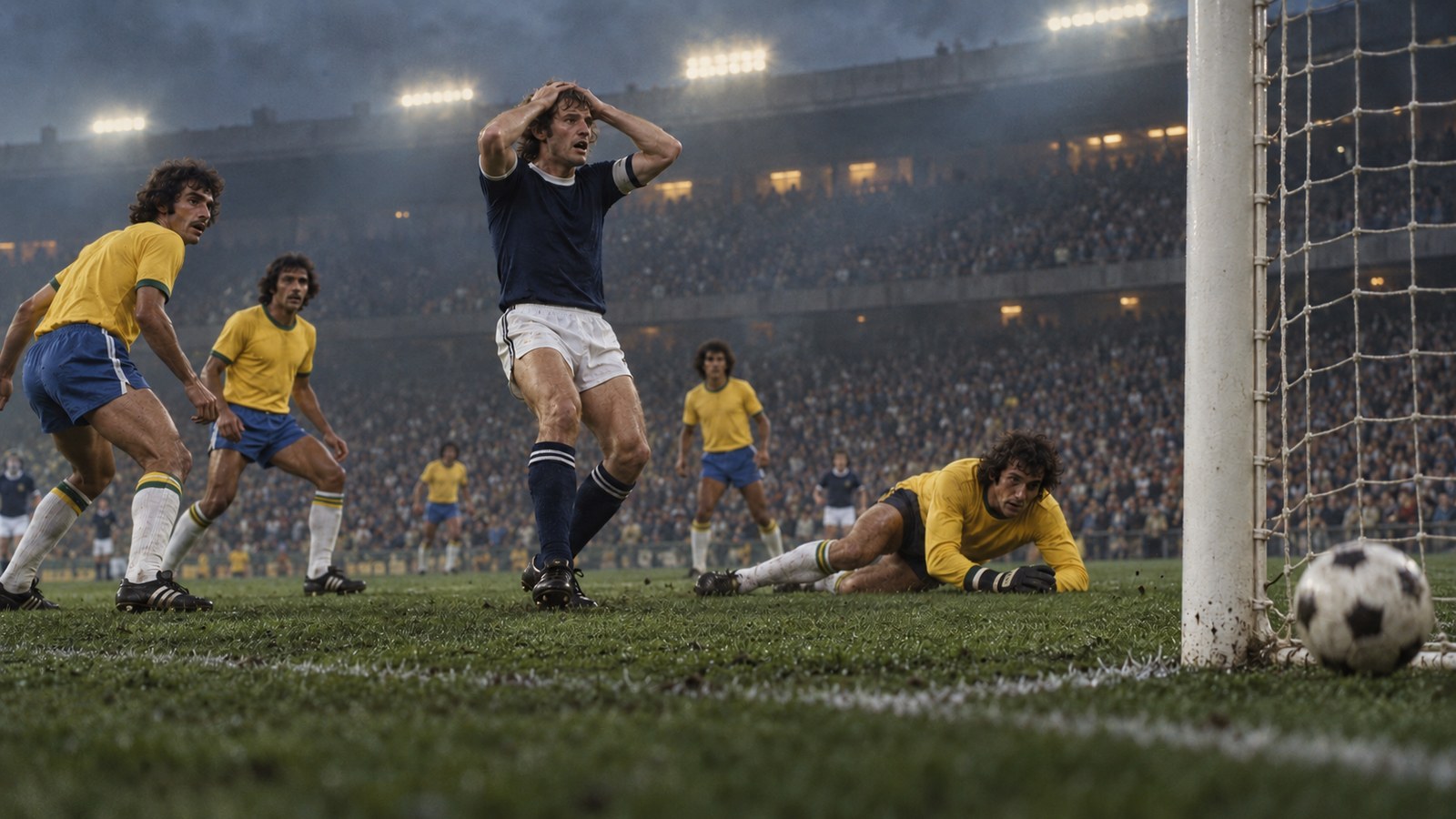
Four days later Scotland met the defending world champions in Frankfurt. Brazil no longer had Pelé, but they still carried the yellow shirt, Jairzinho, Rivellino and the authority of Mexico 1970. Scotland survived early pressure and then found the game’s clearest opening.
Jordan headed toward goal. Émerson Leão saved, but the rebound struck Bremner’s shin. The ball did not settle for a controlled finish; it squirmed inches beyond the post. Jordan later resisted treating the moment as a simple miss. Bremner had received a ricochet rather than a pass, and the contact sent it narrowly wide.
The 0–0 draw was a major result. Scotland had three points from two matches under the two-points-for-a-win format and had yet to concede. A victory over Yugoslavia in the final game would guarantee progress. A draw could also work, depending on Brazil’s margin against Zaire.
Elsewhere that day, the arithmetic changed violently. Yugoslavia beat Zaire 9–0. The scale of that result gave Yugoslavia a huge goal-difference advantage and exposed how little Scotland’s opening 2–0 had banked. The Zaire team would later be remembered through Mwepu Ilunga’s sprint from the wall at a Brazilian free kick, but its tournament also shaped the group through the radically different margins conceded to three opponents.
Two Matches Became One Moving Table
The final fixtures began on 22 June with Scotland facing Yugoslavia in Frankfurt and Brazil playing Zaire in Gelsenkirchen. The group could not be understood by watching only one pitch. Each goal altered the comparison among three teams that had entered the day close together on points.
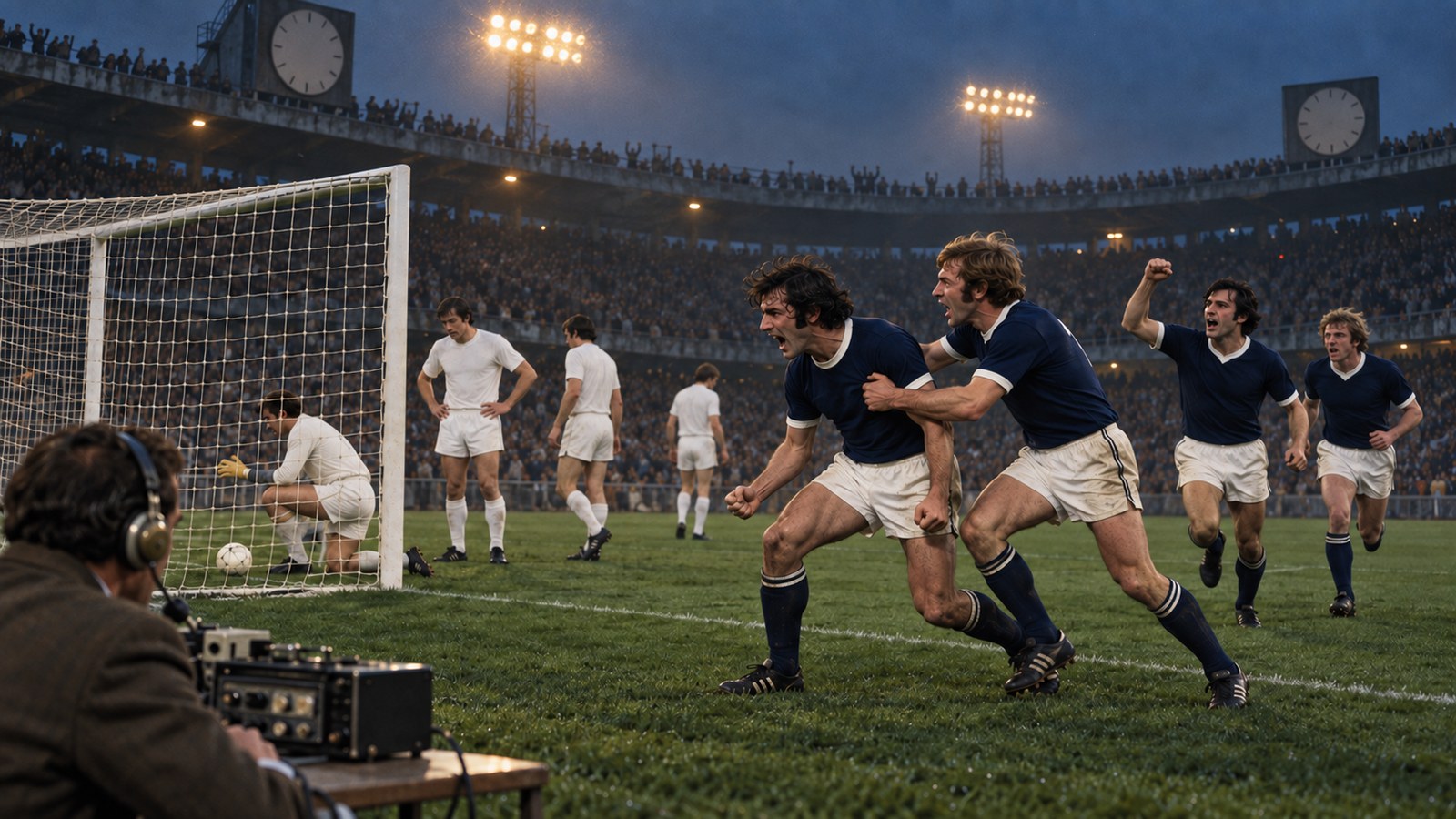
Scotland’s clearest route was victory. A draw would be enough if Brazil failed to beat Zaire by three clear goals. That condition linked Scottish progress to a match roughly 150 miles away. The radio updates mattered almost as much as the movements in front of Bremner.
Brazil scored its third goal. That put the defending champions ahead of Scotland on goal difference while the Scottish match remained level. Then, with fewer than ten minutes left, Dragan Džajić’s Yugoslavia went ahead. Scotland were suddenly chasing survival directly rather than waiting for help elsewhere.
Jordan Equalised, but the Fourth Goal Never Came
Jordan scored late to make it 1–1. Scotland had avoided defeat and recovered the point, yet the draw could not repair the opening-night margin. Brazil’s 3–0 was precisely large enough. Yugoslavia finished with ten goals scored and one conceded; Brazil had three scored and none conceded; Scotland had three scored and one conceded.
All three teams stood on four points. Their goal differences were +9, +3 and +2. Scotland’s elimination therefore rested on one goal in the table, although there were many moments from which that goal could be imagined: a third against Zaire, Bremner’s rebound against Brazil, preventing Džajić’s strike, or finding a winner after Jordan’s equaliser.
The old two-point scoring format tightened the knot. A win and two draws gave Scotland the same total as rivals with identical unbeaten records, so there was no cushion for having avoided defeat. Goals scored and allowed across separate fixtures became the separator. Yugoslavia’s nine in one afternoon did most of its work; Brazil’s three on the final day supplied exactly enough for second place.
Jordan returned to the first match when he assessed the campaign. Scotland had conceded once in three games, but it had scored fewer against Zaire than either rival. Brazil’s third goal in Gelsenkirchen did not create the vulnerability. It exposed the cost of easing through the second half in Dortmund.
The Only Unbeaten Team Was Already Home
Yugoslavia and Brazil both advanced to the second group stage and both lost there. The Netherlands beat Brazil; West Germany beat Yugoslavia and later defeated the Dutch in the final. West Germany had already lost to East Germany in a match decided by Jürgen Sparwasser, the only senior international meeting between the two German states.
Those later defeats produced Scotland’s strangest distinction. Every team that remained in the competition eventually lost, while Ormond’s side had already departed with one win and two draws. Scotland were the finals’ only unbeaten team.
The label sounds triumphant, but it does not reverse the table. Tournament football measures more than avoidance of defeat. In a short group, margins against the weakest opponent can carry forward into the final minutes of another match in another city. Scotland’s defence allowed one goal and did nearly everything asked of it. The attack produced three, and the distribution of those goals left no spare margin.
That is why Jordan’s late equaliser remains such a complicated ending. It preserved the unbeaten record at the exact moment progress disappeared. Scotland left West Germany with evidence that it could stand beside the world champions—and with a result sheet showing how a comfortable 2–0 win had become the score it most wished it could replay.
Sources
- BBC Sport, “World Cup 1974: Scotland’s undefeated campaign in West Germany”
- RSSSF, “World Cup 1974 finals”
- FIFA match records for 1974 World Cup Group Two