

In April 1958, Rachid Mekhloufi occupied two football worlds at once. He was a 21-year-old French champion at Saint-Étienne, a four-cap France international, and a forward being considered for that summer’s World Cup. He was also an Algerian from Sétif while the Algerian War was being fought across the Mediterranean.
He resolved the collision by leaving. Mekhloufi travelled out of France in secret with other Algerian professionals and joined the football team created by the National Liberation Front, or FLN, in Tunis. The choice removed him from the World Cup and from FIFA-recognized club football. It gave the independence movement a team whose matches could carry its argument into stadiums abroad.
The remarkable part of the story is not confined to the departure. After independence, Mekhloufi returned to Saint-Étienne. The club and its public received him again; he won three more French titles there and scored both goals in the 1968 Coupe de France final. His career therefore has two sporting peaks connected by four years outside the official game, with the same green shirt on either side.
Saint-Étienne made an 18-year-old from Sétif a champion
Mekhloufi was born in Sétif on 12 August 1936 and began playing locally. Jean Snella, the coach whose judgment would recur throughout his career, recommended him to Saint-Étienne. The French club signed the 18-year-old in 1954.
The adjustment was immediate enough to appear in the numbers. Mekhloufi scored nine league goals in his first top-flight season, then 21 in his second. In 1956–57 he struck 25 times in 30 league appearances as Saint-Étienne won the first French championship in the club’s history. He was small, mobile and technically precise, a forward who could connect moves as well as finish them.
France selected him four times between 1956 and 1957. On 14 July 1957 he won the Military World Cup in Buenos Aires. By spring 1958 he was under consideration for the senior World Cup squad, where Just Fontaine would score a record 13 goals in borrowed boots.
That trajectory makes the date of his departure essential. Mekhloufi was not leaving after his place had disappeared or his club career had stalled. He was moving away from a championship side and a possible World Cup at the precise moment when his football opportunities were widening.

The April journey exchanged a World Cup place for an unofficial team
On 13 and 14 April 1958, Algerian professionals based in France left without publicly announcing their plan. Mekhloufi travelled toward Tunisia via Switzerland with Mokhtar Arribi, formerly of Lens, and Abdelhamid Kermali of Lyon. Others took separate routes. The secrecy protected the operation until the players were beyond the immediate reach of their clubs and French authorities.
They gathered in Tunis to form the FLN team. The initials belonged to the Front de Libération Nationale, the movement fighting for Algerian independence. A football squad could not determine the war, but it could make the existence of an Algerian national claim visible in places where the territory did not yet have a recognized national side.
The sacrifice was concrete. Mekhloufi forfeited the chance to travel to Sweden with France. He left Saint-Étienne after 118 appearances across competitions in his first spell, according to the French biographical record. He also stepped beyond the official football structure that supplied league fixtures, transfer registration and recognized internationals.
The FLN side’s first listed international came quickly: a 5–1 victory over Tunisia in Tunis on 3 May 1958. Eleven footballers presented Algeria as a sporting identity before independence created a FIFA member association.
The FLN tour used fixtures as public appearances
France attempted to restrict the team through football’s governing channels. FIFA members were discouraged from staging recognized matches against it, so the FLN side operated beyond the conventional international calendar. Its route ran through countries willing to receive the players, with games functioning as sporting contests, diplomatic visits and fundraising occasions.
Mekhloufi’s record for the team is listed as 40 appearances and 43 goals. The total captures the quality that the project had recruited. These were not ceremonial representatives assembled for photographs. They were professionals from the French league, able to produce a strong touring side while carrying an explicitly political identity.
For Mekhloufi, each match extended an unusual gap in his official résumé. A player who had won a national league and represented France spent four years outside FIFA-recognized competition. There was no French selection or ordinary club rhythm without abandoning the choice made in April.
The team lasted until 1962. Its existence showed that football affiliation could be claimed before it was administratively granted. A passport, a federation registration and the shirt a player believed he represented did not line up neatly. Mekhloufi’s presence gave that contradiction a face familiar to French supporters.

Independence opened a route back through Geneva
The FLN team dissolved in March 1962 as the war ended and Algerian independence approached. Returning to ordinary club football was not as simple as walking back into the dressing room he had left four years earlier. Mekhloufi first spent part of 1962 with Servette in Geneva.
Jean Snella again supplied the connection. The coach who had helped bring the teenager to Saint-Étienne was working with Servette and then returned to the French club. Mekhloufi followed him. The move created a public test: how would supporters react to a former France international who had departed for the FLN team during the war?
The anticipated hostility did not define the return. The reception in Saint-Étienne was positive, and Mekhloufi resumed his career in green. The circumstances had changed dramatically. Saint-Étienne was in the second division, while Algeria now had its own recognized national team. Mekhloufi could play for the club again and represent independent Algeria rather than the unofficial touring side.
He helped Saint-Étienne win promotion in 1963. One year later the club won the French championship. Further league titles followed in 1967 and 1968. The player who had disappeared from the official French game at 21 returned to become central to the most successful early period in Saint-Étienne’s history.
That second spell also changes how the departure should be understood. It was not a permanent rejection of the club or the city. Mekhloufi separated his political decision from the relationships that had developed around football. Saint-Étienne, in turn, made room for a player whose four-year absence could not be treated like an ordinary transfer.
Two cup-final goals completed the circle in 1968
By 1968, Mekhloufi was 31 and Saint-Étienne had secured another league title. The Coupe de France final against Bordeaux offered the club its first chance to complete a league-and-cup double.
Bordeaux scored first, forcing Saint-Étienne to respond rather than control the occasion from in front. Mekhloufi supplied both goals in a 2–1 victory. The precise symmetry is difficult to improve upon: ten years after leaving a possible France World Cup squad, he decided the French cup final for the club he had left.
He later joined Bastia, became a player-coach, and managed Algeria in several spells. Yet the cup final gives his Saint-Étienne story its clearest closing image. The 1957 champion and the veteran returning from the FLN years were linked by goals across an interruption no conventional career summary can explain.
Saint-Étienne would later suffer its own painful European memory when square Hampden posts denied two shots against Bayern in 1976. Mekhloufi belonged to the generation that built the club’s domestic authority before that night. Four French titles with Saint-Étienne, the 1968 cup, and his work for the FLN team sit together rather than cancelling one another.
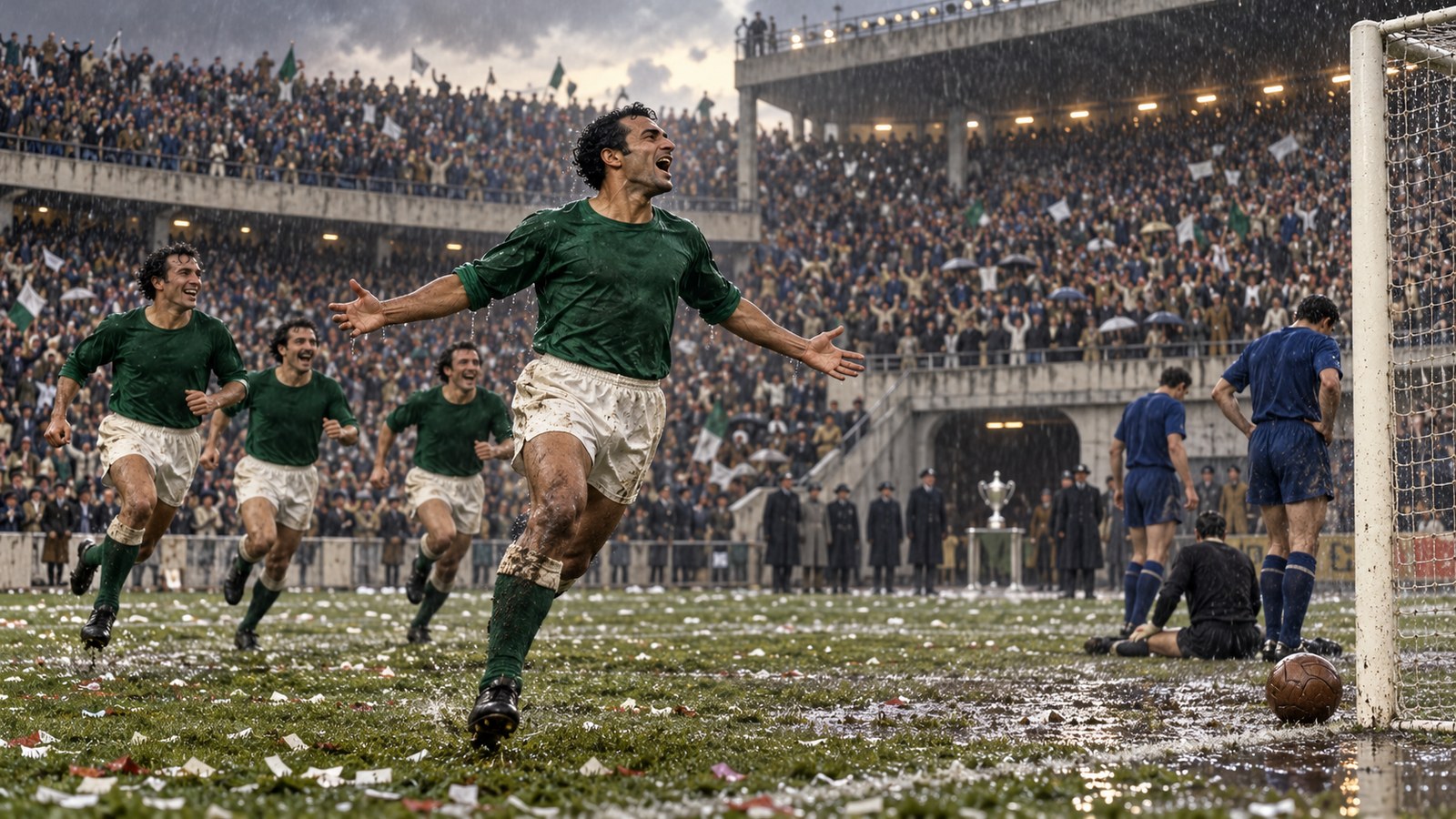
His career demonstrates how a footballer can leave the strongest available competition without leaving football behind. Between 1958 and 1962, the matches changed status, the audiences changed and the shirt represented a country not yet admitted to the formal game. When official club football became possible again, Mekhloufi returned and proved that the missing seasons had not erased his ability.
The biography is therefore larger than a choice between sport and politics. Mekhloufi used sport to make a political choice visible, then returned to sporting institutions that had survived the conflict. His April journey cost him the 1958 World Cup. His later years at Saint-Étienne ensured that the cost did not become the end of his career.
Sources
French historical record for Rachid Mekhloufi; FLN football team historical record; AS Saint-Étienne career and honours records.