
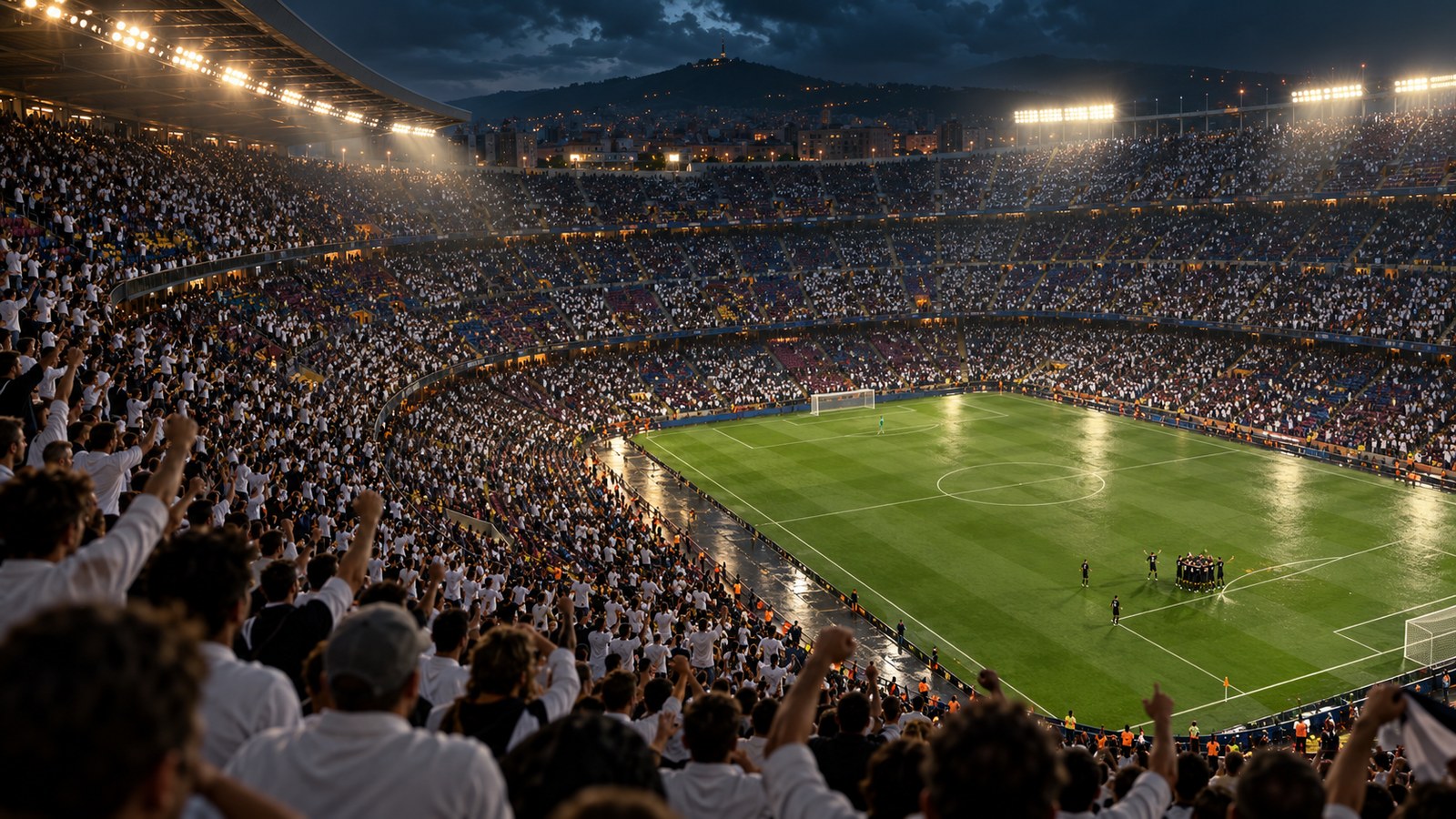
Five thousand away tickets should have produced one pocket of white in one corner of Camp Nou. On 14 April 2022, white shirts instead appeared behind goals, along touchlines and high across the bowl. Eintracht Frankfurt had brought far more than an away end to Barcelona. Almost 30,000 of their supporters were inside a stadium whose recorded attendance was 79,468.
The count mattered because it exposed two contests at once. One was a Europa League quarter-final level at 1–1 after the first leg. The other was a struggle over who could enter, where they could sit and which club would sound at home. Barcelona had tried to limit German demand before kickoff. Its own ticket network then carried thousands of Frankfurt supporters beyond the 5,000-seat allocation.
Frankfurt still had to win the football match. An early penalty gave the visitors control, a long-range strike gave the travelling crowd a picture to carry home, and a third goal made the tie look settled before a frantic stoppage-time finish. Yet the lasting argument began outside the pitch markings. Camp Nou had become proof that an away allocation and an away following were no longer the same thing.
The Away End Was Only the Starting Number
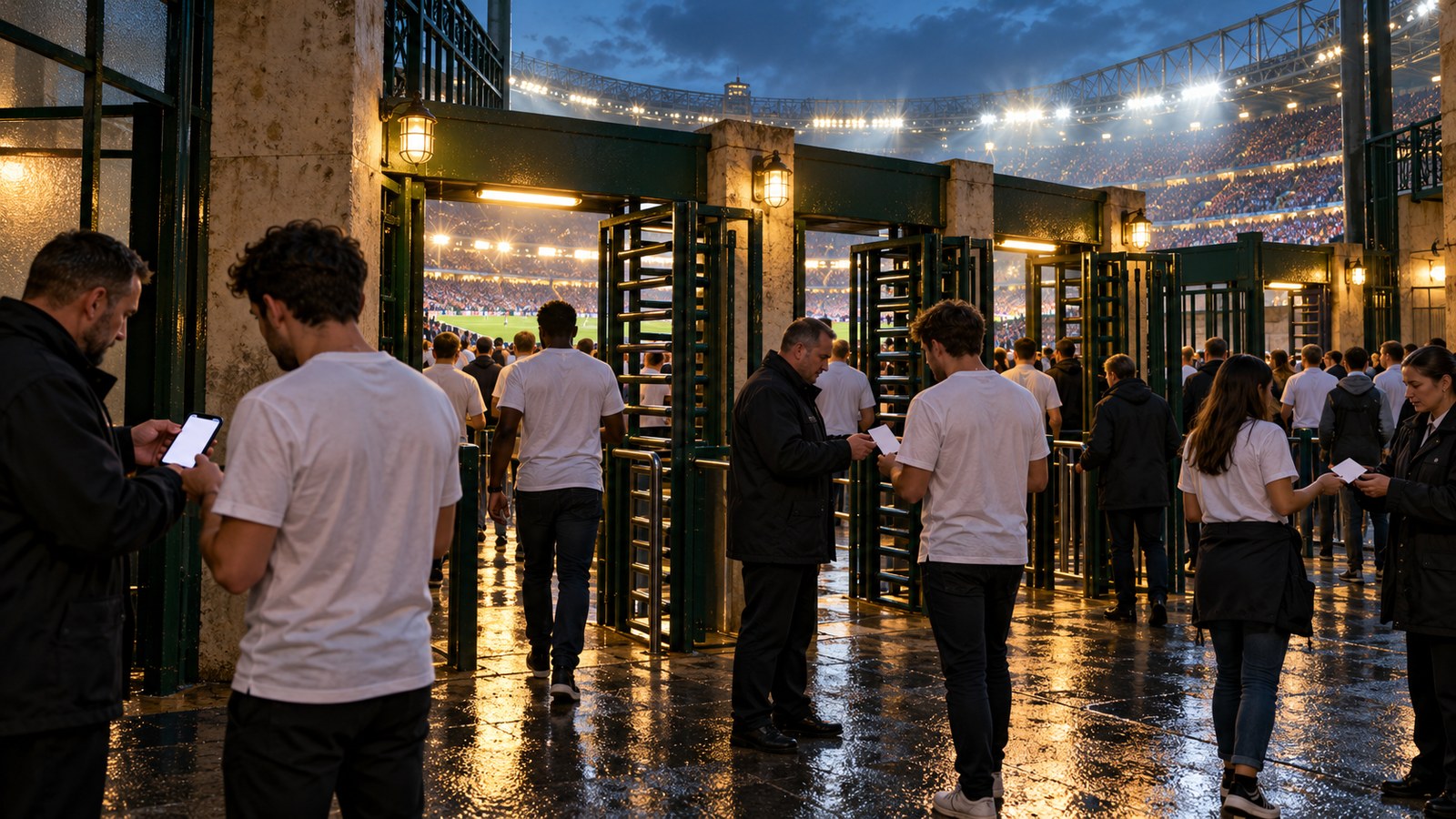
The official allocation gave Frankfurt 5,000 tickets. That number described a controlled block, not total demand. Barcelona knew the pressure was larger. Before the match, the club said purchases made from German internet addresses would be cancelled. It also warned that Frankfurt colours would not be admitted in home sections. Those measures treated the problem as one of identification at the first sale and presentation at the gate.
They could not trace every ticket after that first transaction. Barcelona president Joan Laporta later said some club members had resold their seats to visiting supporters. Other tickets circulated through channels that did not look German at purchase. A restriction based on an IP address could screen one moment; it could not govern every transfer between the sale and the turnstile.
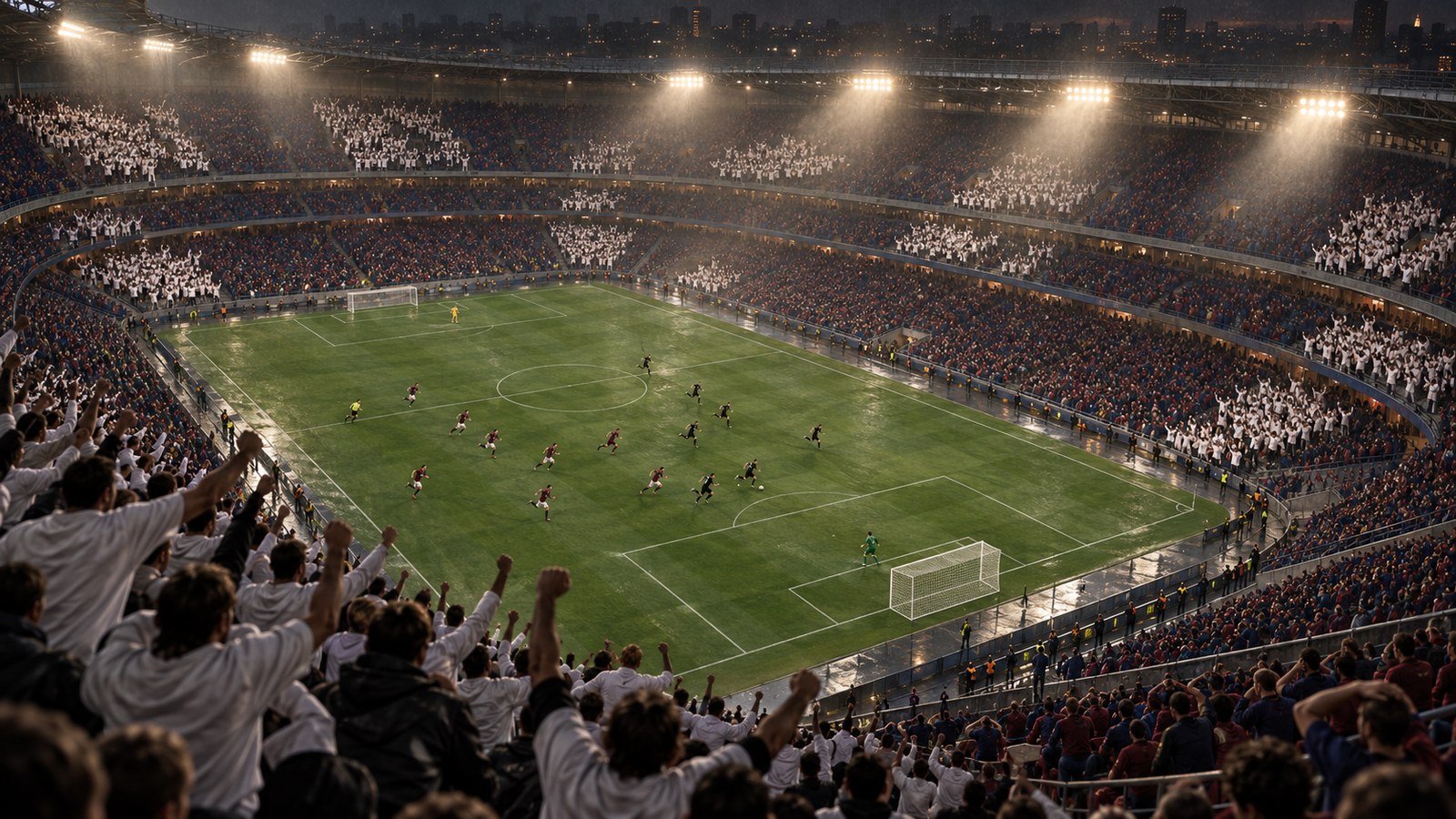
The result was visible long before the teams settled. Frankfurt supporters were dispersed instead of boxed into a single vertical strip. Their white clothing made the distribution legible from a distance, while their noise joined across separate parts of the stadium. This was not the same mechanism as Dynamo Dresden supporters buying tickets for an empty match. In Barcelona, the ticket represented physical access, and thousands of separate purchases assembled into one travelling presence.
Four Minutes Changed the Sound of the Ground
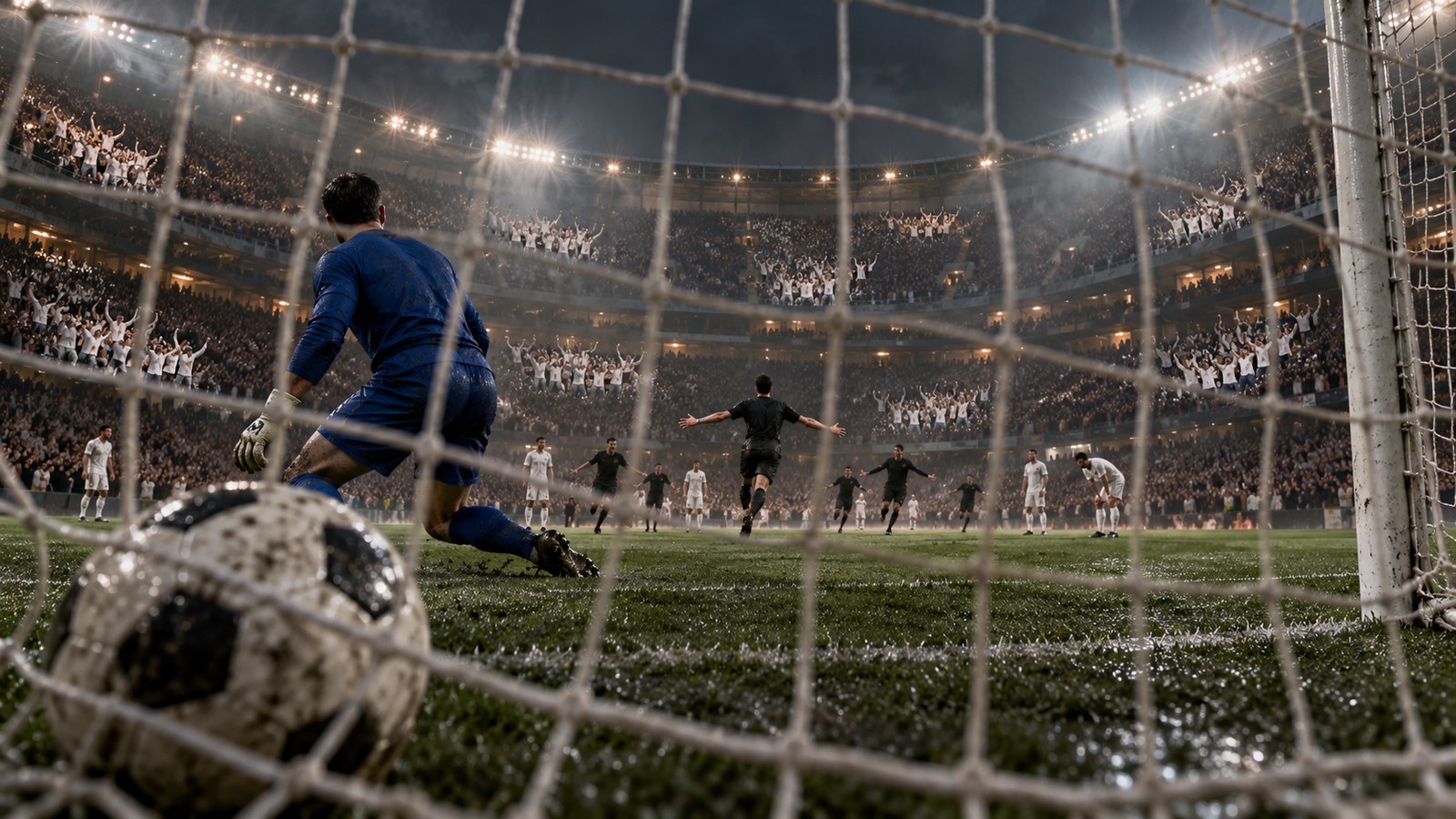
Barcelona had barely begun to test the evening when Eric García fouled Jesper Lindstrøm. Filip Kostić took the fourth-minute penalty and scored. An away crowd normally answers an early goal from one contained end. This celebration came from around Camp Nou, revealing seats that the official allocation had never described.
The goal also gave Frankfurt the match they wanted. Barcelona needed to chase through a ground that no longer offered a simple home soundtrack. Frankfurt could defend compactly, release runners and let Kostić attack the space ahead of him. The first leg in Germany had finished 1–1, so the penalty put the visitors ahead in the tie without forcing them to abandon their shape.
In the 36th minute, Rafael Borré changed the emotional scale of the night. He received the ball outside the penalty area and drove a shot beyond Marc-André ter Stegen. It was a clean, sudden strike, the sort that creates a breath of silence before the sound arrives. Frankfurt now led 2–0 on the night. White shirts rose across the stadium rather than in one fenced-off patch.
A White Shirt Became a Wayfinding Device
Frankfurt’s white kit and the supporters’ white clothing did more than create a photograph. They made a scattered group readable as a group. A person searching the bowl could follow one white section into another and understand that the official away end was only the densest point in a much larger map.
The club later connected that European run with the name Bestia Blanca, the White Beast. The phrase fitted an unbeaten Europa League campaign, but Camp Nou gave it a physical form. Frankfurt did not arrive as a collection of neutral-looking customers who happened to prefer the same team. Their colour turned ticket-market leakage into a public spectacle.
Camp Nou had carried this kind of crowd meaning before. When Luís Figo returned with Real Madrid in 2000, hostility in the stands made a transfer dispute tangible. The Frankfurt night worked differently. The shock came from recognition: Barcelona members looked around their own ground and saw how many seats had crossed an invisible boundary from home inventory to visiting support.
Kostić sharpened that recognition in the 67th minute. He finished low across goal for his second of the night. Frankfurt were 3–0 ahead at Camp Nou and 4–1 ahead on aggregate. Every scoreboard calculation now pointed toward the semi-final, while every wide view of the celebration pointed back toward the ticket question.
Barcelona’s Late Goals Arrived After the Tie Had Gone
The scoreline eventually became narrower than the experience. Sergio Busquets had one effort disallowed, then scored in the first minute of second-half stoppage time. Memphis Depay converted a penalty in the eleventh minute of added time. The final whistle followed almost immediately. Barcelona had reduced the match to 3–2, but Frankfurt advanced 4–3 on aggregate.
Those late goals prevented the result from reading like a routine rout. They did not recover the tie, and they did not restore the familiar relationship between pitch and stands. Frankfurt’s players had managed the central hour in front of a crowd whose scale altered the emotional risk of every transition. A Barcelona attack met home expectation, but a Frankfurt break could awaken voices from several directions.
The visitors carried that momentum onward. They beat West Ham in both semi-final legs, then drew 1–1 with Rangers in Seville and won the Europa League on penalties. Camp Nou was therefore neither an isolated stunt nor the endpoint. It became the most vivid away chapter in an unbeaten continental campaign.
The Ticket Failure Outlived the Scoreline
Laporta described the scene as shameful and promised an investigation. Xavi said the atmosphere had affected his team and called the planning a mistake. Their reactions separated the issue from a normal complaint about vocal away fans. Barcelona had sold access to a home fixture, tried to control its onward movement and discovered that the visible result contradicted the intended segregation of demand.
The important mechanism sat between membership privilege and the secondary market. A home supporter’s right to buy or hold a seat could become a visiting supporter’s route into the stadium. Once that happened thousands of times, gate rules about colours could only catch the most obvious cases. A scarf could be hidden. A digital ticket could look valid. The identity of the person sitting down was not necessarily the identity anticipated when the seat entered circulation.
That distinction explains why the number 5,000 survives beside the estimate of almost 30,000. Neither number cancels the other. The first was the formal away allocation. The second described the human reality that emerged after resale, transfer and travel. Frankfurt’s supporters did not enlarge the away block; they made its boundary irrelevant.
For Barcelona, the embarrassment was not simply that visiting fans celebrated a 3–2 win. It was that Camp Nou displayed a loss of control before Kostić took the penalty. The match then gave the crowd a sequence worthy of the journey: a goal after four minutes, Borré from distance, Kostić again, and two late home goals that arrived too late. The ticket trail built the stage. Frankfurt’s team made the takeover impossible to dismiss as scenery.
Sources
- UEFA Europa League match records
- The Guardian match report, 14 April 2022
- Reuters / The Observer report on Camp Nou ticket distribution, 15 April 2022
- Eintracht Frankfurt official retrospective on the 2021–22 European campaign