
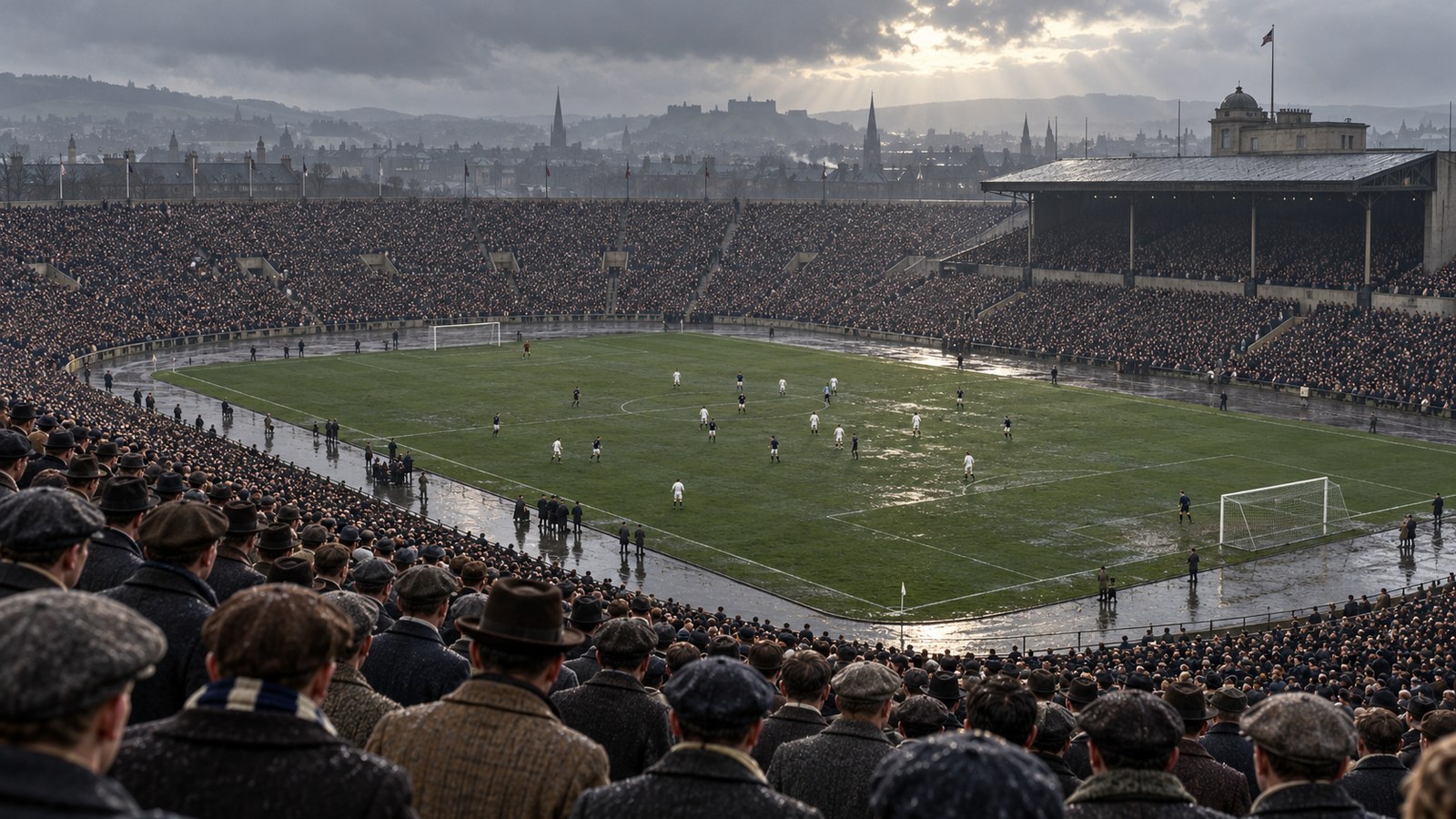
The largest crowd ever recorded for a football match in Britain gathered for a prize neither team could win. On 17 April 1937, Scotland and England met at Hampden Park after Wales had already secured the British Home Championship. The table had closed one argument, but it had not reduced the pull of the oldest international fixture. Ticket holders still poured toward Mount Florida until the official attendance reached 149,547.
The number is usually presented as a monument. It is more revealing as a logistical problem. Hampden had been enlarged because previous crowds had overwhelmed Glasgow’s railways, trams and terraces. The 1937 match tested that rebuilding, then showed what a mass of supporters could do to the emotional direction of a game. England led at half-time. Scotland scored three times after the interval. Players later remembered the noise as an active force rather than scenery.
Before the Roar Came the Railway Crush
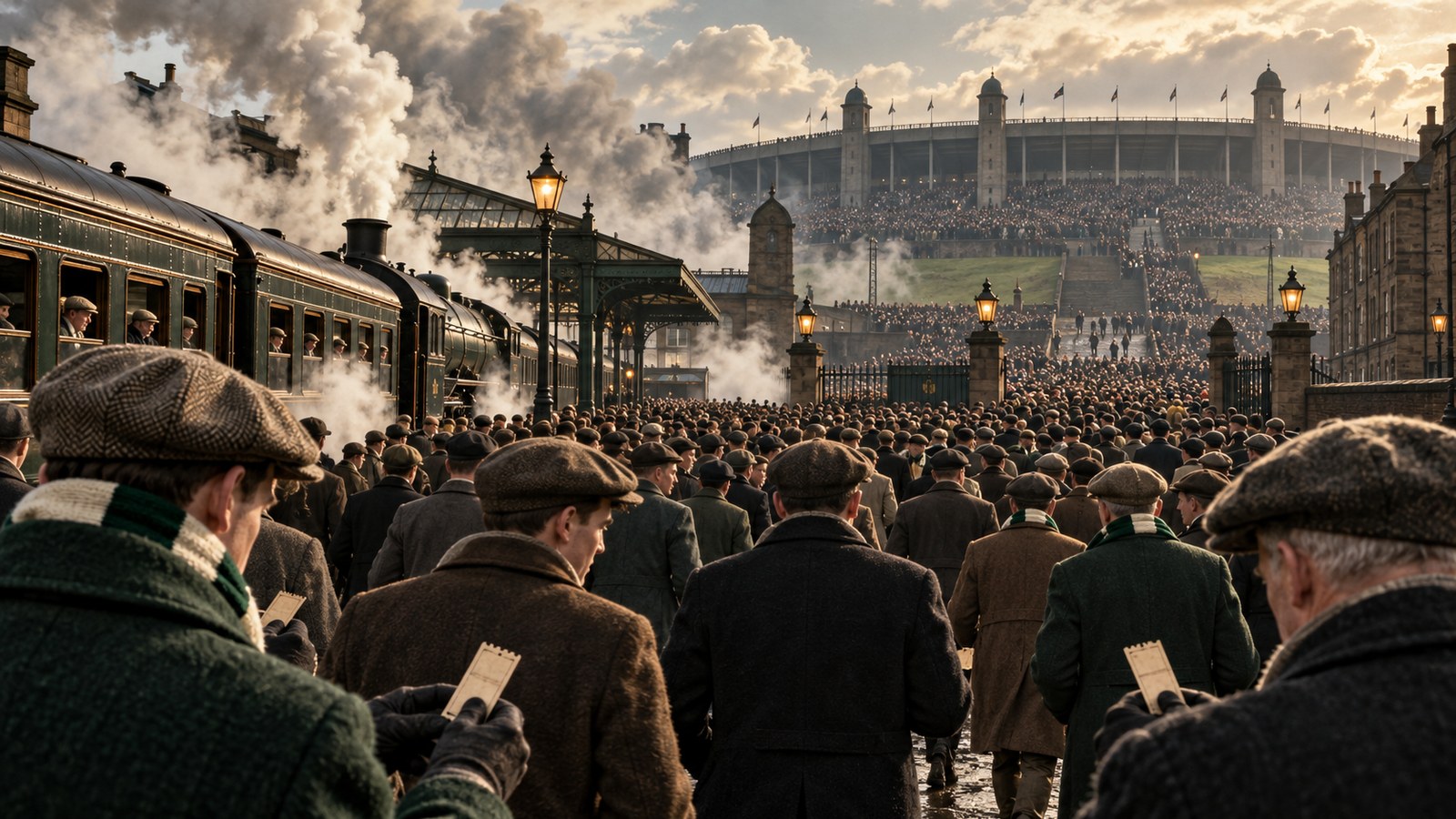
Hampden’s record afternoon began with trouble two years earlier. Before the 1935 Scotland–England match, supporters hurried through Glasgow in numbers the existing transport plan could not absorb. Some crossed working railway lines at Central Station to reach trains for Mount Florida. Others boarded incoming trams before they reached their terminus so they could secure a place on the return trip. Overcrowding followed at the ground.
The Scottish Football Association faced an awkward choice. Restricting Hampden’s capacity would have made major matches safer to manage, but it would also have cut gate receipts and locked out tens of thousands. Instead, the association sought a ground capable of holding roughly 150,000 people. Queen’s Park offered to expand Hampden in exchange for a 21-year right to stage Scotland–England internationals and Scottish Cup finals.
Engineering turned the ambition into measurements. The expanded ground provided 14,269 seats and calculated standing room for 135,700. The design allowed less than two square feet for each person on sections of the east and west terraces. Plans claimed that 150,000 spectators could enter in under 75 minutes and leave in 19. Those figures described a stadium as a flow of bodies, not merely a ring around a pitch.
A Dead Rubber Sold Every Ticket
The British Home Championship had been running since October 1936, involving England, Scotland, Wales and Ireland. By the time the final fixture reached Glasgow, Wales had already done enough to take the title. Scotland could finish second, but neither a home victory nor an England win could remove Wales from first place.
That should have made the match easier to ignore. Britain was still living with the effects of the Depression, and unemployment left little spare money for entertainment. The coronation of George VI was approaching, filling towns and newspapers with another national spectacle. Yet Scotland against England operated outside the ordinary calculation of points. It was an annual occasion through which supporters measured players, cities and football identities.
The demand produced the first all-ticket international played at Hampden. The official figure is sometimes reported with small variations: contemporary and later accounts cite 149,407 or 149,547. The Scottish record history uses 149,547, while reports noted that police, stewards, journalists and other non-ticketed people may have pushed the number around or beyond 150,000. Even the lower total represented a world record for a full international.
Seven-year-old John Cairney entered with his family for his first football match. Decades later, he could recall the yellow ticket, the mass of people and the noise more clearly than most passages of play. His memory matters because it restores scale to an abstract attendance. One person in 149,547 was a child trying to stay close to the adults who had brought him.
One Hundred and Fifty Thousand Became a Physical Problem
The completed Hampden was built to admit extraordinary numbers quickly, but a capacity calculation could not make such a crowd comfortable. Terrace spectators had to locate a place, keep their footing and accept that leaving temporarily might mean losing their view. The boundaries between separate voices disappeared. A shout beginning in one section could spread until it reached players as a single impact.
The match programme contained recognisable stars. Scotland included Hearts forward Tommy Walker, Rangers striker Bob McPhail and Celtic winger Jimmy Delaney. England selected Stoke City’s Stanley Matthews and 20-year-old centre-forward Freddie Steele. Yet the spectators were not simply consumers assembled to admire celebrities. Their expectation supplied the event’s pressure.
Scotland kicked off after England captain George Male won the toss and gave the hosts that choice. The opening was rough and interrupted by fouls. England handled it better. Steele scored in the 40th minute, and the visitors carried a 1–0 advantage into half-time.
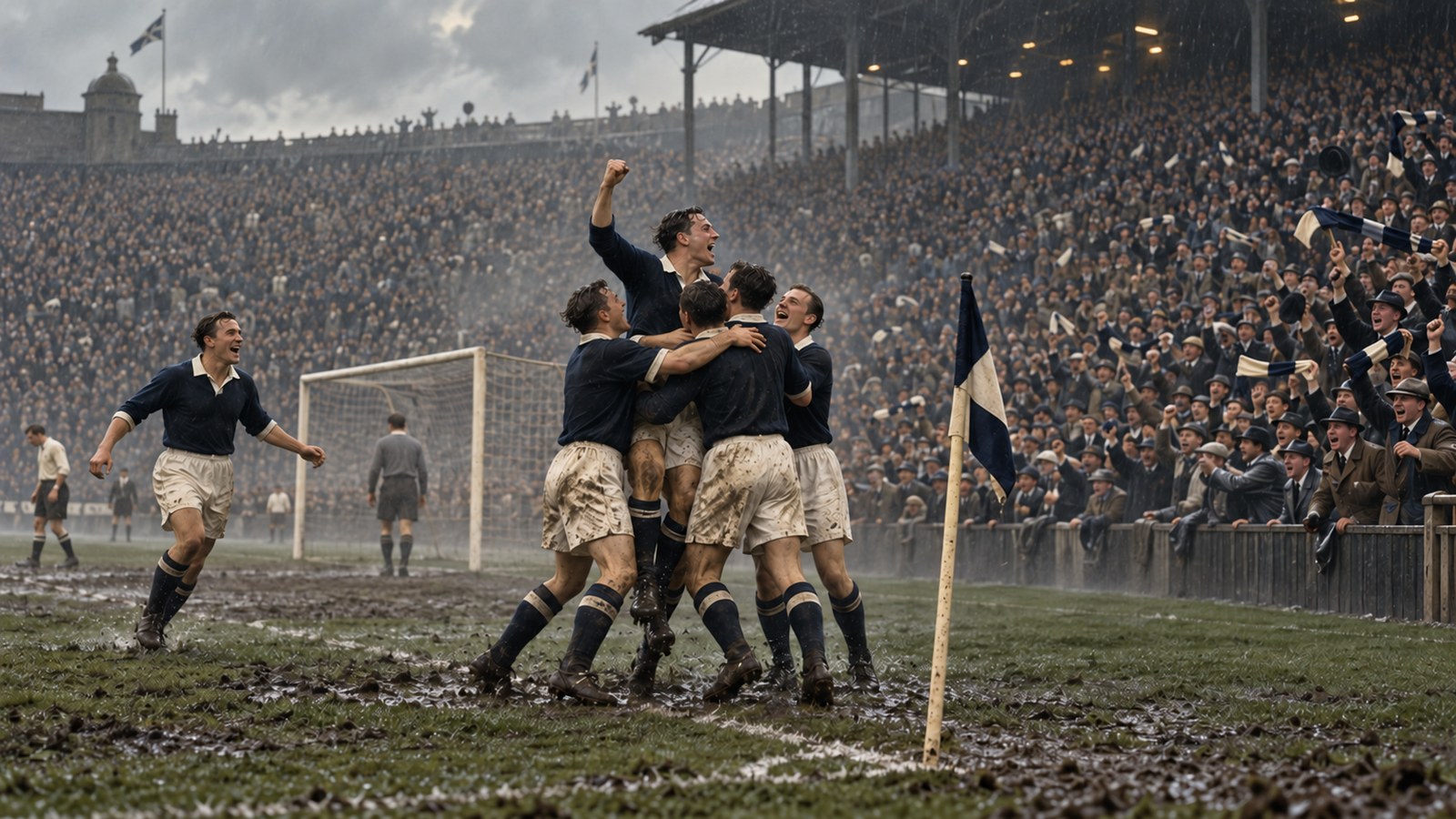
A crowd that large could not revise the score, but it could make every Scottish attack feel as if it were arriving with weather behind it. Newspapers called the sound the “Hampden Howl.” Cairney remembered joining a kind of collective frenzy without feeling afraid because he was among his own people. The description captures both sides of the terrace: potentially intimidating in scale, reassuring in belonging.
England Led Until the Crowd Found Its Voice
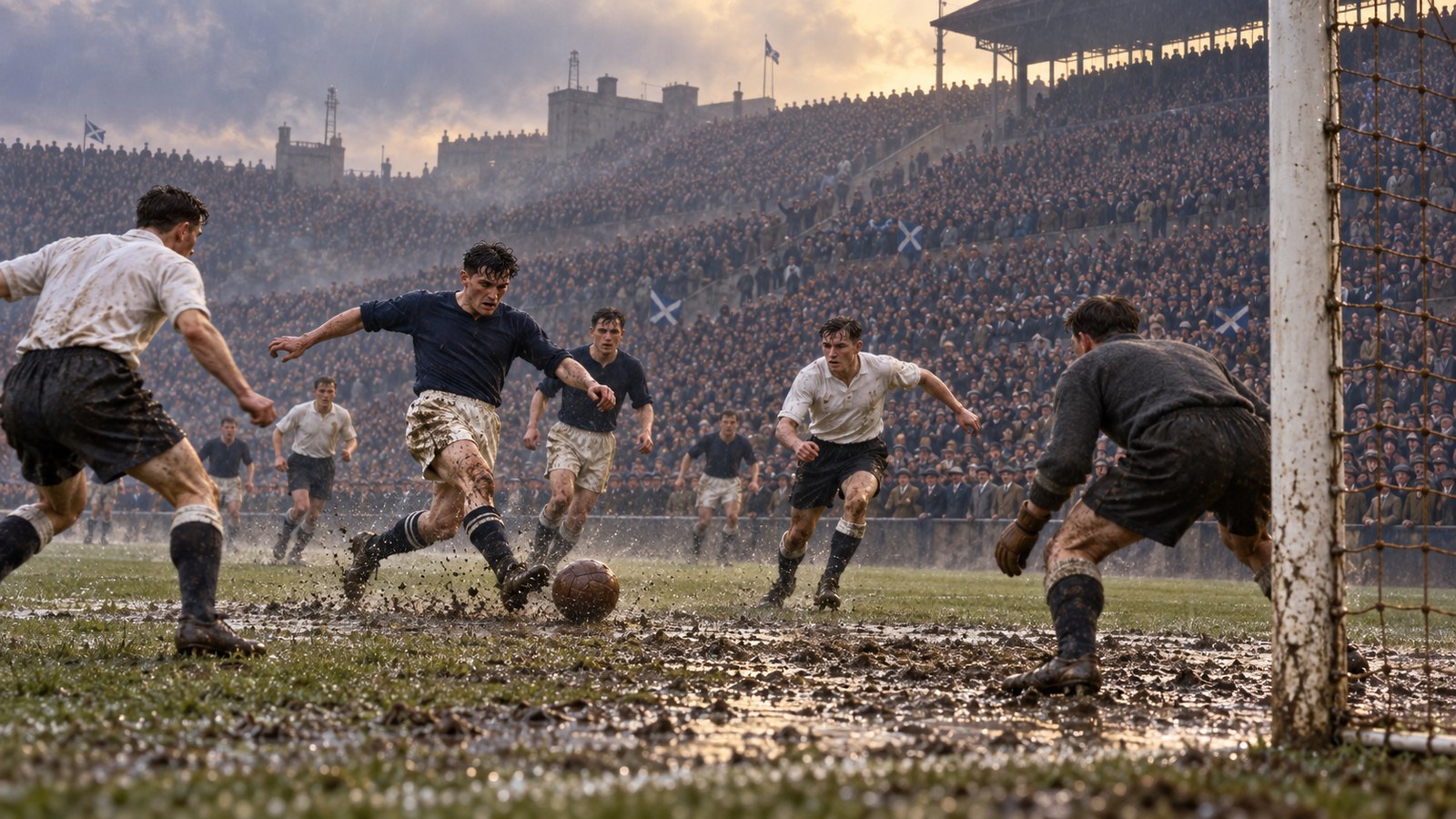
Scotland equalised two minutes after the restart. Walker moved the ball across the England defence and Francis O’Donnell finished from close range in the 47th minute. The reaction was remembered as bedlam. For England’s players, the equaliser changed more than the arithmetic. It gave almost the entire ground a reason to believe the match had tilted.
Stanley Matthews later wrote that the roar shook him and his teammates. His recollection does not prove that sound scored the goals. It does show that elite players experienced the crowd as part of the contest. The pressure became most visible in the final ten minutes, when Scotland repeatedly forced play toward England’s goal.
McPhail put Scotland ahead in the 80th minute after a scramble, scoring from a narrow angle. He added a header from a free-kick in the 89th. The official sequence therefore reads Steele 40, O’Donnell 47, McPhail 80 and McPhail 89. A 0–1 half-time score had become a 3–1 home win.
The result left Scotland second in the championship behind Wales. In competitive terms, it did not reopen the title race. In cultural terms, that limitation explains the afternoon’s importance. Nearly 150,000 people had not gathered because a trophy required them to. They had gathered because this fixture still meant enough on its own.
The match belongs beside the first Scotland–England international in 1872, which began with only a few thousand spectators and no goals. Across 65 years, the fixture had moved from a club cricket ground to a purpose-expanded national stadium. The rules and the audience had both grown around it.
The Record Revealed Both Power and Risk
Hampden set another immense mark one week later when 147,365 watched Celtic beat Aberdeen in the Scottish Cup final. The back-to-back crowds appeared to vindicate the expansion, but they also revived questions about blocked passageways, swaying and overcrowding. Glasgow councillors discussed reducing capacity to 135,000. No immediate reduction followed.
The 149,547 figure remains Hampden’s attendance record and a European record for an international. Its endurance does not mean football became less popular. Stadium policy changed. Seating, segregation, emergency access, television and modern safety standards altered the relationship between demand and admission. Building another terrace for another 30,000 people ceased to be the obvious answer.
The same density that amplified belonging reduced personal space and magnified the consequences of poor crowd control. Hampden’s expansion was itself a response to unsafe journeys and congestion in 1935. Its record day displayed impressive organisation while leaving authorities to debate whether the permitted number was still too high.
The ground later produced other forms of collective memory. In 1960, Hampden spectators acclaimed a Real Madrid side after a 7–3 European Cup final. In 1976, Saint-Étienne’s square-post defeat made the stadium part of another enduring story. The 1937 international was different because the crowd itself was the central event.
Wales kept the championship. Scotland kept a 3–1 victory. Hampden kept the number. Those outcomes can coexist because the afternoon operated on several levels at once: tournament fixture, national rivalry, transport exercise, engineering test and shared performance. The title had already been decided, but 149,547 people still found something football could settle only in person.
Sources
RSSSF Scotland international match records; Paul Brown, “Scotland 3 England 1,” The Blizzard; Douglas Gorman, “How Hampden Park Became the Largest Football Ground in the World,” Scottish Sport History; British Home Championship historical record.