
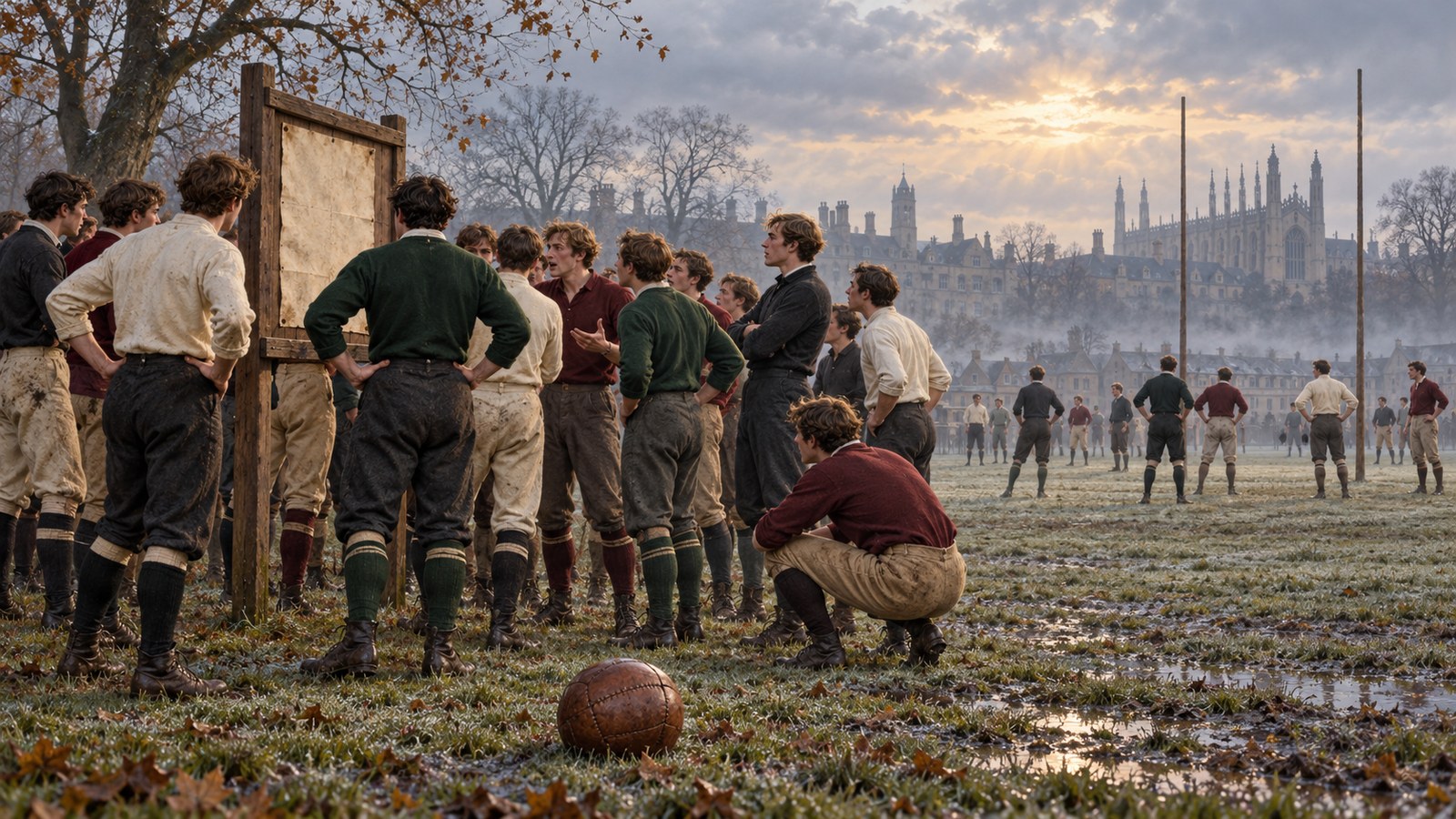
On a Friday afternoon in November 1863, Cambridge students were invited to Parker’s Piece for a football match that came with unusually exact instructions. Kick-off would be at 2:15. Anyone at the university could join the club for one shilling a term. Most important, everyone could read the same 14 rules before the ball moved.
That last detail solved a problem bigger than one fixture. Students arrived from Eton, Rugby, Harrow, Shrewsbury, Marlborough and Westminster carrying habits that did not agree. Some expected to handle the ball. Others objected. What counted as offside, what happened beyond the goal line and how much physical contact was acceptable all depended on where a player had learned the game.
The Cambridge code did not descend as a finished version of modern football. It was a negotiated way to make one afternoon possible. Its committee fixed dimensions, defined a goal without a crossbar, restricted the hands and allowed charging while banning four named forms of violence. The significance lies in that practical work: rival football traditions could share a pitch once their disagreements had been converted into sentences.
Before one match could begin, six school games had to agree
Football at Cambridge preceded the 1863 sheet, but uniform football did not. Early nineteenth-century schools developed their own codes. When former pupils met at university, a familiar word could describe materially different games. Rugby’s handling tradition collided with forms that placed more emphasis on kicking. Local understandings of fair play were not portable.
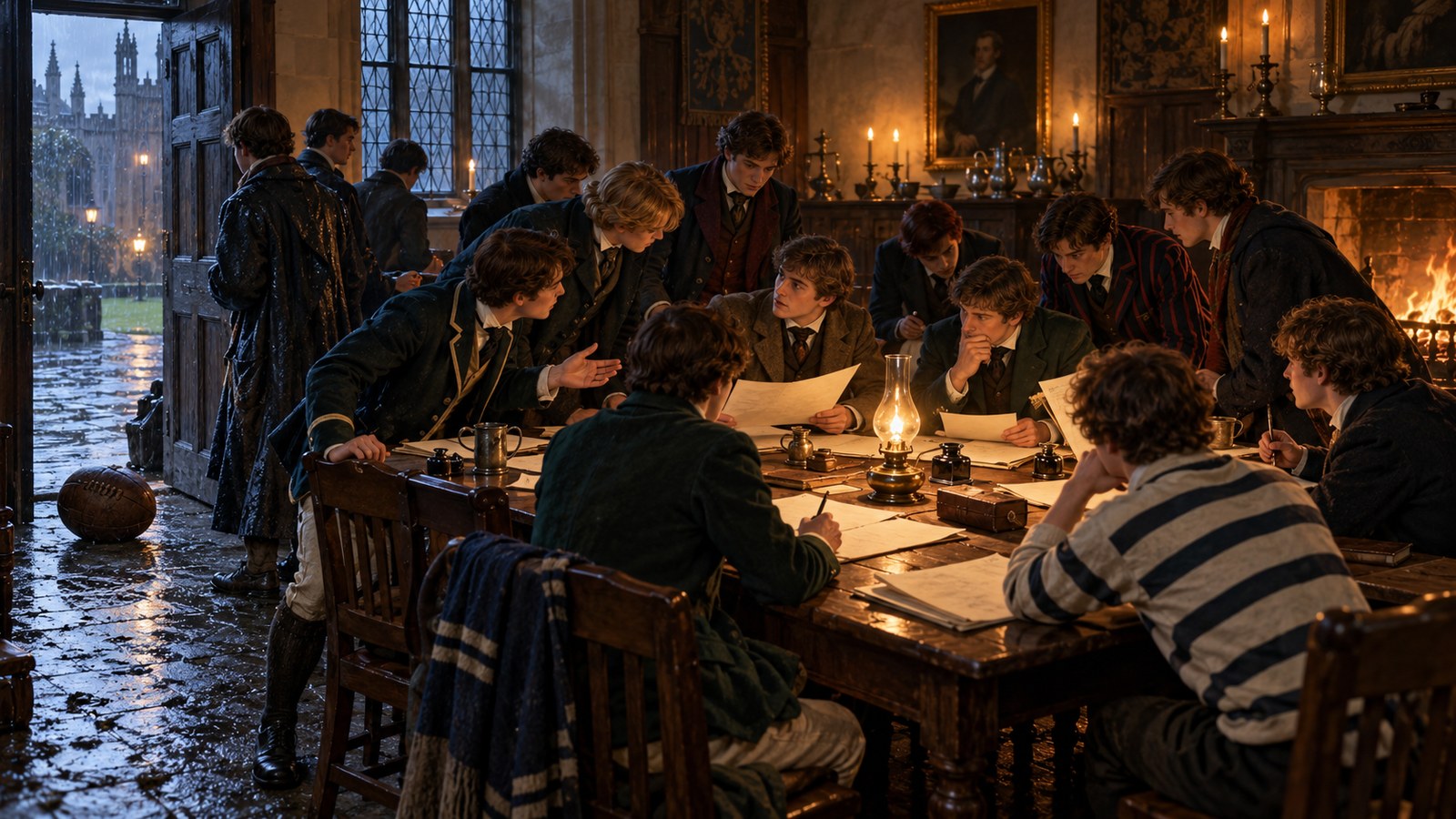
Henry Charles Malden later described an effort to settle the confusion in 1848. By his recollection, approximately 14 men took part. Harrow, Eton, Rugby, Winchester and Shrewsbury each had representation, while Malden and G. Salt spoke for the university rather than a public school. Every delegation brought written rules or carried them from memory.
The setting gives the negotiation a human scale. Hall was at four in the afternoon. Malden cleared his table and supplied pens, ink and paper. The meeting continued until five minutes before midnight. When the school representatives divided evenly, Malden and Salt could carry or remove a proposal. A playable game emerged from hours of small votes rather than one person’s grand design.
Malden said copies were printed and posted around Parker’s Piece. The 1848 text itself has not survived, however. That missing document matters. Modern retellings sometimes present a neat list as “the” 1848 Cambridge Rules, but Cambridge produced several codes. The remembered meeting establishes the method and the conflict; it does not give historians every line that the players read.
The surviving 1863 sheet was built for use, not ceremony
Further Cambridge rules appeared in 1856, and another committee drew up a code in October 1863. This later document survives clearly enough to read as an operating plan. Its notice announced that a general game for the university was desirable, named the committee and scheduled the first match for Friday 20 November at 2:15 p.m. on Parker’s Piece.
Nine committee members were listed. Their affiliations covered Shrewsbury, Eton, Rugby, Marlborough, Harrow and Westminster. The composition was the argument in miniature: no single school could simply bring its own game and call it neutral. The committee’s authority came from placing several traditions around one table.
The one-shilling term subscription is easy to overlook, but it shows what the rules were for. This was a club seeking players, not a museum display. The document had to answer questions quickly enough for strangers to participate. Who kicked off? When did the teams change ends? What happened when the ball crossed a side line? Which player could touch it next?
That purpose separates the code from an origin myth. Cambridge did not need to prove that it had invented every feature. It needed to reduce arguments during a match. Written law became valuable because the players could point to it when inherited custom pulled them in opposite directions.
A 150-by-100-yard rectangle contained an unfamiliar game
Rule one allowed a ground no longer than 150 yards and no wider than 100. Posts marked the field, including two on each side line 25 yards from the goal line. The goals themselves were two upright poles 15 feet apart. No crossbar limited their height.
A goal therefore counted when the ball passed between the poles, including at a height where it would have crossed the line had the posts continued upward. To a modern spectator, the open sky above the goal would look unfinished. To the committee, the wording was enough to settle whether a kick had scored.
The match began from the middle after a toss. The sides changed goals after half the agreed time, when the ball next went out of play. The captains decided both the duration and the number of players. Those choices reveal a sport before universal match length and team size had hardened into expectation.
The touchline restart was a kick, not the modern throw-in. Beyond the goal line, first touch could earn a free kick brought 25 yards into the field. The code was recognizably football, yet it remained full of solutions that later law-makers would alter or discard. That is what a working compromise looks like: coherent enough to play, provisional enough to revise.
The hands and offside clauses drew the real border
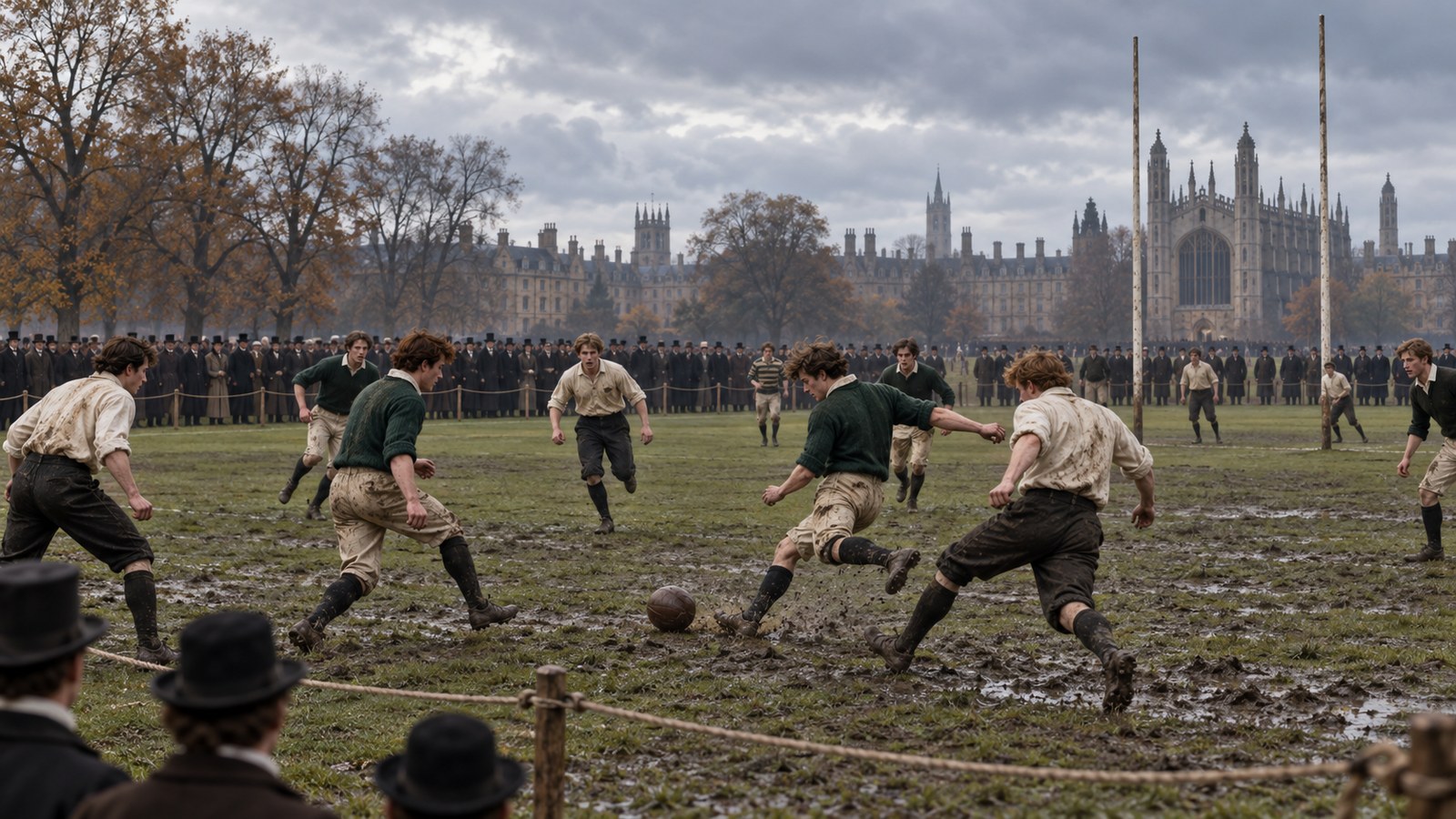
The deepest separation between football traditions appeared in two rules. First, the 1863 Cambridge code declared that a player could stop the ball with any part of the body but could not hold or hit it with the hands, arms or shoulders. The wording allowed contact without permitting possession in the Rugby sense.
Second, the offside rule was severe. After a player kicked the ball, any teammate nearer the opponents’ goal line was out of play. That teammate could not touch the ball or obstruct an opponent. Forward passing was consequently squeezed by law; movement and support had to respect the kicker’s position.
Physical contact was treated with similar precision. Charging was fair. Holding, pushing with the hands, tripping and shinning were forbidden. The list did not remove collisions, but it placed a border around them. Cambridge’s contribution was not simply choosing “skill” over “force.” It was naming which force remained part of the contest and which acts stopped being negotiable.
Later football laws would keep changing those borders. The corner kick, for example, entered another rule tradition before becoming familiar, as the history of Sheffield’s 1868 restart shows. The penalty kick arrived still later at 12 yards. The Cambridge sheet belongs to that longer period of experiment, not to a single moment when modern football appeared complete.
Its influence is strongest when the differences stay visible
The Football Association formed in the same autumn. The FA has acknowledged that elements of the Cambridge Rules appeared in its original 1863 laws, while also emphasizing that the two codes differed. That careful wording is more useful than claiming that one document was copied whole.
Cambridge supplied evidence that representatives of incompatible games could agree on a football code and test it in public. Its rules restricted handling, stated an offside principle and prohibited specific forms of rough play. The FA’s meetings then made their own choices. The route toward association football was institutional: proposals, votes, printed laws, matches and revisions.
Cambridge kept revising after 1863. Its 1867 version expanded to 18 rules and drew representatives from university clubs and a longer list of schools. That continuation undercuts the idea of a sacred founding text. If the 1863 committee had thought every question permanently solved, there would have been no reason to meet again.
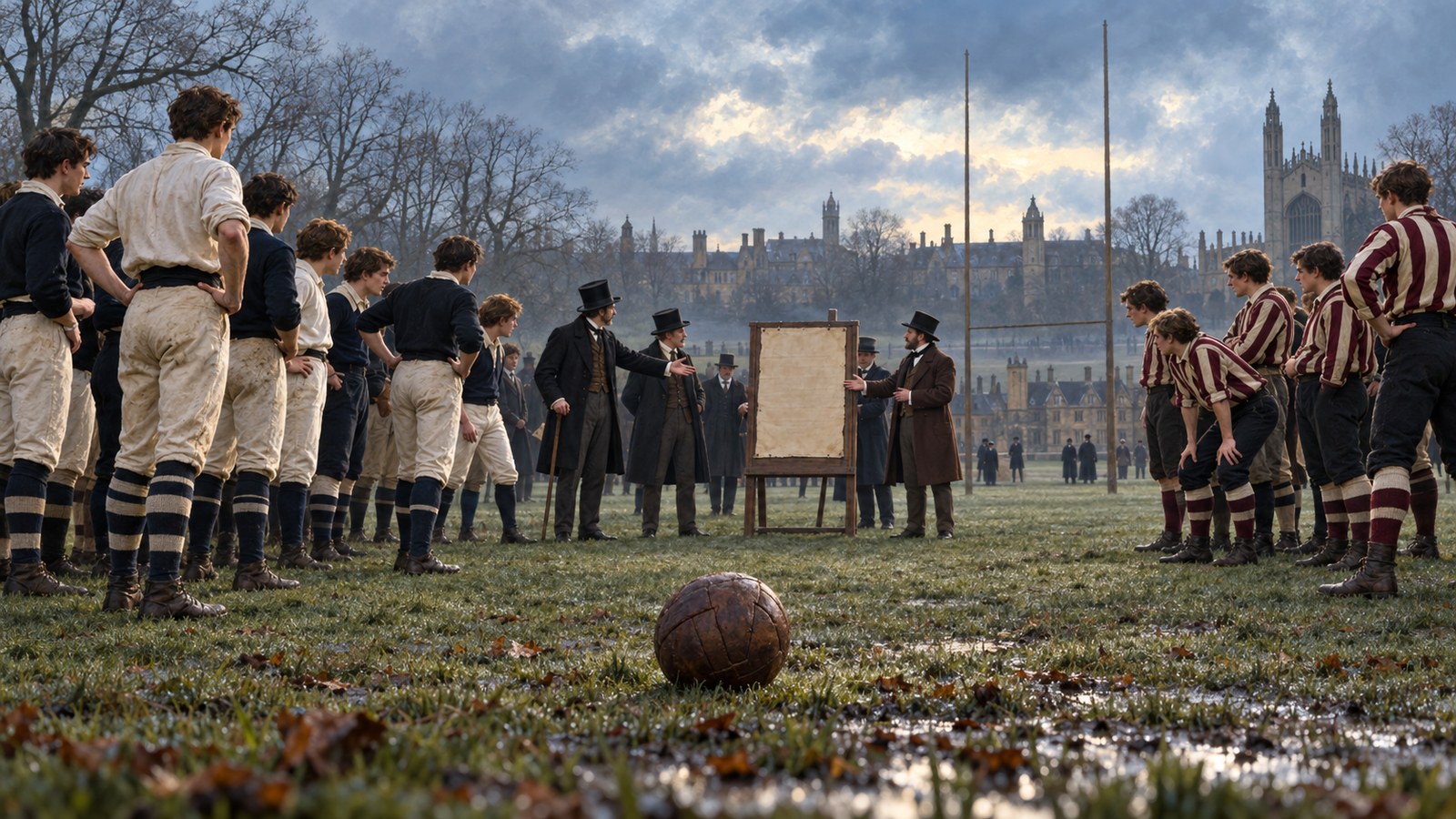
The more convincing legacy is the habit of agreement. At four in the afternoon in 1848, former schoolboys began comparing codes. Five minutes before midnight, they had something they believed could govern a shared match. Fifteen years later, another committee published exact dimensions, exact prohibitions and an exact kick-off time.
Those details carried football further than a claim to invention could. A game can travel only when newcomers know what actions mean and disputes have answers outside memory. Parker’s Piece provided the open ground. The committees supplied the portable part: a rule sheet that made players from different traditions teammates and opponents under the same conditions.
Sources
Cambridge Football Rules (1863); Cambridge Football Rules (1867); BBC News, “Cambridge bids for FA football rules recognition”; historical record of the Cambridge rules and Henry Charles Malden’s published recollections.