
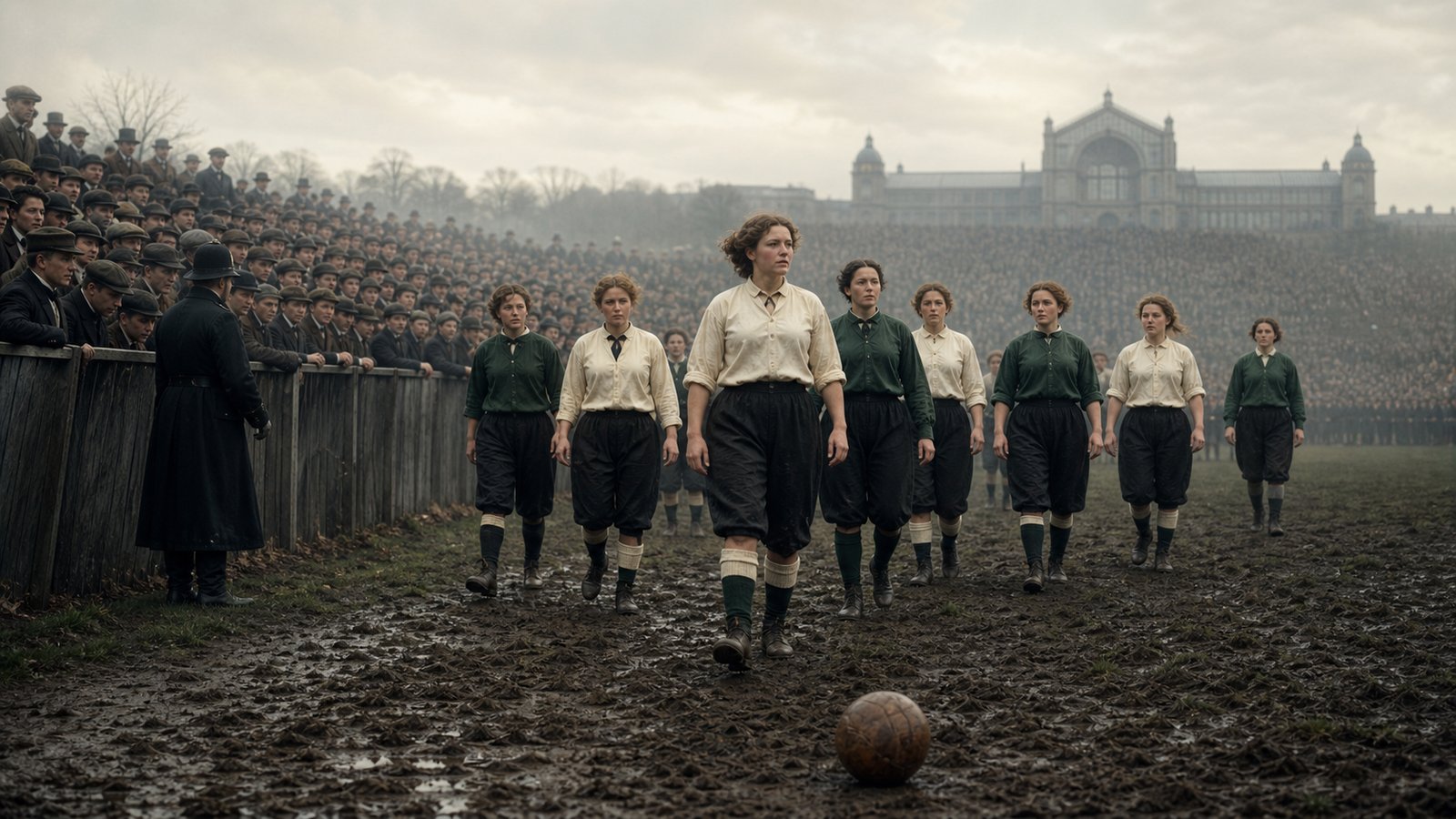
Before there was a league, a fixture list or a settled idea of what women’s football could be, there was an advertisement. In late 1894, a woman presenting herself as Nettie Honeyball asked the press for players. Roughly thirty answered. Within months they were training near Alexandra Palace, arguing through clothing as well as sport, and preparing to sell tickets to a match Victorian newspapers noticed.
The press helped create the British Ladies’ Football Club, then treated the club as an exhibit. That tension explains the startling arc of 1895: a crowd of about 12,000 at Crouch End, a tour through English grounds, sharp swings between admiration and ridicule, and an audience that eventually dwindled into the hundreds. Honeyball’s experiment was football, but it was also a fight over who was allowed to look like a footballer in public.
An advert found thirty players
Honeyball’s letters and advertisement offered something unusually concrete. This was not a salon argument about whether women might play. It was a call to train. About thirty women joined, and the new club practised twice a week near the Alexandra Park racecourse at Hornsey. J. W. “Bill” Julian, associated with Tottenham Hotspur, coached them. Lady Florence Dixie, a writer and campaigner for women’s rights, became the club’s president or patron.
The arrangement gave the project several things at once: a recognizable football instructor, an aristocratic advocate and a spokesperson who understood publicity. Honeyball told the press that she had founded the association to challenge the picture of women as “ornamental and useless.” She looked forward to women sitting in Parliament and having a voice in matters that concerned them. The club’s public purpose was therefore impossible to separate from its sporting one.
Yet the training itself mattered. New players had to learn positioning, tackling, passing and the physical rhythm of a game from which custom had excluded them. The twice-weekly sessions represented a claim stronger than any slogan: these women intended to become a team by doing the repetitive work teams do. Honeyball’s most effective argument was the sight of players returning to the field.
Clothes became part of the contest
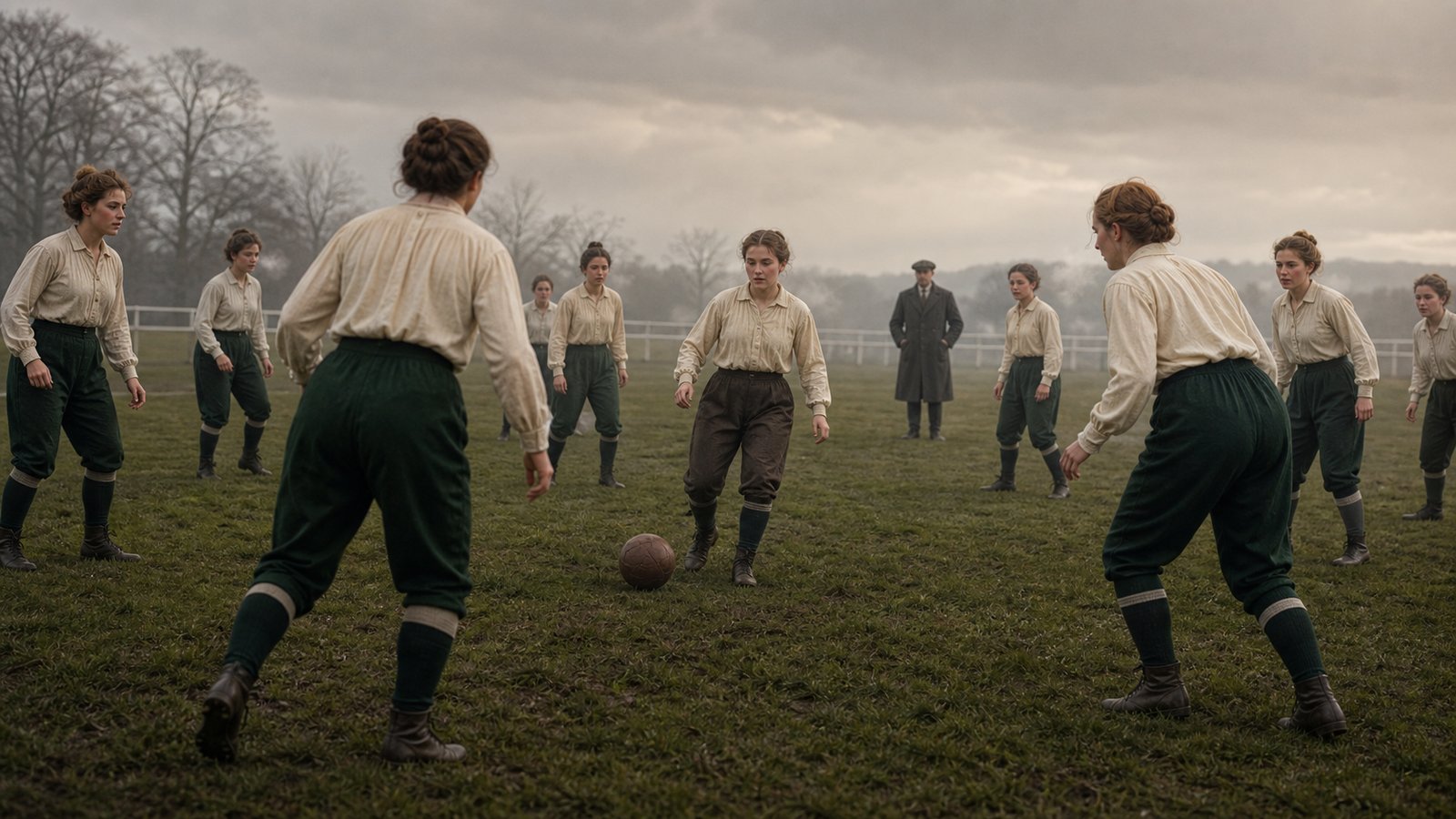
Even before the first major match, clothing occupied an extraordinary amount of the coverage. Ordinary fashionable dress was unsuited to running and kicking, so players appeared in loose blouses or jerseys, knickerbockers, boots and leg protection. Their choices overlapped with the Rational Dress movement, which challenged restrictive corsets, high heels and cumbersome skirts.
That practical adjustment became evidence for critics who already saw any alteration of gender convention as provocation. Reports described sleeves, embroidery, skirts and figures in detail. The attention rarely worked in the other direction: male footballers were not required to justify their right to play through a discussion of tailoring. For the British Ladies, every sprint carried an argument about respectability.
The clothes also show why the club cannot be reduced to a quaint novelty. A safe and workable kit was part of building the conditions in which the game could happen. The players were solving a physical problem under surveillance. They had to move freely enough to play while presenting themselves carefully enough to retain grounds, patrons and paying spectators. The boundary line was sporting; the negotiation around it was social.
Twelve thousand watched at Crouch End
On 23 March 1895, the club divided into North and South teams at Crouch End. Estimates put the attendance at about 12,000. North won 7–1. The scene made the venture difficult to dismiss as a private eccentricity: thousands had paid attention to an organized match played in public under association rules.
The newspapers supplied two incompatible verdicts. Before the match, The Sketch had described the women as the “sporting sensation of the hour.” Afterwards, its tone hardened. The event became a “huge farce,” and the crowd was interpreted as curiosity rather than support. Other commentary dwelt on what the players supposedly lacked when compared with men who had enjoyed years of access to the sport.
Not every report accepted that framing. The Sportsman acknowledged differences in speed and strength but challenged the assumption that the women possessed no knowledge or skill. Its defence ended with a stubborn prediction: if the lady footballer died, she would die hard. The argument was no longer about whether a match had taken place. It was about who had the authority to decide what the match meant.
The tour measured curiosity town by town
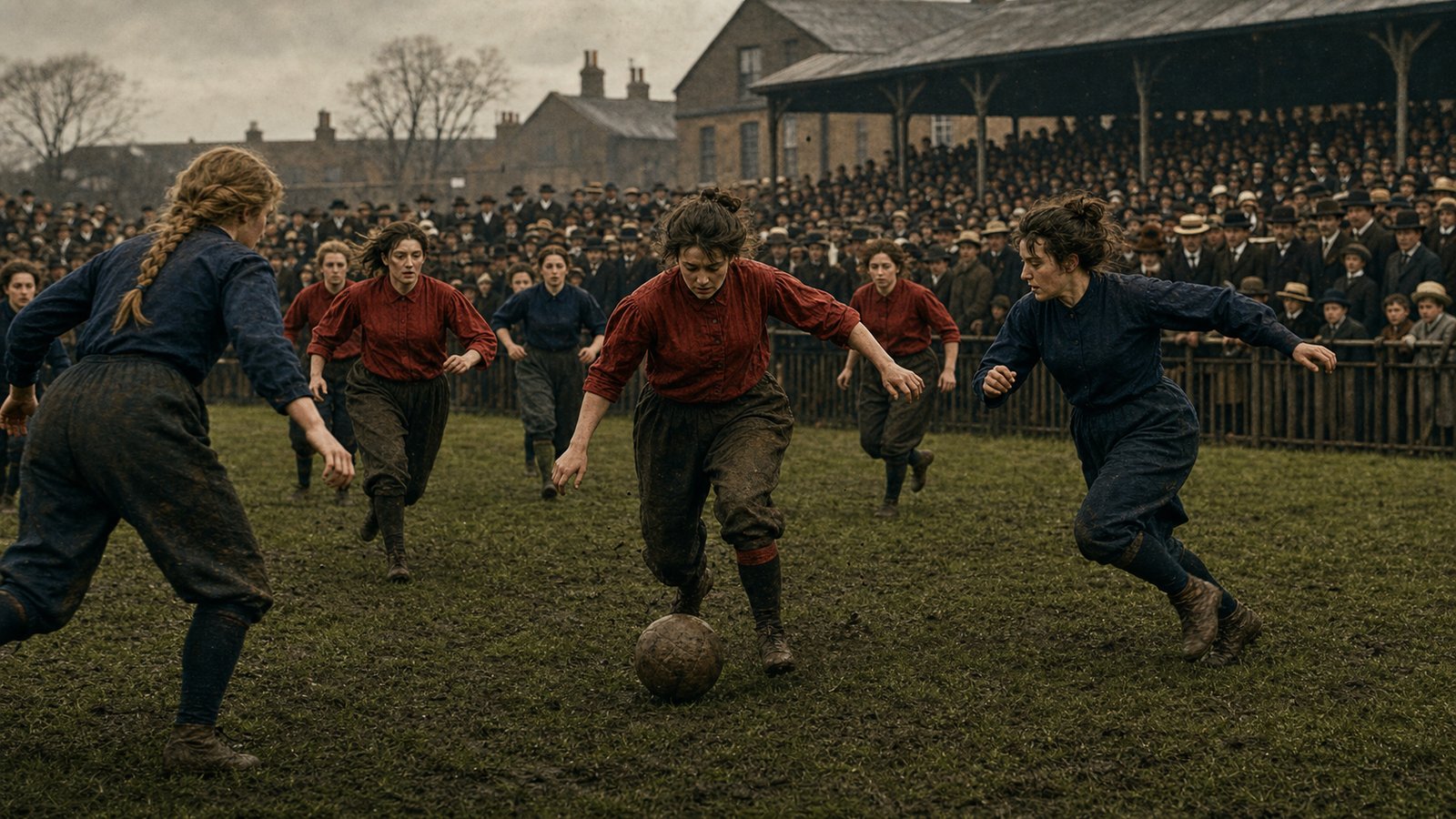
The club did not stop after its opening gate. It travelled. Matches followed at Brighton, Bury, Reading, Bristol, Newcastle and elsewhere. Each stop required a ground, promotion, transport, local cooperation and enough players able to continue. The tour was an attempt to convert one spectacular afternoon into a repeatable football culture.
At Bury, more than 5,000 attended and the match finished 3–3. At St James’ Park in Newcastle, more than 8,000 watched North win 4–3. Reports singled out individual players, including the diminutive Daisy Allen, and recorded actual goals and performances alongside the familiar commentary on appearance. The women were creating the basic material from which supporters remember football: places, scores, characters and incidents.
But the numbers also exposed the fragility of novelty. A later match at Jesmond drew only about 400. Public fascination could fill a ground once without producing a stable local following. Touring increased visibility, yet it also consumed money, energy and organizational trust. Behind the crowded touchlines, divisions appeared within the club. By late spring Honeyball was no longer visible with the playing group, and her period as secretary also ended.
This was not a simple line from triumph to suppression. The club’s own strains mattered, as did the practical burden of maintaining a touring side. Hostile reporting mattered too because it continually converted football into spectacle, inviting an audience to inspect women rather than attach itself to a team. When the first surprise faded, there was no league structure underneath to hold the attention.
An address brought Honeyball back into view
For decades, Honeyball’s identity became almost as unstable as the club’s reputation. Historians wondered whether the memorable name was a pseudonym. A digitized notice from the Morning Leader, published in March 1896, offered a significant clue: it announced that Miss Nettie J. Honeyball, honorary secretary of the British Ladies Football Association, had moved from 27 Weston Park to 56 Lillington Street in Belgravia.
Sports historian Andy Mitchell connected that second address to Anne or Annie Jane Honeyball, born in Pimlico in 1867, the daughter of Francis Honeyball, a carpenter and cabinet maker. Census, baptism and newspaper records make the identification persuasive, although not beyond dispute; another family candidate remains possible. The uncertainty deserves to stay visible. Recovering women from fragmentary records should not become an excuse to turn a good clue into a false certainty.
The address changes the texture of the story even without closing the case. Honeyball was not merely a symbolic name attached to an old team photograph. Someone received correspondence, moved across London, arranged players and grounds, spoke to reporters and stood as captain when a five-figure crowd arrived. Administrative traces return weight to sporting labour that later summaries made almost invisible.
The experiment left more than a novelty
The British Ladies’ Football Club did not establish a permanent competition. Its burst of attention receded before women’s teams connected to wartime workplaces drew enormous crowds a generation later. The Football Association’s 1921 restriction on women using affiliated grounds belonged to that later landscape, not to the immediate mechanics of Honeyball’s 1895 tour.
Keeping those periods separate makes the first club more interesting. Honeyball’s players had no inherited national structure to join and no settled audience to inherit. They recruited through newspapers, trained in public, adapted their clothing, booked grounds and discovered the difference between a crowd and a supporter base. Their season revealed how quickly media attention could open a gate and how little infrastructure it left behind when it moved on.
Later players such as Lily Parr would build long careers in a different women’s football world. The British Ladies’ Football Club belongs earlier: a Victorian attempt to manufacture that world almost from nothing. Its importance sits not only in being first or nearly first, but in showing every piece a football culture needs beyond the ball—practice, clothing, venues, administration, reporting, memory and people willing to return after the first crowd has gone.
Sources
Football Makes History; British Online Archives; Scottish Sport History; Spartacus Educational.