
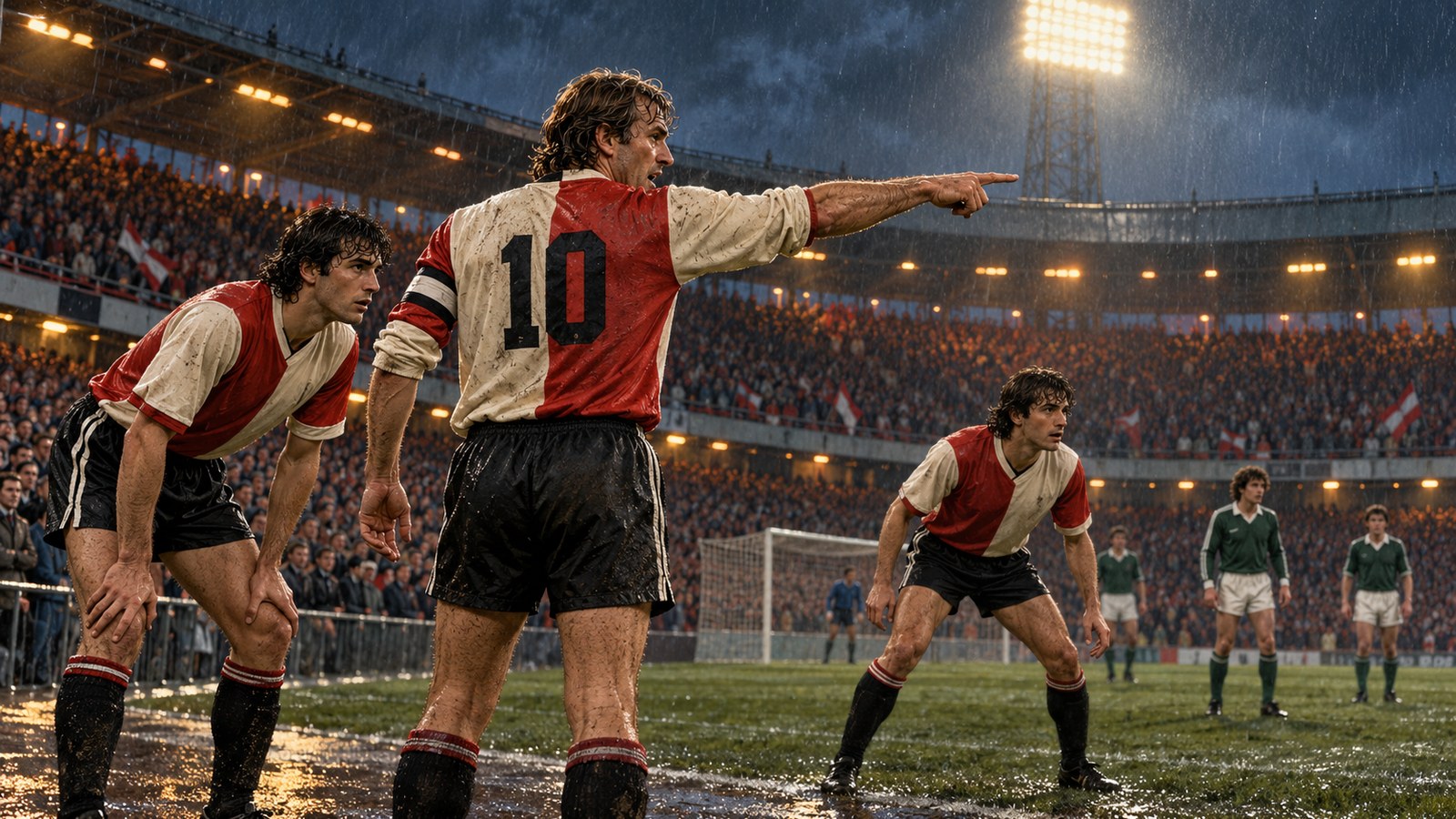
Ajax’s decision arrived before Johan Cruyff’s legs had made the same choice. In the summer of 1983, the Amsterdam club declined to extend the contract of the player who had defined its greatest years. Cruyff was 36, back from spells in North America and Spain, and willing to play one more season. Retirement would have been the tidy ending. Instead, he crossed the rivalry and signed for Feyenoord.
The move looked personal because it was personal. Cruyff’s own account described anger as the force behind it. Yet revenge alone cannot explain what followed. Feyenoord had Ruud Gullit’s power, Peter Houtman’s goals and a squad capable of absorbing a demanding new centre of authority. The veteran did more than appear in a rival shirt. He entered a team that had finished well short of the title, survived an 8–2 humiliation against Ajax, and helped it become Dutch champion and cup winner.
Cruyff’s last season therefore reads less like a farewell tour than a test of influence. His pace was no longer the pace of 1974. He could still determine where teammates stood, when possession accelerated and which defeat deserved to be treated as evidence rather than destiny. Feyenoord gave him one year. He used it to make Ajax’s contract judgment look painfully incomplete.

One Contract Decision Moved the Rivalry South
Cruyff had already returned to Ajax once. After years away, he rejoined the club in 1981 and won two more Eredivisie titles. His request in 1983 was not for a long rebuilding project. He wanted one final playing contract. Ajax board member Tom Harmsen rejected the extension, and Cruyff answered by choosing the club’s principal domestic rival.
That route carried more weight than an ordinary transfer between strong teams. Amsterdam and Rotterdam offered different loyalties, different accents and a rivalry that needed no new grievance. Cruyff had grown inside Ajax, won European Cups there and became the face of an idea about Dutch football. Feyenoord supporters were being asked to trust the man most closely identified with the opponent they measured themselves against.
The suspicion did not vanish at the signing photograph. Cruyff’s archived official biography says Rotterdam supporters were initially sceptical. He was an ageing Ajax symbol entering De Kuip, not a neutral star arriving from abroad. The arrangement would be judged through results, but also through whether he treated Feyenoord as a real sporting commitment rather than a platform for a private argument.
There was useful precedent in his career for turning a transfer dispute into football. A decade earlier, his move to Barcelona had been delayed by registration problems, a story explored in the six-million-guilder transfer that kept Cruyff waiting until October. In 1983 the paperwork moved faster. Acceptance was the harder negotiation.
An 8–2 Defeat Made the Bet Look Absurd
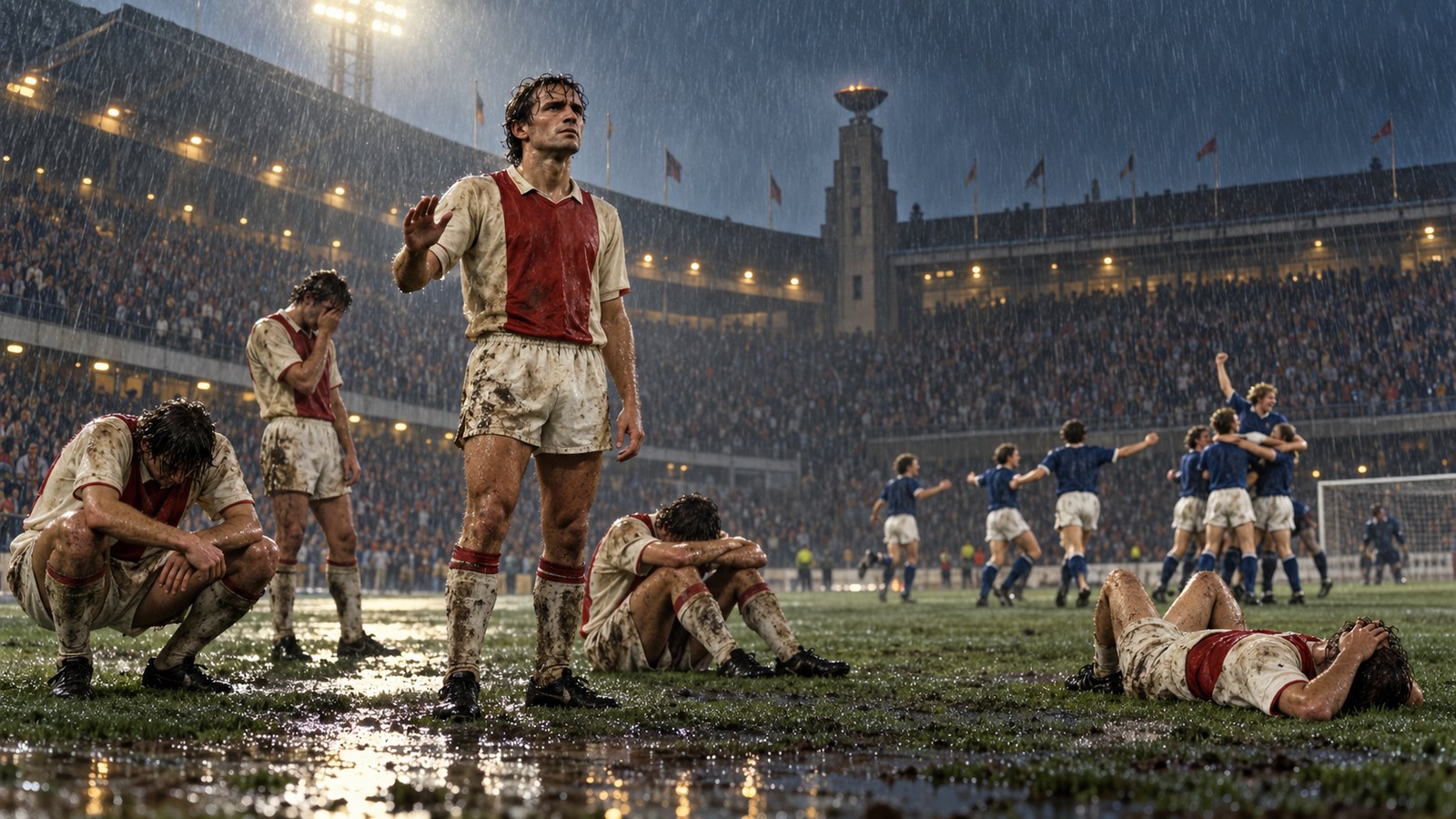
The seventh league match supplied Ajax with an answer that seemed definitive. On 18 September 1983, Feyenoord went to Amsterdam’s Olympic Stadium and lost 8–2. Marco van Basten scored three. Jesper Olsen scored twice. Ajax led 4–2 at half-time and added four more after the interval. Forty thousand people watched Feyenoord’s new veteran return to the city as the centre of a rout.
Cruyff refused the obvious interpretation. His later biography records him declaring that Feyenoord would still win the championship. The prediction matters because it was made after the worst possible evidence, not during a polished unveiling. It also shifted the demand onto the weeks that followed. A public promise after an 8–2 defeat can become theatre unless training, selection and match control begin to support it.
Feyenoord did not answer by trying to reproduce the same match at a higher speed. The team became harder to move, more orderly with the ball and more consistent across ordinary league afternoons. Cruyff influenced the lineup, training and tactical organisation. Ajax could score spectacularly and still drift. Feyenoord could win without needing each victory to resemble a manifesto.
Houtman and Gullit Kept the Season From Becoming a Solo Act
The temptation is to make every Feyenoord improvement an extension of Cruyff’s mind. The scoring record resists that simplification. Peter Houtman led the club with 21 league goals and 25 in all competitions. He offered a fixed penalty-area threat while Cruyff moved through the spaces behind and around him. The veteran’s 11 league goals mattered, but they did not make him the team’s main finisher.
Ruud Gullit supplied another kind of force. Still early in the career that would later carry him to Milan, he could travel with the ball, compete physically and arrive from deeper positions. Feyenoord’s own remembered account of the season names Houtman’s finishing and Gullit’s dynamism beside Cruyff’s inspiration. That balance is important. Authority worked because it connected to qualities already present.
Cruyff’s personal numbers still describe a full workload rather than a ceremonial role. His official record lists 33 league matches and 11 goals, seven cup matches and one goal, plus four European appearances and one goal. Across those competitions, that was 44 appearances and 13 goals in his final Dutch season.
The Return Match Rewrote September’s Scoreline
Feyenoord did not have to erase 8–2 from the record. It had to stop that afternoon from defining the competition. February brought two opportunities against Ajax. Feyenoord first removed its rival from the KNVB Cup. Then came the second league meeting at De Kuip.
This time Feyenoord won 4–1, and Cruyff scored. The swing from eight conceded in Amsterdam to a three-goal victory in Rotterdam was too sharp to dismiss as steady decline on one side or a lucky response on the other. It showed that the season had changed shape. September’s match remained real, but its meaning had narrowed from verdict to warning.
The larger contrast sat in the table. Feyenoord’s organisation kept converting routine fixtures into points while Ajax’s campaign remained less stable. A title is built from those weeks more than from one rivalry match, however enormous the score. Cruyff’s promise after the rout came true because Feyenoord did not spend the rest of the season trying to win the argument in a single night.
The club had carried European ambition before. Its 1970 European Cup win had opened the Dutch era before Ajax’s three straight triumphs, as Feyenoord’s midfield victory over Celtic showed. The 1983–84 side was doing something more domestic and intimate: taking the country’s most famous Ajax figure and fitting him into a Rotterdam title race without losing its own strengths.

The Final Match Completed a Double, Not a Tribute
Feyenoord finished first in the Eredivisie and won the KNVB Cup. Houtman ended as the leading scorer. Gullit’s season confirmed the scale of the player he was becoming. Cruyff was voted Dutch Footballer of the Year for the fifth time. The honours distributed the credit more honestly than a one-man revenge story can.
On 13 May 1984, Feyenoord hosted PEC Zwolle in the final league fixture. Zwolle scored first through Alex Booij in the fourth minute. Cruyff equalised in the 13th, and Houtman supplied the winner in the 76th. The 2–1 result offered a compact final image: the veteran answered early, the season’s leading scorer finished the work, and De Kuip saw the champions close their campaign.
Cruyff rejected Feyenoord’s offer to continue because he no longer believed his body could meet the physical demand. That choice separates the ending from the beginning. Ajax had decided for him that another year was too much. Twelve months later, after 44 competitive appearances and two trophies, he made the retirement judgment himself.
The transfer is often presented as Cruyff’s revenge, and anger plainly set it in motion. Its richer point is that emotion had to become repeatable football. Feyenoord’s supporters did not owe an Ajax icon their trust. Houtman and Gullit did not exist as supporting characters in somebody else’s farewell. Cruyff earned his place inside their season by helping a strong group survive humiliation, control the long calendar and finish with both trophies available at home.
That is why the 8–2 belongs in the story without owning it. Ajax won the loudest afternoon. Feyenoord won the league, the cup and the right to give Johan Cruyff his final Dutch shirt.
Sources
- Johan Cruyff official archive, “Playing for Feyenoord”
- 1983–84 Feyenoord season record
- 1983–84 Eredivisie record
- Johan Cruyff career record and biography