
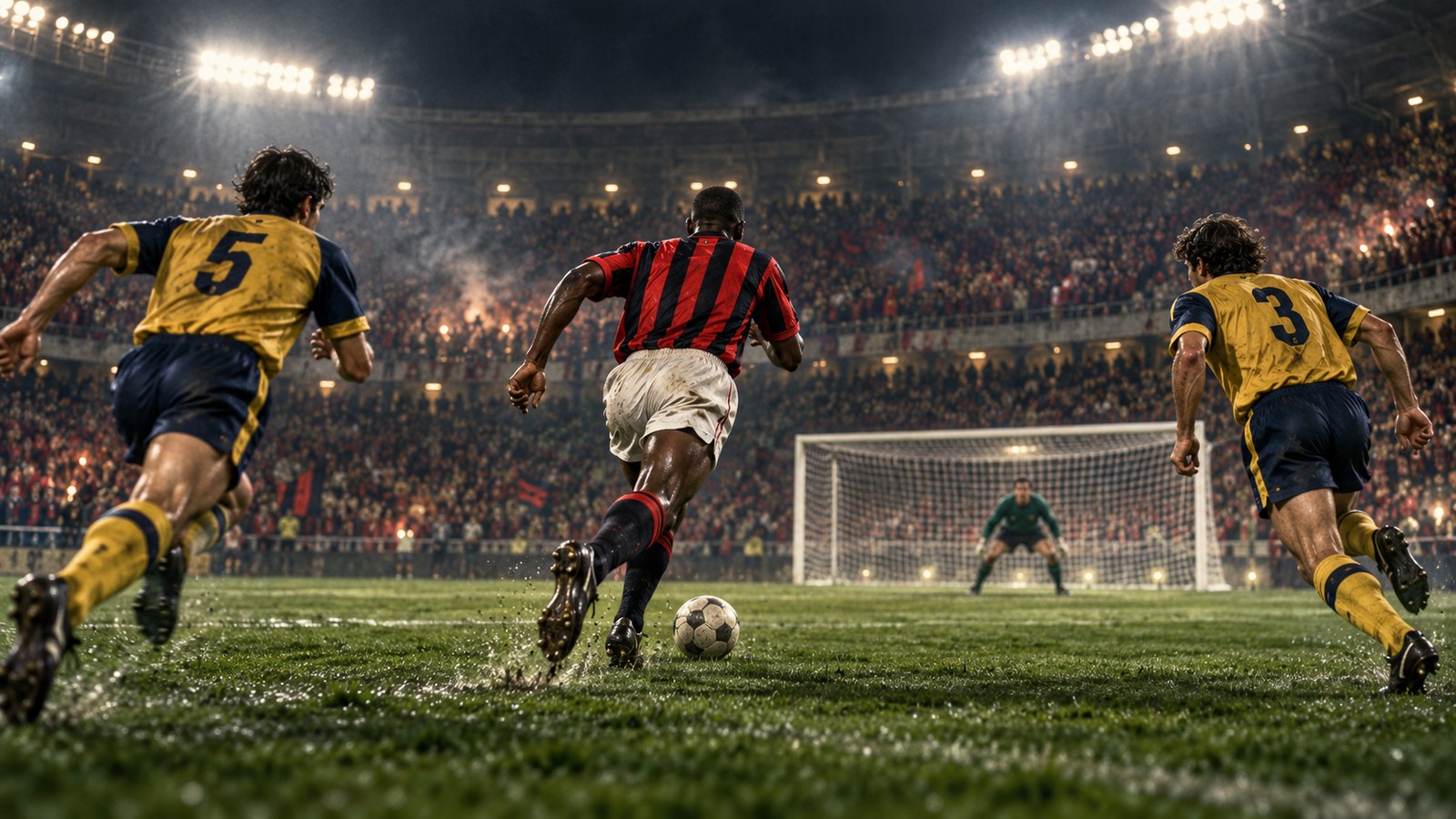
A Verona corner dropped just outside AC Milan’s penalty area on 8 September 1996. George Weah controlled it with his own goal behind him and almost the entire pitch ahead. Milan’s other players had come back to defend. For a moment, the safest choice was also the most obvious one: hold the ball, find a teammate and let the side move out together.
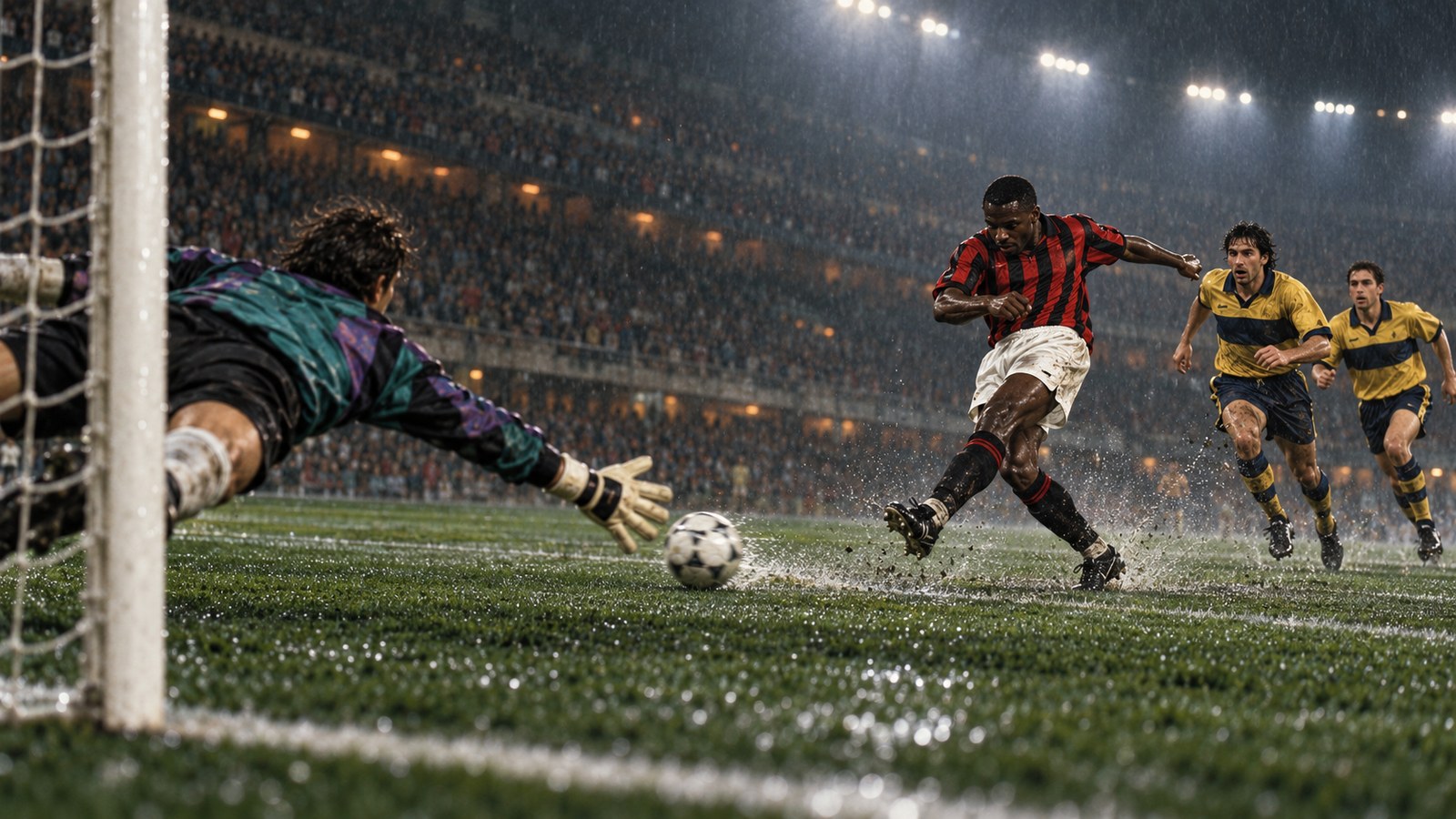
Weah accelerated instead. The first chase began in Milan’s defensive third. Another defender tried to close the route near halfway. By the time the attack reached Verona’s penalty area, the move had stopped looking like a counterattack and started looking like a test of how long one player could preserve speed, balance and a clear decision. Weah drove his finish into the bottom-left corner.
The goal came in an opening-day 4–1 victory at San Siro, with Weah scoring in the 85th minute. Its lasting value lies beyond distance. A striker collected a defensive clearance, carried possession through several separate problems and completed the move himself. The run compressed Weah’s route from Liberia through Cameroon, Monaco and Paris into one piece of football: receive in an unlikely place, travel at unusual speed and remain composed at the finish.
A Verona corner opened nearly a full pitch of space
Milan were defending a corner when the move began. Weah controlled the loose ball just outside his own penalty area. His teammates were still behind the ball, so there was no forward already waiting to receive a pass. The transition belonged to whoever could escape the first pressure.
That starting point changes how the goal should be read. It was not a conventional break led by a midfielder with runners on either side. Weah was the runner and the carrier. Every touch had to move him away from the defenders recovering behind him without pushing the ball so far ahead that the next defender could step across the route.
He crossed halfway with the ball still under control. The defenders did not meet him as one organised line; they arrived as individual delays. That helped the run continue, but it also required repeated choices. Weah could not use one burst and coast. He had to protect the ball, change the angle of his stride and then accelerate again.
Zvonimir Boban later remembered Milan’s players wondering when Weah would stop. The answer arrived only inside the opposite penalty area. Weah directed the shot low to the goalkeeper’s left, turning the length of the field into a single unbroken possession.
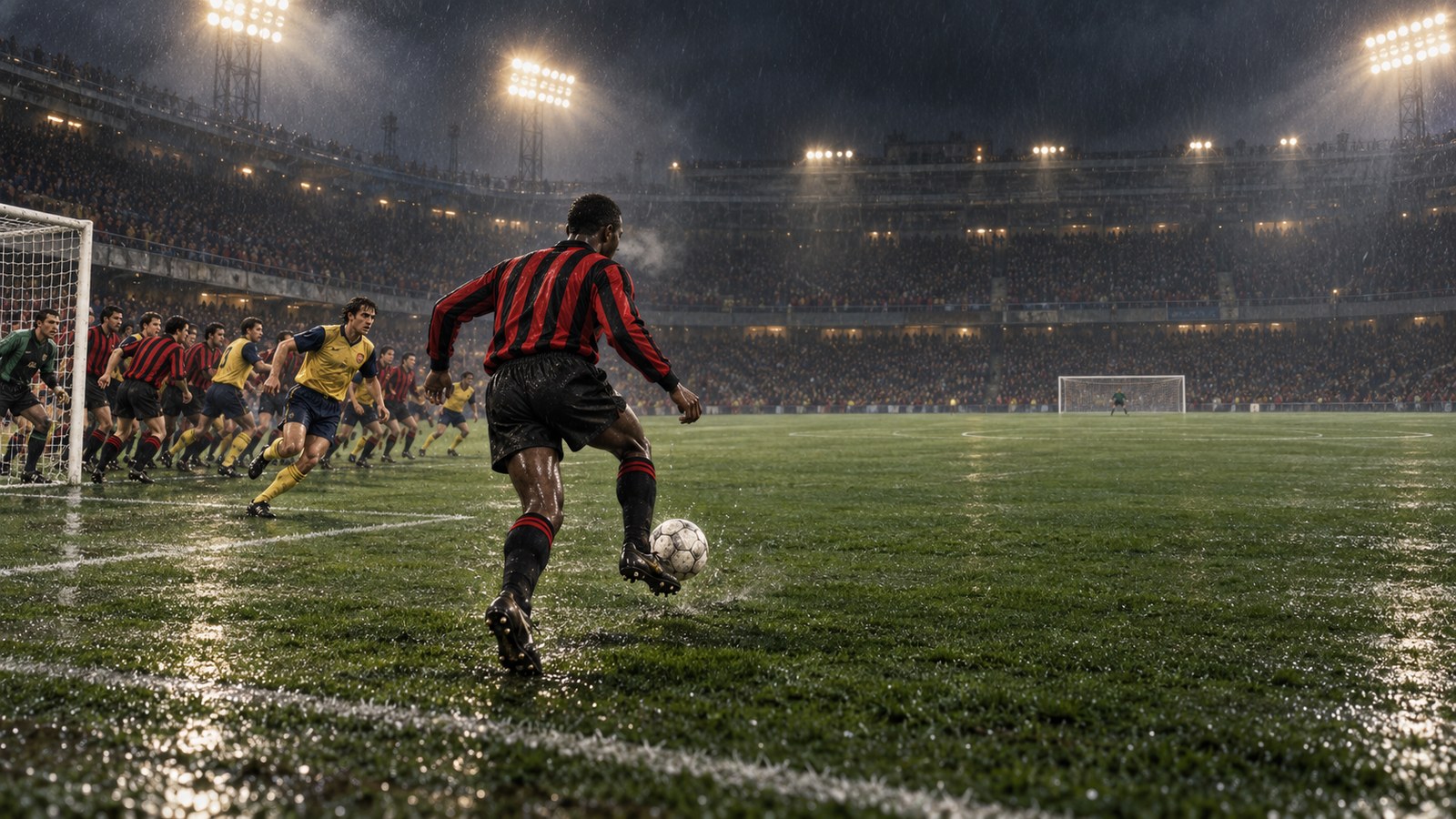
The 85th-minute goal completed Milan’s opening-day win
The run is often detached from its match, but the score gives it useful proportion. Verona had taken the lead through Michele De Vitis in the 24th minute. Marco Simone scored twice after half-time, in the 49th and 66th minutes, before Weah added Milan’s third in the 85th. Roberto Baggio made it 4–1 in the 90th minute.
This was the first league match of Milan’s 1996–97 season. The recorded attendance was 54,128. Weah entered it as a reigning champion and one of the game’s most decorated players, not as a surprise discovery. Milan had signed him from Paris Saint-Germain in 1995. He had helped the club win Serie A in his first Italian season.
He had also collected the Ballon d’Or and the FIFA World Player of the Year award for his 1995 performances. AC Milan’s own record describes him as the first non-European footballer to win the Ballon d’Or. The recognition mattered because his career had not begun in one of Europe’s established academies. The route to San Siro had crossed leagues, languages and very different expectations of what a centre-forward should do.
That background made the Verona goal more than an athletic curiosity. The player carrying the ball from one box to the other was already valued as an elite scorer. Yet the move began in a position normally associated with a defender or a deep midfielder. Weah’s threat came partly from refusing to wait where a striker was expected to wait.
Liberia and Cameroon came before Arsène Wenger’s call
Weah was born in Monrovia on 1 October 1966. His senior path included Young Survivors, Bong Range United, Mighty Barrolle and Invincible Eleven in Liberia before a move to Tonnerre Yaoundé in Cameroon. With Invincible Eleven, he helped win the 1987 Liberian league title and finished as the competition’s leading scorer.
Claude Le Roy, then coaching Cameroon’s national team, recommended Weah to Arsène Wenger. Wenger travelled to see him and brought him to Monaco in 1988. The reported transfer fee was £12,000. For a forward coming from African club football, Monaco supplied both a major change in level and a manager willing to develop the wider parts of his game.
Weah scored 47 league goals in 103 appearances for Monaco. He won the Coupe de France in 1991 and helped the club reach the 1992 European Cup Winners’ Cup final. Those seasons established a pattern visible in the Verona run: he was powerful enough to operate through the centre but mobile enough to begin an attack away from it.
The move to Paris Saint-Germain in 1992 brought a league title in 1994 and further cup success. Weah then finished as the leading scorer in the 1994–95 Champions League. Milan were buying a forward whose game had survived each larger stage rather than one defined by a single domestic scoring record.
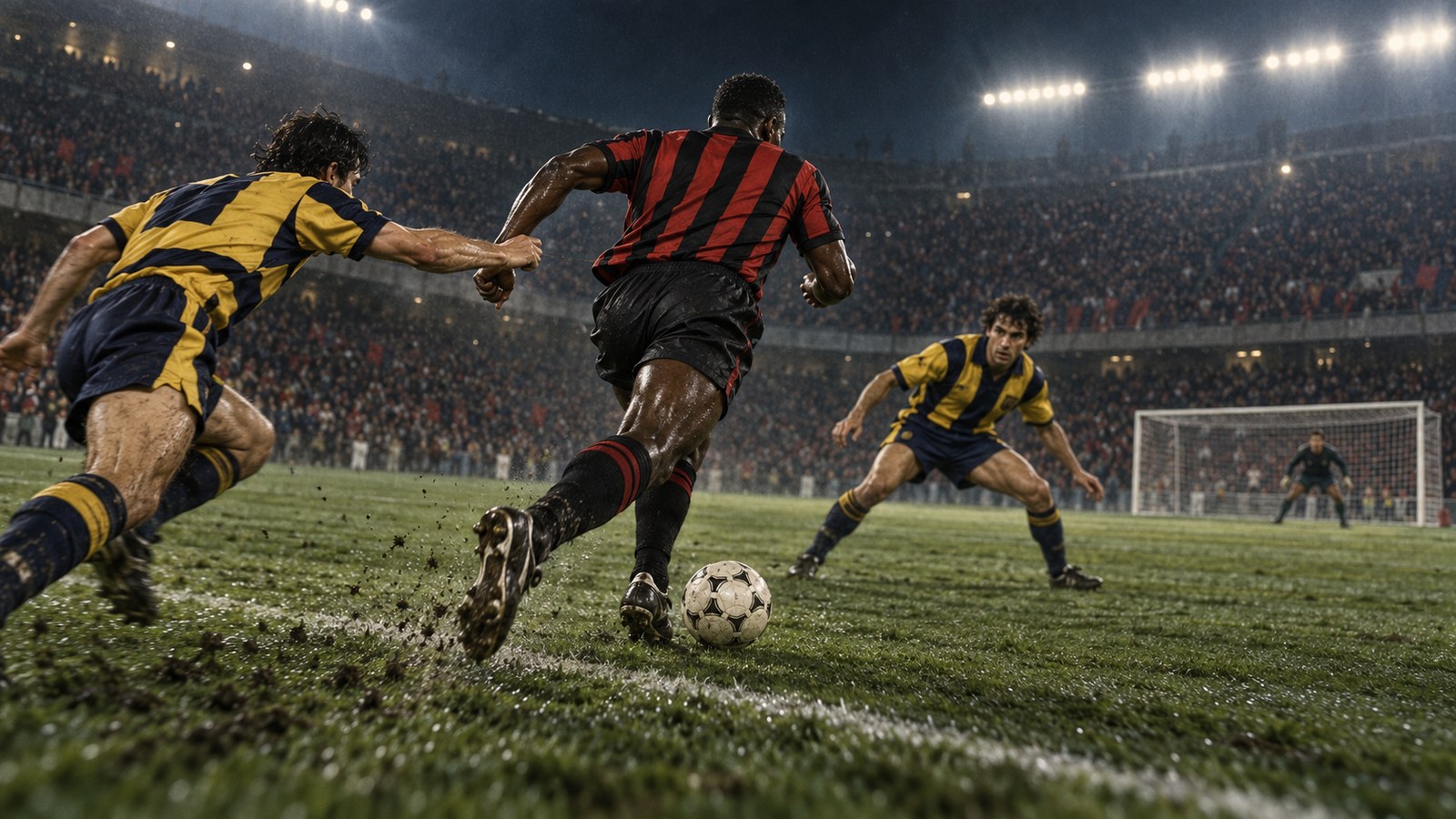
Paris and Milan widened the meaning of a number nine
Traditional number-nine work can be measured around the penalty spot: occupy centre-backs, attack crosses and convert chances. Weah could do those jobs, but his speed made a deeper starting position dangerous. If he dropped away from the back line, a defender had to decide whether to follow. If the defender stayed, Weah could turn. If the defender stepped out, the space behind became available.
The Verona sequence showed the most extreme version of that freedom. There was no need to manufacture separation with a short movement because a corner had placed both teams near Milan’s goal. Once Weah escaped, the whole pitch became the separation. The attacking problem was not finding space but keeping ownership of it for long enough.
His European career also helps explain why the finish remained calm. By September 1996, Weah had played title races in France and Italy and knockout matches across European competitions. The final shot followed a remarkable sprint, but it was taken by a forward accustomed to deciding attacks. He did not reach the penalty area merely to complete the spectacle. He reached it to score.
Milan’s history contains many forwards defined by specialist qualities. Gunnar Nordahl arrived as an extraordinary penalty-area scorer. Weah offered a different route to the same destination. He could begin far from goal and carry the attack there himself.
One sprint became the shortest biography of George Weah
The 1996–97 season did not become a great Milan campaign. The club finished 11th in Serie A, despite Weah leading its league scoring with 13 goals. That contrast protects the Verona goal from an easy team myth. It did not announce a dominant season. It captured the range of one player within a difficult one.
Across his Milan career, the club records 147 matches and 58 goals in all competitions, including 46 league goals in 114 Serie A appearances. He won another league title in 1998–99. Later spells took him to Chelsea, Manchester City, Marseille and Al Jazira before his playing career ended in 2003.
The wider career included honours that no African player had previously combined in 1995, but the Verona run remains unusually direct evidence. Awards require ballots and seasons require totals. This goal asks only that the move be followed from its first touch to its last. Control near one penalty area; repeated acceleration; a low finish at the other end.
It also sits beside football’s other memorable solo goals without depending on imitation. The beginning came from defensive necessity, not a prepared attacking position. The route was long enough for several opponents to intervene, and the finish arrived after the sprint had already demanded most of the obvious physical work. Like René Higuita’s Wembley intervention, it expanded what spectators thought a player in a familiar role might attempt.
AC Milan call it a coast-to-coast goal. The phrase fits, but the appeal is more exact than distance. Weah repeatedly chose to continue when passing or slowing would have been understandable. The ball survived each choice. At San Siro, one possession carried the outline of a career that had already travelled farther than most.
Sources
AC Milan player archive; George Weah biographical record; 1996–97 AC Milan season record.