
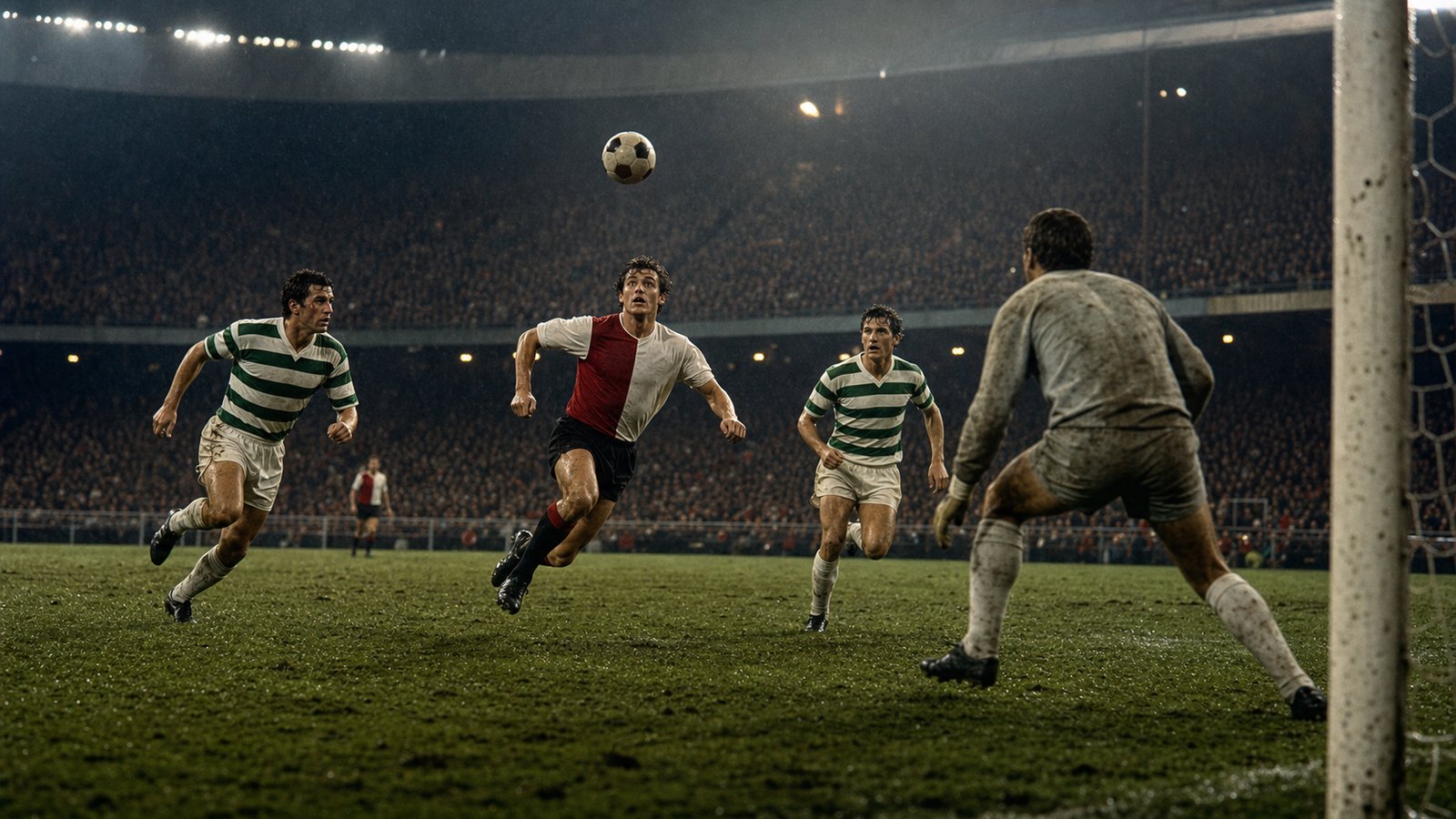
With three minutes of extra time left in Milan, the European Cup final had stopped looking like a coronation for anybody. Celtic had scored first. Feyenoord had answered almost immediately. Then 86 minutes passed without another goal, and the night narrowed to a long ball dropping between a tiring defence and Ove Kindvall.
Kindvall did not need to turn the moment into a masterpiece. He needed to read it before everyone else. Celtic captain Billy McNeill misjudged the flight, goalkeeper Evan Williams came forward, and the Swedish striker lifted the ball beyond him. The finish in the 117th minute made Feyenoord the first Dutch winners of Europe’s champion-club competition.
The familiar story of Dutch football usually begins somewhere else: Ajax, Cruyff, orange shirts, and Total Football. Feyenoord’s 1970 team arrived one year earlier with a less polished mythology. Its breakthrough was built from hard recoveries, midfield control and Ernst Happel’s willingness to redesign a match around the opponent’s greatest threat. Rotterdam opened the door before Amsterdam became the symbol.
Rotterdam learned to survive the second leg
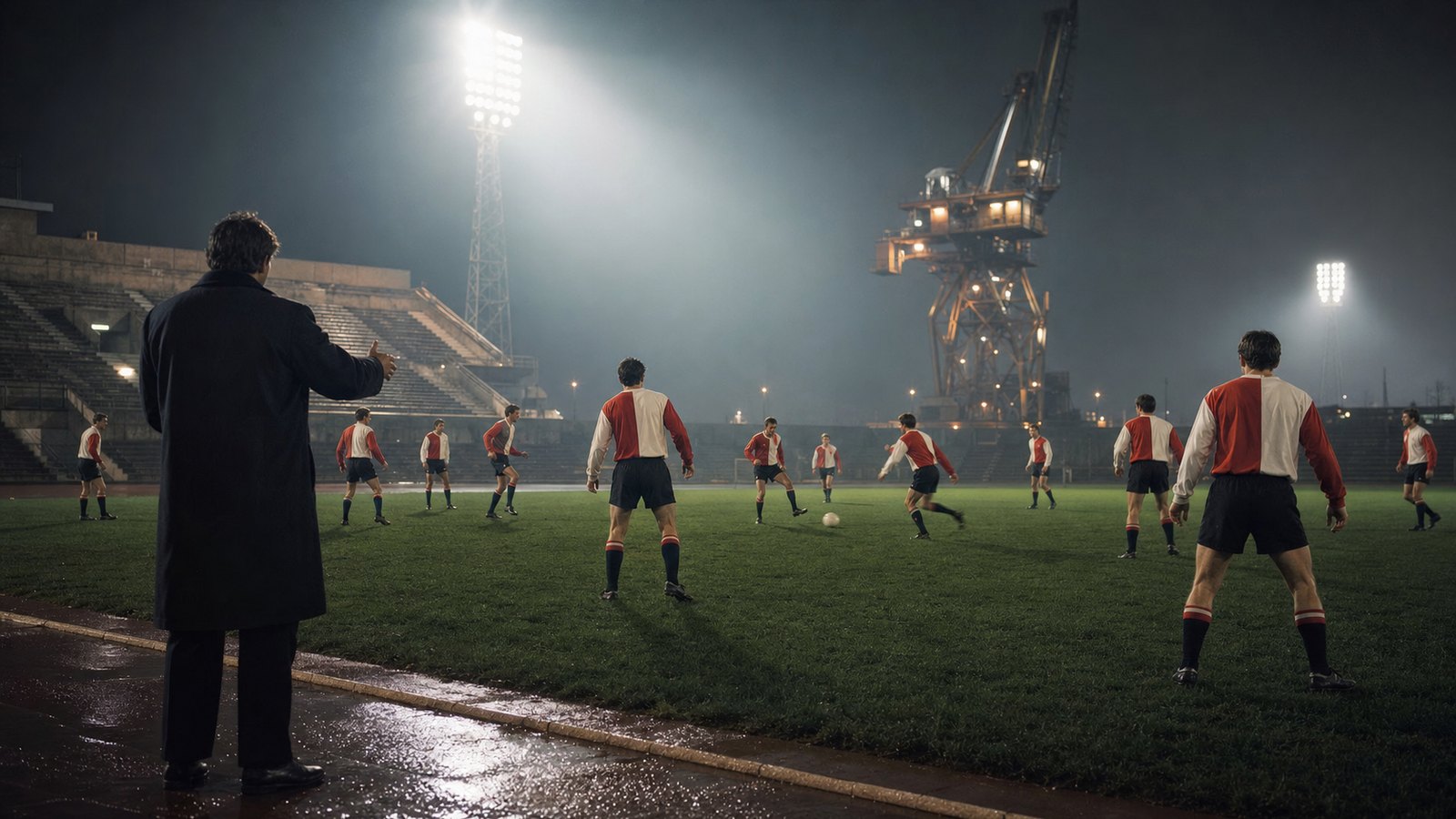
Feyenoord’s route to Milan began with excess. Against KR Reykjavík, the Dutch champions won 16–2 on aggregate. That score suggested an easy campaign; the rounds that followed taught the opposite lesson. In the second round, holders Milan beat Feyenoord 1–0 in Italy. The return in Rotterdam demanded patience, because one away goal could have made the task far steeper. Feyenoord won 2–0 and removed the defending champions.
The quarter-final repeated the shape. Vorwärts Berlin won the first leg 1–0. Again Feyenoord returned home needing to solve a deficit without losing control. Again the response was 2–0. These were not glamorous margins, but they created a useful habit: the team could live inside a tie without mistaking urgency for panic.
Legia Warsaw then held Feyenoord to 0–0 in the first leg of the semi-final. A third European night in Rotterdam ended 2–0, sending Happel’s side to its first final. Across those three decisive home legs against Milan, Vorwärts and Legia, Feyenoord scored six goals and conceded none. The pattern mattered more than any slogan. This was a team learning that European progress depended on controlling the return, not merely attacking it.
Happel made Celtic’s best route feel crowded
Celtic brought the authority of the Lisbon Lions. Jock Stein’s team had won the European Cup in 1967 and arrived at San Siro as the side with final experience. Jimmy Johnstone could distort a defence from the wing; Bobby Murdoch and Bertie Auld gave Celtic competitive force in midfield; Billy McNeill organised the back line. Feyenoord could not treat the final as an open demonstration of Dutch ambition.
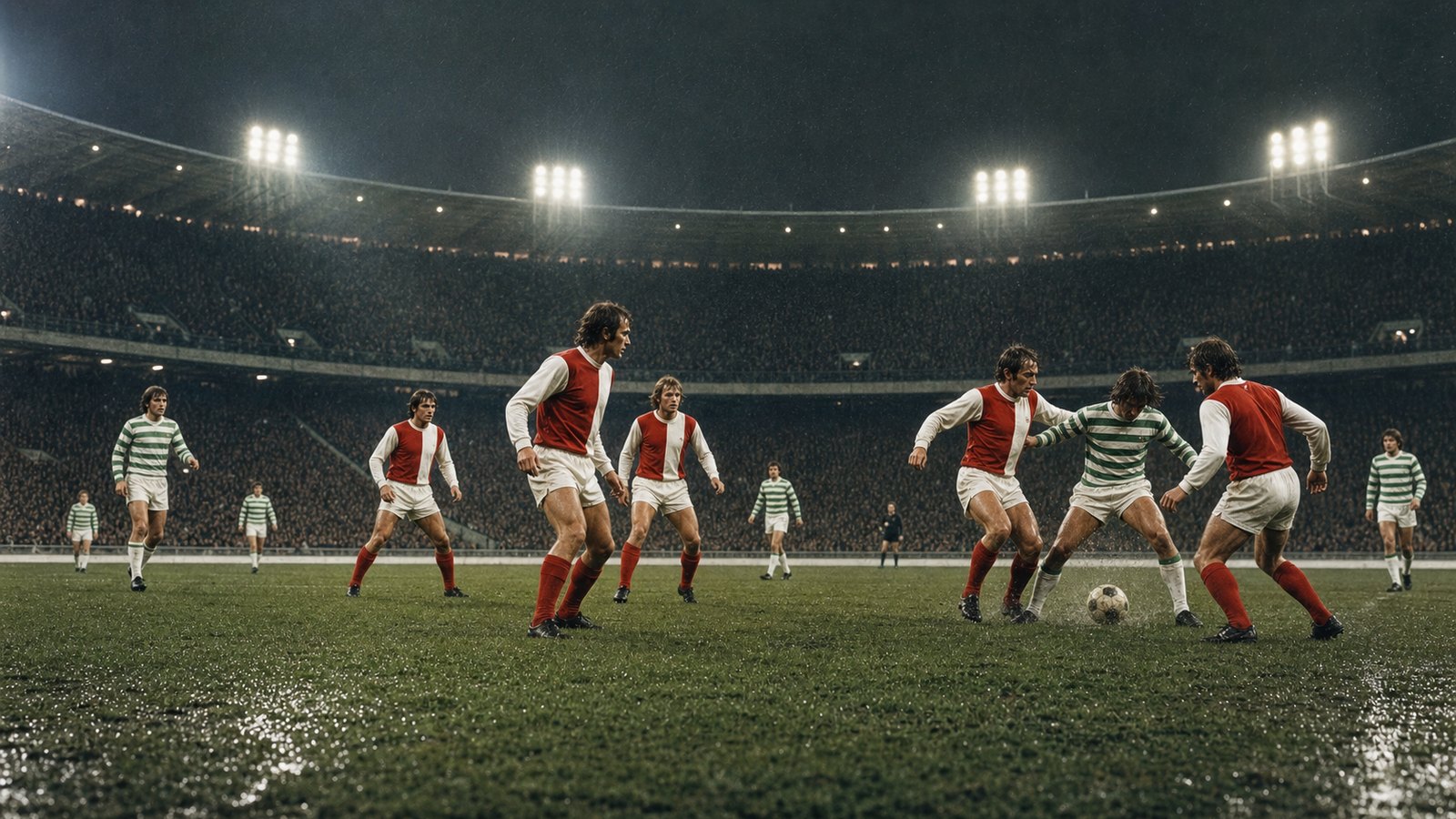
Happel’s answer was specific. Retrospective accounts of the match describe Johnstone being double-marked, reducing the space in which Celtic’s most dangerous dribbler could turn. The point was not simply to add a second defender. It was to force Celtic’s attacks toward areas where Feyenoord’s midfield could compete for the next ball.
That midfield carried the plan. Franz Hasil, Wim Jansen and Willem van Hanegem gave Feyenoord different forms of control: movement, pressure, passing and the ability to keep an attack alive after the first duel. Celtic could still threaten, but its favourite release valve was crowded. Feyenoord did not wait for Dutch football’s later international reputation. It imposed a Dutch midfield on a final before Europe had learned to expect one.
Two minutes changed the emotional direction
The opening goal seemed to confirm Celtic’s status. In the 29th minute, Tommy Gemmell put the Scottish champions ahead. A team facing the Lisbon Lions could have felt the final sliding into a story already written: Celtic’s experience, Celtic’s occasion, Celtic’s second European crown.
Feyenoord equalised in the 31st minute. Rinus Israël, the central defender and captain, supplied the answer. Two minutes were enough to prevent Celtic from settling into protection of the lead. The scoreboard returned to level, but the emotional direction had shifted. Feyenoord had absorbed the first blow and proved that the final would not be governed by Celtic’s memory.
The score stayed 1–1 through the second half. That can make the final sound uneventful when reduced to a line of results. In reality, the long stalemate tested whether Feyenoord could maintain its structure while fatigue changed every distance. Johnstone still had to be tracked. Midfield runners still had to be passed on. A single loose duel could undo work accumulated across an entire season.
Extra time made the same demands with heavier legs. Happel introduced Guus Haak for Piet Romeijn in the 106th minute, one of the few available interventions in an era before deep substitute benches. The contest had become an exercise in keeping concentration alive long enough for one imperfect ball to become an opportunity.
Kindvall found the gap at minute 117
The winner began far from the kind of flowing combination later attached to Dutch football’s global image. A long free kick travelled from Feyenoord’s half toward Celtic’s penalty area. McNeill stumbled and failed to settle the dropping ball. Williams advanced. Kindvall kept running.
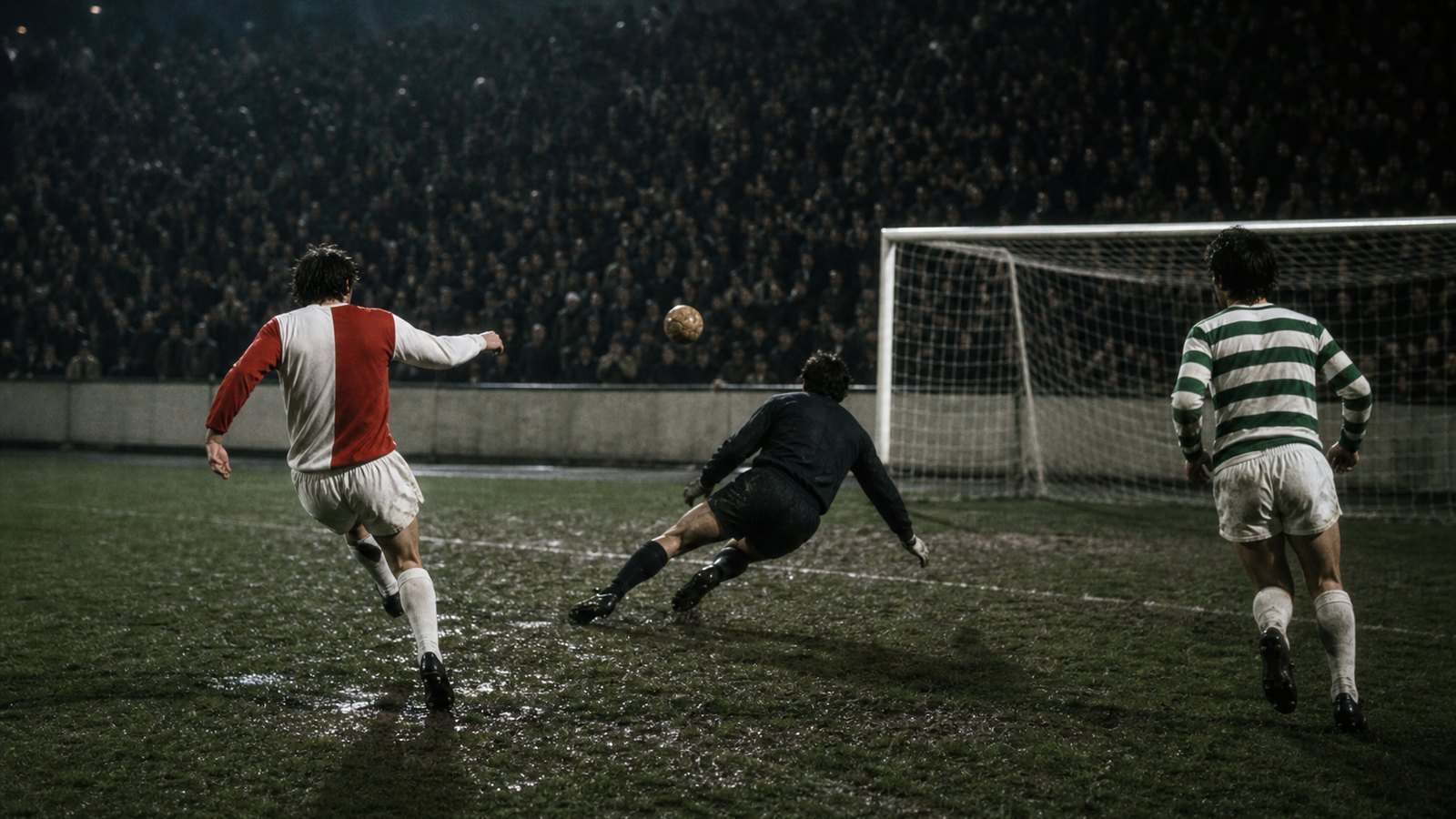
That sequence captured the practical intelligence of the whole campaign. Feyenoord had repeatedly recovered from first-leg deficits because it recognised when not to force the tie. In the final, Kindvall recognised the opposite moment: the instant when patience had to become action. He reached the loose situation first and chipped the goalkeeper before the defence could reset.
The clock read 117 minutes. There was almost no time for Celtic to rebuild the match. Feyenoord won 2–1 after extra time in front of a recorded crowd of 53,000 at San Siro. The goal did not validate one grand theory of football. It rewarded a team that had spent the night making the opponent’s strengths harder to access, then attacked the one gap that finally appeared.
The Dutch era started in red and white
Feyenoord’s victory changed the map of the competition. No Dutch club had won the European Cup before 1970. Ajax won the next three editions, creating the dynasty that came to define the country’s football revolution. That sequence can make Feyenoord look like a prologue, but the first breakthrough was not ceremonial. It defeated the reigning champions, overturned two away defeats, controlled an experienced Celtic side and found a winner at the edge of exhaustion.
The team also complicates the idea that Dutch innovation had one uniform. Happel was Austrian. Kindvall was Swedish. Hasil was Austrian. The core around them was rooted in Rotterdam, including Jansen, Van Hanegem and captain Israël. Their football did not need to resemble the Ajax team that followed in every detail. What connected the eras was a belief that midfield organisation, intelligent movement and collective pressure could let a Dutch club dictate Europe’s largest matches.
There is a reason the final still feels like a discovery rather than a routine entry in a winners list. Celtic arrived with the famous story. Ajax soon supplied the famous sequel. Feyenoord owned the narrow space between them. For 120 minutes in Milan, Rotterdam showed that the next order in European football had already begun.
Sources
- UEFA, “1969/70: Feyenoord establish new order”
- UEFA match record, Feyenoord v Celtic
- Rec.Sport.Soccer Statistics Foundation, European Competitions 1969–70
- 1970 European Cup final reference chronology
- 1969–70 European Cup reference chronology