
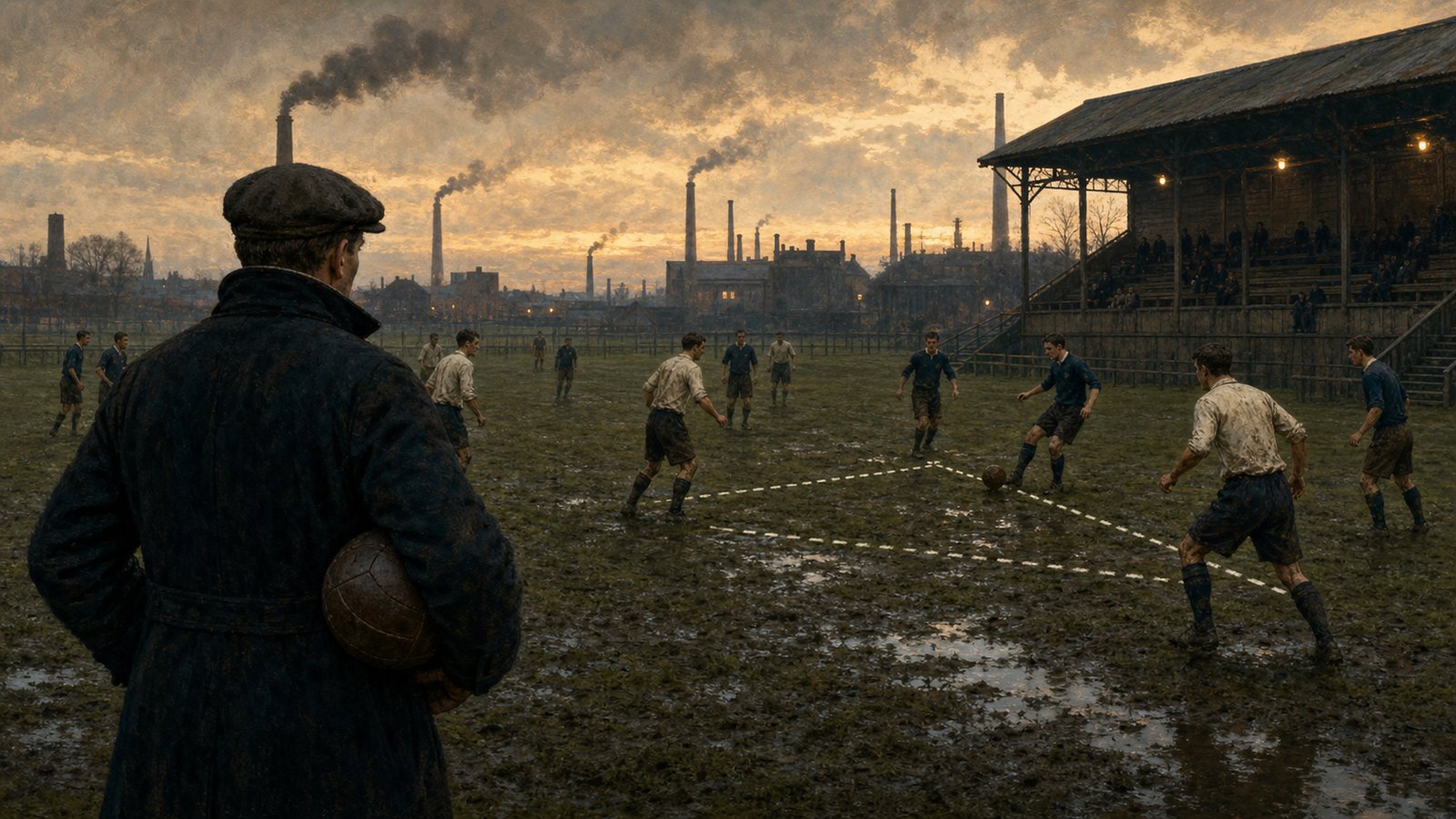
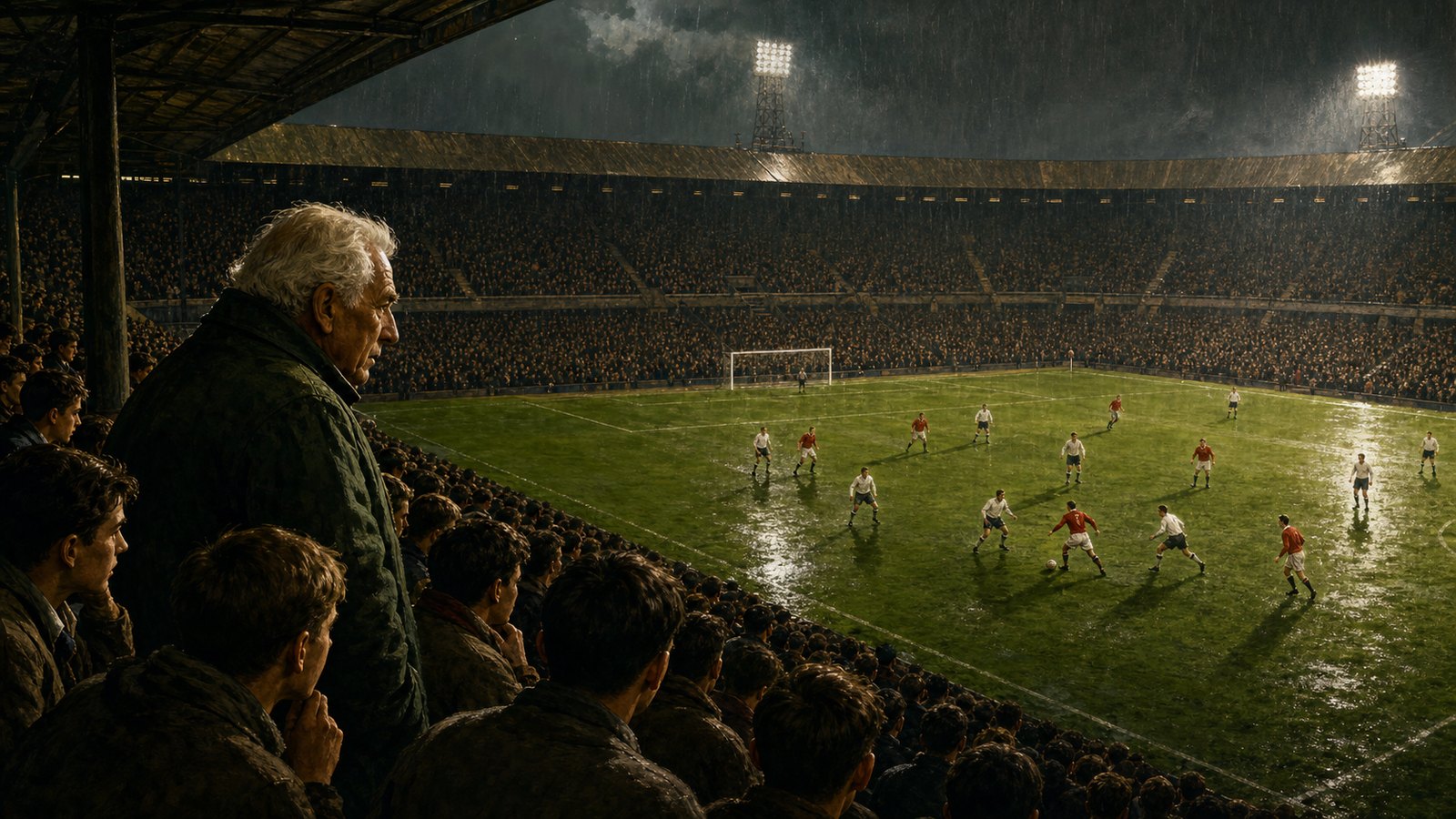
Jimmy Hogan was 71 when he climbed into Wembley’s stands on 25 November 1953. Around him sat a group of Aston Villa youngsters he was still teaching. Below, England prepared to defend a reputation that had survived every continental visitor. Hogan had no place in the Royal Box and no formal role in the occasion. He had simply bought his way into the ground to watch what happened when ideas he had carried through Europe finally arrived back in his own country.
Hungary won 6–3. Their short passing, constant movement and Nándor Hidegkuti’s withdrawal from the centre-forward line pulled England apart. Afterward, Hungarian federation president Sándor Barcs credited the old English coach in the crowd: “Jimmy Hogan taught us everything we know about football.” The remark was generous, but it was also an accusation. England had produced one of Europe’s most influential teachers and then spent decades treating his classroom as foreign.
A mill worker who kept asking what the ball could teach
Hogan’s path did not begin with a grand tactical manifesto. Born in Nelson, Lancashire, in 1882, he came from an Irish Catholic family tied to the cotton industry. His father hoped he would enter the priesthood. Hogan instead worked as a cotton weaver and pursued football, beginning with Nelson before spells at Rochdale, Burnley, Fulham, Swindon Town and Bolton Wanderers. He was an inside-forward rather than a star, but his playing career gave him a question that mattered more than celebrity: why did so much English training take place without the ball?
A tour match with Bolton against Dordrecht helped turn observation into vocation. Bolton won easily, yet Hogan was struck by the Dutch players’ appetite to learn. A coach could explain technique, movement and cooperation rather than use running as punishment and hope Saturday supplied the football.
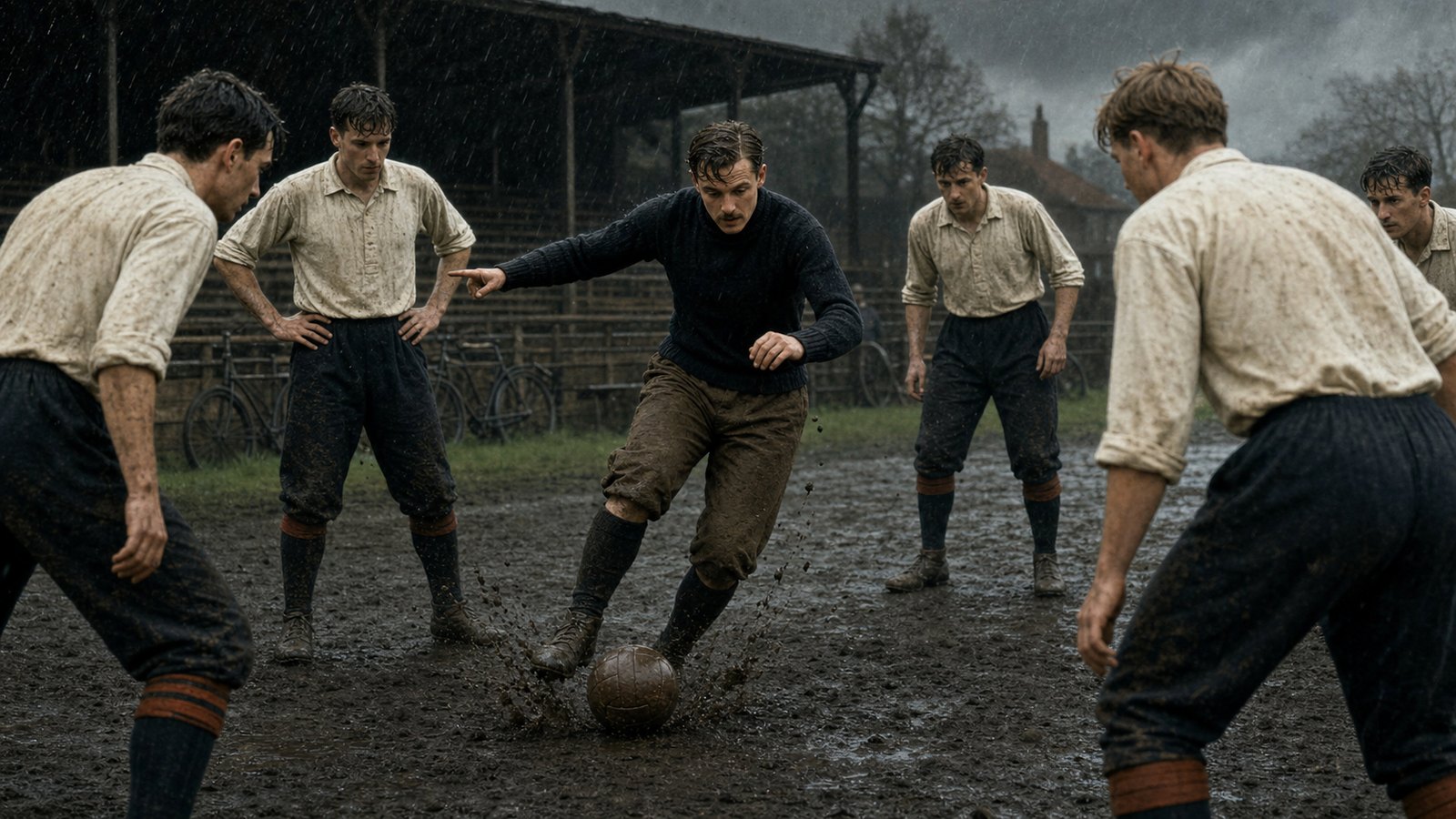
He returned to the Netherlands as a coach while still young enough to demonstrate every exercise himself. The Guardian later described his standard plainly: Hogan would not ask a player to perform a skill he could not execute. That principle made his sessions physical in a precise sense. Feet touched the ball repeatedly. Players rehearsed receiving, passing and moving into another angle. Fitness served the game instead of replacing it.
War trapped the coach, but Budapest opened a classroom
Hogan’s European life became more than an adventurous appointment when the First World War began. He was coaching in Austria when war was declared and, as a British subject, was detained. The Guardian records that he was awakened at dawn and imprisoned before eventually being permitted to work in Hungary. What looked like a dead end became the most consequential station of his career.
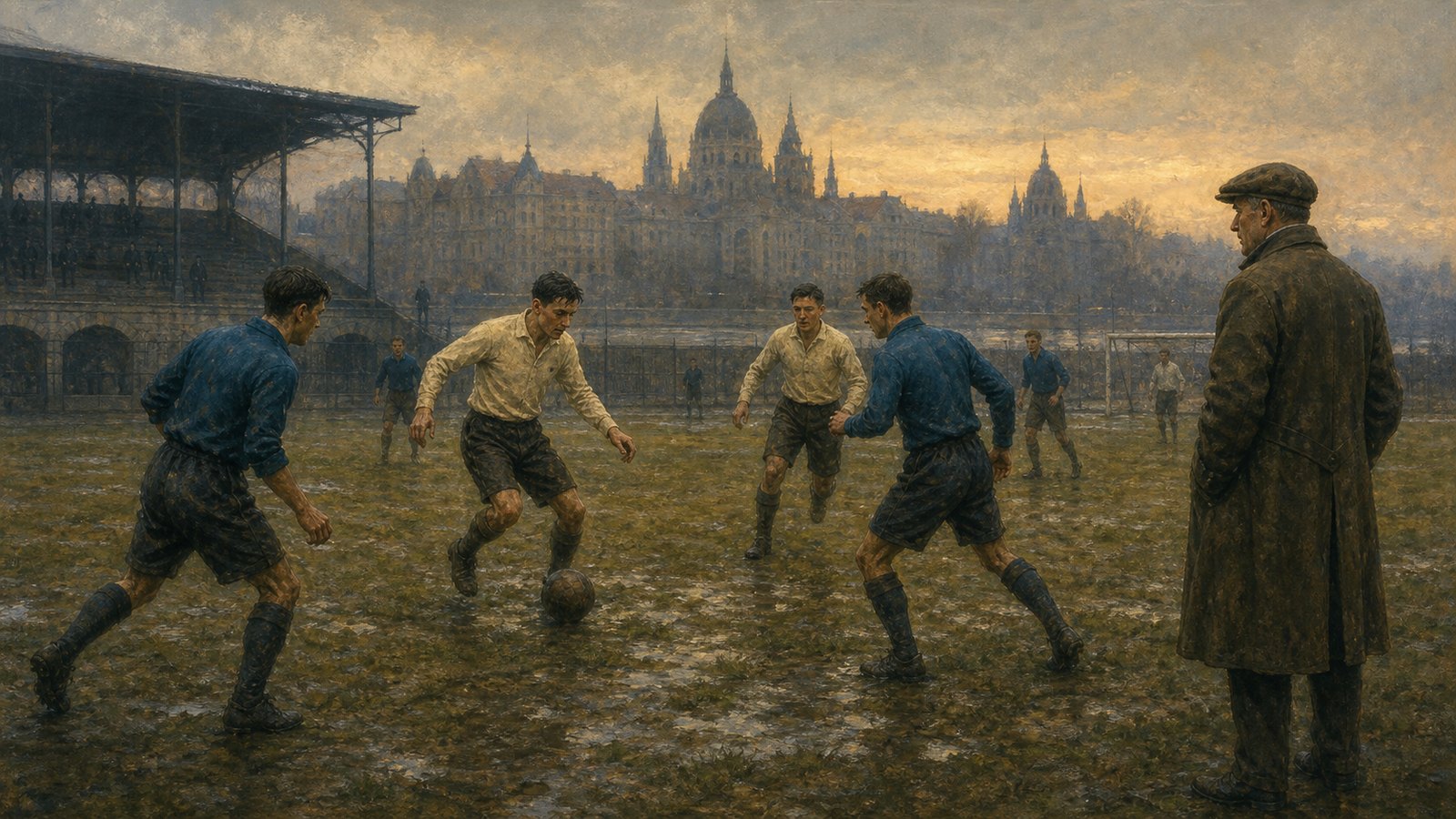
At MTK in Budapest, Hogan found players willing to treat technique as serious work. The BBC places his first period with the club during the war and credits him with introducing the quick, short and incisive passing associated with the Danubian style. Nemzeti Sport records three league titles with MTK and stresses that the trophies alone cannot measure the influence. Players absorbed the methods, then travelled as coaches and carried them into other countries.
Hogan’s deeper contribution was a method of learning. The ball stayed present. Players thought about angles and timing. Short passing changed how a side escaped pressure and how one movement created space for the next. Those habits could be adapted rather than copied.
Hogan returned to England in 1918 with little money. The contrast between his reception abroad and at home became brutal. According to the Guardian, the Football Association had offered financial help to men who suffered during the war. When Hogan sought the £200 payment, secretary Frederick Wall instead offered him a pair of khaki socks. He was also branded a traitor for having worked on the continent during wartime, although detention and necessity had shaped those years.
The ideas moved farther than the man’s name
Hogan resumed a coaching life that stretched through Switzerland, Germany, France, Austria and Hungary. Olympedia calculates more than 21 years working on the continent. His influence travelled through pupils as well as jobs.
He worked with Hugo Meisl around the Austrian national side, whose combinations made the Wunderteam a landmark of the early 1930s. The Guardian identifies Austria’s 4–3 defeat by England at Stamford Bridge in 1932 as a career highlight for Hogan: the score preserved an English victory, but the visitors’ play warned that continental football was no longer a pupil waiting obediently at the touchline. Hogan also influenced Helmut Schön, later a World Cup-winning manager with West Germany, who called him a shining example for coaches.
Olympedia adds a concrete medal to this network. Hogan took charge of Austria at the 1936 Berlin Olympics and returned with silver. Afterward he joined Aston Villa, then outside the top division, and helped bring the club back within two years. These were not the achievements of a theorist detached from results. His training survived different languages, squads and competitive demands because it started with transferable football actions.
England hired him, then resisted being coached
Hogan’s returns to British clubs exposed a recurring problem: methods work only if players accept they can improve. At Fulham, senior players resisted and he was dismissed after 31 matches. Celtic’s established players later showed limited interest, but younger footballers listened.
One was Tommy Docherty, then a teenage midfielder who later managed Scotland and Manchester United. Another was Ron Atkinson at Aston Villa. Both remembered Hogan as a formative influence. Atkinson described sessions built around control and passing and called the approach revolutionary. The word fits not because cones and ball drills now look exotic, but because Hogan challenged the assumption that British professionals already possessed everything a coach could teach.
Hogan’s authority came from demonstration and detail rather than rank. If a first touch failed, the answer was practice, not a speech about character. Such correction could threaten dressing rooms where seniority protected habit. On the continent, many players saw a specialist. In England, some heard an accusation that they were unfinished.
Wembley made the hidden coaching tree visible
By 1953, Hungary’s Golden Team had developed through many minds: Gusztáv Sebes organised the national side, Márton Bukovi advanced the deep-lying centre-forward role, and gifted players such as Ferenc Puskás, József Bozsik and Hidegkuti supplied the intelligence to make the structure live. Giving Hogan sole authorship would flatten that history. His importance lies instead in the lineage. Nemzeti Sport connects Sebes, Bukovi and Gyula Mándi to an MTK tradition in which Hogan had been a major teacher.
That lineage is why the scene at Wembley carried such force. Hungary arrived as Olympic champions and, according to the BBC, unbeaten in 32 matches. Hidegkuti moved away from England’s centre-half, teammates flooded the spaces created, and passes arrived faster than fixed marking could adjust. The 6–3 exhibition was the visible result of a mature Hungarian football culture, not a single afternoon’s trick.
Hogan watched from an ordinary seat with his Villa pupils. Barcs explained that Hungary had not invited him because the English FA staged the match, then promised he would be honoured when England visited Budapest. The tribute joined past and present in one sentence. A coach dismissed as inconvenient at home had helped establish habits that England could no longer contain.
A grave restored after the football had spoken
Hogan died in 1974 aged 91. Recognition remained uneven long after Wembley. In Burnley he lay in an unmarked grave, a strange ending for a coach praised across Europe. In 2021, a fundraising effort supported by MTK and Hungarian football organisations produced a new headstone. Representatives of Aston Villa, Bolton, Burnley, Celtic and Fulham attended the ceremony. A memorial plaque was also unveiled near Turf Moor.
The restored grave offers a quieter measure of his career than any claim that he “invented” modern football. Hogan did not own passing, movement or technical training. He became a crucial carrier: from Lancashire playing fields to Dutch curiosity, from wartime Budapest to Vienna, Berlin and British youth teams. His methods were powerful because others could use and transform them.
Hogan insisted that footballers could be taught through the ball, that intelligence could be rehearsed, and that movement belonged to a collective language. Europe adapted the lessons and built its own schools. When the argument returned to Wembley, it arrived as six goals.
Sources
BBC Sport; The Guardian; Olympedia; Nemzeti Sport.