
Wembley was supposed to be a measuring stick. On 25 November 1953, England walked into a friendly believing the old scale still worked: home grass, familiar weather, a packed national stadium, and the comfort of never having lost at home to a team from outside the British Isles. Hungary turned that comfort into the first problem of the afternoon.
The score, 6-3, became the easy part to remember. It was bright enough for headlines and simple enough for memory. But the more unsettling thing was not that Hungary scored six. It was that they made England look as if they were defending a different sport. Nandor Hidegkuti did not behave like the centre-forward English centre-halves expected to wrestle. Ferenc Puskas did not wait in one obvious channel. Jozsef Bozsik did not pass like a half-back asked only to tidy up. The whole Hungarian side seemed to move a question around the pitch until England answered the wrong one.
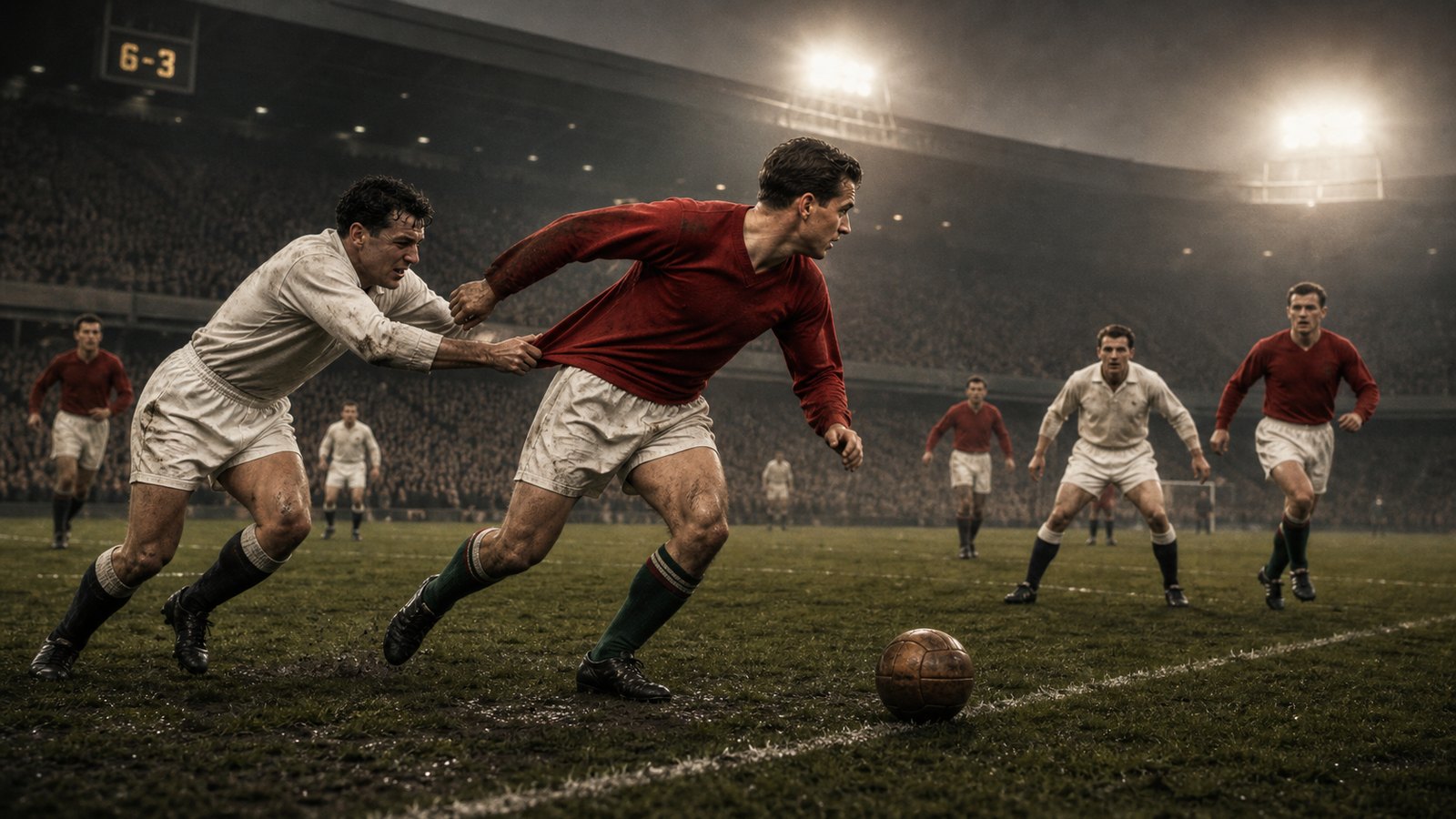
The unbeaten record hid a tactical blind spot
England’s home record mattered because it gave the match a ceremonial frame. The Football Association treated the game as a high-status occasion, and the crowd arrived expecting a test of national prestige. Yet the record also encouraged a dangerous assumption: that the opponent would enter the same grammar of positions, duels, and responsibilities. Hungary arrived with different syntax.
Gusztav Sebes had not built a side around one magician and ten witnesses. The Golden Team was an integrated machine, but not in the dead, mechanical sense. It was machine-like because one movement triggered another. When Hidegkuti dropped from the front line, the English centre-half faced a decision that did not exist in the old manual. Follow him and leave space behind; hold the line and allow him to receive freely. Neither answer restored order, because the next Hungarian runner was already using the answer against England.
That is why the early goal mattered beyond the clock. Hidegkuti scored after roughly one minute, not because England had suffered a freak lapse, but because the match immediately exposed the confusion Hungary wanted. The visitors did not need a long feeling-out period. They had brought the experiment with them.
Hidegkuti was the disappearing centre-forward
The most famous tactical detail is still the simplest: Hungary’s nominal number nine refused to stay where England expected a number nine to live. Hidegkuti’s withdrawal pulled the defensive reference point away from the penalty area. In an age when many defenders still interpreted their job through direct marking and familiar shapes, that was devastating. He was not hiding. He was relocating the argument.
His hat-trick gave the idea a scoreboard. It also made the idea impossible to dismiss as theory. A withdrawn forward can sound elegant in retrospect, but Wembley saw the practical cruelty of it: a forward receiving in pockets, midfielders stepping forward, inside forwards attacking the gap, and defenders hesitating just long enough for the next pass to arrive. Every hesitation looked small on its own. Added together, they became six goals.
Puskas supplied the image that stuck in England’s memory. His drag-back before scoring has often been replayed as pure individual humiliation, and it was dazzling. But it was also a symptom of the larger problem. The defender was not beaten in a quiet, isolated duel. He was exposed inside a game where Hungary had already stretched the usual defensive cues. The trick looked personal because the system had made the personal duel impossible to solve cleanly.
Bozsik turned passing into control
Jozsef Bozsik gave the side its calmer form of violence. His goal made the scoreline heavier, but his deeper influence was in possession. Hungary did not simply counterpunch. They used passing to decide where England would be tired, late, or uncertain. The ball did not move for decoration; it moved to rearrange the opponent.
That made the match feel different from a one-off upset. England were not merely punished for two or three mistakes. They were repeatedly led into bad distances. Press too eagerly and a passing lane opened. Wait too long and a Hungarian receiver turned into space. The team in red seemed to understand the next angle before the team in white had finished processing the current one.
The details are important because they rescue the game from myth. Hungary were not a mystical side who floated above tactics. They were physically and technically excellent players executing a collective idea at speed. Their greatness was not less romantic because it was organized. If anything, Wembley was frightening because the beauty had instructions.
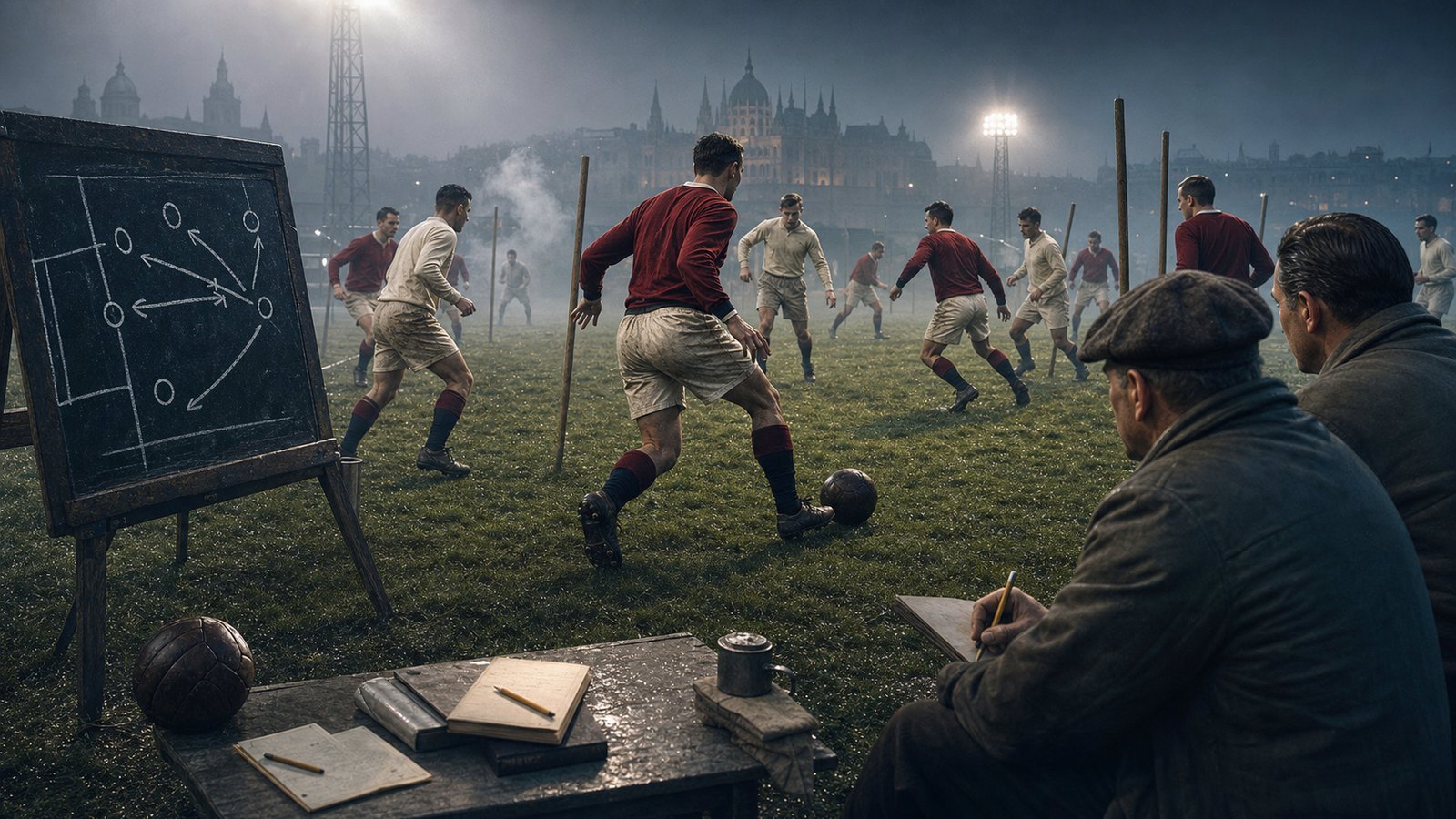
The 7-1 return proved Wembley was not weather
One way to reduce a shock is to blame the setting. A cold afternoon, a bad matchup, a friendly rhythm, a few moments that went wrong. Hungary removed that escape route in Budapest in May 1954, beating England 7-1. The second result did not carry the same first-contact drama as Wembley, but it made the earlier lesson harder to explain away.
Together, the two games said something brutal about football’s map. England had been central to the sport’s self-image; Hungary showed that tactical modernity could arrive from elsewhere and arrive fully formed. This was not a small nation borrowing English football and adding flair. It was a side using different assumptions about space, role, and collective movement, then forcing the supposed teacher to learn in public.
The timing sharpened the point. The World Cup in Switzerland was months away, and Hungary entered it with the aura of a team that had already solved something the rest of Europe was still naming. They would score heavily, including an 8-3 group-stage win over West Germany. They had Puskas, Hidegkuti, Bozsik, Sandor Kocsis, Zoltan Czibor, and a cast comfortable inside Sebes’s moving structure. By mid-1954, the Golden Team was not just admired. It was feared as a preview of football’s next language.
The final made the myth hurt
The strange thing about Hungary’s story is that its clearest proof and its permanent wound sit almost beside each other. In the 1954 World Cup final, Hungary led West Germany 2-0 inside the opening minutes. The ending seemed to be following the script written by Wembley and the tournament’s early rounds. Then the final turned. West Germany came back to win 3-2, and the Miracle of Bern became one of football’s defining reversals.
For Hungary, the defeat did not erase the evidence. Puskas had been injured earlier in the tournament and still played the final. West Germany had already met Hungary in the group stage and lost heavily, then met them again when the stakes, weather, and momentum were different. The final became a reminder that superiority over a period does not guarantee possession of the one match history chooses as the seal.
This is where the Golden Team becomes more than a tactics lecture. If Hungary had won in Bern, Wembley might be remembered as the opening chapter of an inevitable coronation. Because they lost, Wembley became something more haunting: a glimpse of a future that arrived early, dazzled everyone, and still failed to collect the trophy that would have made the argument tidy.
The revolution survived the missing medal
Hungary’s 6-3 at Wembley should not be treated only as England’s embarrassment or as a sepia clip of Puskas fooling a defender. Its deeper value is that it shows tactical change becoming visible under pressure. The withdrawn centre-forward, the rotating front line, the technical midfield control, the coordinated runs: all of it made the pitch feel larger for Hungary and smaller for England.
The players were not anonymous components. Hidegkuti’s intelligence, Puskas’s balance and left foot, Bozsik’s passing, Kocsis’s finishing, Czibor’s directness: each mattered. But the genius was that the side made individual brilliance more repeatable by giving it better conditions. The tactical laboratory did not replace talent. It placed talent where the old defensive system least wanted to find it.
That is the reason the 1953 match still feels alive. It was not a curiosity from another football planet. Modern viewers can recognize the problem immediately: false nines, midfield overloads, forwards vacating zones, defenders punished for following or staying. The names and boots have changed. The dilemma is familiar.
Wembley ended 6-3, but the score was only the loudest evidence. Hungary had made a national stadium watch an idea travel faster than its vocabulary. Bern later broke the spell, not because the spell was fake, but because football has always been cruel to teams whose influence outlives their medals. The Golden Team did not need the 1954 trophy to prove it had changed the sport. It needed Wembley to make everyone else realize the change had already happened.
Sources
- FIFA World Cup 1954 tournament archive
- RSSSF 1954 World Cup match records
- The Football Association: England v Hungary 60th anniversary feature
- Jonathan Wilson, Inverting the Pyramid
- UEFA Golden Team historical feature