
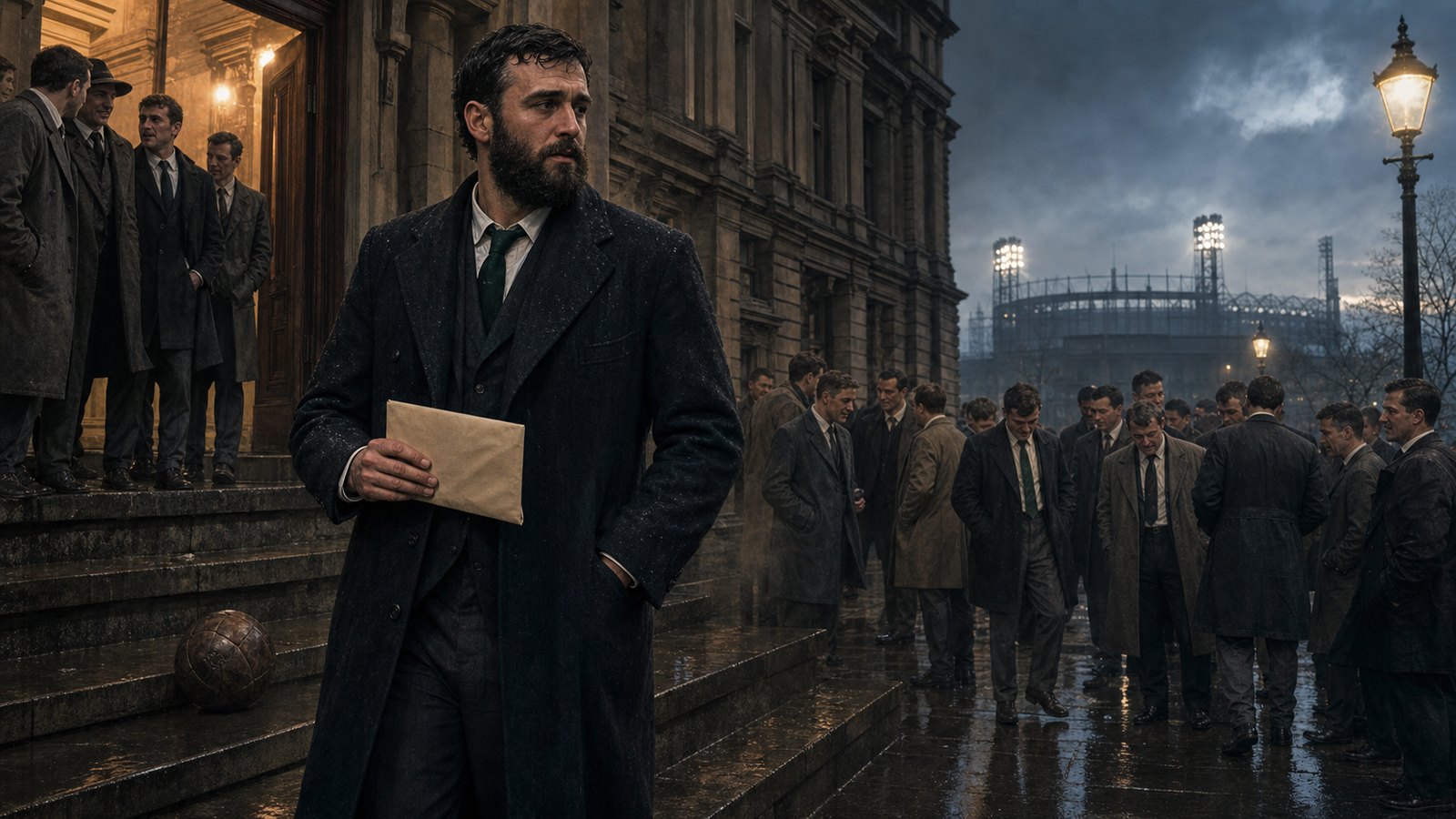
At the Ministry of Labour on 18 January 1961, Jimmy Hill had one announcement ready for the evening radio news: the players’ strike was off. Three days before footballers had planned to withhold their labour, the Football League’s ceiling on their wages had finally broken. Hill stood on the steps with league president Joe Richards, labour minister John Hare and Trades Union Congress chairman Ted Hill. The handshakes made a neat photograph. The argument behind them had occupied English dressing rooms for years.
The disputed number was £20 a week during the season, with the ceiling falling to £17 in summer. It applied to England internationals and reserves alike. A brilliant player could fill a ground, improve a club’s receipts and still be forbidden from negotiating a higher basic wage. Hill’s victory changed that relationship. It did not make every professional rich, and it did not settle every restriction on a player’s career. It established something more immediate: the Football League could no longer decide that no player was worth more than one fixed sum.
The ceiling survived while the business around it grew
The Football League imposed a £4 weekly maximum in 1901. By 1958 the limit had reached £20, but the principle remained: clubs competed for talent while agreeing not to compete freely on basic pay. Floodlit matches, European competition and television were enlarging football’s possibilities, yet exceptional performance could not be reflected in a higher basic wage.
That contradiction could be seen in January 1961 through Jimmy Greaves. The 20-year-old Chelsea forward had already become the youngest player to score 100 league goals and a major attraction at the gate. An Observer interview recorded him earning the same £20 ceiling while discussing the brevity of a football career. His concern was security after retirement, not a fantasy of limitless wealth. A player had perhaps ten good earning years, with injury capable of cutting the period shorter.
Hill understood that insecurity from inside the profession. He had joined Brentford before moving to Fulham in 1952. At Craven Cottage he became a versatile inside-forward, scored five goals in one match against Doncaster Rovers in 1958 and helped a lively side reach the FA Cup semi-final. He was a working player asking why the performer who created the value could not bargain over his share of it.
A quiet committee seat became a public campaign
Hill’s union role began without the aura later attached to his television career. He joined the Professional Footballers’ Association management committee in the mid-1950s and became chairman soon afterward. The work required votes, meetings and persuasion among players whose circumstances differed sharply. A famous international and a lower-division professional shared the ceiling, but a strike placed different risks on their households.
The PFA also faced opponents accustomed to governing football through club chairmen and league committees. Hill’s advantage was that he treated public communication as part of collective bargaining. He could explain the issue in the language of worth, choice and a short career. The campaign was about the right to negotiate rather than a demand that every club pay the same larger wage.
That distinction mattered. Abolishing the ceiling would permit a wealthy or ambitious club to offer more, while leaving another club free to offer what it could afford. Hill argued that the agreement should arise between employer and player, not from a competition-wide rule imposed before either side sat down. The PFA’s leverage came from the only thing the players controlled together: whether a Saturday fixture could take place.
Manchester gave the strike a visible body
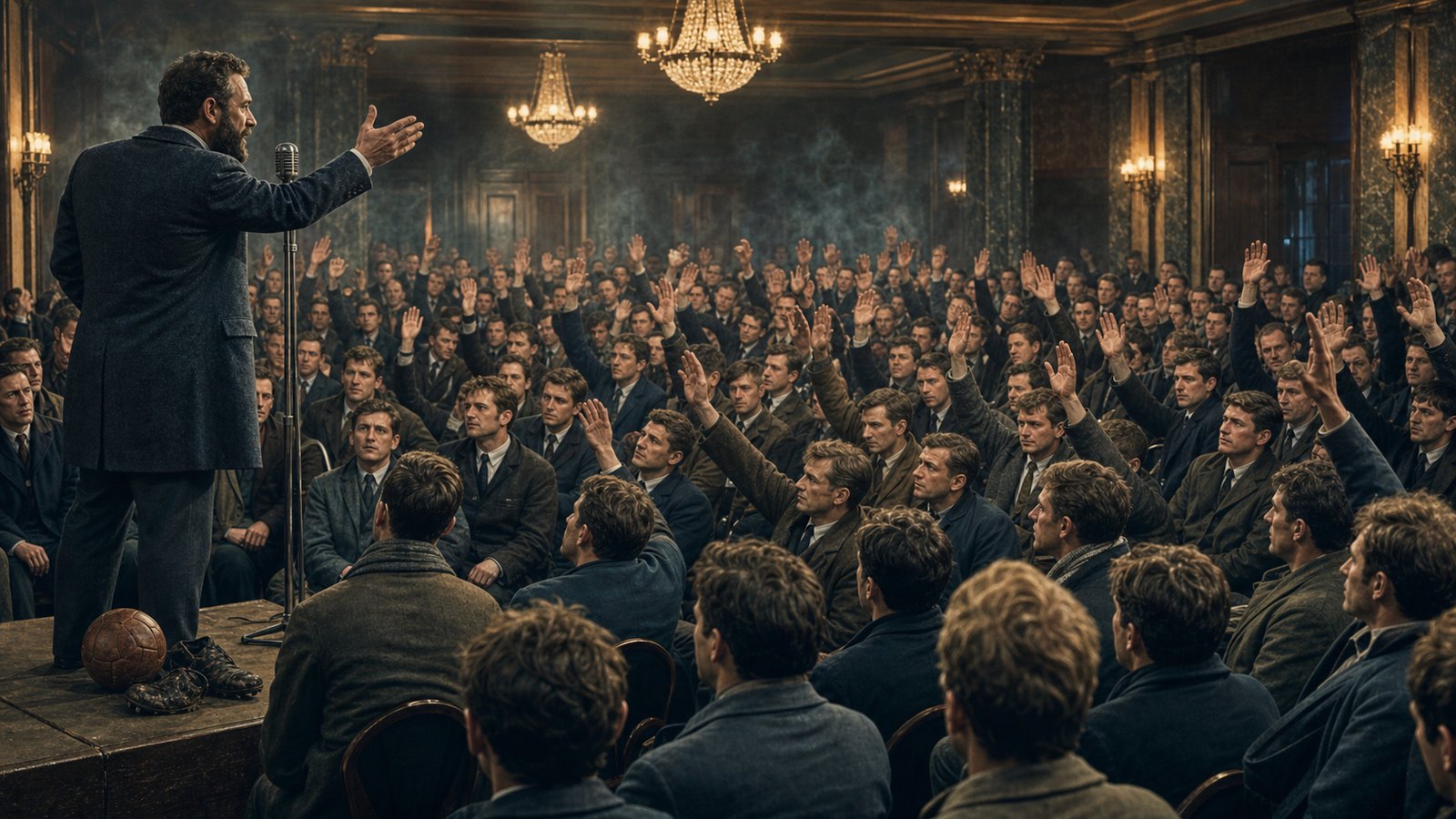
A mass meeting at Manchester’s Grand Hotel changed the campaign from correspondence into a countable threat. The Guardian’s retrospective records 344 northern players packed into the ballroom as Hill called for industrial action. Another contemporary reconstruction describes a new-year rally of 190 players as unrest hardened. The reports differ in which gathering they count, but they agree on the decisive point: support had moved beyond a small union committee.
The planned strike date was Saturday, 21 January. Ted Hill of the Trades Union Congress backed the players and urged the public to boycott any matches that clubs attempted to stage. Football pools added another layer of pressure. A blank league programme would disrupt not only turnstiles but a weekly ritual followed far beyond the grounds.
Hill’s beard and willingness to challenge the establishment produced the nickname “bearded beatnik.” The image was useful because it gave newspapers a recognisable protagonist, but the campaign was not a one-man performance. Its force came from professionals agreeing that the risk of acting together was smaller than another season under the same ceiling. Hill could speak on the steps because players had made the threat credible in rooms away from the cameras.
Seventy-two hours separated confrontation from settlement
Government involvement brought the sides to the Ministry of Labour. On 18 January, roughly 72 hours before the scheduled walkout, Hill and PFA secretary Cliff Lloyd met the football authorities. The agreement removed the maximum wage, allowing the union to cancel the strike before the weekend programme.
The settlement was not perfectly tidy. League officials and resistant chairmen continued to argue over the details during the following months. Even so, the central barrier had gone. Football League secretary Alan Hardaker later believed the clubs might have preserved a ceiling by offering an increase to £30. Instead, their refusal to concede earlier helped turn a limited pay dispute into a defeat for the entire principle.
There was a sharp human detail in the aftermath. Hill returned to Fulham and was cheered when he touched the ball, yet he remained on £18 a week. A knee injury soon ended his playing career before he could profit properly from the freedom he had won. The union chairman’s reward was therefore historical rather than financial: other players could enter negotiations he never enjoyed himself.
Johnny Haynes made the new freedom visible
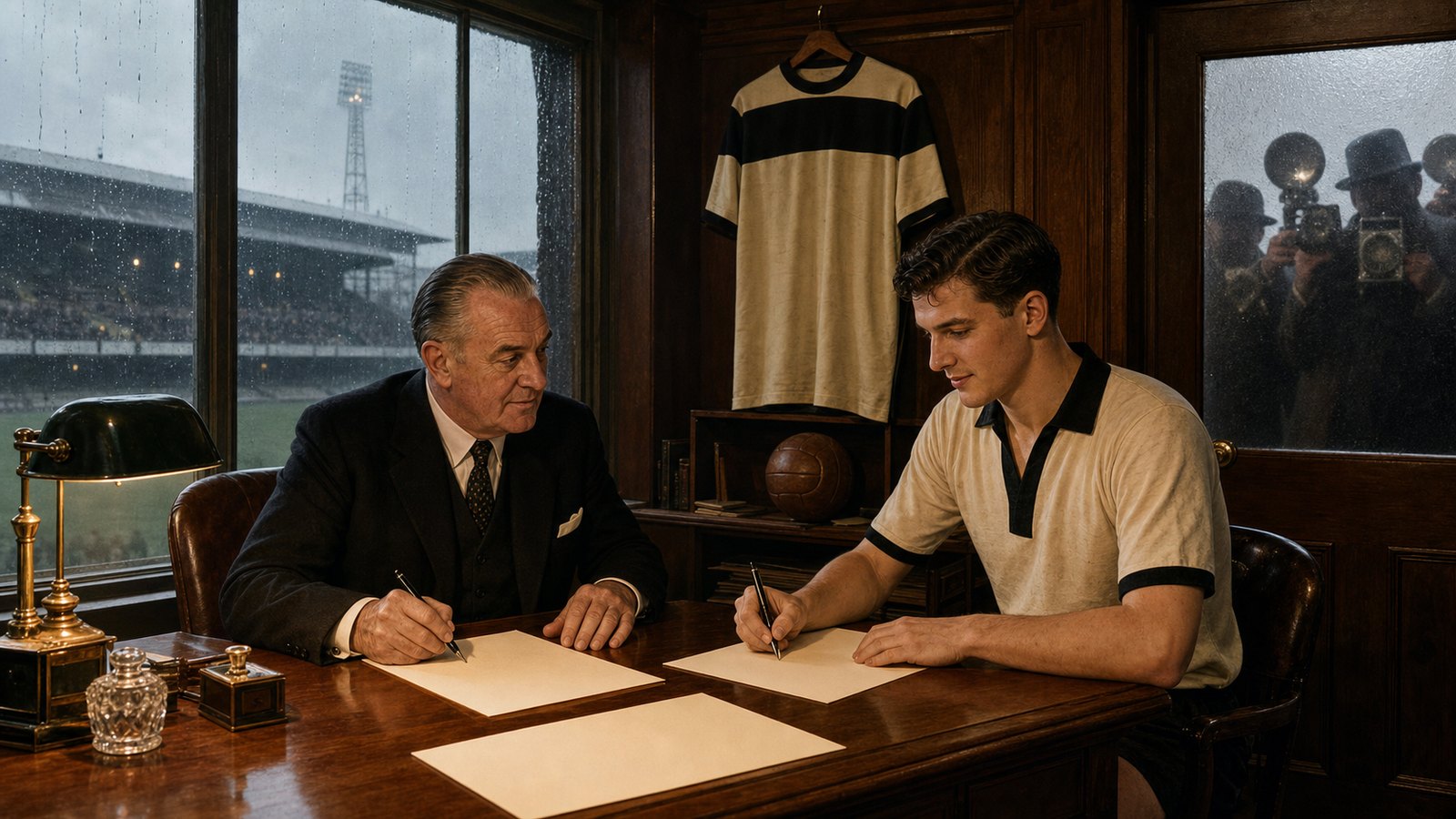
Fulham chairman Tommy Trinder had publicly promised that if the ceiling disappeared, captain Johnny Haynes would receive £100 a week. Trinder was a comedian and showman, and Haynes later remembered the promise as a publicity stunt. Once the PFA prevailed, however, the player arrived with paperwork and journalists nearby. The chairman had to honour his line.
Haynes becoming Britain’s first £100-a-week footballer gave the abstract victory a face and a dramatic multiplication: five times the old winter maximum. He was an England captain and a gifted two-footed passer, yet the importance of the contract was larger than one star’s salary. It demonstrated that the former ceiling had concealed what at least one club was prepared to pay.
The change did not produce equal bargaining power. Haynes recalled staying on £100 for the remaining years of his Fulham career without another rise. Clubs retained substantial control, and the retain-and-transfer rules remained a separate battle over whether a player could move after a contract. The Bosman case would expose another limit on mobility decades later. January 1961 should therefore be understood as one door opening, not every restraint disappearing at once.
The victory changed who could name a player’s value
Modern salaries can make the old dispute look like the first step toward excess. Hill rejected that shortcut. He maintained that a player should be free to negotiate what he was worth, while clubs remained responsible for offers they could afford. Removing a legalised ceiling did not require directors to abandon judgment. It required them to own their decisions.
The PFA campaign also altered the professional footballer’s public identity. Players had acted as workers with a union, elected representatives and the capacity to withdraw labour. The stars supplied attention, but solidarity gave the threat its weight. Greaves’s request for security, Haynes’s contract and Hill’s unrewarded final season showed three different consequences of the same rule.
Hill spent the rest of his career changing football in other roles, from Coventry manager to broadcaster and executive. None carried the compressed drama of that winter week. A ballroom filled, a Saturday emptied in prospect, government convened a meeting, and the £20 figure lost its authority. The final handshake did not create modern football wages by itself. It ended the assumption that a league committee could set every player’s highest possible price before the player entered the room.
Sources
BBC Sport; The Guardian and Observer archive; Fulham FC; Football Bloody Hell.