
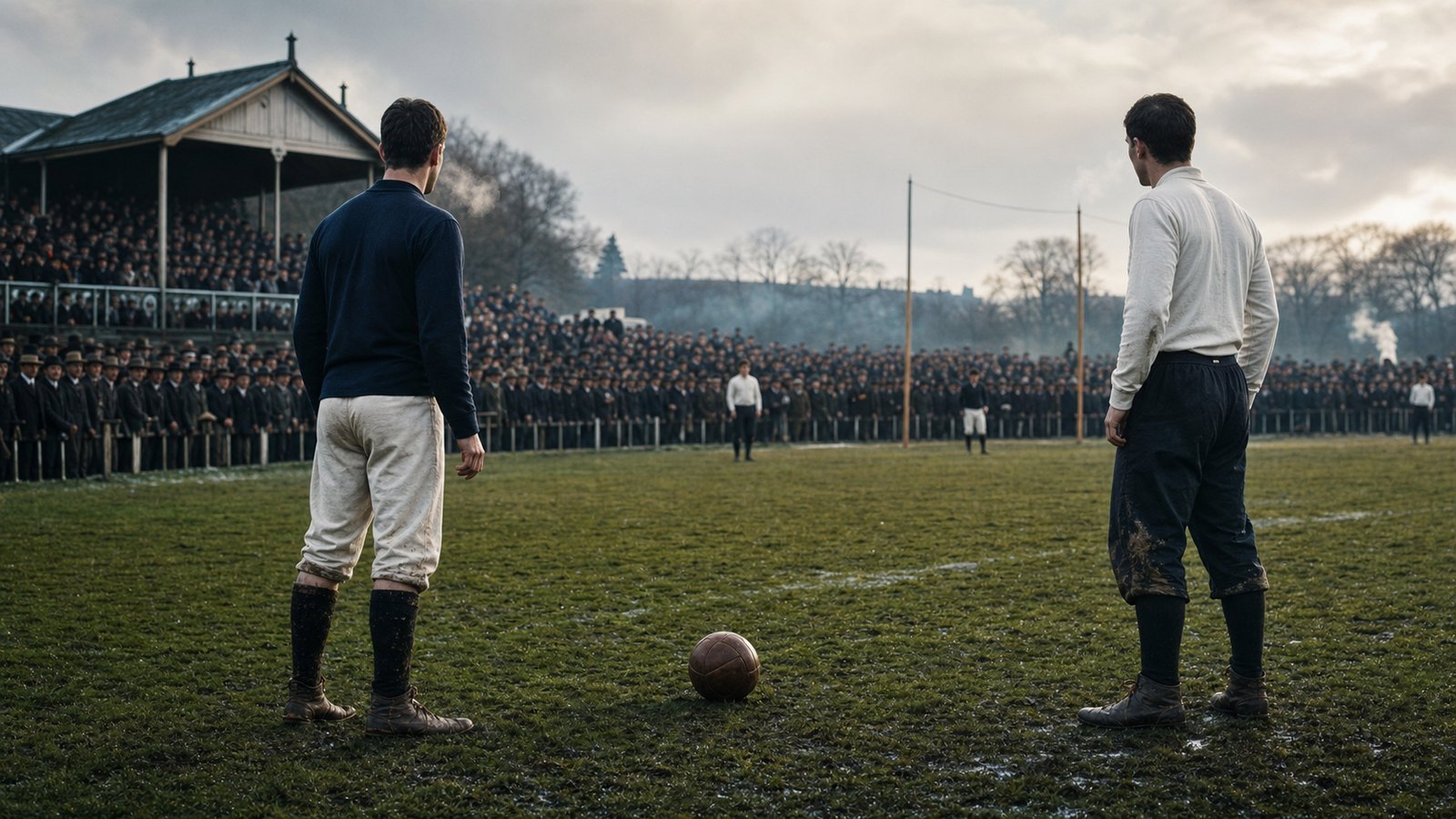
At two o’clock on the afternoon of 30 November 1872, several thousand people were supposed to be watching Scotland play England. Instead, they were still waiting beside a sloping cricket field in Partick while the teams prepared for an experiment whose rules some newspapers felt obliged to explain.
The delay lasted about twenty minutes. The ground was Hamilton Crescent, home of the West of Scotland Cricket Club. Men had paid a shilling to enter; women were admitted without charge. There were no nets and no rigid crossbar, only a tape stretched between the posts. Scotland wore dark blue. England wore white. Ninety goalless minutes later, the crowd applauded as if it had seen proof of something larger than a score.
The first official international did not begin with a national anthem, a tournament bracket or even two national associations. It began because one club accepted a challenge, assembled eleven men who knew one another, and tested whether football could mean the same thing on both sides of a border.
Twenty Minutes Past Two
Association football was still unfamiliar enough in Scotland for the Scotsman to describe its basic shape to readers. The paper counted twelve laws, compared with roughly forty in rugby, and emphasized the prohibition on handling except by the goalkeeper. It explained that a goal had to pass under the tape. Hacking, tripping, holding and charging from behind were forbidden. The dribble, the paper suggested, was one of the game’s attractions.
That explanation tells us how new the occasion felt. This was not an established rivalry being renewed. League championships did not yet exist in either country. England had staged the first FA Cup, but Scotland’s national cup and its football association were still in the future. Rangers had only been formed earlier in 1872; many of the institutions that would later define Scottish football did not yet exist.
The crowd itself was difficult to count. The Scotsman estimated 4,000, another paper guessed 2,500, and The Field believed more than 5,000 had gathered. Gate receipts support the lower end of that range. Whatever the exact figure, the gathering was unusually large for Scottish football, and it arrived on St Andrew’s Day to see whether a proposed international could become a real one.
Before Scotland Had an FA
There had been five earlier England–Scotland matches in London between 1870 and February 1872. They mattered as trials, but the “Scotland” teams were drawn mainly from players living around London. Scottish critics objected that a side selected so far from the country could not fully represent it. Charles Alcock, secretary of the Football Association and the driving force behind the fixtures, replied that his invitations had been open to any Scot willing to play.
The dispute was not merely about geography. Different football codes were followed in Scotland, and association football had only a small club base there. Then Queen’s Park showed that a Glasgow side could compete under the FA laws. In March 1872 the club travelled to London for an FA Cup semi-final against Alcock’s Wanderers. The match ended 0–0. Queen’s Park could not afford to remain for a replay and withdrew, but the trip made a properly Scottish international look practical rather than imaginary.
In October, the FA decided to send a team to Glasgow. Queen’s Park accepted the task of representing Scotland because there was no Scottish FA to do it. The venue was a cricket ground, just as the first official rugby international between the countries had been played on cricket territory twenty months earlier. A new form of football was borrowing the spaces, calendars and organizational habits of older sports.
Eleven Clubmates Against Nine Clubs
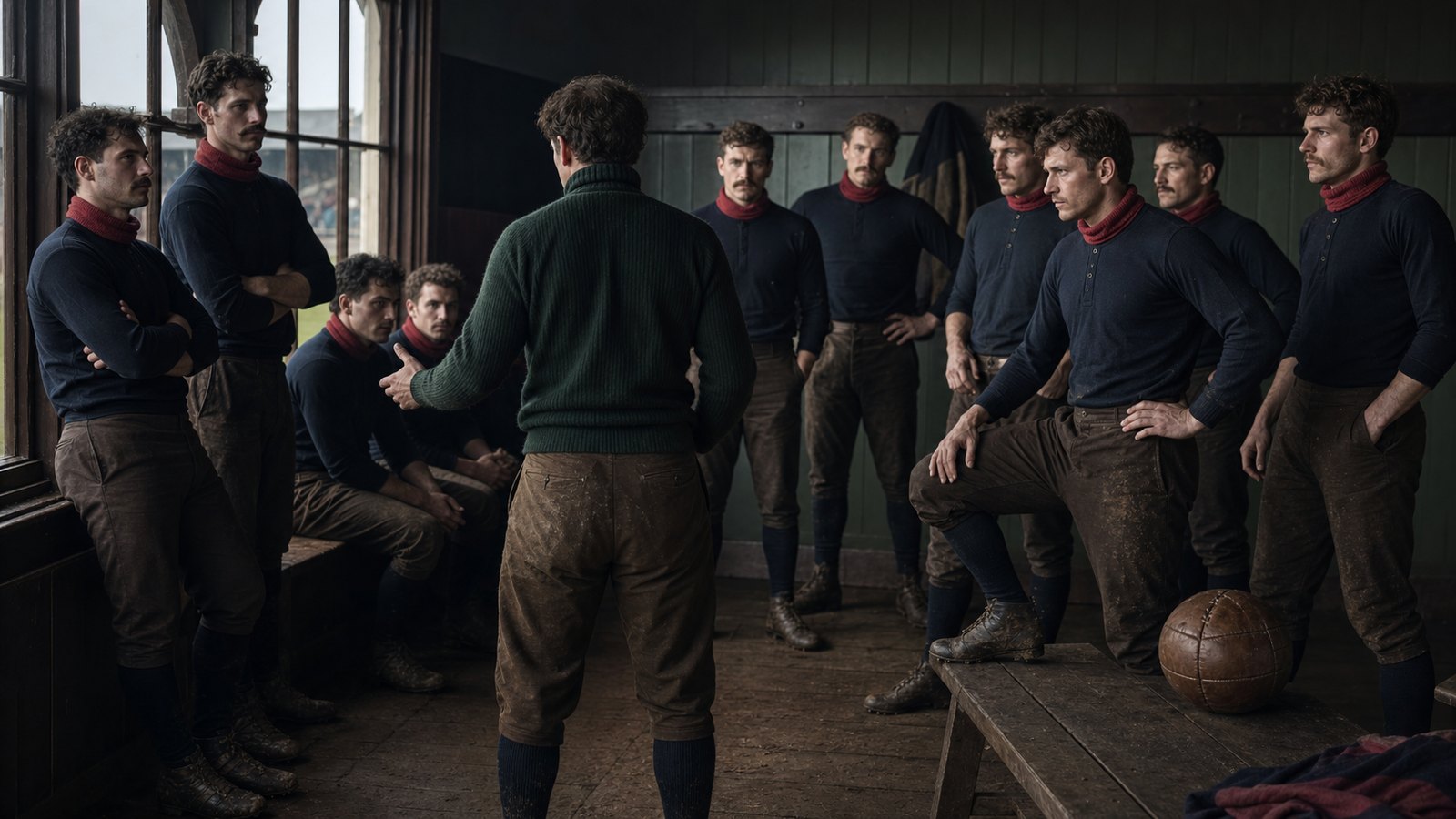
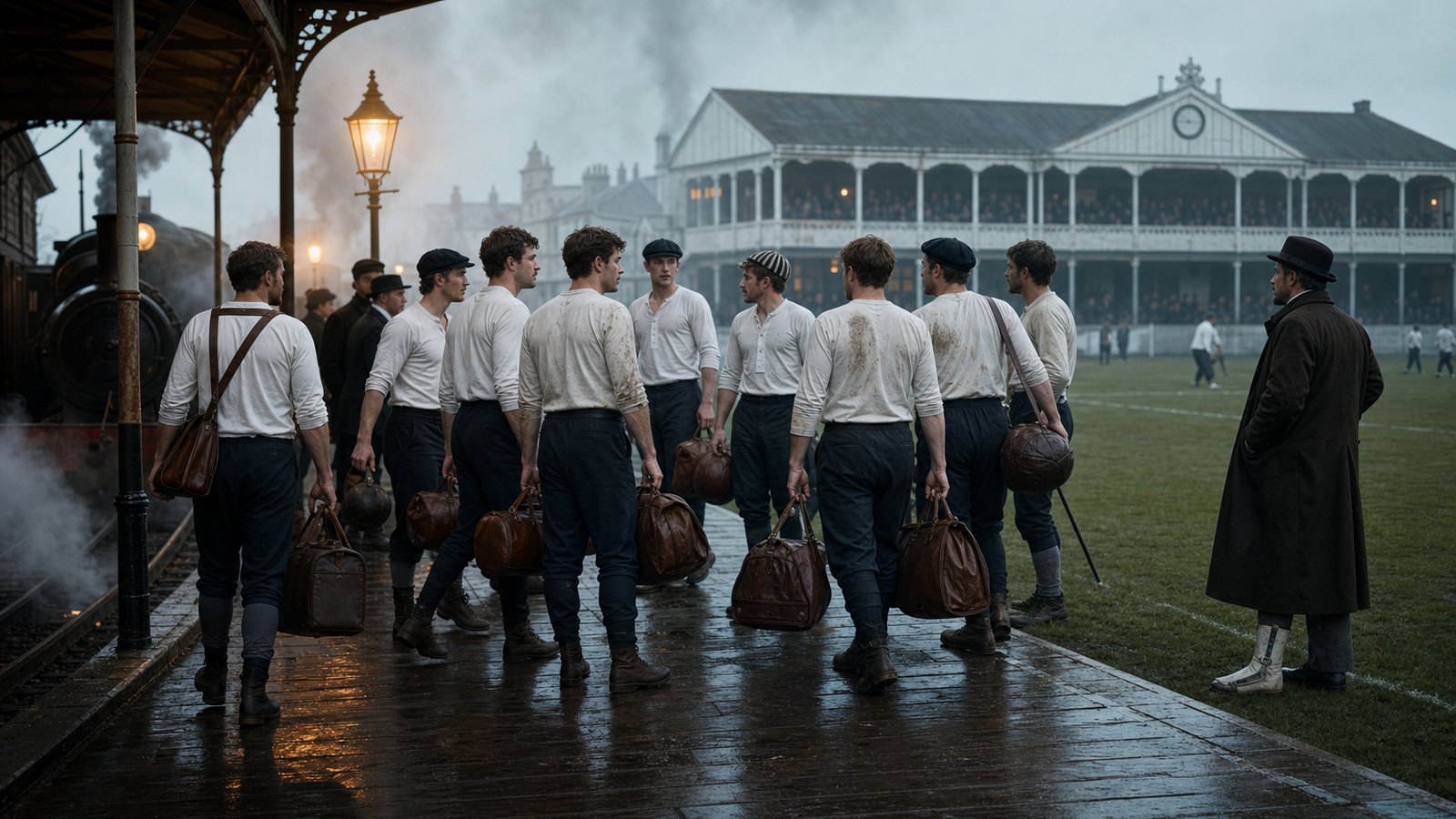
The teams arrived with opposite kinds of preparation. Every Scotland player belonged to Queen’s Park. Goalkeeper Robert Gardner captained the side and helped select it. The men in dark blue did not need an international camp to learn each other’s habits; their shared club football had already done that work.
England’s players came from nine different clubs. Alcock selected them but could not play because of injury. Oxford University supplied three men, while only Reginald Welch came from the FA Cup-winning Wanderers side. Cuthbert Ottaway captained a group whose individual ability was not matched by the same accumulated familiarity.
That contrast shaped the opening half, but it should not be turned into a tidy myth about Scotland inventing passing while England did nothing but chase the ball alone. Contemporary reports repeatedly describe dribbling by both teams. They praise Willie Kerr for a brilliant run through the field, Robert Leckie and his teammates for driving England back, and Ottaway for “very pretty dribbling.” The documented Scottish advantage was collective knowledge: Queen’s Park’s players understood one another’s movement because they played together every week.
Scotland also had the slope in its favour before half-time. England improved after the interval when the geography reversed. The Scotsman noted that the visitors had not worked well together in the first half but left little to be desired in that respect in the second. The match therefore became a live demonstration of how quickly strangers could adapt—and how much club familiarity mattered before international football had any training infrastructure.
The Tape That Fooled the Crowd
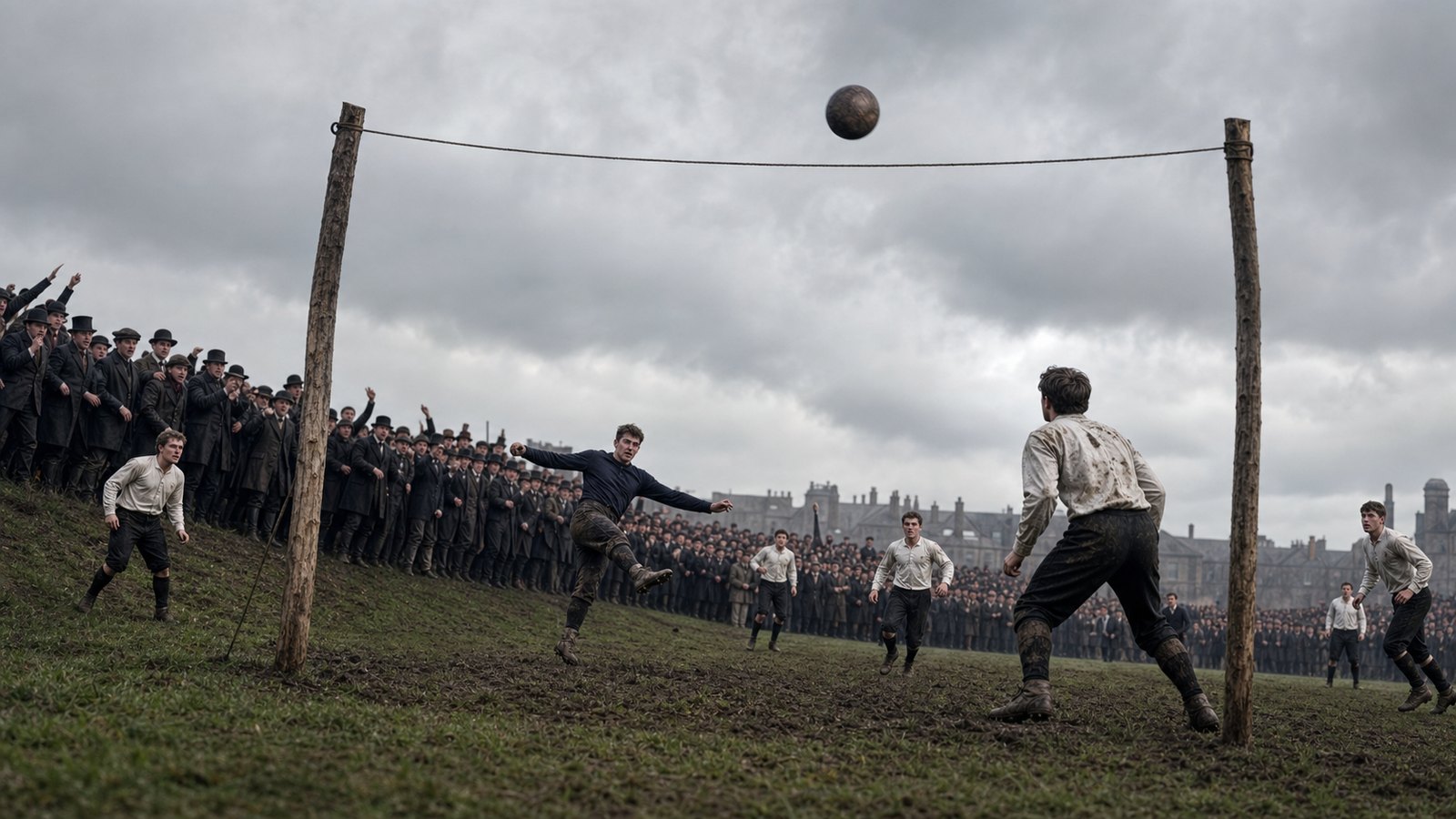
The closest moment to a Scottish goal came near the end of the first half. Leckie sent the ball just over the tape. Without a solid crossbar or a net to make the geometry obvious, part of the crowd celebrated in the belief that the shot had gone under. It had not. The primitive goal frame had created a split-second argument before the officials’ decision restored the scoreless match.
England found the woodwork after the break. Charles Chenery and Arnold Kirke Smith each struck a post as the visitors grew into the contest. Scotland still threatened through direct runs, but neither team found the legal space beneath the tape. After an hour and a half, the umpires ruled the match drawn.
The absence of goals did not make the day feel empty. The Field recorded “rapturous applause” and described the play as spirited and pleasant. The teams cheered each other, and the spectators continued until the last players had disappeared. This reaction matters. People had not come with decades of rivalry, qualification pressure or broadcast expectation. They were judging whether the event itself worked. A close, recognizable contest was enough.
A Draw That Made the Idea Real
The next day’s sporting world did not instantly reorganize around Hamilton Crescent. The Manchester Guardian devoted only 124 words, plus the teams, to the match; its account of the Birmingham cattle show on the same page was several times longer. The Times ignored the football. The first international was important in retrospect, but its contemporary footprint was still small enough to sit beneath livestock and agricultural implements.
Its consequences arrived through repetition. The Scottish Football Association was formed four months later. Annual Scotland–England meetings replaced the improvised London representative games. Within six years, internationals could draw 15,000 to the first Hampden Park; by the middle of the 1890s, 57,000 were crowding into Parkhead. The format travelled because Glasgow had shown that a team selected at home, playing under agreed rules against visitors, could attract a crowd and produce a credible sporting occasion.
The 0–0 also left a tactical clue without pretending to solve football in one afternoon. Scotland’s club cohesion gave it an early advantage. England adjusted during the match. Both sides dribbled, both created chances, and neither could break the tape. International football began not with a perfected national style but with two temporary teams discovering what could be transferred from club play and what had to be invented in front of the crowd.
That is the enduring strangeness of Hamilton Crescent. Almost every familiar layer of the modern international game was missing: federations on both sides, fixed stadium architecture, national selection systems, rehearsed camps, competition stakes and mass media attention. Yet the essential bargain was already visible. Eleven players could stand for a country, another eleven could answer them, and strangers would pay to see what happened.
Sources
- BBC, A Sporting Nation: The First International Football Match
- The Guardian, Before England’s 1,000th, the Story of the First Full Football International
- The Scotsman contemporary match report, preserved by London Hearts
- FIFA, historical recognition of the 1872 Scotland–England match