
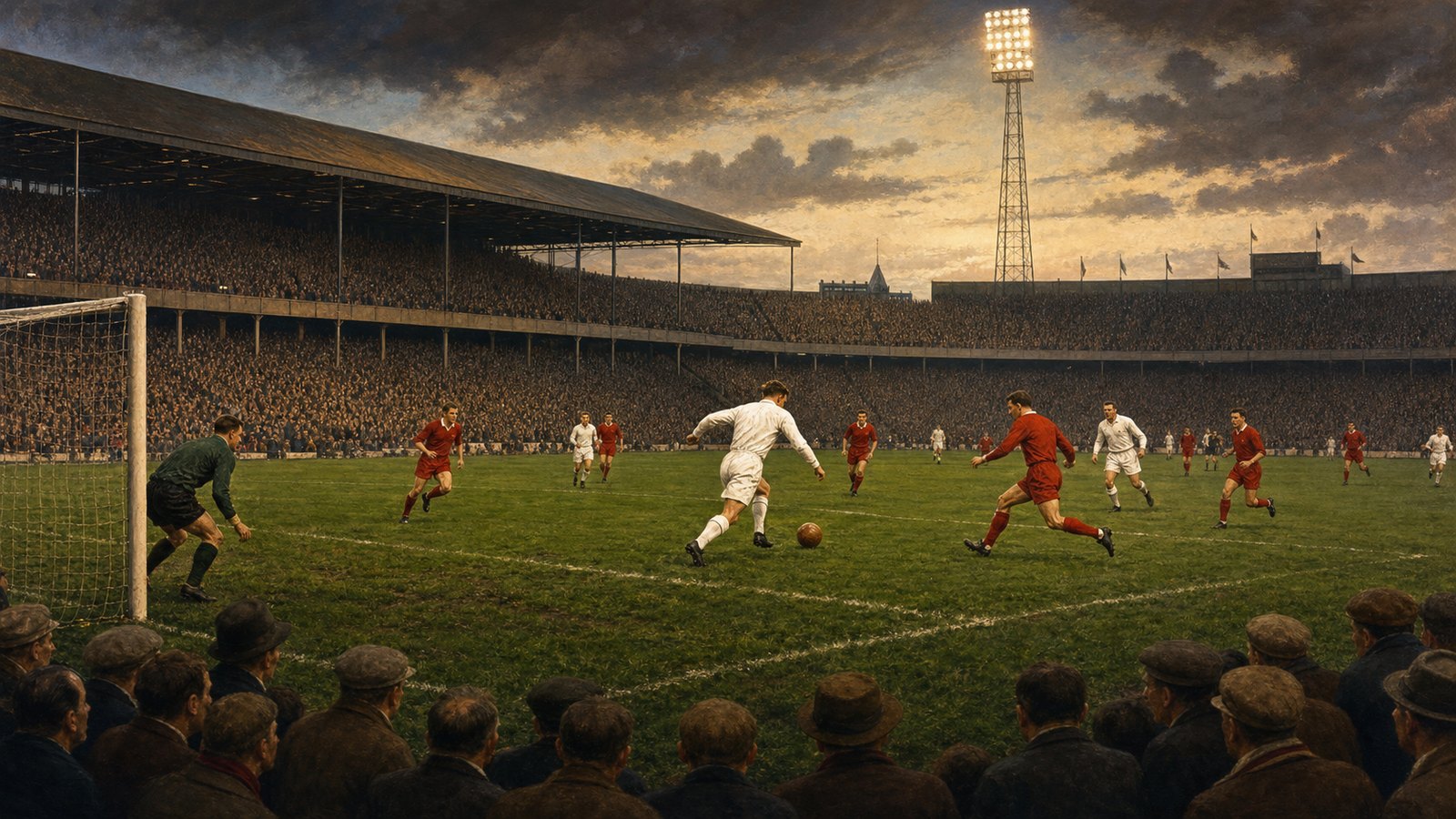
Hampden Park had already seen a surprise before Real Madrid began to play. In the 18th minute of the 1960 European Cup final, Richard Kress put Eintracht Frankfurt ahead. The West German champions had arrived in Glasgow after scoring twelve goals across two semi-final legs. They were young, aggressive and willing to attack the four-time holders. For nine minutes, the final seemed ready to escape Madrid.
Then the holders scored seven times. Alfredo Di Stéfano struck three, Ferenc Puskás four, and a match that finished 7–3 became a reference point for what club football could look like. Yet the score alone makes the evening smaller. This was not a sterile exhibition arranged for Madrid’s greatness. Frankfurt’s refusal to retreat gave the champions space, danger and a reason to reach for another level. The losing team helped make the spectacle possible.
Frankfurt earned the right to attack
Eintracht did not reach Hampden as ceremonial opposition. In the quarter-finals they eliminated Wiener Sport-Club 3–2 on aggregate. The semi-final against Rangers was emphatic: 6–1 in Frankfurt and 6–3 at Ibrox, a 12–4 aggregate victory. Scottish spectators therefore knew the visitors as the side that had dismantled one of their own major clubs.
Real Madrid’s path carried a different weight. They had won every European Cup since the competition began in 1955–56. Their 1959–60 campaign included a 6–2 aggregate win over Barcelona in the semi-final, with 3–1 victories in both legs. A fifth consecutive trophy was possible, but the final still put two high-scoring teams into the same old Glasgow bowl.
The setting amplified every movement. The Guardian’s later reconstruction gives a crowd of 127,621, while the RSSSF statistical record lists an estimated 135,000. Both figures describe a scale almost impossible for a modern European final. The older Hampden offered standing terraces, a rough surface and wind moving through the grandstands. This was also the first European Cup final staged in Britain.
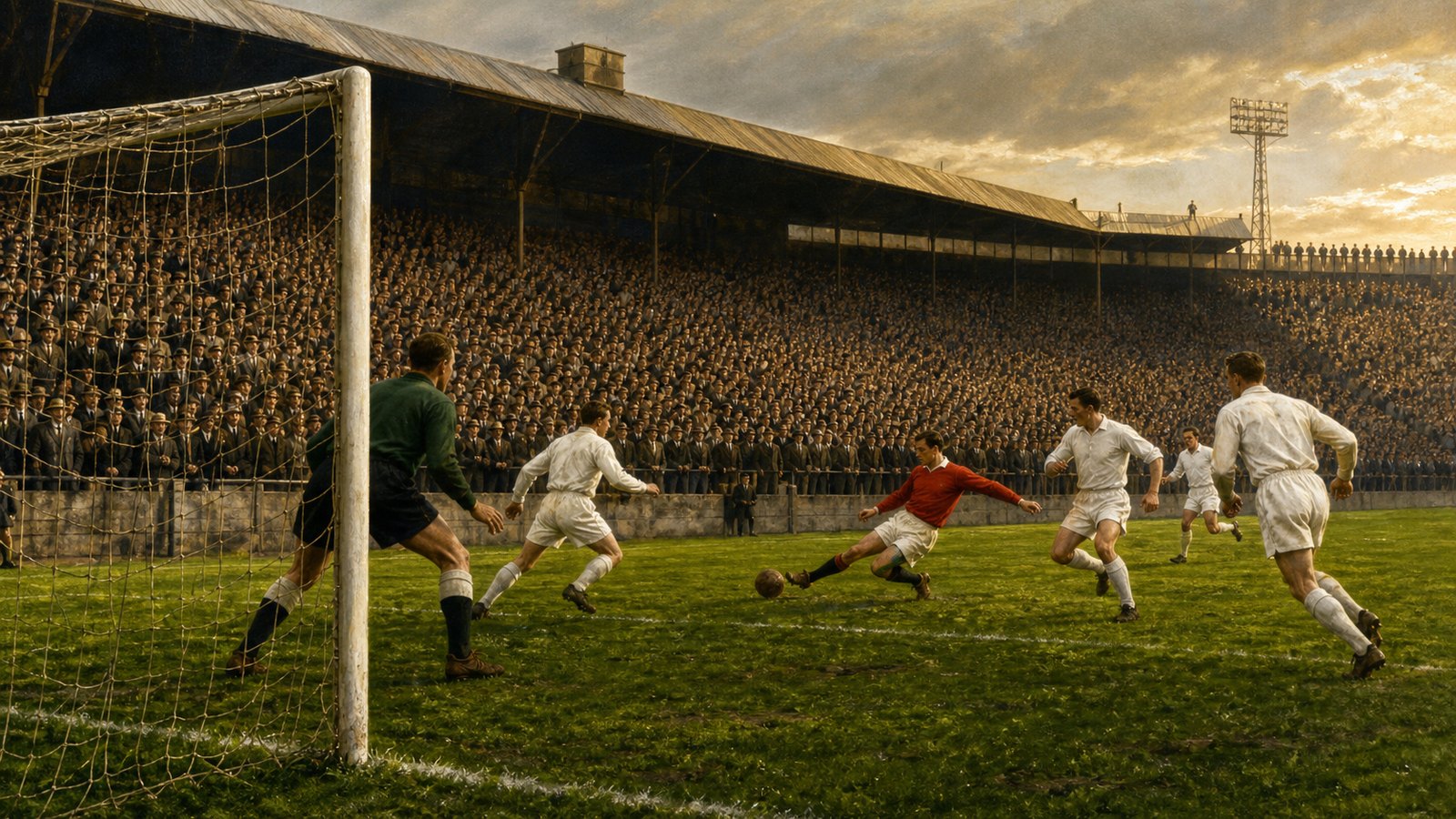
The audience extended far beyond the ground. A 2002 Guardian retrospective estimated 70 million television viewers around Europe, then the largest audience for a live BBC outside broadcast. Gate receipts of £55,000 were reported as a British record. A five-year-old competition was about to receive a shared visual memory, not merely another name on its trophy.
The first goal acted like a provocation
Kress’s opener came after 18 minutes. Madrid defender José Santamaría later remembered it as the sting that changed his team’s mood. The metaphor matters because the response was immediate rather than cautious. Di Stéfano equalised in the 27th minute and scored again in the 30th. Within twelve minutes of falling behind, Madrid led.
Puskás made it 3–1 on the stroke of half-time. Frankfurt had forced the holders to accelerate, but Madrid’s technical speed now stretched the match in every direction. Di Stéfano described his role as a withdrawn striker, which allowed him to arrive from different depths. Puskás required less territory. Teammates remembered how a few metres and his left foot could turn a half-opening into a shot.
The combination punished a defence that still had attacking obligations of its own. Frankfurt had not built its route to Glasgow by closing every corridor. Once behind, it kept trying to play through Kress, Alfred Pfaff and Erwin Stein. That ambition meant the final never settled into the slow protection of a lead. Each Frankfurt move carried the possibility of a reply and the risk of another Madrid break.
Seven goals came from two different kinds of forward
Puskás scored a penalty in the 56th minute, then added goals in the 60th and 71st. Four goals in one European Cup final remains an extraordinary concentration of finishing. His movement did not need to dominate the whole pitch. Madrid used the width and speed of Paco Gento and Canário, the industry of Luis del Sol, and Di Stéfano’s roaming influence to keep delivering the ball into Puskás’s decisive zone.
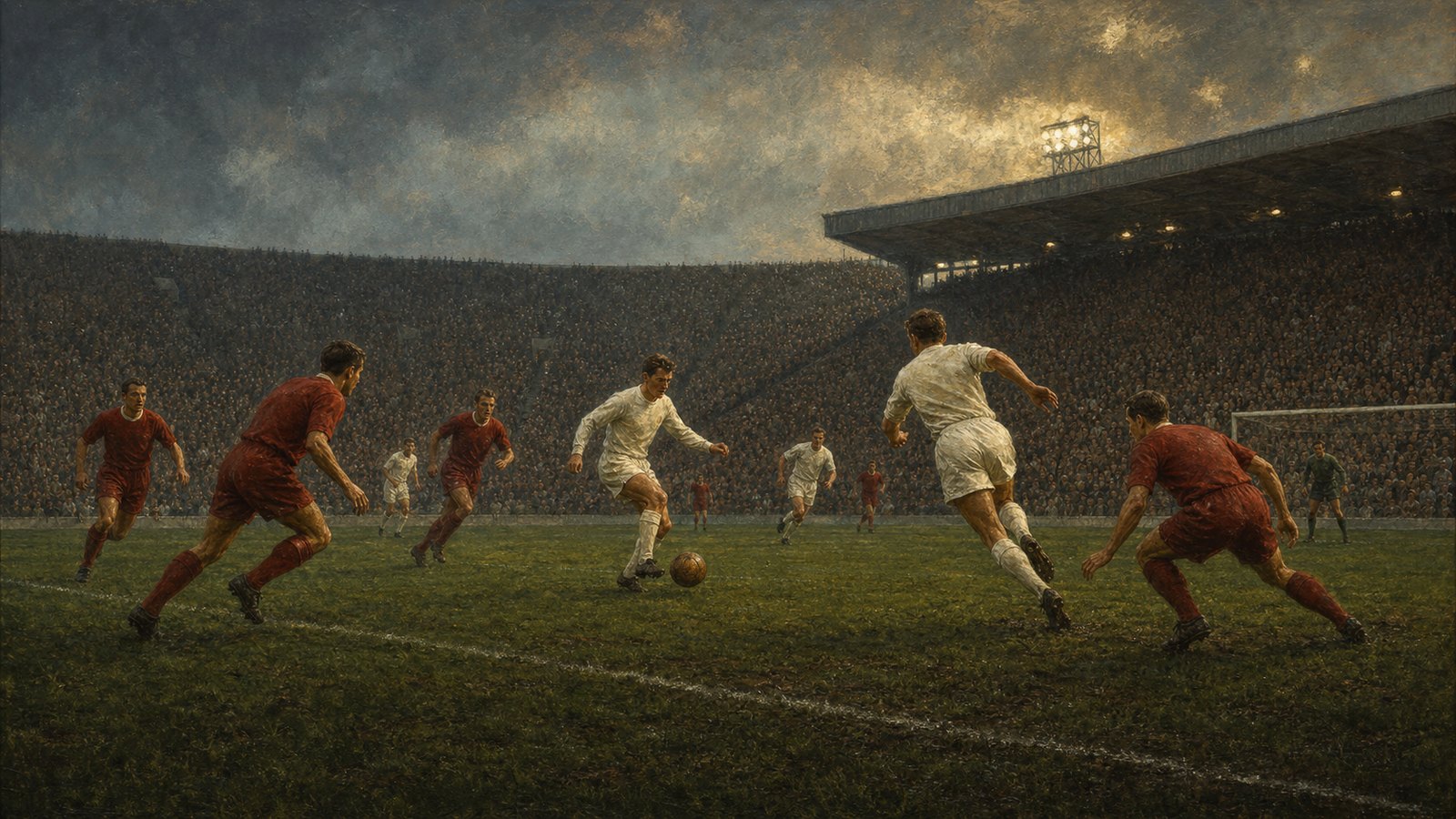
Di Stéfano’s hat-trick had a different shape. His first two goals reversed the early deficit; his third arrived in the 75th minute after he had spent the evening linking midfield and attack. The scoring list reads like a private contest, but the team around them made it possible. Madrid could change the angle of an attack without losing speed, a quality northern European opponents were less accustomed to facing at the time.
The sequence also shows why the final felt larger than a routine rout. Madrid led 6–1 after 71 minutes, but the next five minutes produced four goals. Stein scored for Frankfurt in the 72nd. Di Stéfano replied in the 75th. Stein scored again in the 76th. The losing side was still searching for the goal even as the scoreboard became overwhelming.
Ten goals arrived from only three scorers on Madrid’s side and two on Frankfurt’s. Kress had opened the match; Stein’s brace completed Frankfurt’s total. At the other end, Puskás and Di Stéfano divided all seven. The concentration gave the match recognisable protagonists, but the pace between goals made the whole contest feel collective and unstable.
The losers refused to make the score respectable
Modern knockout football often teaches the weaker side to reduce the number of events. Frankfurt did the opposite. Its semi-final had produced sixteen goals across two legs, and the final retained that willingness to exchange attacks. This was costly. It also prevented Madrid from converting superiority into possession without purpose.
Frankfurt’s final two goals could not alter the trophy, yet they changed the emotional temperature. A 7–1 finish would have resembled an execution. At 7–3, the beaten team remained visible inside the game. Stein kept moving, asked for the ball, and found two finishes after Madrid had reached six. The response did not disguise the gulf; it displayed competitive pride inside it.
A small scene after the whistle captures that respect. Puskás had scored four and wanted the match ball. Di Stéfano had scored three and wanted it too. According to Puskás’s later account, however, Stein asked for the ball three times. Puskás finally gave it to the Frankfurt forward because Stein had scored twice and lost the match. Even the souvenir passed toward the defeated side.
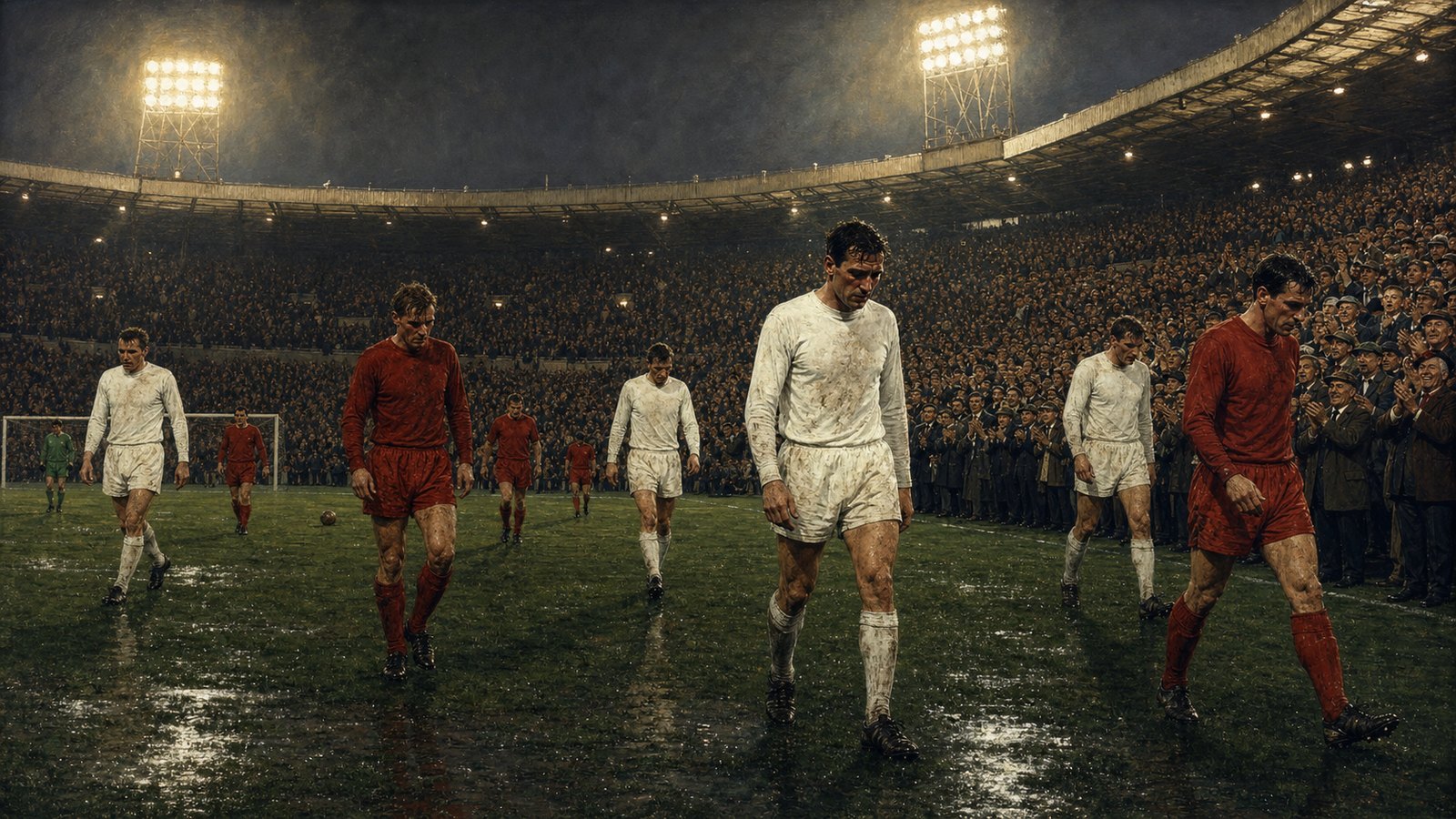
The Scottish crowd understood the bargain. Santamaría remembered the applause for a performance that spectators had not seen before. Frankfurt had eliminated Rangers, which gave Madrid’s victory a local edge, but contemporary and later accounts describe something broader than revenge. The audience responded to the quality and openness of the match itself.
Television turned one night into a measuring stick
People who watched remotely described the game as a revelation. BBC commentator Kenneth Wolstenholme later called it the finest match he had covered. Jimmy Greaves watched from a hotel in Budapest, where England were preparing to face Hungary. Bobby Charlton saw football operating at a level outside his familiar education. These reactions came from professionals, not distant admirers.
The broadcast mattered because it let the performance travel beyond Madrid, Frankfurt and Glasgow at once. Viewers could see the speed of combinations, the rough pitch, the crowd and the constant desire for another goal. The European Cup was no longer only a sequence of results carried by newspapers. It could provide a continent with the same astonishment in real time.
Madrid’s fifth consecutive title has never been matched. That achievement secured the dynasty, but Hampden supplied its most reusable image. Four earlier final victories had established authority. The 7–3 showed what that authority looked like when challenged by an opponent prepared to attack. Frankfurt’s opening goal created urgency; its later goals kept the contest alive after the winner was clear.
The celebration itself was strangely restrained. Santamaría recalled the team being kept in a hotel near the airport with orange juice and yellow biscuits while Santiago Bernabéu insisted on order. The public celebration came after the return to Spain, where white convertibles and thousands of people awaited them in central Madrid. The private night and public homecoming formed opposite endings to an extravagant match.
Calling Hampden simply Madrid’s masterpiece misses the mechanism that produced it. Great attacking displays need decisions from both teams: whether to press, retreat, protect, or continue. Frankfurt chose to continue. It lost by four goals, but it helped create a final remembered beyond the identities of winner and loser. The scoreboard recorded domination. The game itself recorded two teams refusing to make the evening smaller.
Sources
RSSSF, European Competitions 1959–60
The Guardian, “We marked an era” — 60 years on from when Real won 7–3 at Hampden
The Guardian, Hampden dazzled by white magic