
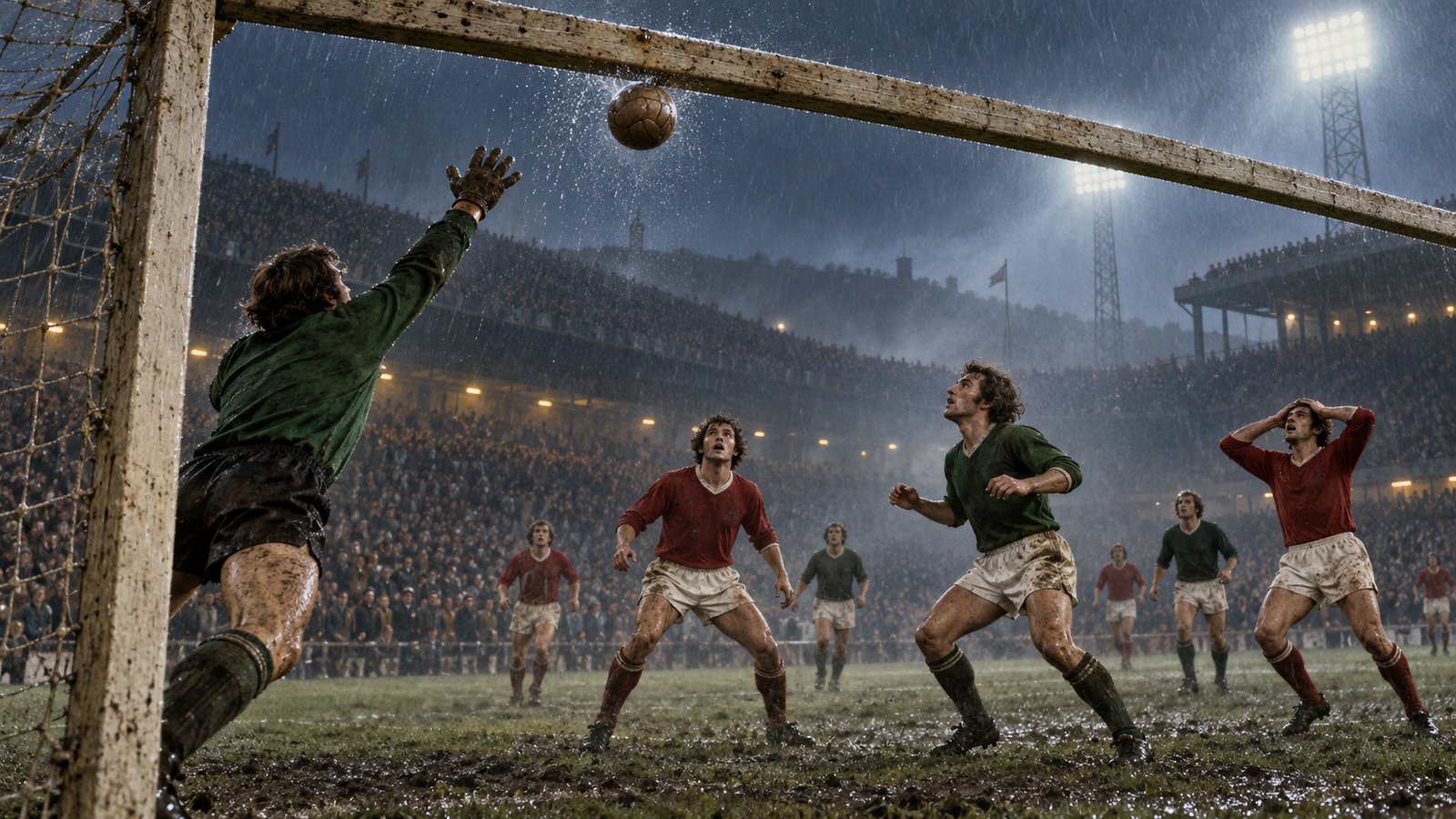
The ball struck Hampden’s frame twice before Bayern Munich found the net. In the 34th minute, Dominique Bathenay’s shot beat Sepp Maier and hit the crossbar. Five minutes later, Jacques Santini met Christian Sarramagna’s cross with his head and found the bar again. Saint-Étienne had put two clean attempts beyond the goalkeeper, yet the scoreboard stayed blank.
Those contacts became the shorthand for the 1976 European Cup final. Hampden had rectangular wooden frames rather than the round posts familiar in France, and disappointed supporters named them les poteaux carrés, the square posts. The phrase made a one-goal defeat tangible.
But the final was larger than a grievance about geometry. Saint-Étienne reached Glasgow through a violent swing against Dynamo Kyiv, created the first half’s two clearest moments, then conceded from a rehearsed-looking free-kick in the 57th minute. Bayern’s third consecutive European Cup and France’s celebration of the beaten finalists emerged from the same narrow match.
A three-goal night against Kyiv opened the road to Hampden
Saint-Étienne’s campaign did not begin as a fairy tale. They beat KB Copenhagen 2–0 away and 3–1 at home in the first round, then removed Rangers with another pair of victories, 2–0 and 2–1. The margins suggested control. The quarter-final against Dynamo Kyiv demanded something else.
The first leg left Robert Herbin’s side two goals behind. Kyiv won 2–0, forcing Saint-Étienne to chase the tie at home without conceding the away goal that would deepen the task. The return remained level on aggregate until Saint-Étienne forced the contest beyond 90 minutes. A 3–0 victory after extra time overturned the entire deficit.
That comeback changed the emotional scale of the run. Against PSV Eindhoven in the semi-final, the required margin was smaller. A 1–0 home win and a 0–0 draw away carried the French champions into their first European Cup final.
Bayern arrived through a route with less late theatre but heavier authority. They recovered from a 1–0 first-leg defeat against Malmö to win 2–1 on aggregate, beat Benfica 5–1 over two matches, and eliminated Real Madrid 3–1 in the semi-final. The holders knew how to manage European ties and how to survive a final. Their 1974 final against Atlético Madrid had required a replay 48 hours later; by 1976, the core of the side was pursuing a third cup in succession.
The 34th and 39th minutes gave the final its permanent sound
Hampden Park held 54,864 spectators on 12 May 1976. Bayern’s lineup carried names already fixed in the history of the era: Maier, Franz Beckenbauer, Uli Hoeneß and Gerd Müller. Saint-Étienne answered with Ivan Ćurković in goal, Osvaldo Piazza in defence, Jean-Michel Larqué in midfield and the Revelli brothers in attack. Hungary’s Károly Palotai controlled the match.
The first half’s decisive sounds came from wood rather than a whistle or a celebration. Bathenay’s 34th-minute strike travelled beyond Maier and hit the crossbar. It was not a hopeful ball dropped into traffic. The goalkeeper was beaten, and the rebound denied the shot a finish. In the 39th minute, Sarramagna supplied a cross and Santini’s header reached the bar as well.
Two impacts within five minutes created an unusually exact memory. Supporters had an object and two moments. Hampden’s rectangular frames supplied the villain because their shape differed from the round posts used elsewhere, while the goalless half supplied the apparent consequence.
No later retelling can prove what a circular frame would have done to either ball. A rebound depends on the point of contact, pace and angle, and the famous counterfactual is impossible to replay. What is secure is more interesting than a certainty invented afterward: Saint-Étienne beat Maier twice in the space of five minutes, both attempts struck the bar, and neither crossed the line. The geometry became legend because the chances were real.
Beckenbauer moved the ball a few feet and Roth changed the story
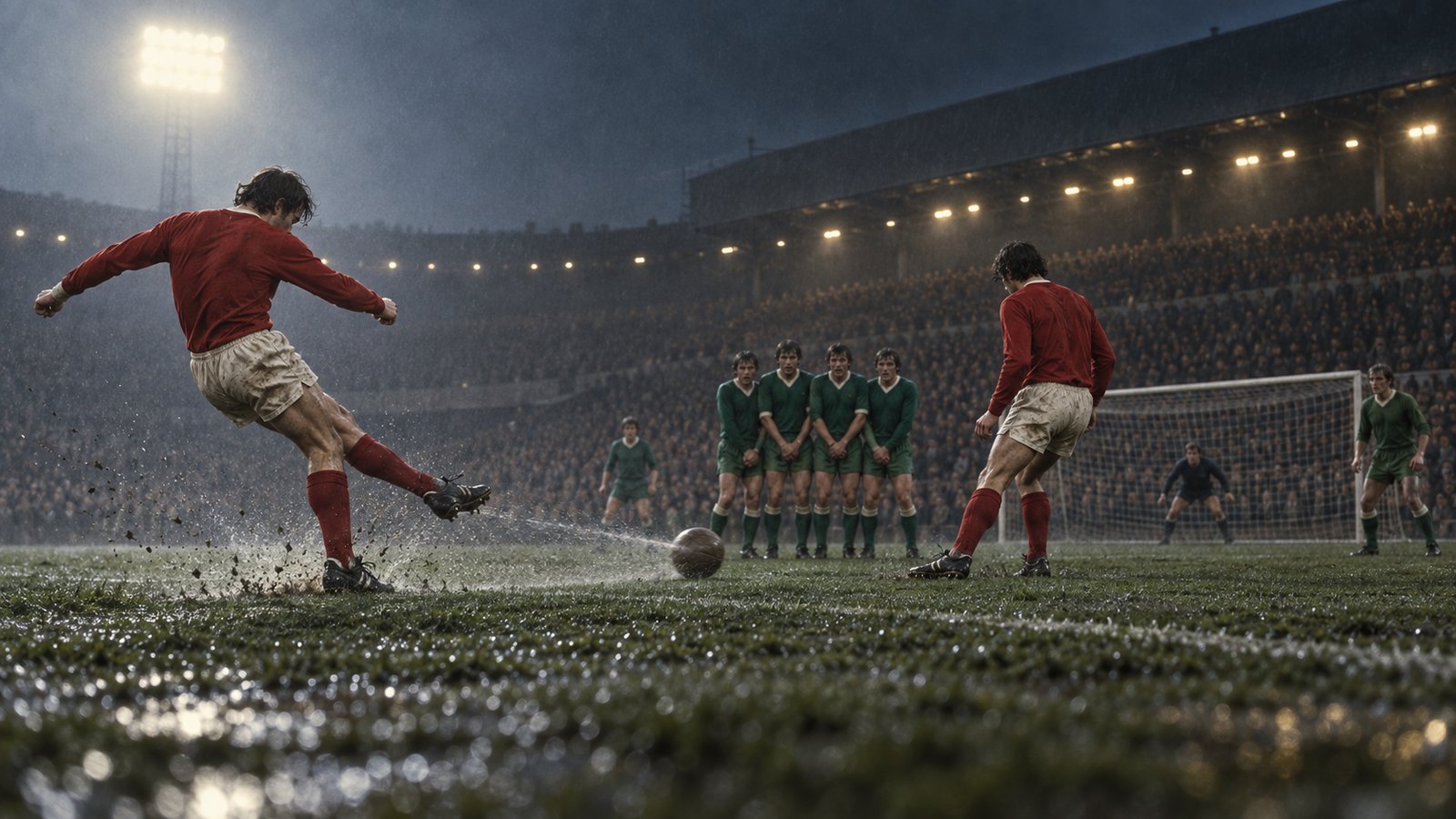
The teams returned with the score still 0–0. Bayern’s breakthrough did not come from a long siege. In the 57th minute, Piazza challenged Müller about 20 metres from goal, just to the left of the penalty arc. Palotai awarded the free-kick, giving Bayern a stationary ball close enough to threaten but at an angle that invited more than a direct shot.
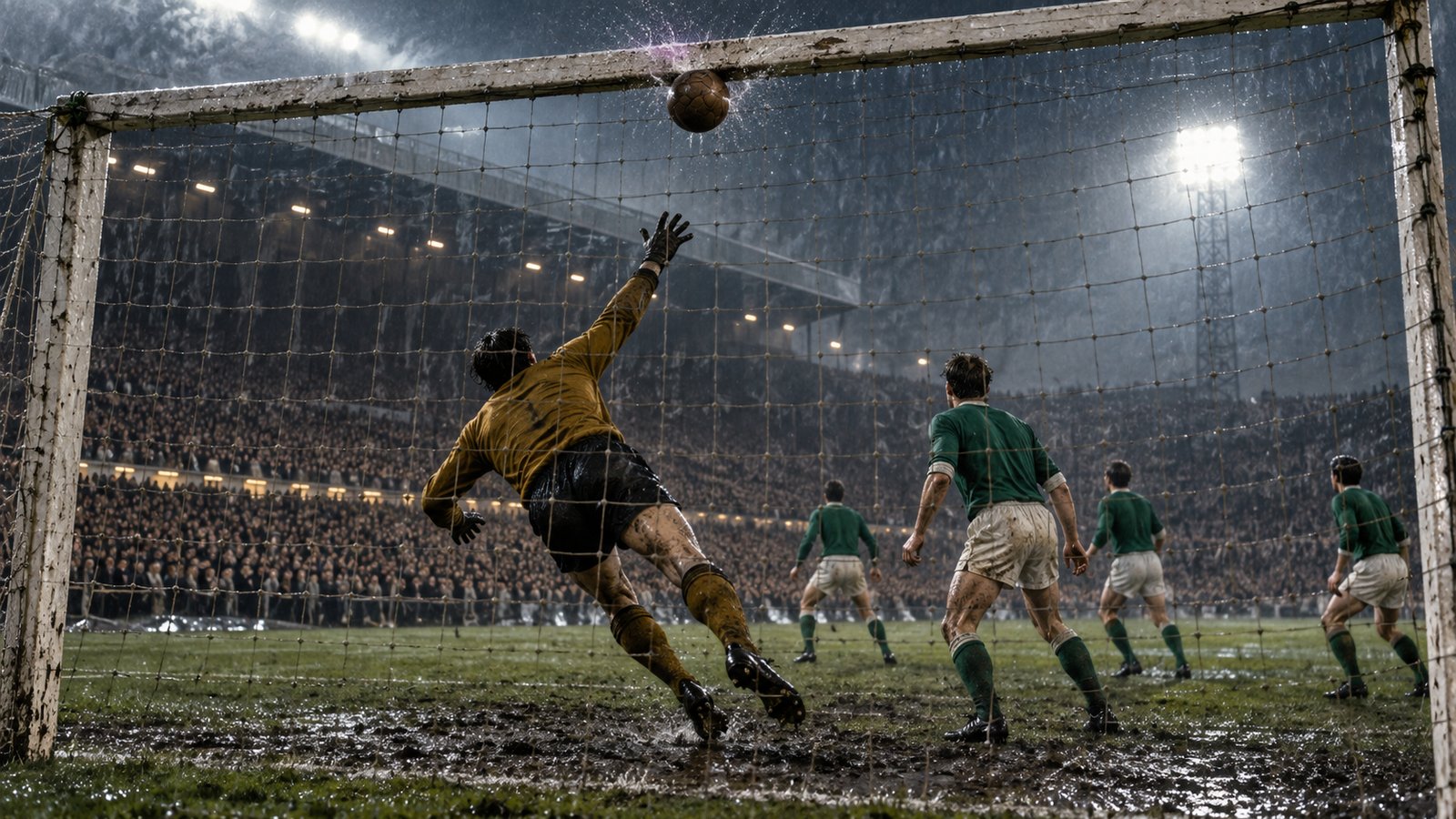
Beckenbauer stood over it. Instead of driving at goal, he nudged the ball to his right. Franz Roth met the short touch and struck toward the left side of Ćurković’s net. The move was brief enough to look simple after completion, but it changed the final’s balance: Saint-Étienne now had to recover against a side built around protecting a lead on Europe’s largest stage.
Roth’s goal also complicates the square-post story. The French side’s two first-half chances explain the ache of the defeat, but Bayern still had to produce the match’s only legal finish. Their advantage came from recognizing the free-kick’s angle, shifting the point of contact and giving Roth a clearer lane. One team’s near misses and the other’s execution can belong in the same account.
Herbin eventually sent on Dominique Rocheteau for Sarramagna in the 83rd minute. It was a late attempt to add a different attacker, not enough time to redesign the match. Bayern held the 1–0 score through the closing minutes. A final remembered for rebounds was decided by the one ball that stayed beyond the frame.
Bayern lifted a third cup while the losers received a victory parade
For Bayern, Hampden completed a run achieved by only two clubs before them. Real Madrid had built the competition’s first dynasty, and Ajax had won three straight from 1971 to 1973. Bayern followed with titles in 1974, 1975 and 1976. The narrow win over Saint-Étienne was the closing act, not an isolated surprise.
The French response produced a stranger image. On 13 May, Saint-Étienne’s players travelled along the Champs-Élysées and were received by president Valéry Giscard d’Estaing. ICI’s Radio France archive shows Ćurković and Gérard Farison riding in green Renault 5 cars, while Larqué signed autographs.
A supporter in the same archive remembered roughly 5,000 to 6,000 French fans waiting at the airport after the match. That recollection conveys the unusual public scale better than calling the team moral winners. The crowd knew the cup had gone to Munich. It celebrated a run that had moved from Copenhagen and Glasgow to a comeback against Kyiv, then finished inches from a different result.
The parade did not reverse the score. It established which parts of the campaign France intended to keep: the green shirts, the two rebounds, the journey to Hampden and the feeling that a club from Saint-Étienne had stood level with the European champions. Defeat supplied the wound; public reception made it communal memory.
“The square posts” survived because they hold two truths at once
Football history often sands a final down to its winner and scorer. This match resisted because its losing image was so physical. The phrase les poteaux carrés holds an argument in three words. Saint-Étienne were close enough to strike beyond Maier twice, unlucky enough to receive no goal, and memorable enough that the objects around those misses acquired a life of their own.
The phrase also leaves room for Bayern’s achievement when used carefully. Roth scored; Bayern defended the lead; the club completed three consecutive European Cups. Nothing about the bars removes those facts. Equally, listing the winner and scorer alone cannot explain why a defeated side travelled down the Champs-Élysées in green cars the next afternoon.
That tension is the final’s lasting shape. Saint-Étienne’s route had required an extra-time comeback from two goals down. At Hampden, two first-half rebounds replaced a lead. Bayern needed one short free-kick routine and the discipline to preserve its advantage.
The square frames became famous because they sit exactly between event and imagination. They are evidence of chances that happened, but they also invite a match that never did. Fifty years of retelling have not settled the angle of the rebounds. They have preserved something better: the sound of Saint-Étienne coming within one crossbar of changing Europe’s final.
Sources
UEFA match archive; Rec.Sport.Soccer Statistics Foundation; ICI and Radio France archive; Wikipedia’s 1976 European Cup final summary, used for the minute-by-minute crossbar sequence.