

Gunnar Nordahl’s Sweden career ends with a line that looks unfinished: 33 matches, 43 goals, and no caps after the age of 27. His last appearance came against Denmark in November 1948, three months after he had scored in an Olympic final at Wembley. He had not slowed down. He was about to become far more prolific on a larger professional stage.
The cutoff came because Nordahl crossed a boundary that Swedish football still treated as decisive. In January 1949, he left IFK Norrköping for AC Milan and became a professional. That move removed him from national-team selection under the policy then in force. Sweden lost the centre-forward who had scored seven times during its gold-medal Olympic campaign; Milan gained the striker who would score 210 Serie A goals.
This is a biography divided by one administrative choice. The same decision closed a yellow-and-blue shirt and opened a red-and-black one. Following the numbers across that divide reveals more than an exceptional scorer. Nordahl’s move showed what Italian clubs could find in Swedish football, encouraged a wider migration, and left one of Europe’s most efficient international careers permanently frozen.
A one-room childhood produced an unusually powerful forward
Nordahl was born in Hörnefors on 19 October 1921. FIFA’s biographical account places him in a family of ten children, sharing a one-room home with his parents and siblings. There was little money for equipment. Football entered his life at school, and by 16 he was playing senior matches for Hörnefors IF.
The early return was startling: 68 goals in 41 matches across three seasons. Degerfors brought him into Sweden’s top level, but his next move joined football to an ordinary occupation. IFK Norrköping helped secure him work as a firefighter. The detail matters because Nordahl’s Swedish success belonged to an amateur structure in which an elite player still needed a job outside the game.
His build did not resemble the modern stereotype of a darting penalty-area forward. FIFA lists him at 1.81 metres and 95 kilograms in 1944, while also emphasizing his heading and volleys. Strength gave him access to crowded spaces; timing let him finish before those spaces disappeared. In 1945 he scored seven times as Norrköping beat Djurgården 11–1.
Norrköping won four consecutive championships during his spell, and Nordahl finished as leading scorer in each of those seasons. The club had not simply found a large target near goal. It had found someone who could repeat the same essential action across years: read the defenders, reach the ball first, and turn a small opening into a shot.

Thirty-three Sweden appearances contained forty-three goals
Nordahl made his senior international debut against Denmark in Copenhagen on 28 June 1942 and scored. The rate barely softened. RSSSF’s match-by-match record gives him 43 goals in 33 appearances, an average of 1.30 per match. He scored against ten different opponents and produced four-goal and five-goal international games before his career reached its Olympic peak.
The London tournament in 1948 condensed his gifts into four fixtures. He scored twice in the 3–0 opening win over Austria, including two goals within ten minutes. Four more followed when Sweden beat Korea 12–0. Denmark resisted more effectively in a 4–2 semi-final, but Sweden still reached Wembley to face Yugoslavia.
Yugoslavia scored first in the final. Sweden recovered to win 3–1, and Nordahl supplied his seventh goal of the tournament before a crowd of more than 60,000. He finished as joint leading scorer and returned home with an Olympic gold medal. George Raynor, Sweden’s English coach, later remembered a forward who seemed born to score and possessed a special ability to locate space.
That observation is more useful than mythology about raw force. Nordahl’s international record was assembled through positioning as much as impact. Forty-three goals did not come from one generous tournament: 24 arrived in friendlies, 12 in Nordic Championship matches and seven at the Olympics. Different settings kept producing the same conclusion.
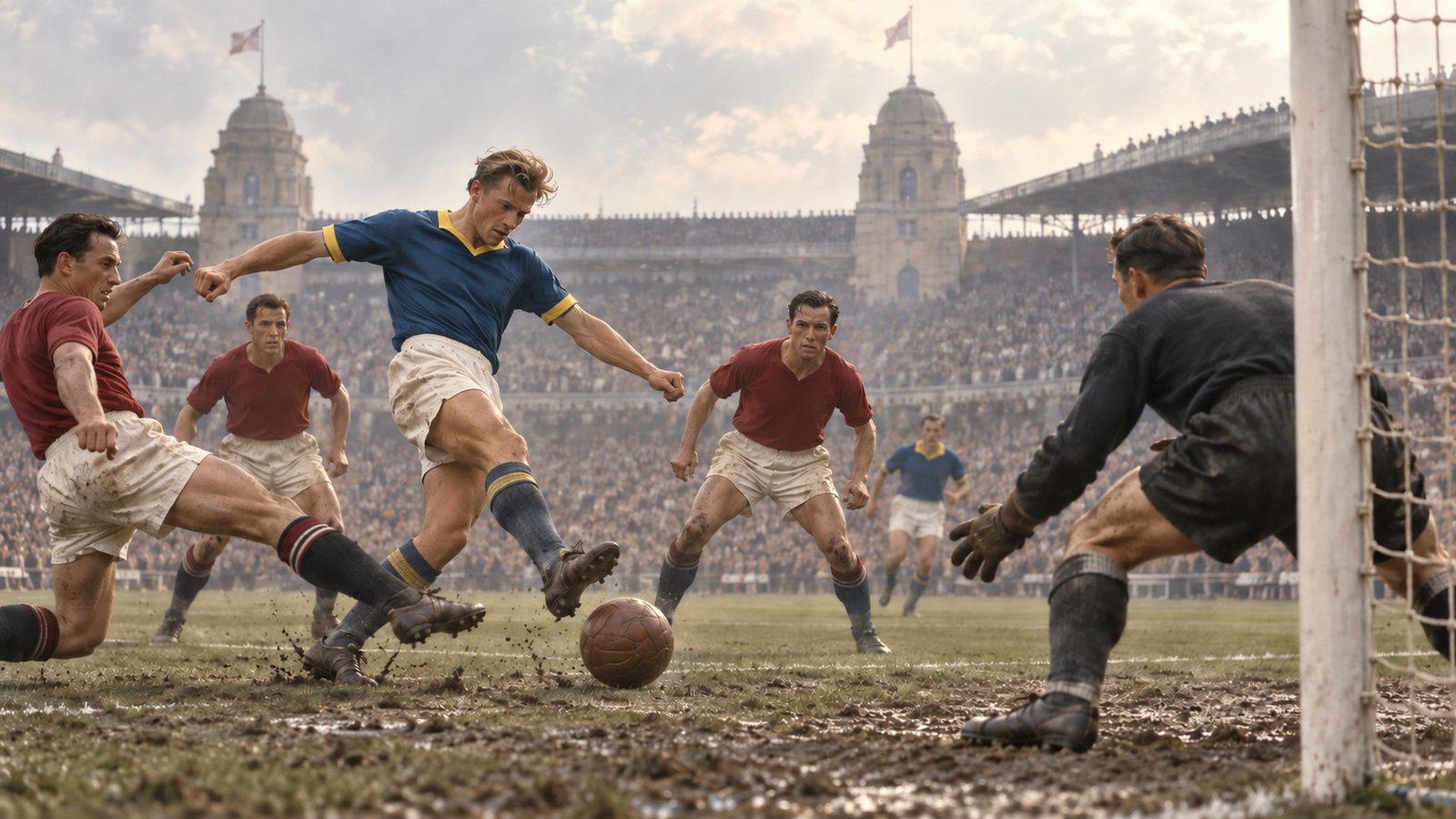
January 1949 exchanged international selection for a profession
AC Milan signed Nordahl from Norrköping in January 1949, only months after the Olympic victory. The personal transition was severe. FIFA recounts a firefighter leaving his colleagues and arriving in a city of tailored suits, expensive watches and unfamiliar expectations. Nordahl later admitted that he felt he had entered another world and wondered whether he could adapt.
He also became a test case. FIFA describes him as the first Swede to take up professional football. Under Sweden’s selection rules, accepting that status meant surrendering his place with the national team. His final cap had already occurred against Denmark on 14 November 1948. There was no ceremonial farewell and no decline to explain the ending.
The cost can be seen in Sweden’s next major results. Without him, the national team finished third at the 1950 World Cup. This does not prove where Sweden would have finished with Nordahl, and Raynor’s later confidence that the striker would have taken them farther remains an opinion. What is certain is that one of the world’s most productive forwards was ineligible while continuing to score for his club.
The bargain was therefore asymmetric. Milan could pay Nordahl to devote himself to football and use him every week. Sweden’s national side chose the amateur boundary over access to its leading scorer. Nordahl had not abandoned elite competition; he had entered its professional centre.
Milan measured adaptation one penalty area at a time
Nordahl’s first Milan goal came against Pro Patria. It began a total that the club records as 221 goals in 268 appearances across all competitions. In Serie A, he scored 210 times in 257 matches and finished as the division’s leading scorer in five seasons. The figures answer his private question about adaptation with unusual bluntness.
His success also changed recruitment around him. Gunnar Gren and Nils Liedholm followed to Milan, creating the Gre-No-Li trio. The names are often compressed into a charming label, but Nordahl’s first months gave the idea its proof. An Italian club had imported a Swedish Olympic champion at 27 and discovered that his scoring translated immediately.
Milan won two league championships during Nordahl’s years, ending a 44-year wait for the first of them. He did not provide every part of those teams, yet his repeatable work near goal gave their attack a dependable endpoint. Gren and Liedholm could connect phases; Nordahl made the final movement count.
There is a later echo in John Charles’s first season at Juventus. Both careers show Italian clubs looking beyond familiar markets for a physically imposing forward whose game contained more refinement than the body type suggested. Nordahl arrived earlier and, through the Swedes who followed, widened the route.
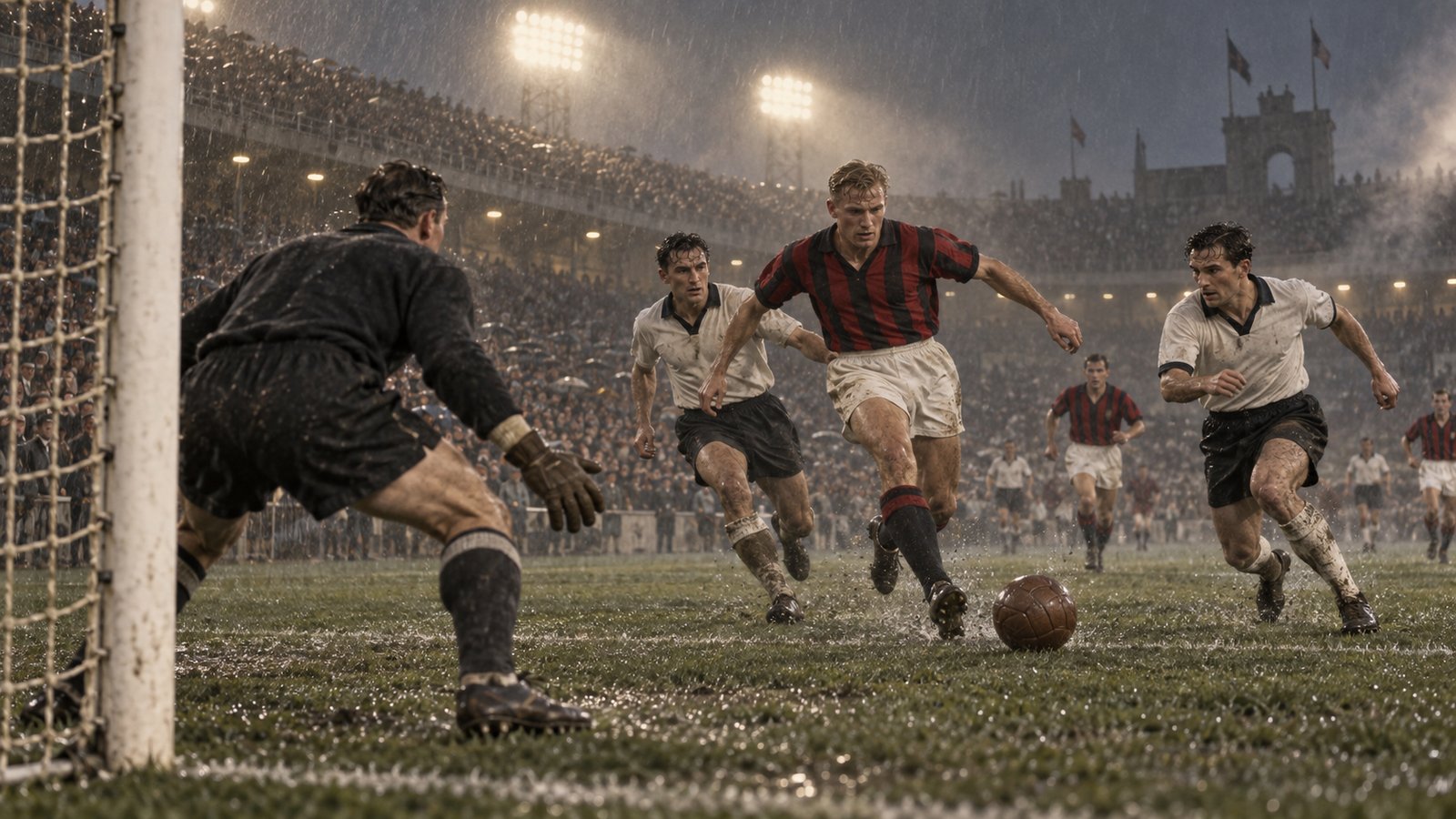
The missing Sweden years sharpen the scale of the Milan years
Nordahl spent seven years with Milan before moving on. His club still identifies him as its most prolific scorer. The durability of that record is remarkable, but the empty national-team column after 1948 gives it a different weight. Every Milan goal arrived during a period when Sweden would not select him because he had become a professional.
It is tempting to treat the policy as merely old-fashioned and move on. The human sequence deserves more attention. In August, Nordahl scored in an Olympic final. In November, he made his 33rd international appearance. In January, he crossed into paid football. Then the international record stopped while the club record accelerated.
That break also prevents a tidy total-career celebration. Nordahl’s 43 Sweden goals cannot be presented as the complete international output of his prime. They are the output available before a rule intervened. His 210 Serie A goals are not a second chapter after decline; they are evidence of how much peak football remained.
Nordahl’s story survives in two sets of numbers that refuse to fit comfortably together. Forty-three in 33 describes a national striker at extraordinary speed. Two hundred and ten in 257 describes sustained production in Italy. The line between them was neither injury nor lost form. It was the moment a firefighter from Norrköping accepted football as his full-time work.
Sources
FIFA; AC Milan; Rec.Sport.Soccer Statistics Foundation.