
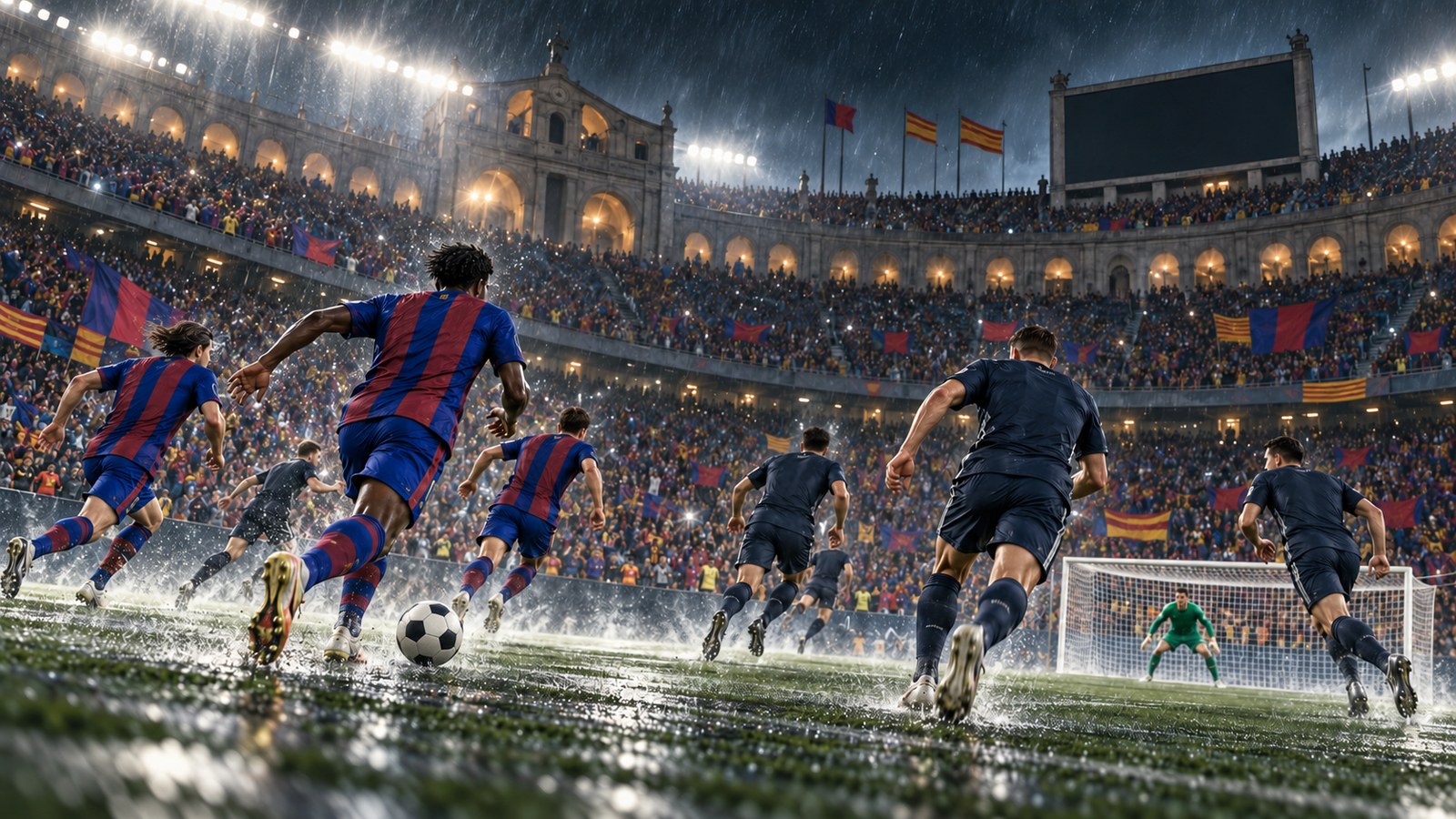
With four minutes of normal time left at Camp Nou, Barcelona’s task had become absurdly precise. They had already scored three times against Paris Saint-Germain, yet Edinson Cavani’s away goal meant the scoreboard still demanded three more. One goal would decorate a failed comeback. Two would produce a famous victory on the night and elimination from the tie. Only three would send Barcelona through.
The next sequence lasted barely seven minutes. Neymar bent in a free-kick, converted a penalty and then lifted one final ball into a crowded area. Sergi Roberto reached it in the fifth minute of stoppage time. Barcelona had moved from 3–1 to 6–1 after the 87th minute, winning the tie 6–5 on aggregate.
The comeback is often remembered as a single eruption. Its real tension came from a changing equation. Every goal altered the required risk, and Cavani’s strike made Barcelona’s early work almost worthless. The closing minutes mattered because the team had to restart its own impossible chase three separate times.
A four-goal deficit set the terms before kick-off
PSG had won the first leg 4–0 in Paris on 14 February 2017. Barcelona therefore entered the return on 8 March 2017 needing at least four unanswered goals merely to force extra time. An away goal for PSG would raise the requirement to six because the away-goals rule was still in force.
Luis Enrique arranged Barcelona to live near PSG’s penalty area. A three-man defensive line held the halfway zone while the wide players advanced. The shape was less a normal starting formation than a declaration of where the match had to be played. Barcelona could not spend long building patient attacks from deep. It needed recoveries close to goal, repeated deliveries and enough bodies around every second ball to keep the pressure from resetting.
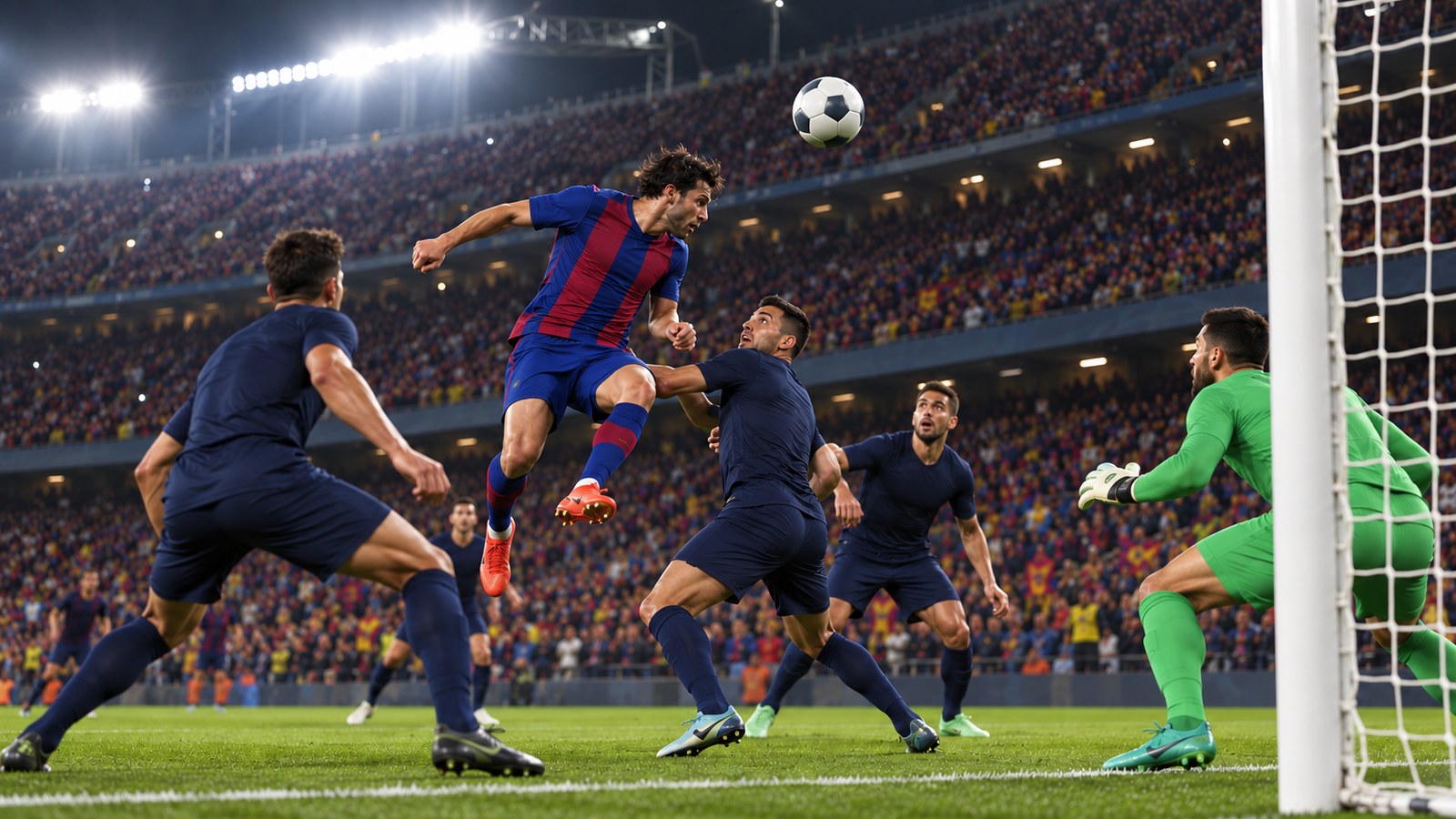
The first reward arrived after three minutes. Luis Suárez attacked a loose ball near the goalmouth and headed it over the line. The finish did not erase much of the aggregate gap, but its timing changed the sound inside Camp Nou. A crowd of 96,290 no longer had to imagine a perfect opening. It had seen one.
PSG’s problem was psychological as well as tactical. Unai Emery’s side had four goals of protection, but protecting them meant deciding when to step forward and when to retreat. Each retreat allowed Barcelona to recover possession closer to the penalty area. Each attempt to break out exposed space behind the first receiver if the pass failed.
The first fifty minutes reduced four goals to one
Barcelona’s second came in the 40th minute. Andrés Iniesta kept a difficult move alive near the byline, and the ball eventually crossed the line off Layvin Kurzawa. The goal was officially an own goal, but its value came from persistence: Barcelona had forced another action in the narrow strip where defenders could not clear cleanly without turning toward their own net.
Five minutes after half-time, the referee awarded Barcelona a penalty and Lionel Messi converted it. The score was 3–0 on the night. A tie that had required four goals now required only one more, and there were roughly forty minutes left to find it.
This was the point at which the comeback seemed to acquire a clean script. Score early, reach half-time with momentum, strike quickly after the interval and let the stadium carry the last push. Yet the away-goals rule made that script fragile. PSG did not need to control the match for long. It needed one successful attack.
Cavani had already reminded Barcelona of that threat by finding space in the penalty area. In the 62nd minute, he finished decisively. PSG’s players ran toward the corner while the arithmetic changed at once: 3–1 on the night, 5–3 to PSG on aggregate, and Barcelona now needing three more goals rather than two. The early surge had taken an hour to construct. One away goal forced the home side to begin another climb.
Cavani’s goal made every Barcelona attack more dangerous
There was no safe version of the remaining match. Barcelona had to push more players forward, which left PSG with clearer space whenever it escaped. A second PSG goal would have ended any realistic argument. Cavani’s first had already placed Barcelona in a position where conceding and failing to score carried almost the same practical result.
That changed the texture of possession. The home side could no longer wait for a perfect passing lane. Crosses, ricochets and set pieces became useful because each one shortened the time before another attempt. PSG, meanwhile, could see the clock moving in its favour. The visitors had reached the Champions League quarter-finals in each of the previous four seasons. With the score still 3–1 deep into the second half, that run appeared ready to continue.
The crowd’s role also changed. Early noise had celebrated progress. Later noise had to resist the evidence on the clock. By the 87th minute, Barcelona still required three goals. The famous late turn began from a dead ball, which gave Neymar one controlled strike amid the disorder.
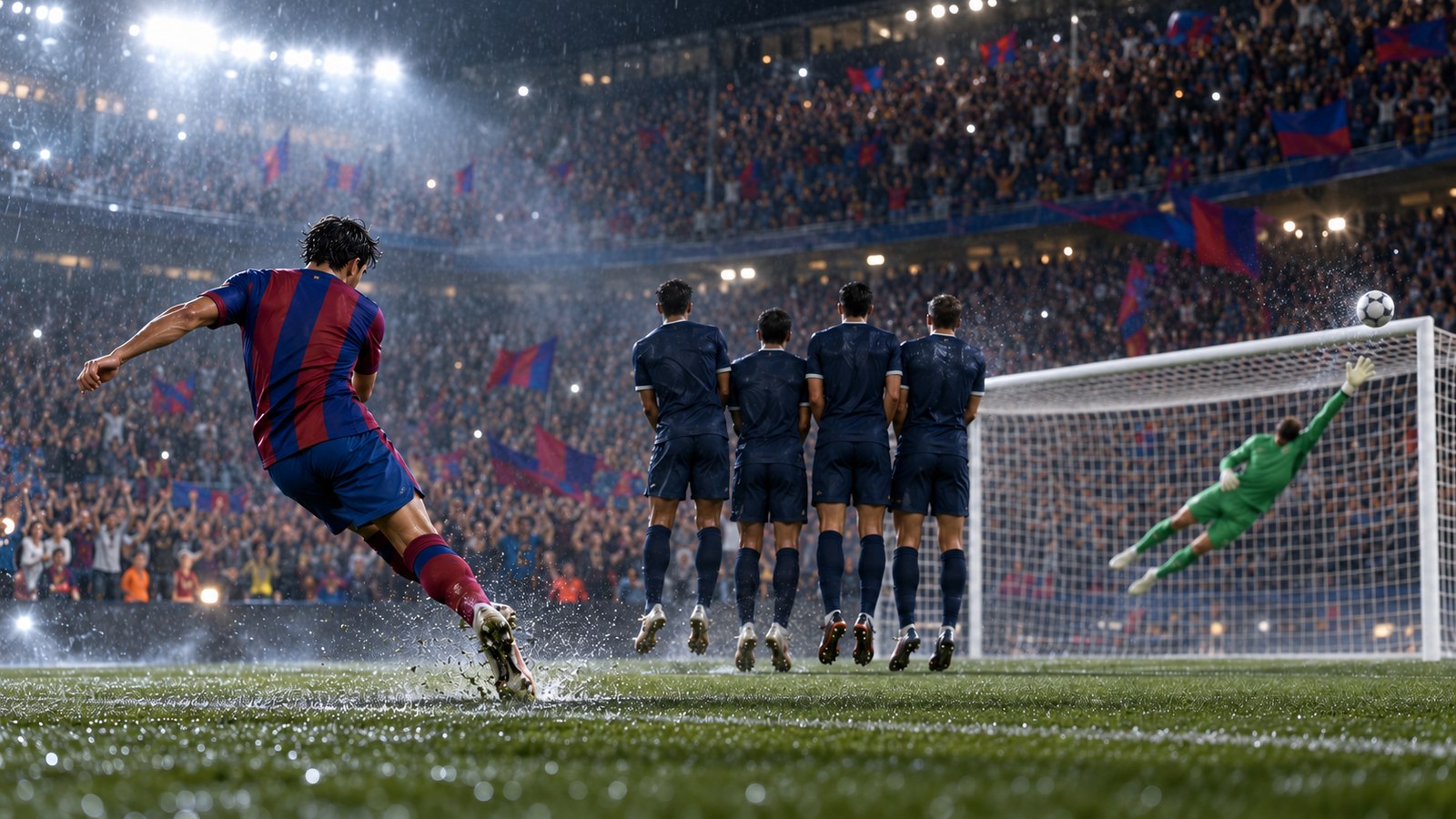
His free-kick in the 88th minute bent beyond the goalkeeper. It was an outstanding goal, but it did not yet create a narrow finish. Barcelona still needed two. The players retrieved the ball because celebration time had become part of the calculation.
Neymar reopened the tie twice in four minutes
The next opening came in stoppage time when Barcelona were awarded another penalty. Neymar took responsibility and scored in the first added minute. The score was 5–1 on the night and 5–5 on aggregate, but PSG still led on away goals. Barcelona had completed the visible part of the comeback and remained eliminated.
That detail separates the match from a conventional late winner. Neymar’s penalty did not equalise the tie in a usable sense. It purchased one final attempt. PSG could not treat 5–1 as a score to defend through another phase of ordinary possession; Barcelona could not accept it as the emotional summit. The ball had to return to play immediately.
The sequence resembles the compressed finale of Manchester United’s 1999 final against Bayern, but the scoreboard pressure was different. United needed one goal to force extra time and another to win. Barcelona’s fifth still left it behind. Every player in the final attack knew that a sixth was the only result with value.
PSG attempted to clear and Barcelona recycled possession. Goalkeeper Marc-André ter Stegen had moved far from his own area, another body committed to keeping the attack alive. The field had effectively collapsed toward one penalty box. There was no meaningful defensive shape left to preserve because there was almost no match left after the next clearance.
Sergi Roberto arrived for the only touch that counted
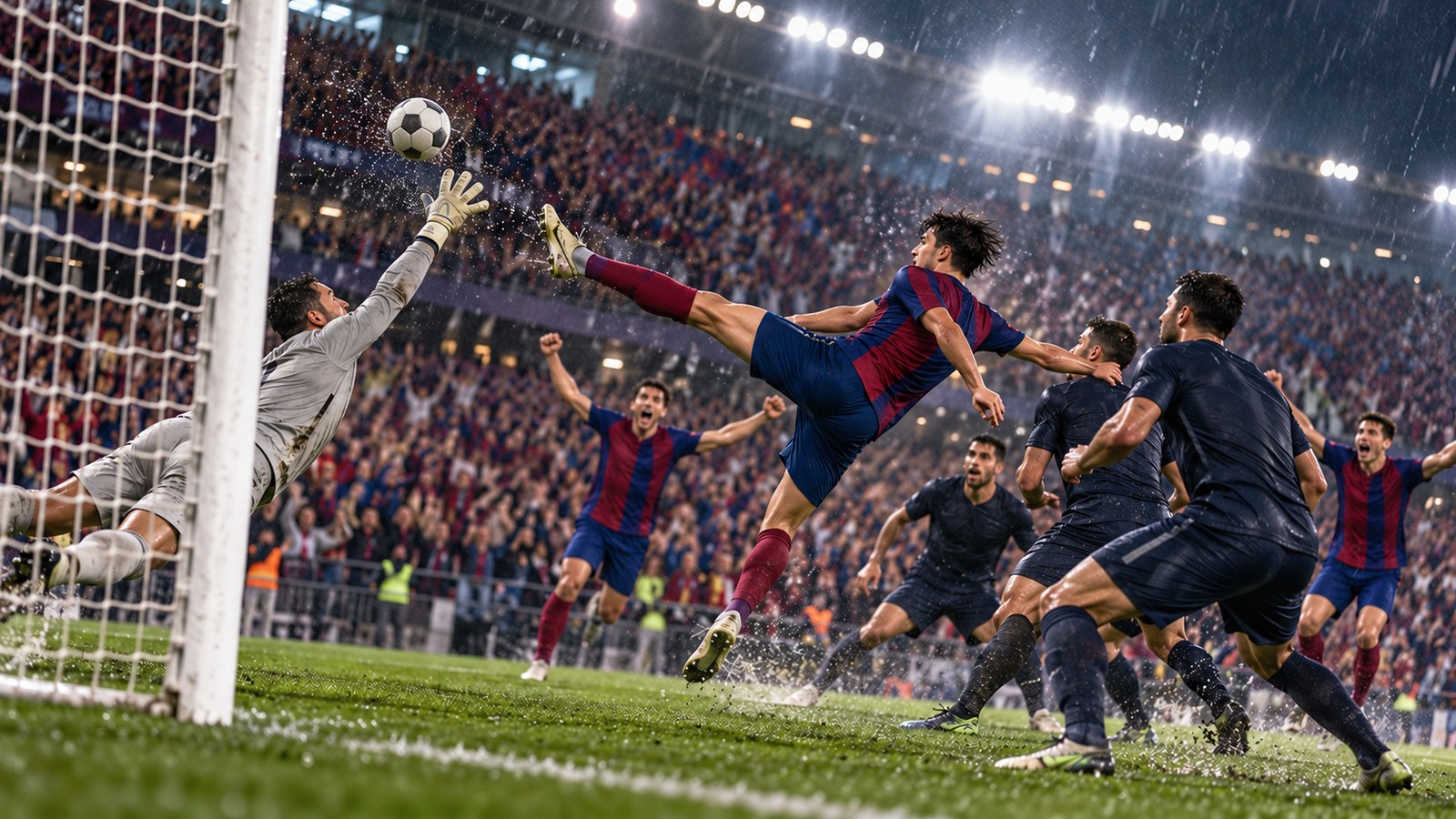
Neymar received the ball again and lifted a measured delivery over the first line of defenders. Sergi Roberto, introduced as a substitute, ran from outside the immediate crowd. He stretched his right leg toward the dropping ball and redirected it past the goalkeeper in the fifth minute of stoppage time.
The finish made it 6–1. Barcelona had won 6–5 on aggregate and became the first team in Champions League history to overturn a four-goal first-leg deficit. Roberto’s touch also completed an unusual distribution of responsibility: Suárez had started the chase, pressure had forced Kurzawa’s own goal, Messi had scored from the spot, Cavani had reset the problem, and Neymar had produced two goals plus the final delivery.
The stadium reaction obscured the pitch. Players, substitutes, staff and photographers converged while supporters leaned over barriers. Roberto disappeared under teammates. The scene was chaotic because the final goal had removed the need for any further calculation. For almost the entire match Barcelona had been scoring toward a condition. The sixth was the first goal that actually satisfied it.
There is a useful contrast with Michael Thomas’s title-winning stoppage-time goal at Anfield. That finish answered one clear requirement at the last possible moment. Barcelona’s ending required the condition to be rebuilt after Cavani scored, then approached through three late actions without room for a failed restart.
The 6–1 survives because it joined spectacle to arithmetic. Barcelona did not merely score three late goals. It scored one to make the impossible visible, another to earn a final attack, and a third to turn a victory on the night into survival in the competition. Seven minutes held three different versions of the same match.
Sources
BBC Sport; UEFA match records.