
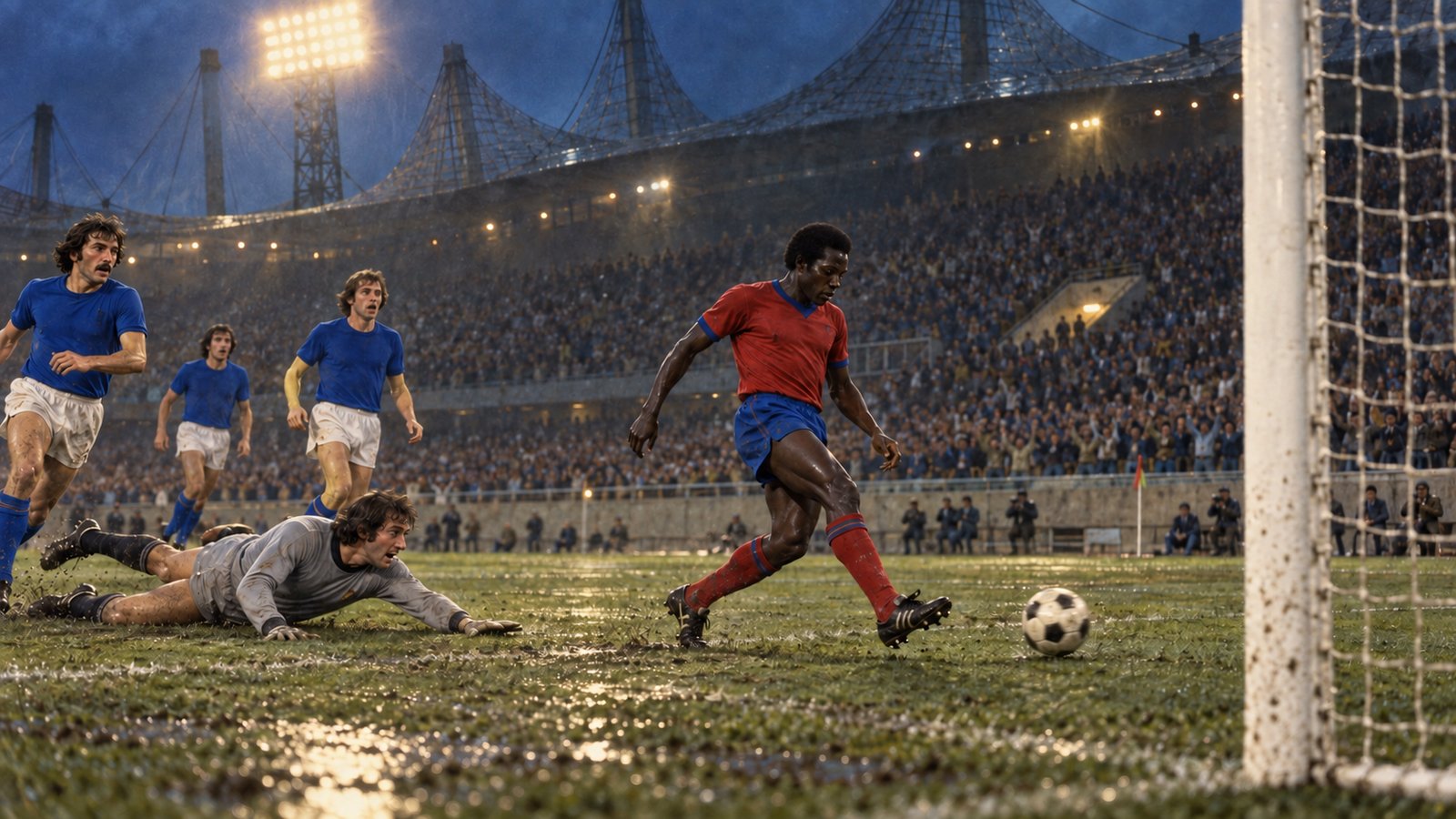
For one minute in Munich, the scoreboard held an impossible-looking order: Haiti 1, Italy 0. The clock had just entered the second half of Haiti’s first World Cup match when Philippe Vorbe released Emmanuel Sanon through the middle. Sanon outran Luciano Spinosi, carried the ball around Dino Zoff and finished into the open goal.
The moment was startling before anyone counted the minutes behind it. Italy had arrived as the 1970 World Cup runner-up, and Zoff had gone 1,142 minutes without conceding an international goal. Haiti were appearing at the tournament for the first time. Yet the run ended not through a scramble or a deflection, but through a clean pass, a forward’s composure and a finish in the 46th minute.
Italy recovered to win 3–1, and Haiti lost all three group matches. Sanon’s goal was the visible point of a longer Caribbean campaign built in Port-au-Prince and carried to Europe. Following that route explains why a losing match could become a national football memory.
Port-au-Prince hosted the road that carried Haiti to Germany
Haiti did not reach the 1974 finals through an invitation or a single upset. Their route began with two emphatic qualifying victories over Puerto Rico in April 1972. Sanon scored three times in a 7–0 home win and another three in a 5–0 away win. Those six goals brought Haiti into the final CONCACAF round with its attacking reference already established.
The decisive competition was staged in Port-au-Prince in December 1973. Six teams played a round-robin tournament that doubled as the regional championship and World Cup qualification. Every result belonged to a compressed contest for one place in Germany.
Haiti opened by beating the Netherlands Antilles 3–0, with Sanon scoring twice. He added another goal in a 2–1 victory over Trinidad and Tobago. A 1–0 win against Honduras followed, then Sanon scored twice as Guatemala were beaten 2–1. By the time Mexico defeated Haiti 1–0 in the last fixture, the accumulated work had already delivered qualification.
Sanon’s individual return across the two-stage route was not incidental. His match record shows six goals against Puerto Rico and five during the final round. Haiti had a team capable of protecting narrow leads, but their place at the World Cup was also secured by a forward who repeatedly converted the region’s biggest matches into goals.
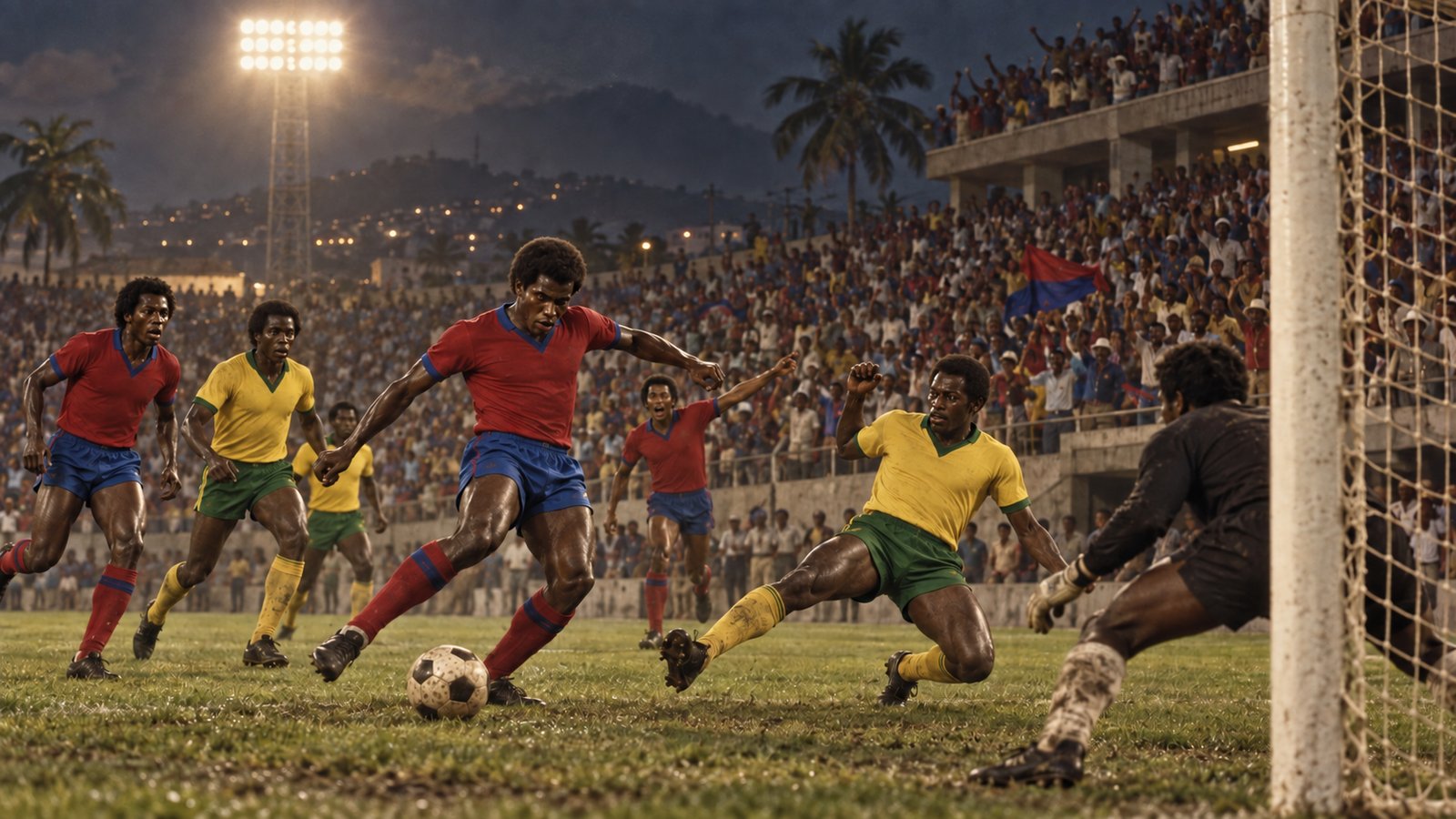
One pass put Sanon between Italy’s defence and its record
The draw in West Germany offered no gentle introduction. Haiti entered a group with Italy, Argentina and Poland. Italy were twice world champions and had reached the previous final. Poland were the reigning Olympic champions and would finish third in this tournament. Argentina possessed a familiar weight even before hosting the competition four years later.
Haiti’s opening task was Italy at Munich’s Olympiastadion on 15 June. The official match record lists a crowd of 53,000. Antoine Tassy’s side survived the first half without conceding, a significant achievement against a lineup containing Giacinto Facchetti, Sandro Mazzola, Gianni Rivera and Gigi Riva.
Then the match changed immediately after the restart. Vorbe’s pass was early enough to catch Italy before its defensive shape settled. Sanon’s run took him beyond Spinosi and toward Zoff, whose long unbeaten sequence gave the confrontation an extra layer only after the move had begun. The goalkeeper advanced. Sanon shifted around him and rolled the ball into a net that no international opponent had reached for 1,142 minutes.
The action lasted seconds, but each part mattered. Vorbe saw the lane before it closed. Sanon trusted his pace rather than checking back. At the final obstacle, he retained enough balance to evade rather than shoot through Zoff. Haiti’s first World Cup goal was constructed by two players making exact decisions under the brightest pressure they had faced.
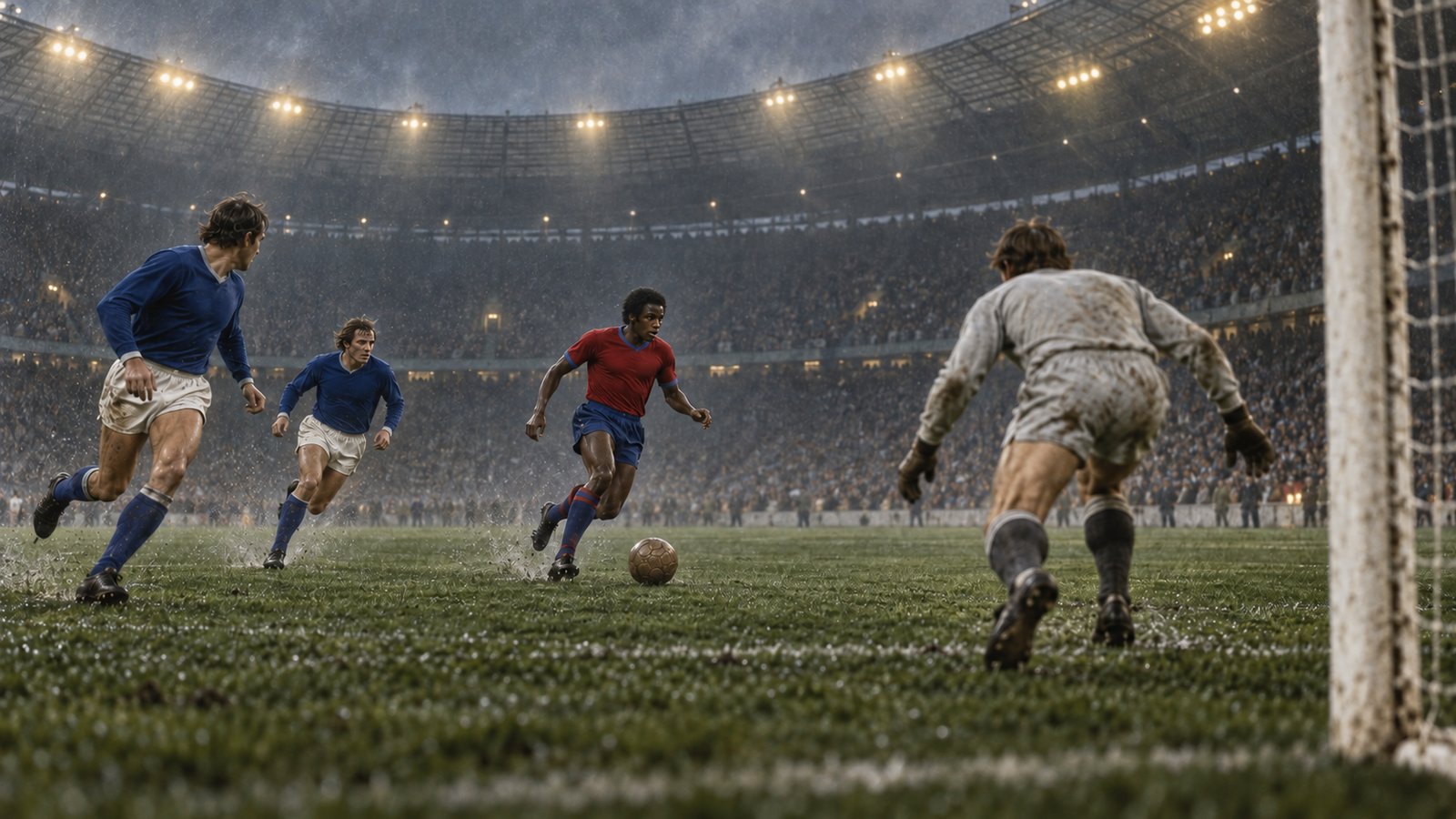
Italy needed six minutes to begin taking the match back
The lead did not survive, but it did force Italy to answer it. Rivera equalised in the 52nd minute, six minutes after Sanon’s goal. The match record then credits Italy’s second as an own goal by Arsène Auguste in the 66th minute, before substitute Pietro Anastasi made it 3–1 in the 79th.
That sequence resists two easy versions of the story. Haiti were not close to winning simply because they scored first; Italy controlled the result once the equaliser arrived. But the goal was not an empty flourish inside an immediate rout either. Haiti held the four-time frame of the match—level through the first half, ahead after the interval, then level again—before Italy finally established separation.
For Zoff, the concession ended a run described by France Football as 19 official matches without allowing a goal. For Sanon, it placed a specific piece of movement inside World Cup history. The record gave the finish global scale, but the finish deserved attention without it. A debutant side had opened Italy by passing through the central lane and beating the goalkeeper one-on-one.
The photographs and retellings naturally stop at Sanon’s celebration. The scoreboard continued. That tension is the reason the scene endures: its emotional truth does not require pretending the final result was different. Haiti had briefly changed the terms of a match it eventually lost.
Two heavier defeats revealed what the opening goal could not solve
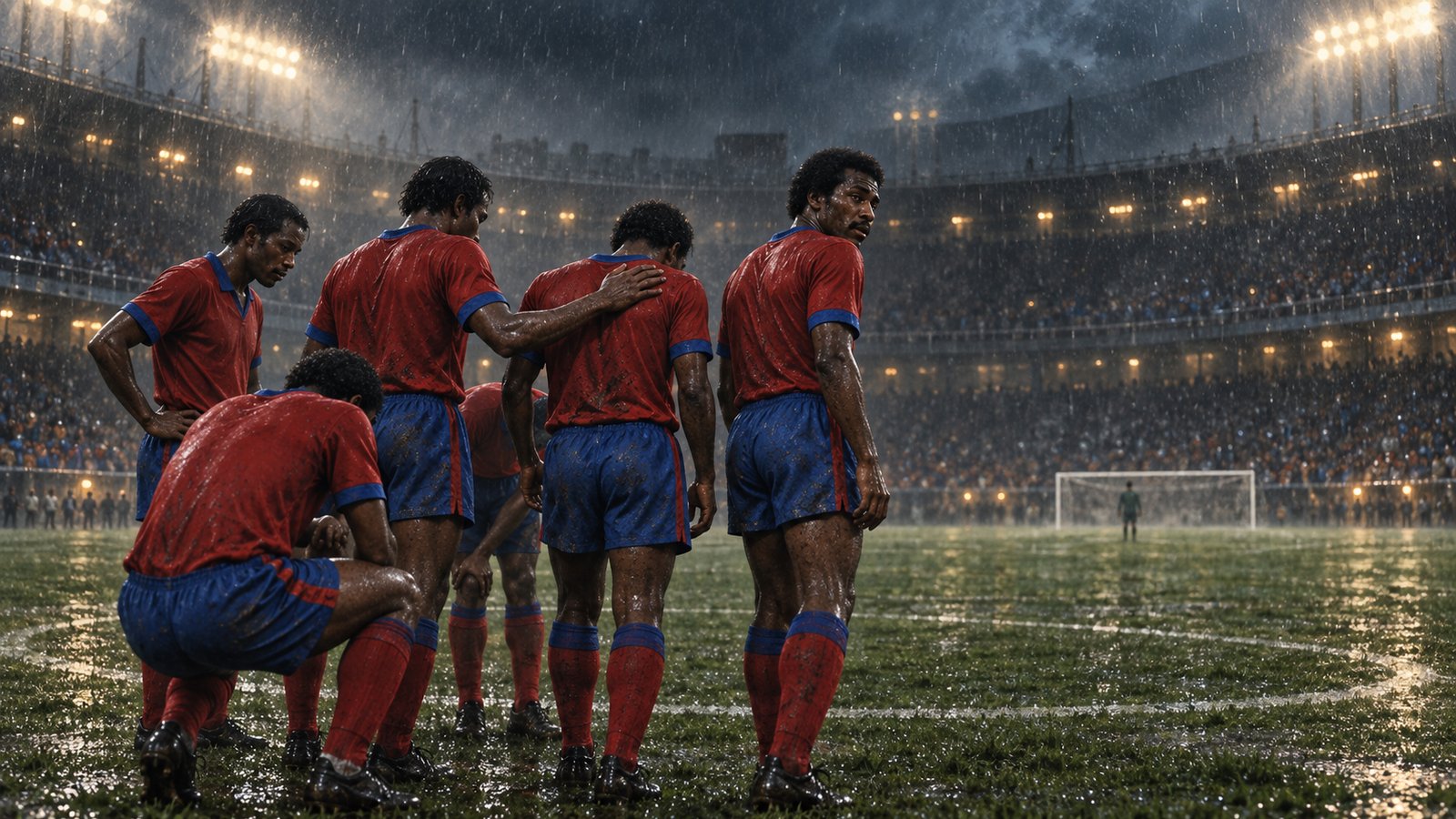
Four days later, Poland beat Haiti 7–0. Grzegorz Lato scored twice, Andrzej Szarmach three times, and the match was already 5–0 at half-time. The margin exposed the difficulty of recovering inside a short tournament while facing one of its strongest teams. Haiti’s first-match resistance could not simply be reproduced by will.
The final group game brought Argentina. Sanon scored again in the 63rd minute, reducing the score to 3–1 before Argentina completed a 4–1 victory. Haiti therefore finished with three defeats, two goals scored and 14 conceded. Both Haitian goals belonged to Sanon.
Those numbers prevent sentiment from replacing analysis. Haiti did not secretly master the group, and one famous finish did not remove the competitive gap. The more interesting truth is that the side produced recognizable attacking quality inside that gap. Sanon scored against two major South American and European opponents because Haiti could still create a route to him.
The experience also belonged to a wider 1974 story about teams entering unfamiliar World Cup space. Zaire’s tournament is often reduced to a single free-kick incident, even though its players carried a more complicated football history. Mwepu Ilunga’s own account of that moment shows how quickly an outsider’s tournament can be compressed into one image. Haiti’s record deserves the same care: Sanon’s goal matters most when the qualifying work and difficult matches around it remain visible.
Sanon carried Munich into a six-season life in Belgium
The tournament changed Sanon’s club path. La Libre’s account says Beerschot noticed him after the World Cup and brought him to Antwerp. He spent six seasons at the club, making 142 appearances and scoring 43 goals. The forward remembered for escaping Italy’s defence later adapted to a different league and, under coach Rik Coppens, even played as an attacking right-back.
His Belgian chapter produced another precise contribution. In the 1979 Belgian Cup final, Sanon made the run and pass that allowed Johan Coninx to score the only goal against Club Brugge. Five years after becoming Haiti’s finisher in Munich, he supplied the decisive final ball for a club trophy.
Sanon’s international record extended well beyond 1974. The statistical archive credits him with 66 appearances and 37 goals from 1970 to 1981. Yet the two World Cup goals occupy a separate place because Haiti have not added another men’s finals appearance. France Football notes that he returned home as a hero and was later given national recognition; after his death in 2008, he received a state funeral.
That legacy begins with a scoreboard but does not end there. The 46th-minute goal joined a successful qualifying campaign to a career that moved through Haiti, Germany and Belgium. Zoff’s 1,142-minute run supplies the famous number. Sanon’s value lies in the football around it: the repeated qualifying goals, Vorbe’s pass, the touch around the goalkeeper and the nerve to make Haiti’s first World Cup moment look entirely deliberate.
Sources
FIFA Match Centre; Rec.Sport.Soccer Statistics Foundation; France Football; La Libre Belgique.