
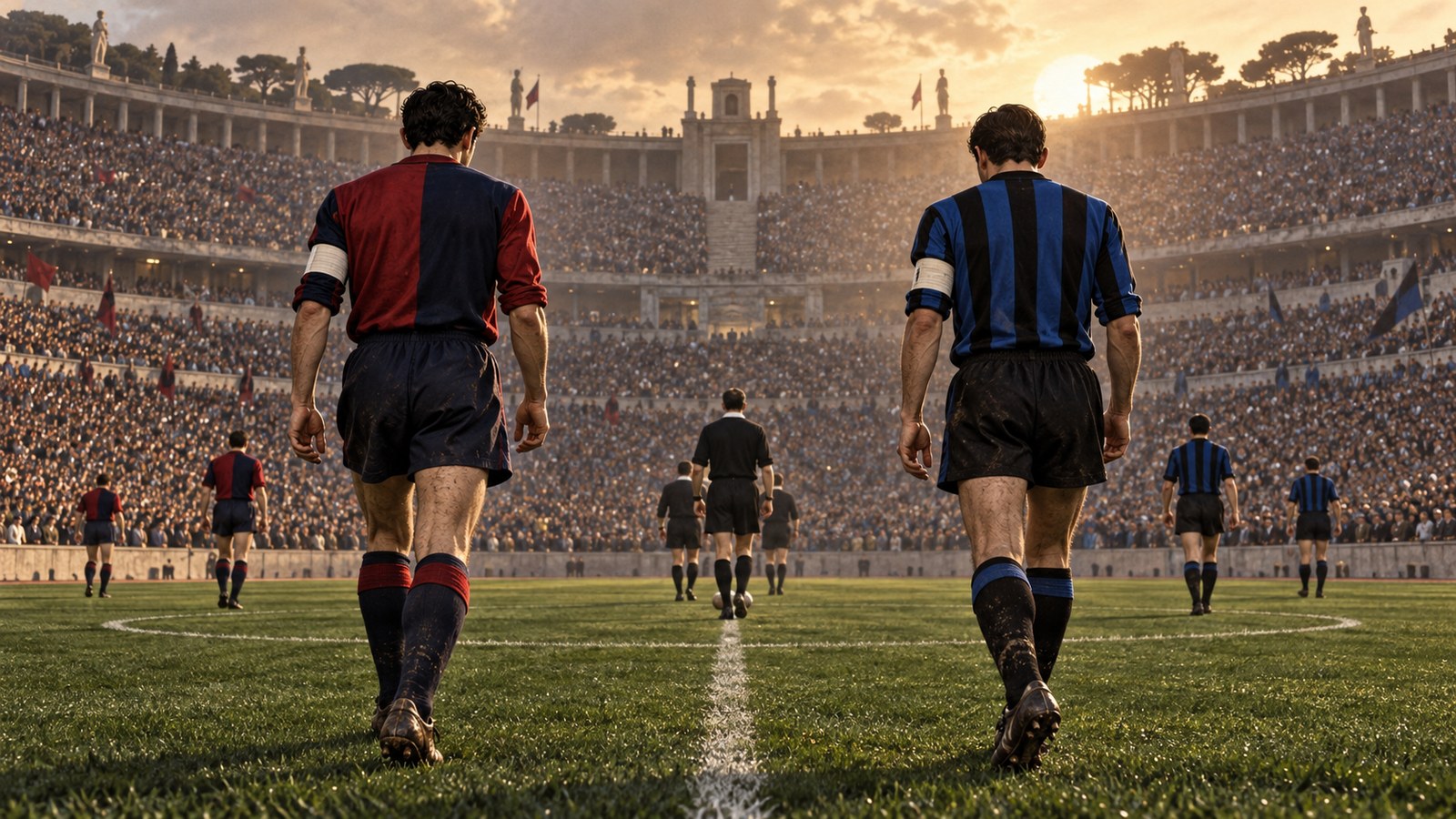
Four days before Bologna played the only championship playoff in Serie A history, the club lost the man who had led it for three decades. President Renato Dall’Ara suffered a fatal heart attack during a meeting at the Italian federation’s offices. The meeting concerned the title decider against Inter. Bologna’s players travelled to Rome carrying a season of suspicion, reprieve and grief into one final match.
The table had refused to separate the teams. Bologna and Inter completed the 1963–64 league season level on 54 points, so the championship could not be awarded by the usual standings. On 7 June 1964, they met at the Stadio Olimpico. Inter arrived as the newly crowned European champion. Bologna had not won Serie A since 1941.
For 74 minutes, the playoff remained scoreless. Then Giacinto Facchetti diverted the ball into his own net. Harald Nielsen added the second seven minutes later. Bologna won 2–0, and an extraordinary title race ended with the trophy returning to a city that had spent the spring wondering whether its challenge would survive at all.
A Seven-Point Lead Disappeared Before the Finish
Fulvio Bernardini’s Bologna had balance rather than a single trick. Giacomo Bulgarelli supplied intelligence in midfield, German international Helmut Haller carried the ball with purpose, and Danish forward Harald Nielsen gave attacks a hard edge. Nielsen finished as the league’s leading scorer with 21 goals. Around them, William Negri, Francesco Janich, Romano Fogli, Marino Perani and Ezio Pascutti made a side capable of winning without abandoning control.
The season developed into a contest with Helenio Herrera’s Inter. Bologna opened a seven-point advantage, a significant margin in an era that awarded two points for a win. Inter nevertheless kept closing. Herrera’s side combined a guarded defensive structure with the running of Facchetti, the authority of Armando Picchi, the passing of Luis Suárez and the goals of Sandro Mazzola and Jair.
By the end of 34 matches, each club had 54 points. Inter had scored 54 league goals and conceded 21; Bologna had scored 54 and conceded 18. The regulations required a deciding match. Goal difference could describe the season, but it could not crown the champion.
The playoff therefore gave Italian football something it had never used for the Serie A title. A neutral ground in Rome would turn a campaign stretching from September to May into 90 minutes. Inter’s European Cup success over Real Madrid on 27 May added another contrast: one side arrived with the continent’s largest club prize already secured, while the other was trying to recover a domestic identity last confirmed before the war.
Bologna Had Already Won Back Three Deducted Points
The tie at the top had nearly been prevented by events away from the pitch. In March, five Bologna players were accused of doping after tests connected to the win over Torino. The club received a three-point penalty. For a leader in a close title race, the punishment threatened to remove the championship before the final round.
Bologna challenged the case. The deduction was eventually overturned and the three points restored, returning the team to the title contest. The reversal did not erase the disruption. Players had competed under public accusation, and the table changed while the campaign was in progress. The championship was no longer merely a pursuit of Inter; it had become an argument over whether Bologna’s results would be allowed to stand.
That experience sharpened the meaning of the playoff. Bologna had twice reached apparent endings: first when the penalty damaged its position, then when the ordinary league schedule finished without a champion. Each time, another stage followed. The team that went to Rome had learned to continue after a verdict that looked final.
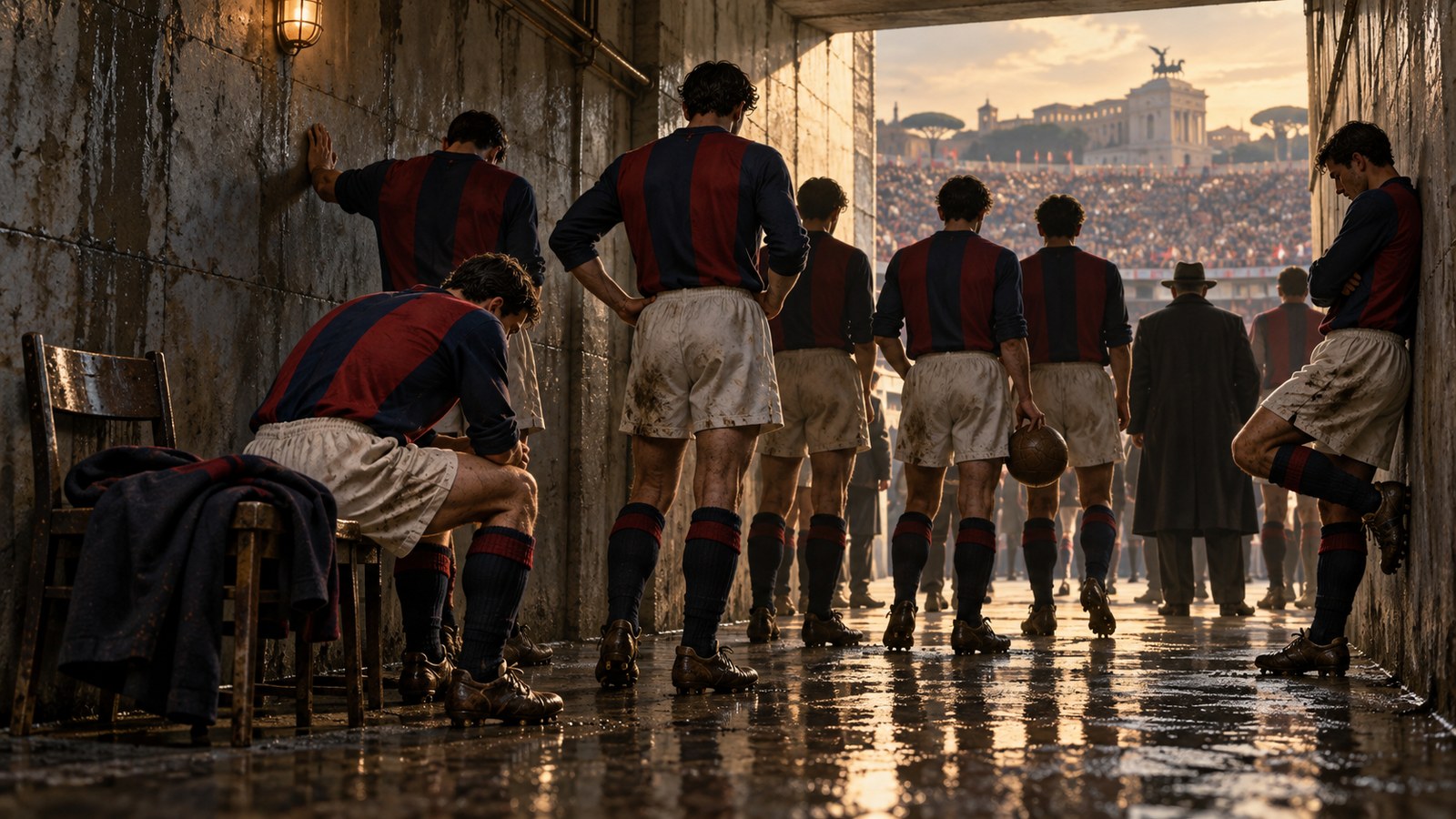
Dall’Ara Died While the Decider Was Being Arranged
Renato Dall’Ara had become Bologna’s president in 1934. His tenure covered the club’s great pre-war championships and the long effort to return. By 1964, he had occupied the office for 30 years. His name was attached to the institutional memory of the team as firmly as any player or coach.
On 3 June, Dall’Ara met Inter president Angelo Moratti at the league’s headquarters in Milan to discuss arrangements for the playoff. During the meeting, Dall’Ara suffered a heart attack and died. The title match was four days away, with the team suddenly deprived of the president who had overseen its journey back to the summit.
The timing changed the emotional shape of the game. Bologna was no longer only attempting to end a 23-year wait. The players were appearing immediately after a death within the club’s leadership. There was no long interval in which grief could settle into commemoration. Training, travel and selection continued because Rome and Inter were already waiting.
Football often turns loss into simple motivational language, but the circumstances were less tidy. Dall’Ara could not know the result of the meeting’s purpose. Bernardini still had to prepare a tactical plan against Europe’s champion. The players still had to manage the opening hour without allowing the occasion to make them reckless.
Inter’s European Champions Met a Patient Bologna
The Stadio Olimpico presented opposing kinds of pressure. Inter could complete a European and domestic double, but its victory over Real Madrid had come only 11 days earlier. Bologna had the fresher calendar and the heavier bereavement. Referee Concetto Lo Bello controlled a match whose first half produced no goal.
Patience suited Bologna. Inter’s reputation rested on denying space and attacking from a secure base, so an early chase could have fed the opponent’s strengths. Bologna kept the contest level into its final quarter. The longer the score remained 0–0, the less the afternoon resembled a celebration of Inter’s European status.
The breakthrough came in the 75th minute. The official season summaries record Facchetti with an own goal. Seven minutes later, Nielsen scored to make it 2–0. His finish brought the league’s top scorer into the decisive record and removed Inter’s remaining room to recover.
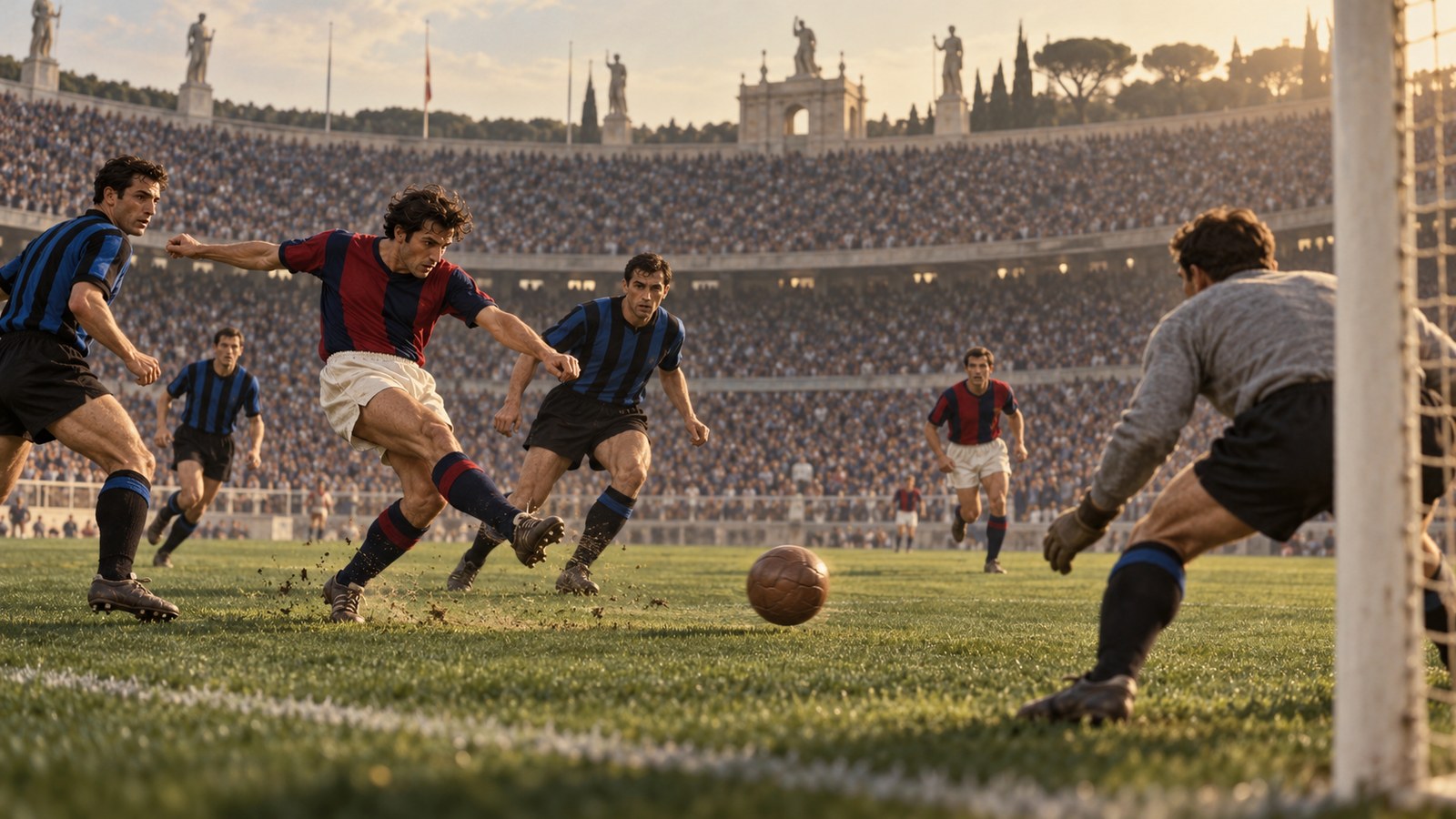
The sequence reversed the season’s direction. Inter had spent months erasing Bologna’s advantage, yet Bologna created the separation that mattered when there was no further fixture available. At full time, the championship belonged to the team that had conceded fewer league goals, survived a points case and absorbed the death of its president days before the decider.
The Only Serie A Title Playoff Left Two Different Legacies
Bologna’s 2–0 victory secured the club’s seventh Italian championship. It remains its most recent league title. That gives the Rome playoff a double identity: a return to the summit after 23 years and the last time Bologna reached it.
Inter’s defeat did not diminish its European breakthrough. Herrera’s team retained the European Cup the following season and won Serie A. The loss in Rome instead shows how narrow the difference between historic achievements could be. Eleven days separated Inter beating Real Madrid and losing a domestic decider to Bologna.
The match also occupies a unique place in the competition’s rules. Serie A has settled later ties through changing criteria rather than staging another championship playoff. The 1964 game remains the single occasion on which two teams entered a separate match with the league trophy itself waiting at the end.
Its place within European football is easier to see beside other finals from the era. Real Madrid’s 7–3 win over Eintracht Frankfurt in the 1960 European Cup final at Hampden represented attacking spectacle. Feyenoord’s defeat of Celtic in the 1970 European Cup final announced a tactical shift. Bologna’s Rome afternoon was different: a domestic season compressed into one last, unrepeatable fixture.
The enduring image is not a table calculation. It is a scoreless match turning in the 75th minute, then Nielsen making the margin safe. Behind it stands the stranger route to Rome: seven points surrendered, three points removed and restored, a president lost at the federation, and Europe’s champion waiting on neutral grass.
Bologna’s season survived every attempt at an ending until the Stadio Olimpico finally supplied one. Serie A has never required the same solution again.
Sources
- Rec.Sport.Soccer Statistics Foundation, Italy 1963/64
- 1963–64 Serie A
- 1963–64 Bologna FC 1909 season
- 1963–64 Inter Milan season