
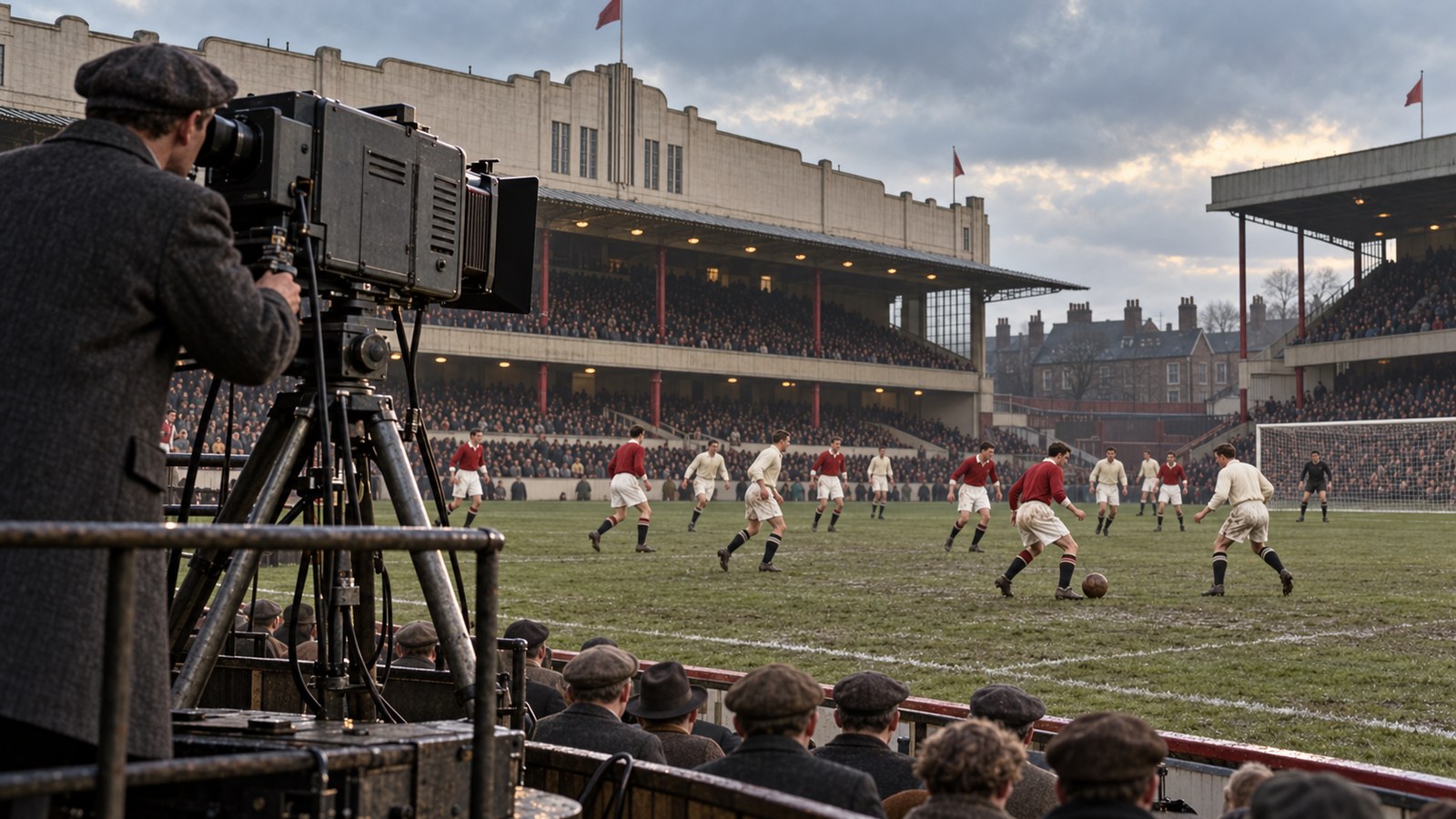
On 16 September 1937, the most important spectator at Highbury was not sitting in the stand. It was a television camera trying to keep a football in frame.
Arsenal’s first team faced the club’s reserves in a specially arranged game, and the BBC sent the pictures to the small number of viewers able to receive its young television service. There were no league points at stake and no cup to lift. The value of the afternoon lay in its control: one ground, two teams from the same club, and a new medium learning what football looked like when reduced to a small monochrome screen.
The experiment lasted in memory because it established a starting point. Within seven months, viewers could watch an international and an FA Cup final. Yet those larger occasions rested on a quieter test in north London, where broadcasters first confronted the basic visual problem that football still presents: the ball is tiny, the pitch is large, and the action can change direction before a camera operator has caught up.
Television Was Barely Ten Months Old
The BBC had opened its regular high-definition television service at 3pm on 2 November 1936. The signal came from Alexandra Palace in north London, and even the meaning of “television” had not been settled. The corporation alternated between John Logie Baird’s 240-line system and the Marconi-EMI 405-line system. Viewers were not entering a mature medium. They were watching competing technologies being tested in public.
The Baird system ended with the BBC’s 30 January 1937 closedown. That left the 405-line electronic standard in use months before the football test, but it did not solve the creative problem of showing live action outside a studio. A presenter could be placed under controlled lights and kept within one frame. Football scattered 22 players across a broad field, hid the ball among moving legs and asked a camera to anticipate rather than merely observe.
Highbury was well placed for the trial. Both the stadium and Alexandra Palace were in north London, within the early service’s practical orbit. More importantly, Arsenal could provide a complete football event without waiting for a league fixture. The first team and reserves supplied familiar shirts, a full pitch and real movement while keeping the occasion under club control.
A Practice Match Offered a Controlled Test
The BBC’s own archive describes the 1937 game as a specially arranged match between Arsenal’s first and second teams. That detail is central. This was not a broadcaster arriving at a major contest and hoping the equipment worked. It was an event assembled for the act of transmission.
A practice setting allowed the camera crew to study the rhythm of play without the obligations surrounding a competitive match. Operators had to decide when to follow the ball closely and when to pull back so viewers could understand shape and distance. A shot tight enough to show a tackle could lose the next pass. A view wide enough to hold the formation could make every player look like a pale moving mark.
The small screen also changed what counted as useful information. Radio had already developed its own solution. In 1927, BBC commentator Henry Blythe Thornhill Wakelam used a numbered pitch grid while an assistant announced the square containing the ball. Our account of the BBC’s eight-square radio experiment shows how sound needed an artificial map. Television removed the spoken grid, but the camera still had to create orientation through framing.
The shift from radio to television did not eliminate commentary’s central question: where should the distant audience look? It transferred part of the answer from the announcer to the operator. On radio, the voice could describe a runner away from the ball. On television, including that runner meant choosing a frame broad enough to contain him. The new medium made spatial judgment visible.
No surviving score is needed to explain the game’s importance. The result was incidental to the test. What mattered was whether a distant viewer could recognize possession, direction and danger from pictures alone.
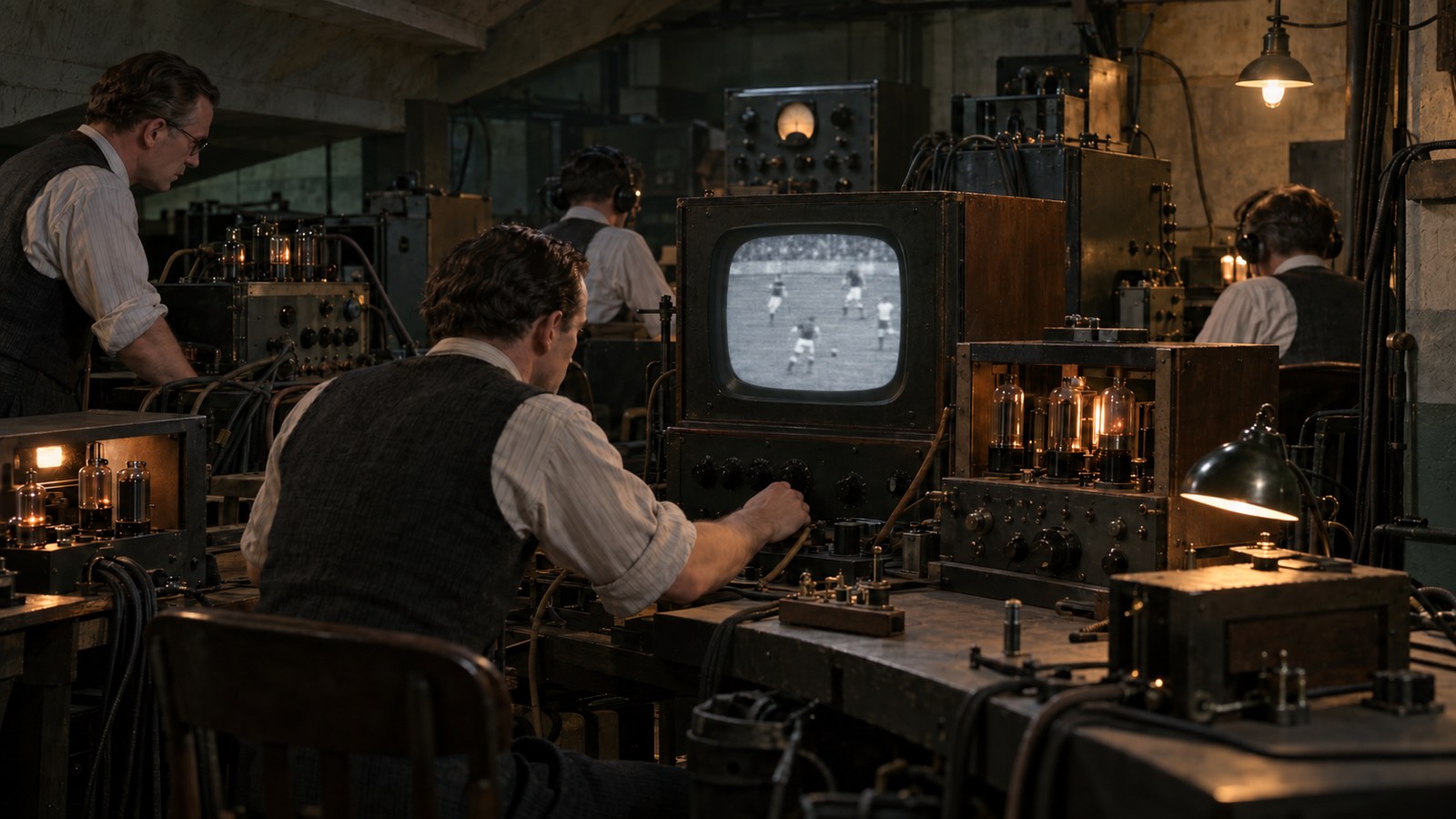
The Camera Had to Learn Football’s Scale
Football is unusually demanding for an early outside broadcast. The meaningful action is not always where the ball is. A forward may begin a run beyond the edge of the frame. A defender may step up several yards away from the pass. On a low-resolution display, the white ball can disappear against shirts, legs or a bright patch of turf.
The Highbury match therefore asked the crew to make editorial decisions in real time. Follow the ball too aggressively and the viewer loses the structure around it. Hold a broad view for too long and the duel that decides possession becomes difficult to read. Those are not only technical choices. They determine which part of the game the audience understands.
The first-team-versus-reserves format made that learning possible without pretending the transmission was already a polished national occasion. Arsenal supplied authentic pace and spacing; the BBC supplied the experimental eye. The camera’s task was to turn a match spread across thousands of square yards into a sequence of intelligible rectangles.
That is the understated legacy of 16 September. Television did not merely carry football from a stadium to a home. It selected, cropped and reordered the viewer’s attention. The person beside the pitch could look away from the ball. The person at home could see only what the lens chose.
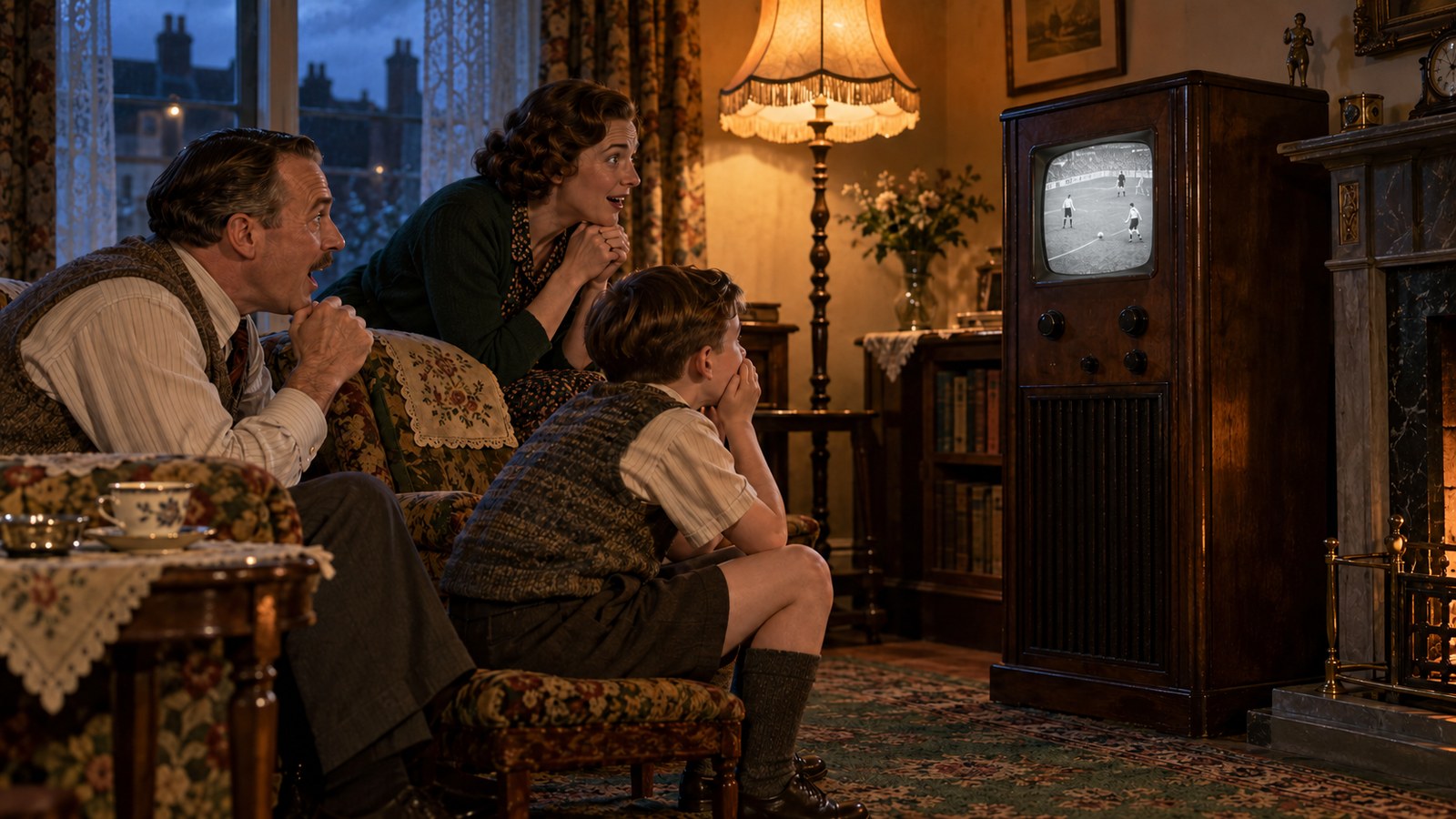
Seven Months Took the Experiment to Wembley
The progression after Highbury was quick. On 9 April 1938, England’s meeting with Scotland became the first live televised international. On 30 April, Huddersfield Town and Preston North End contested the first televised FA Cup final. In little more than seven months, the medium moved from an arranged club trial to two fixtures carrying national importance.
That sequence reveals why the Arsenal rehearsal mattered. The BBC did not begin with the biggest available match. It tested football’s visual grammar first, then applied what it had learned to occasions where failure would have been more conspicuous.
The expansion soon stopped. BBC television closed at noon on 1 September 1939 as war approached and did not resume until 7 June 1946. When live football returned on 19 October 1946, the limitations were still physical and immediate. The BBC showed Barnet against Wealdstone at Underhill, carrying 20 minutes of the first half and 35 minutes of the second before darkness made continuation impossible.
That interrupted transmission is a useful corrective to any smooth story of progress. Cameras, transmitters, available daylight and geography all imposed boundaries. Early post-war matches were sparse, and technical constraints kept coverage close to London. The medium had learned to show football, but it had not yet learned to show it anywhere, at any hour.
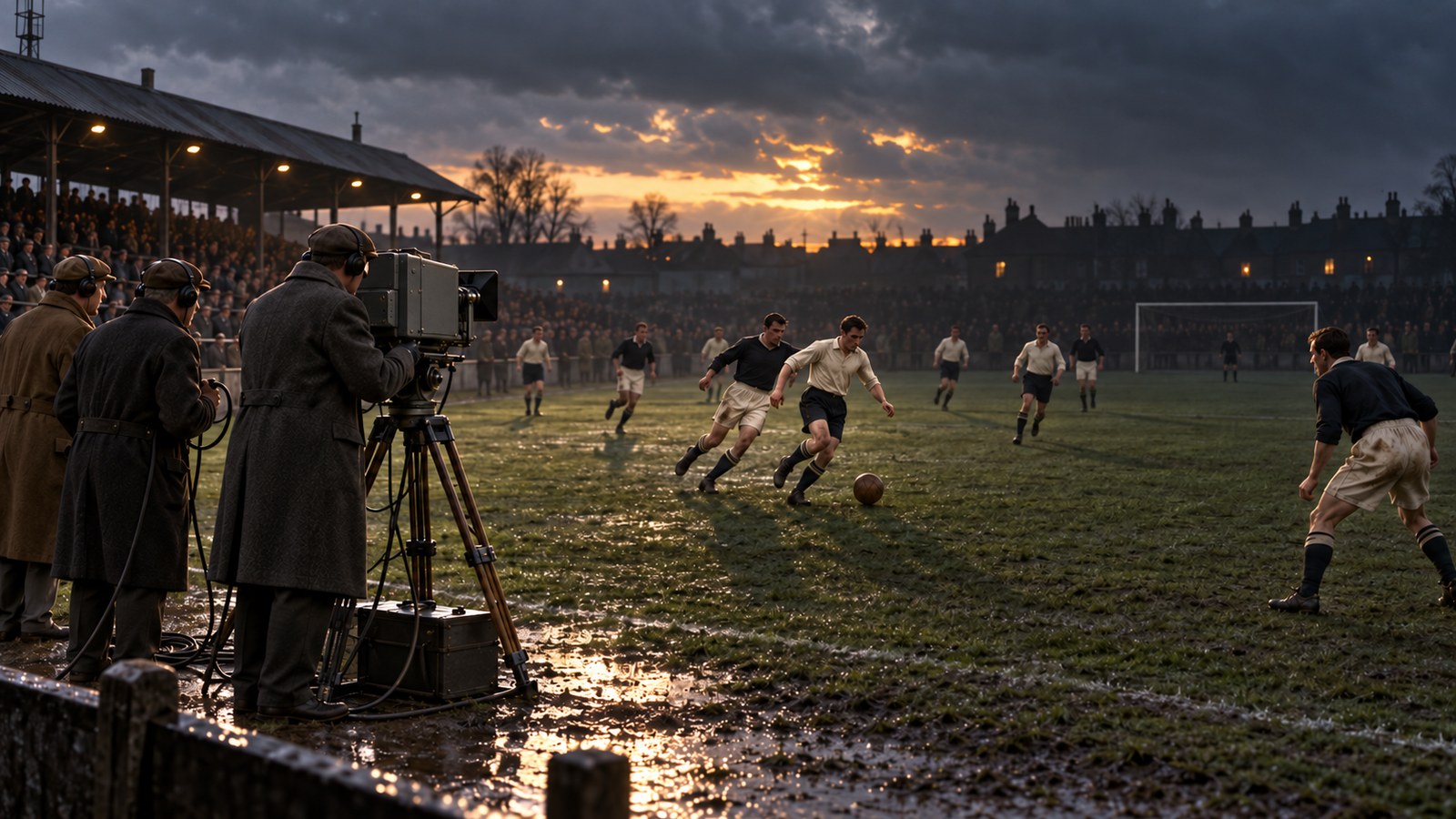
From Tiny Experiment to Scheduled Habit
By 1964, football on television had acquired a regular Saturday-night home. The first Match of the Day showed Liverpool beating Arsenal 3–2 at Anfield. Its estimated audience was 20,000—smaller than the crowd inside the stadium. That comparison captures how modest television football remained even after more than a quarter-century of experiments.
Floodlights, improved cameras and a wider transmitter network gradually removed the limits visible in 1937 and 1946. Club matches could become national events after dark. Our story of Wolves, Honvéd and the Molineux floodlights follows one later stage, when television helped a midweek match reach far beyond the turnstiles.
Highbury’s place in that history is easy to miss because the game itself offered no famous scoreline. Its importance rests in the opposite quality: it was deliberately ordinary. Arsenal’s senior players and reserves provided enough reality for the BBC to test movement, scale and recognition without making the experiment carry a competitive result.
Modern coverage disguises those choices with dozens of cameras, replays, graphics and close-ups. The 1937 broadcast reduced the problem to its essentials. Could a camera find the ball? Could a viewer understand where play was going? Could a stadium event become coherent inside a home? Arsenal’s internal match gave television its first football answers.
Sources
- BBC Sport archive, “Happened on this day — 16 September”
- BBC History, “First regular hi-definition television service”
- BBC Television Service reference history
- English Football on Television reference history