
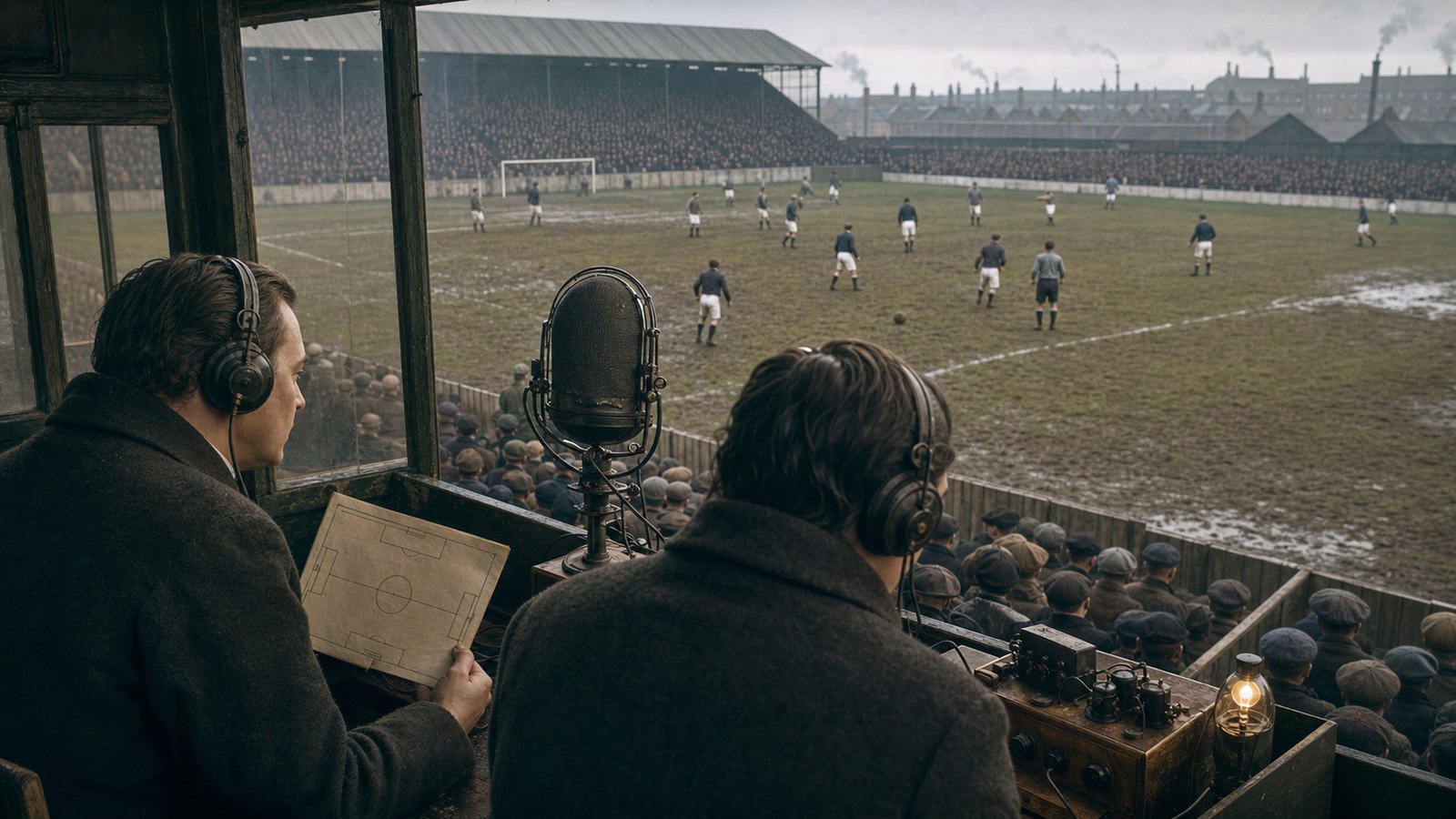
A wooden hut at Highbury held two men, a microphone and a problem nobody in English league football had solved before. On 22 January 1927, Henry “Teddy” Wakelam had to describe Arsenal against Sheffield United to listeners who could hear his voice but could not see where the ball had gone. Producer Lance Sieveking supplied a second language: eight numbered areas printed over a football pitch.
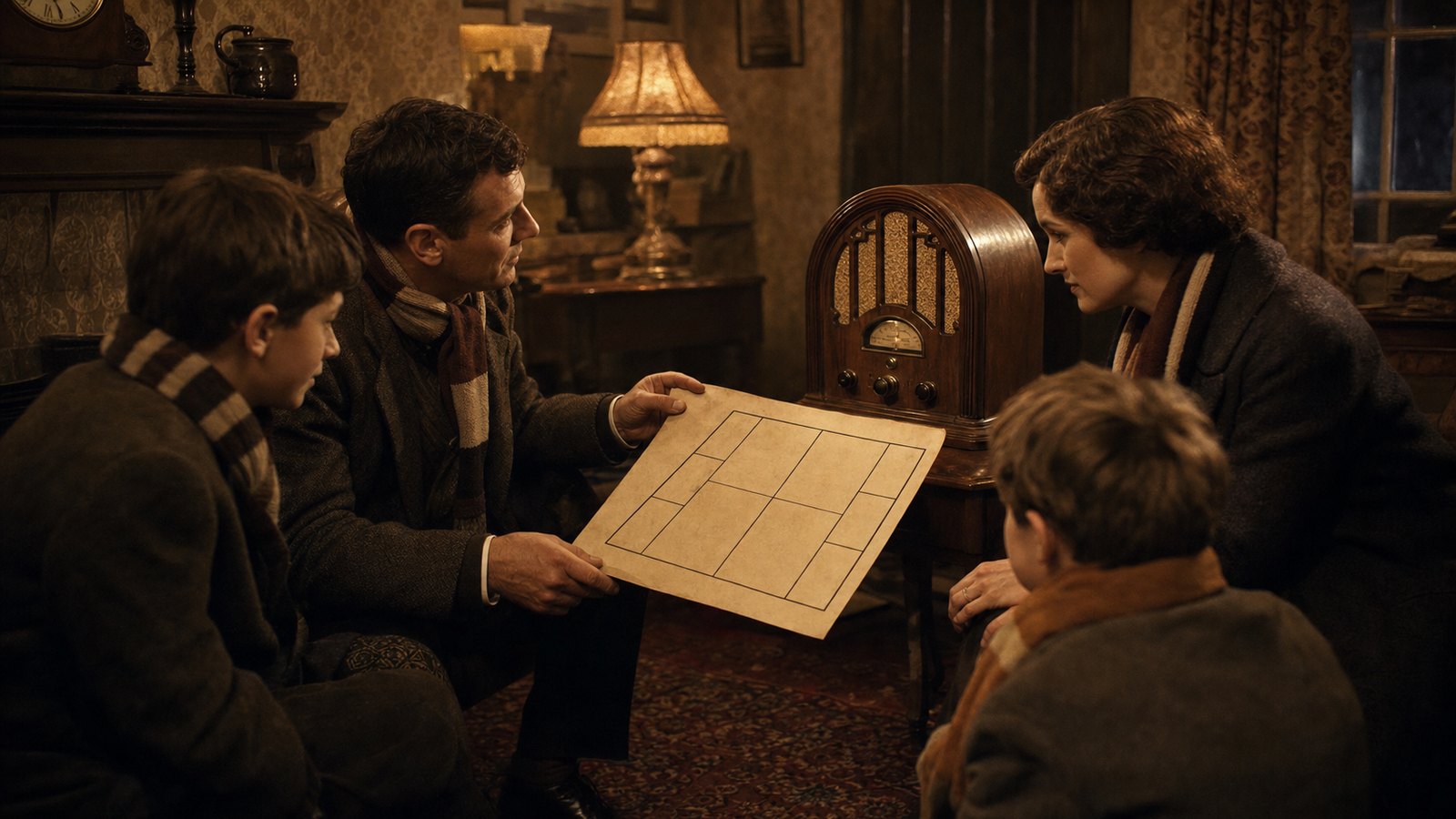
Families following the BBC broadcast could keep the Radio Times diagram on their laps. As Wakelam described the play, a number placed the action inside one of the squares. The device looks primitive beside television replays and animated match trackers, yet it answered a difficult editorial question. Radio could not merely report the score. It had to construct a shared pitch inside thousands of separate rooms.
Football reached radio only after a fight over the gate
Live commentary did not arrive as an obvious extension of the match. Sporting authorities worried that a free broadcast would keep customers away from turnstiles. Fleet Street had its own concern: a voice carrying the action as it happened might reduce the value of newspaper reports. The new medium therefore faced resistance from two businesses whose income depended on controlling how supporters encountered football.
The institutional opening came at the start of 1927. On 1 January, the BBC began operating as a public corporation under its Royal Charter. The change gave it the right to cover major sporting events. Two weeks later, on 15 January, Wakelam delivered a running commentary on England’s rugby union international against Wales at Twickenham. England won 11–9. The football experiment followed seven days later.
That sequence matters because the Arsenal match was not an isolated stunt. The BBC was testing whether continuous spoken description could make a live sporting event intelligible without pictures. A score announcement was simple. Ninety minutes of movement, territory and interrupted possession demanded a vocabulary, a rhythm and a way to stop the listener becoming lost.
Teddy Wakelam received an urgent telephone call
Wakelam was not selected from an established profession of radio football commentators. That profession did not yet exist. He had joined Harlequins in 1911, captained the rugby club and retired from playing after a knee injury in 1924. He also had wartime service in France, Gallipoli, Egypt and Palestine. By January 1927 he brought an athlete’s understanding of space and pressure, but no inherited broadcasting template.
His own account began with an unknown BBC official telephoning while he was working on details of a tender. The caller asked whether he was the Wakelam who had played for Harlequins and requested an urgent meeting. The football assignment was arranged too late to receive proper billing in the Radio Times. Sieveking first tested him on a schools match, only days before the live debut.
The speed of the recruitment exposed the experiment’s uncertainty. Wakelam needed to speak continuously without turning the match into noise. His later admirer John Arlott praised him as a natural talker with a reasonable vocabulary and a determination to avoid journalese. That last quality was essential. A newspaper writer could revise a sentence after the action. Wakelam’s words disappeared into the air at the same speed as the play.
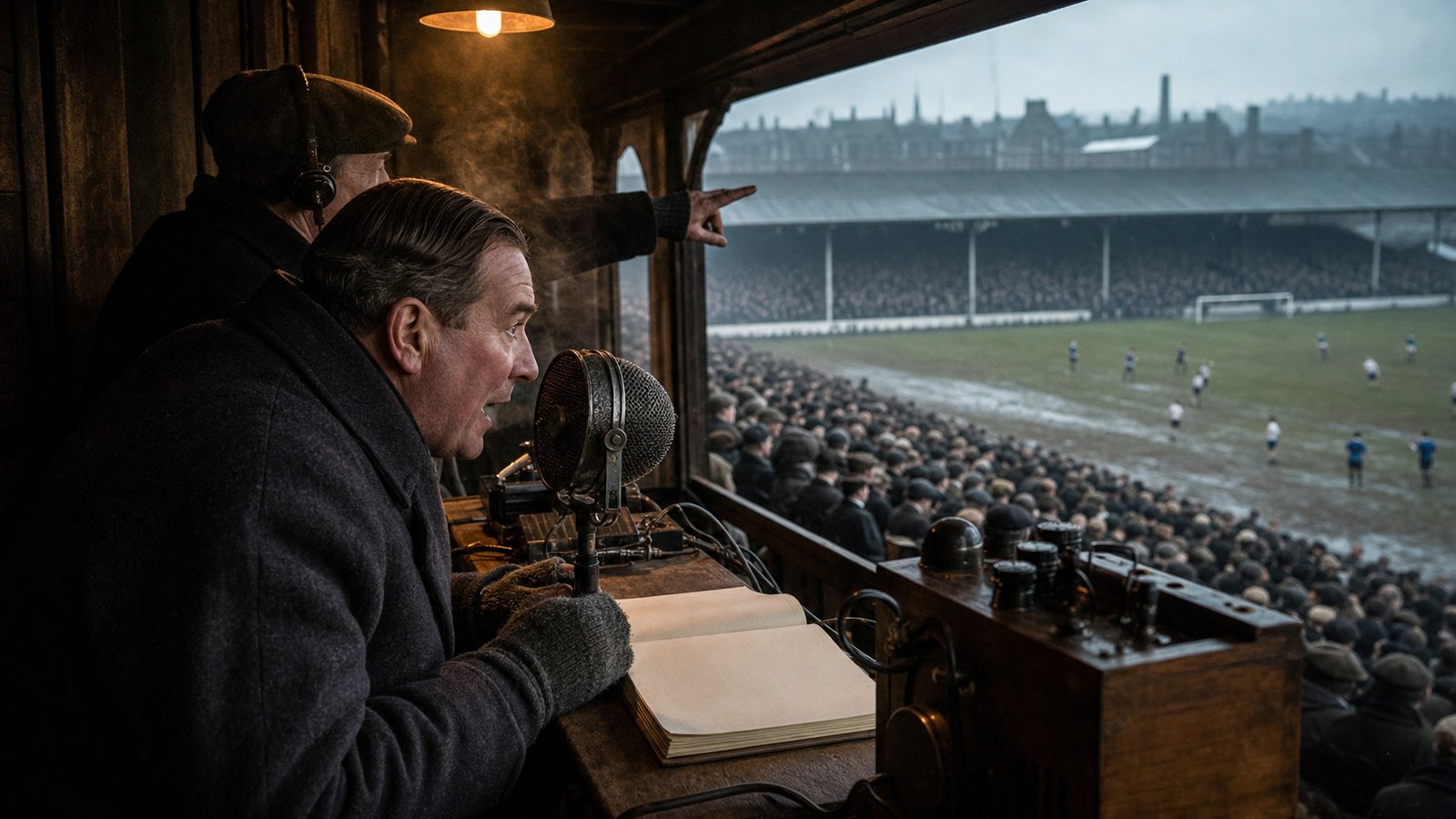
An eight-square diagram gave every movement an address
Sieveking’s answer to the visual problem was a pitch split into eight numbered squares. The chart appeared in the Radio Times so listeners could follow from home. Wakelam supplied the movement and incident; the numbered call supplied location. A run could cross the imaginary boundary between two areas. A clearance could send the listener’s attention back across the paper. The grid turned radio into a coordinated act between commentator and audience.
The method had already been used for the rugby broadcast, where Cecil Arthur Lewis called out the area number behind Wakelam’s description. Football made the problem especially sharp because possession could reverse quickly and because a listener needed to distinguish sustained pressure from an isolated attack. The numbered pitch reduced the amount of explanation required every time the ball moved.
The system is often linked to the phrase “back to square one,” but the origin is not secure enough to present as settled fact. What can be said safely is that surviving early-1930s commentaries still contain references to the squares. The device endured beyond one afternoon because it gave listeners a stable mental map. It was a piece of interface design made from paper, voice and timing.
A 1–1 draw became a test of spoken precision
Arsenal and Sheffield United drew 1–1 at Highbury. The result was ordinary enough to keep the experiment’s true difficulty in view. Wakelam was not narrating a single famous goal after the fact. He had to carry routine passages, changes of possession and pauses while preserving the shape of a Division One match for people who had never heard one described live.
The earliest commentary itself has been lost. That absence prevents modern listeners from judging every phrase, but contemporary responses preserve the impression it made. The Times called Wakelam’s description “notably vivid and impressive.” The Spectator concluded that this type of broadcasting had come to stay. Those reactions praised more than novelty. They suggested that sound had made the match feel present rather than merely reported.
There was also a social shift inside the format. A supporter no longer had to occupy a place at Highbury to share the same minute of uncertainty as the crowd. The broadcast did not reproduce the stadium’s sightlines, noise or physical proximity. Instead, it created a parallel public assembled around radio sets. The paper grid gave that dispersed audience a common orientation.
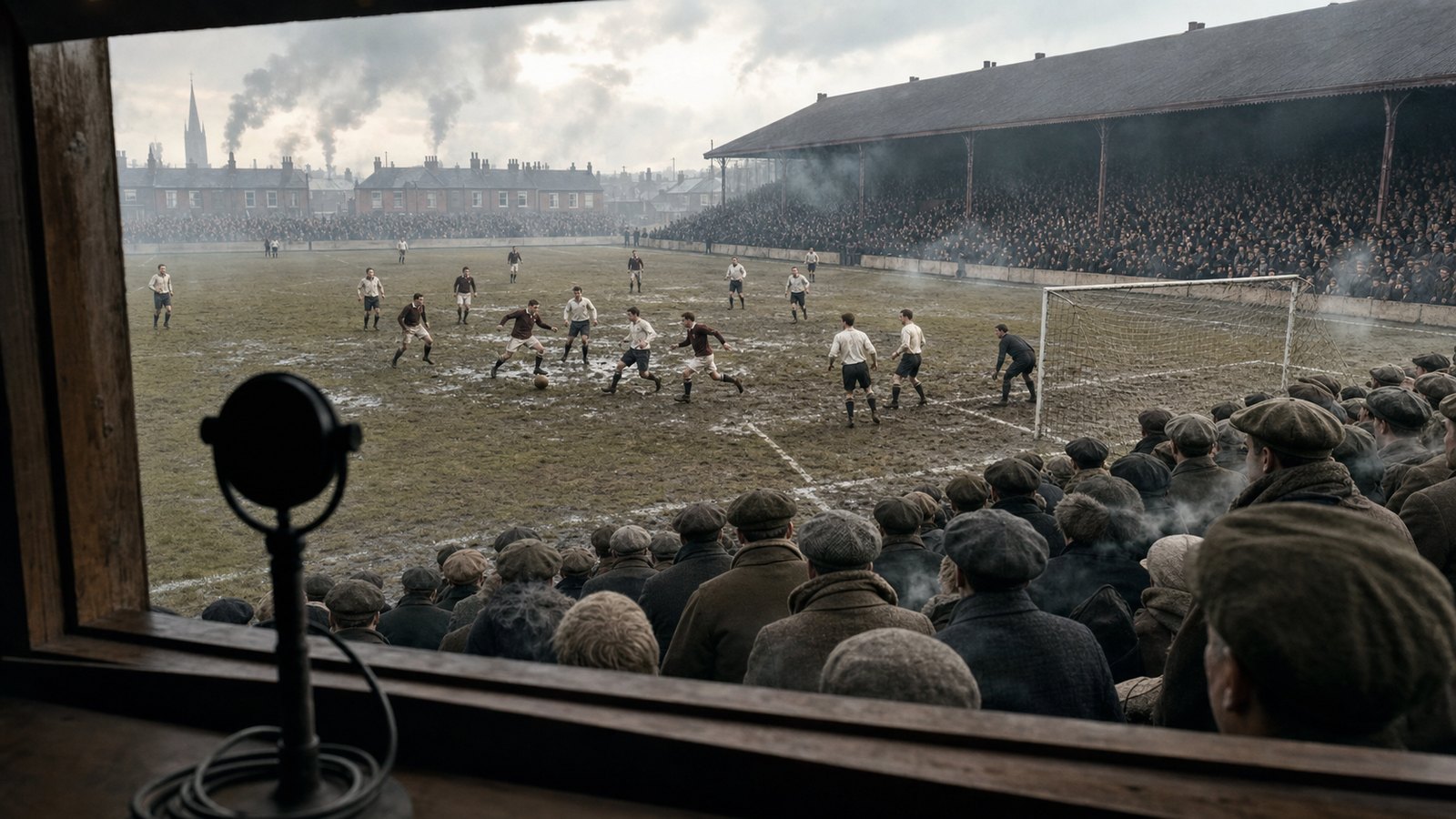
By December, live sport had become a BBC grammar
The football commentary sat near the beginning of a rapid expansion. Before 1927 ended, BBC listeners had heard the Grand National in March; the Boat Race and FA Cup final in April; and the Derby and Wimbledon in June. Wakelam worked across several sports, including cricket and tennis. Each demanded different decisions about pace, silence, position and the amount of explanation a distant audience required.
Sieveking’s role also reached beyond the grid. He was a writer and pioneering BBC producer who helped introduce running commentaries and later worked extensively in radio drama. The same practical imagination connected the forms: unseen action had to be arranged in sound so that a listener could build a coherent scene. In football, the eight-square page was effectively part of the script even though the match itself remained unscripted.
Wakelam’s own career followed the medium as it changed. He commentated on cricket, boxing and tennis as well as rugby and football. In June 1938, he became one of the BBC’s early television sports commentators when he covered the second England–Australia Test at Lord’s. The camera altered the balance because viewers could locate the action for themselves, but the commentator still had to recognize the decisive detail before the moment passed.
The missing 1927 recording makes the printed grid even more important as evidence. It shows that the BBC did not expect a microphone alone to carry the experience. Producer, commentator, publication and listener each held part of the arrangement. What arrived in the sitting room was live football assembled across all four.
The experiment belongs in the longer story of how supporters learned to experience football through media. Earlier crowds had travelled, read delayed accounts or shared reports from those who attended. Radio introduced simultaneous distance. That change was different from the physical uncertainty surrounding the first Scotland–England international in 1872, but both moments forced football to define how an audience could understand a still-new spectacle.
Modern commentary no longer asks listeners to hold a numbered paper pitch. It still performs the same essential conversion. A commentator selects which movement matters, locates it quickly, identifies the pressure around it and leaves enough space for the event to feel live. The tools have changed from an eight-square diagram and a wooden hut. The central problem Wakelam and Sieveking solved has not.
Sources
BBC Sport; BBC Radio historical chronology; Teddy Wakelam biographical record; Lance Sieveking biographical record.