
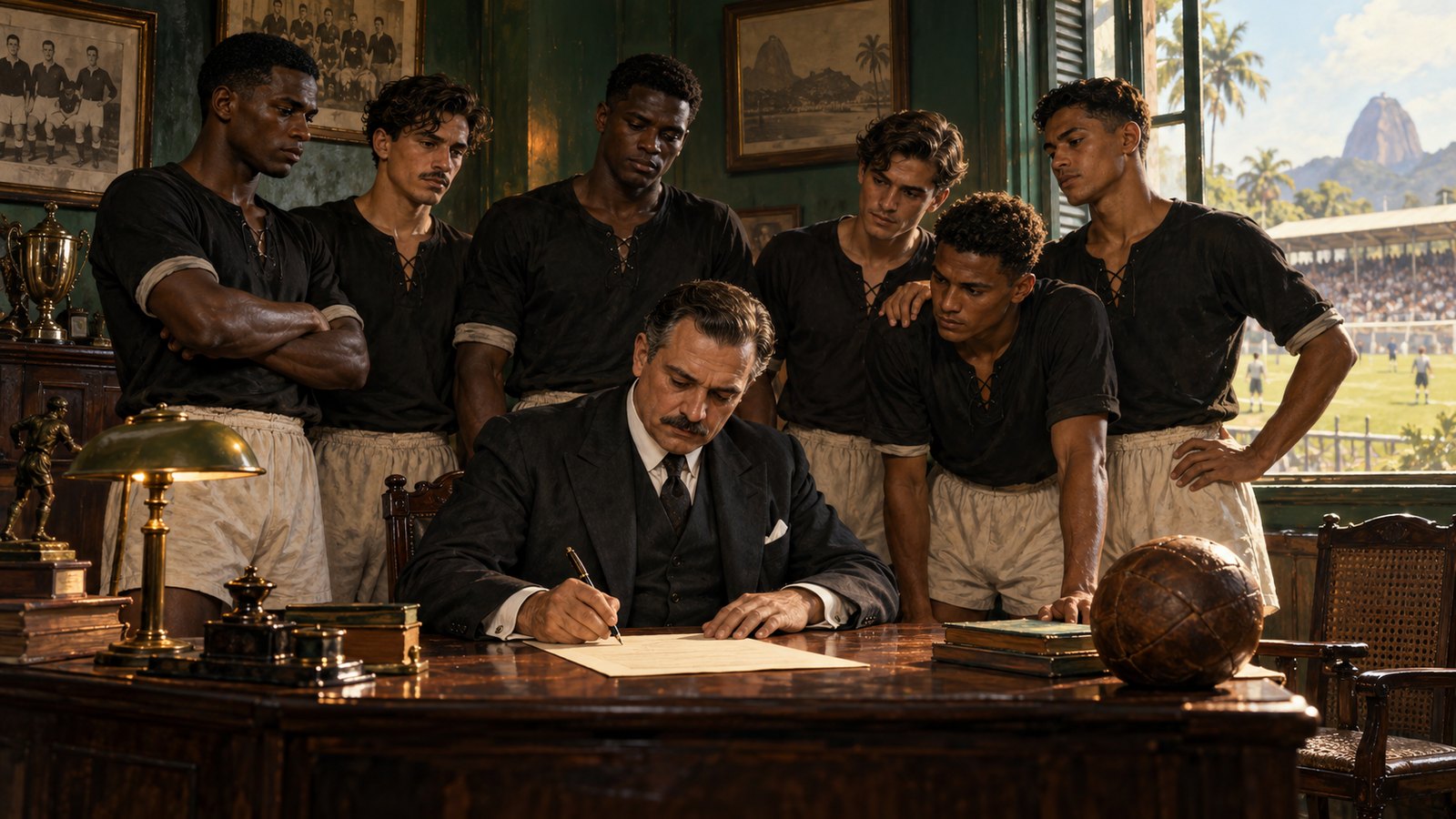
On 7 April 1924, a football club answered an eligibility order with a letter. The page carried a date, a number—Office No. 261—and the signature of Vasco da Gama president José Augusto Prestes. Its decisive line concerned 12 players whom Rio de Janeiro’s new football association wanted removed.
Vasco chose the players. The club withdrew its application to the Associação Metropolitana de Esportes Athleticos, or AMEA, rather than accept a place on terms that would break up its champion side. The decision joined a sporting dispute to a larger argument over who was allowed to represent a leading club: men from poorer districts, manual workers, Black players and players whose literacy or employment could be used against them.
The letter later became known as the Resposta Histórica, the Historic Response. Its force comes from the sequence behind it. Vasco had climbed from the lower level, won the 1923 Rio championship at its first attempt in the top division, and then faced an administrative test that reached beyond results. A team built outside the established social circle had proved itself on the field. The next contest took place in forms, meetings and a club office.
The Champions Arrived From Outside Rio’s Elite
Vasco had been founded as a rowing club and added football in 1915. Its route into the game differed from that of Rio’s established powers. The club recruited from smaller teams and suburban competitions, drawing players whose working lives included jobs as drivers, painters, cleaners and labourers. Arthur came from Hellenico Athletico Club; Torterolli arrived from Carioca Football Club. They were among the players later remembered as the Camisas Negras, the Black Shirts.
The climb accelerated. Vasco won the second tier in 1922 and entered the leading division the following year. Coached by the Uruguayan Ramón Platero, the side won 11 of 14 matches, drew two and lost one. It finished as Rio champion in its first season among the elite clubs.
Those numbers mattered because they denied rivals an easy sporting explanation. Vasco had not entered the top level as a curiosity. It had beaten the competition. Its squad included Black and mixed-race players and men from modest backgrounds at a time when leading football institutions often treated social standing as part of sporting respectability.
Nelson da Conceição embodied the collision. A goalkeeper from Nova Friburgo who had worked as a taxi driver and in a clothing business, he endured racist attacks and accusations about literacy. The club’s response to that environment included practical support: member and librarian Custódio Moura taught players to read and write. The detail shows how an apparently neutral requirement could become a gate. Literacy was not merely recorded; it could determine whether a footballer was admitted.
Football had encountered exclusion long before 1924. Our account of Andrew Watson captaining Scotland in 1881 follows a different country and career, but it also shows why a team sheet can carry social meaning beyond formation and result. At Vasco, the 1923 team sheet had become evidence that men outside Rio’s traditional football establishment could win its championship.
The New Association Asked for a Different Team
In March 1924, rival clubs broke from the Liga Metropolitana de Desportos Terrestres and formed the AMEA. Vasco was invited to apply, but it was not one of the five founding clubs. The admission process asked for unusually detailed information about players, including present and previous places of work.
The association said Vasco could join if it excluded 12 footballers: seven from the first team and five from the second side. Most were Black or came from poorer parts of society. The criteria were presented through registration, employment and standards of conduct, but their effect was concrete. The defending champion would enter the new competition without a substantial group of the players who had carried it there.
This is the mechanism that makes the episode more than a general story about prejudice. The pressure arrived as governance. It used an application, requested employment histories, an eligibility decision and a list of names. No opponent had to take the ball from Vasco’s players. An institution could remove them before kick-off.
The demand therefore placed the club before a precise choice. It could accept the new association’s authority and sacrifice 12 footballers, or preserve its squad and surrender access to the competition organised by the leading clubs. There was no version in which Vasco kept both its place and all its players.

Office No. 261 Chose the Players
Prestes wrote from the club secretariat on 7 April. The surviving document addresses AMEA president Arnaldo Guinle and records that Vasco’s directors had reached their decision unanimously. The prose is formal, but its structure is direct: the proposed conditions placed Vasco in an unjustifiable position of inferiority; the club protested; it would not eliminate the 12; it was withdrawing from the association.
The letter also explained why the names could not be treated as disposable entries on a registration sheet. The players had fought for the 1923 championship. Prestes described them as young men, almost all Brazilian and at the start of their careers. Publicly marking them in order to obtain membership, he wrote, would be unworthy of the club.
One passage supplied the moral centre. Vasco would not sacrifice some of those who had brought it victory simply to satisfy the desire to enter the AMEA. The wording tied loyalty to an identifiable act. The club was not offering sympathy after the players had been cut. It was refusing the transaction that required their removal.
Prestes’s signature carried an immediate cost. Vasco surrendered its 1924 AMEA place before anyone knew the letter would later be displayed and quoted beside club trophies.
The Refusal Carried a Sporting Cost
Vasco remained in the older LMDT competition during the split. It won the 1924 championship unbeaten while the AMEA ran its own tournament. The result did not erase the division, but it prevented exclusion from becoming sporting disappearance. The Camisas Negras continued to draw crowds and remained visible as champions.
That visibility changed the balance. Public interest, gate receipts and the team’s continued success made it harder to treat Vasco as peripheral. The AMEA admitted the club in 1925. The sequence matters: refusal came first, a season outside the new association followed, and entry arrived without the 1924 purge being accepted as the price.
Yet the sporting consequence makes the choice legible. Vasco was not protesting from a safe position inside the new order. It risked isolation at the moment when Rio’s established clubs were reorganising the championship. Winning the older league kept the refusal attached to a functioning team rather than turning it into a noble footnote.
There is a parallel in the way football authorities have used access to grounds and competitions to control who could play. Our history of the English FA’s 1921 action against women’s football examines a different institution and exclusion. Both stories show that a rule need not alter the laws of the game to alter its participants. Control the recognised clubs, registrations and venues, and the field changes before the referee arrives.
A Letter Became Part of the Club’s Public Memory
The Historic Response is now displayed in the trophy room at São Januário. That location is revealing. A letter occupies space normally reserved for cups because Vasco treats the refusal as one of its defining achievements. The document records no score, but it explains what the club believed a championship team was worth when admission demanded that some of its members be abandoned.
Its physical survival also keeps the argument specific. There is a date, an office number, a recipient, a signature and a stated decision. The 12 players are not a vague symbol added decades later. They appear in the reasoning of the original document as people whose public exclusion would stain young careers and betray those responsible for the club.
That choice explains why Office No. 261 outgrew the meeting that prompted it. The 1923 title established the players’ footballing claim. The AMEA’s condition exposed the social boundary around that claim. The response fixed the club’s answer on paper: a place in the new league was not worth purchasing with 12 teammates.
Sources
- GE, “O que é Resposta Histórica? Motivo de orgulho para torcida, ato do Vasco completa 100 anos”
- GE, “100 anos do primeiro título carioca do Vasco: veja quem foram os Camisas Negras”
- Terra, “Os 100 anos da Resposta Histórica que transformou o Vasco em uma causa”
- José Augusto Prestes, Resposta Histórica, Office No. 261
- Ronaldo Helal and João Paulo Vieira Teixeira, “O racismo no futebol carioca na década de 1920”