
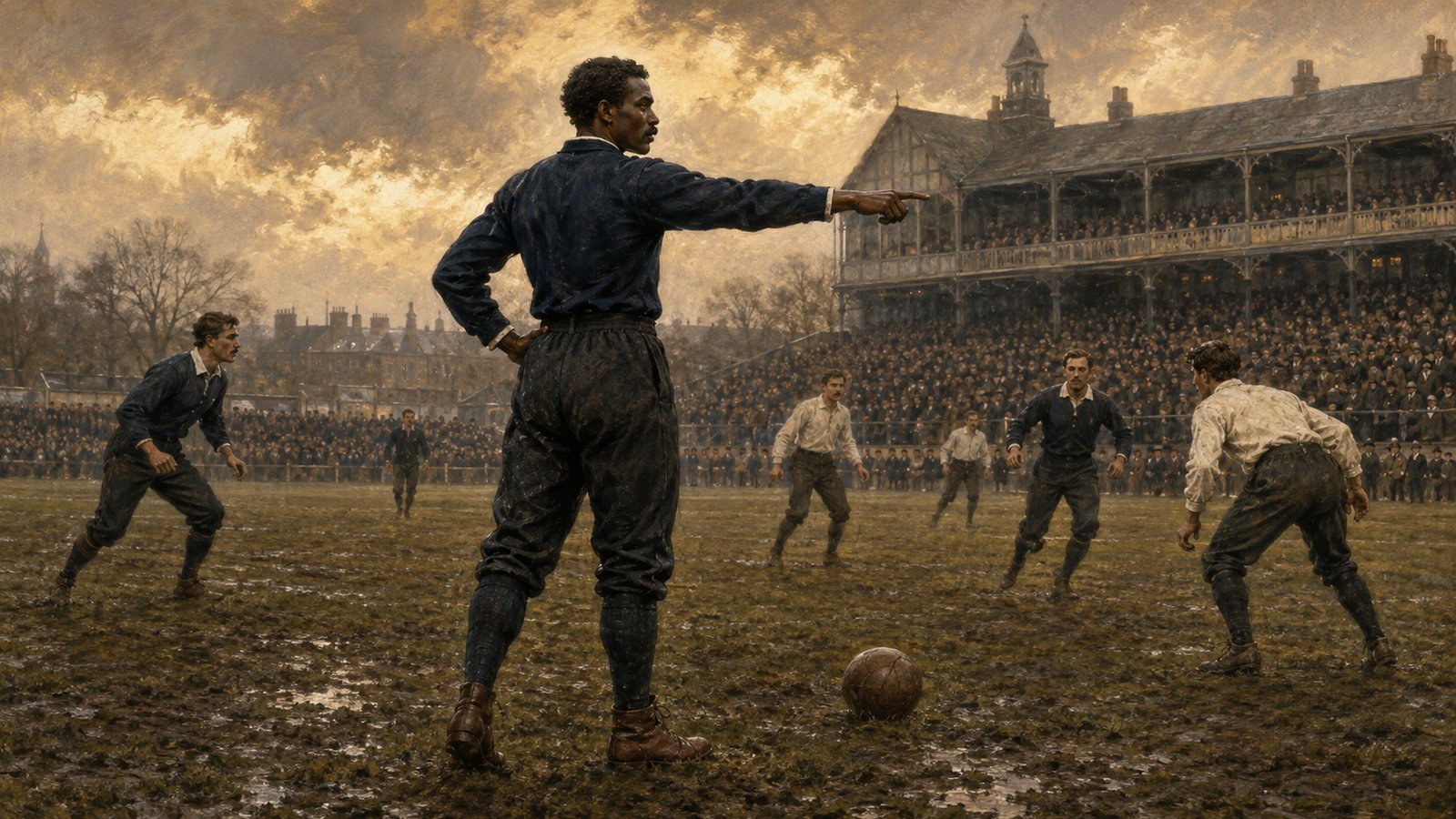
At The Oval on 12 March 1881, Andrew Watson walked out as Scotland captain in brown boots. A contemporary report noted the colour because the other players wore black. It did not pause over the fact that Watson, born in British Guiana, was the first Black footballer to play international association football. The match writer noticed what he did with the ball.
By the end, England had lost 6–1, still its heaviest defeat on home soil. The score is extraordinary, but it can hide the more useful story. Watson’s path from a Glasgow club administrator to Scotland captain ran alongside a change in how elite football was played: fewer heroic solo dribbles, more players moving and passing in relation to one another. His importance sits in that overlap between social breakthrough, tactical authority and the ordinary work of a composed full-back.
The Captain Had Learned Football by Building a Club
Watson was born in Georgetown, Demerara, on 24 May 1856. His father, Peter Miller Watson, was a Scottish solicitor and sugar planter; his mother was a local woman named Hannah Rose. Andrew came to Britain as a child, received a private education and entered the University of Glasgow in 1875. He did not remain there long. Football, then a game still deciding its habits and institutions, became the centre of his life.
He began with Maxwell in Govan and then joined Parkgrove, a club remarkable for the range of people involved in it. Watson was not merely selected on Saturdays. He served as an administrator, became vice-president and invested his own money after receiving an inheritance. The Scottish FA records more than 100 Parkgrove appearances.
Parkgrove folded in 1880. Watson moved to Queen’s Park, the leading force in Scottish football, and entered an environment where passing was treated as a shared method rather than an occasional escape from dribbling. He played either side of the defence and could operate in midfield. Reports described strength and composure, qualities that made him useful behind a side willing to send several players forward in combination.
Queen’s Park Gave Him Authority Before Scotland Did
Queen’s Park was both a team and a workshop for the Scottish game. Watson became its captain and honorary secretary, positions that joined judgment on the field to responsibility away from it. He would make more than 110 appearances for the club, win three Scottish Cups and collect four Glasgow Charity Cups. The Scottish Football Museum identifies him as the first Black player to win a national football trophy and the first Black football administrator.
None of that makes late-Victorian football racially equal. Watson’s resources and schooling gave him unusual access, and later memory largely misplaced him. The surviving record still shows selectors, members and teammates repeatedly trusting him with formal authority. He organised clubs, anchored defences and led sides.
International selection arrived in 1881. Scotland had played England since the first official international in 1872, when a match at Hamilton Crescent finished goalless. The rivalry already supplied a test of competing approaches. England commonly favoured individual dribbling and forward-heavy attacks. Scotland’s strongest clubs were refining a closer passing game in which support and spacing could move the ball faster than one runner.
Six Goals at The Oval Made the Argument Visible
The crowd at The Oval was recorded at about 8,500. Scotland started with five Queen’s Park players, including Watson at full-back, and conceded no goal before half-time. John Smith scored after ten minutes. David Hill added the second after the interval; England’s Edward Bambridge then reduced the score to 2–1. Any assumption that the contest was finished had to wait.
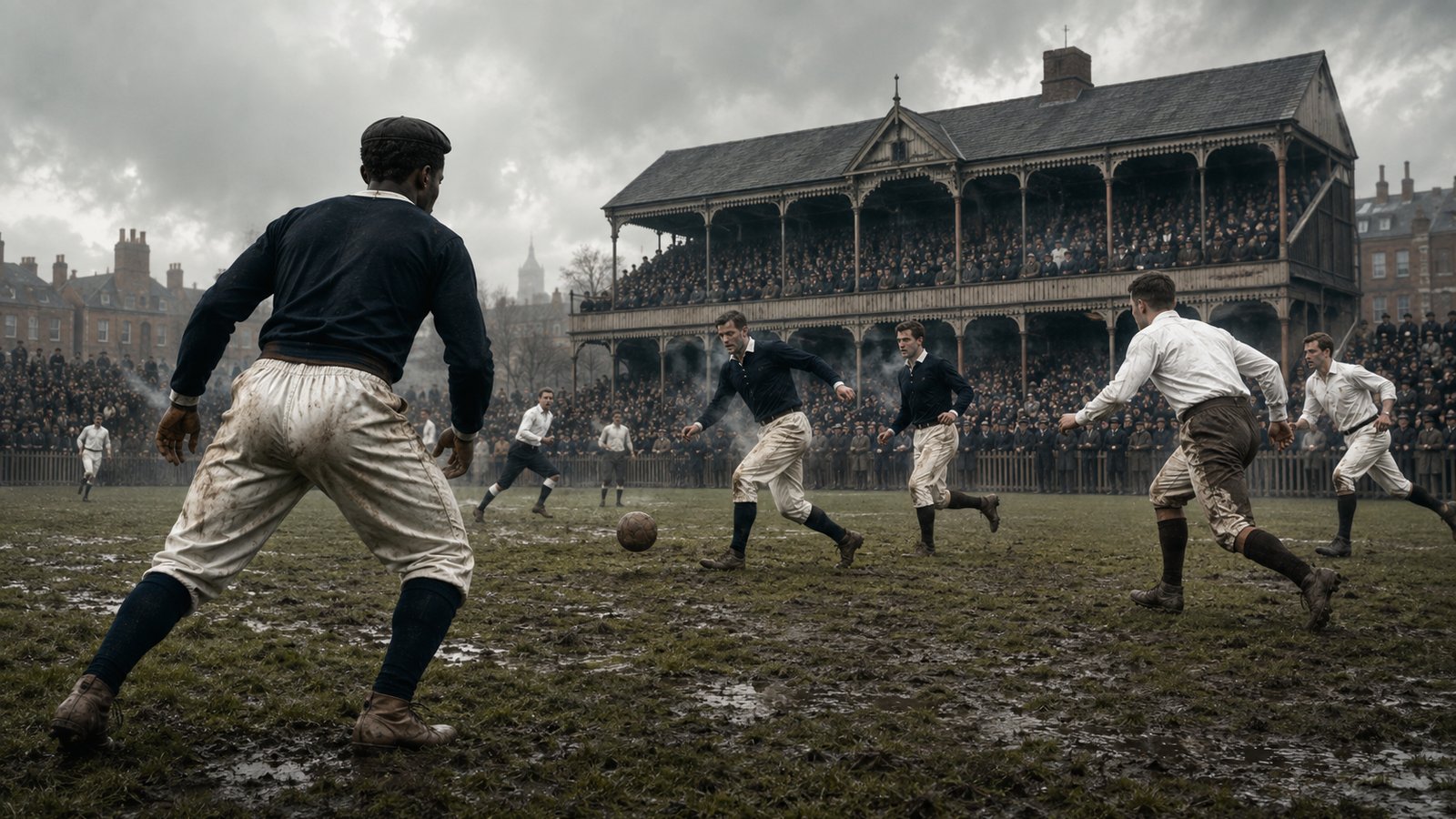
Scotland answered with four goals in the last 21 minutes. Smith completed a hat-trick, while George Ker scored twice, including the final goal in the 89th minute. The 6–1 score remains England’s largest home defeat. A close contest had broken open through connected routes.
Watson’s contribution did not require a goal. The Field described a dangerous England throw-in followed by sharp work in front of Scotland’s “fortress,” which Watson ended “with a capital kick.” That small line is valuable because it resists retrospective symbolism. In the moment, his captaincy was expressed through a defender’s intervention: reading pressure, clearing decisively and allowing the attacking structure to reset.
Brown Boots Were the Detail the Reporter Chose
Modern accounts naturally place Watson’s identity at the centre of the occasion. Contemporary coverage did not use the language later generations would need in order to recover his place. The BBC’s reconstruction notes no period comment about his skin colour in the match reports. The distinguishing observation was that his boots were brown instead of the customary black.
Silence is not proof that prejudice was absent. It does show how securely Watson’s sporting competence sat inside the immediate report. He had already earned the captaincy of a national team dominated by men from powerful clubs. The article’s eye moved to his equipment and his clearances because his presence in the side required no football explanation.

Two days later Watson captained Scotland again, this time in Wrexham, where Wales lost 5–1. His third and final cap came against England in Glasgow in March 1882, another 5–1 Scottish victory. Across his three internationals, Scotland scored 16 goals and conceded three. The sample was brief because selection rules, not form, closed it.
A Move to London Ended the Caps but Spread the Method
When Watson moved south, the Scottish FA selected only players based in Scotland. His international career therefore stopped after three appearances. His influence did not. He played for London Swifts and became the first Black footballer to appear in the FA Cup. He also joined Corinthians, the elite amateur club created partly to improve English football against Scotland.
English players and writers used the phrase “Scotch Professors” for men associated with the passing game. Watson fitted the description literally as well as tactically: he arrived with experience from Queen’s Park and demonstrated how a defender could support a coordinated side. The BBC’s history of his career presents him as a conduit between the Scottish combination game and influential English amateurs who later carried their football on tours.
In 1883 Watson played for Corinthians when they defeated FA Cup holders Blackburn Rovers 8–1. The result did not create the passing game, and no single player can own a collective idea. It did confirm that Watson’s authority travelled. He could step into a new football culture and help make a different set of relationships—support angles, quick release, shared movement—work against leading opposition.
The Missing Years Changed How His Place Was Understood
Watson later returned to Queen’s Park, then played for Bootle on Merseyside while training as a marine engineer. Claims that Bootle paid him prompted an FA inquiry, but the allegation was dismissed. That leaves unresolved whether he should also be considered the first Black professional footballer. Arthur Wharton retains the clearer documented claim; Watson’s possible payments remain a question rather than a fact to tidy away.
He retired from football by the end of the 1880s and died in Kew on 8 March 1921, aged 64. For decades, standard histories gave him little space. Researchers rebuilt the outline through census entries, club records, family history, team photographs and match reports. His induction into the Scottish Football Hall of Fame came in 2012, more than 130 years after the afternoon at The Oval.
The recovery can be distorted if Watson is treated only as a ceremonial “first.” His captaincy mattered because it was attached to choices made under pressure. His administration mattered because clubs had to be built before they could become traditions. His movement between Queen’s Park, Scotland and Corinthians mattered because football was still choosing between competing ways to use eleven players.
The brown boots offer the cleanest final image. They were visible, unusual and worth one line. Around them was a player whose decisions looked entirely at home: a captain ending danger with a firm clearance while his team assembled another passing attack. Watson changed who could be seen at the centre of international football, and he helped move the game itself toward the connected shape we recognise.
Sources: BBC Scotland; BBC Sport; Scottish FA; Scottish Football Museum; The Scots Football Historians Group; The Atkinson.