
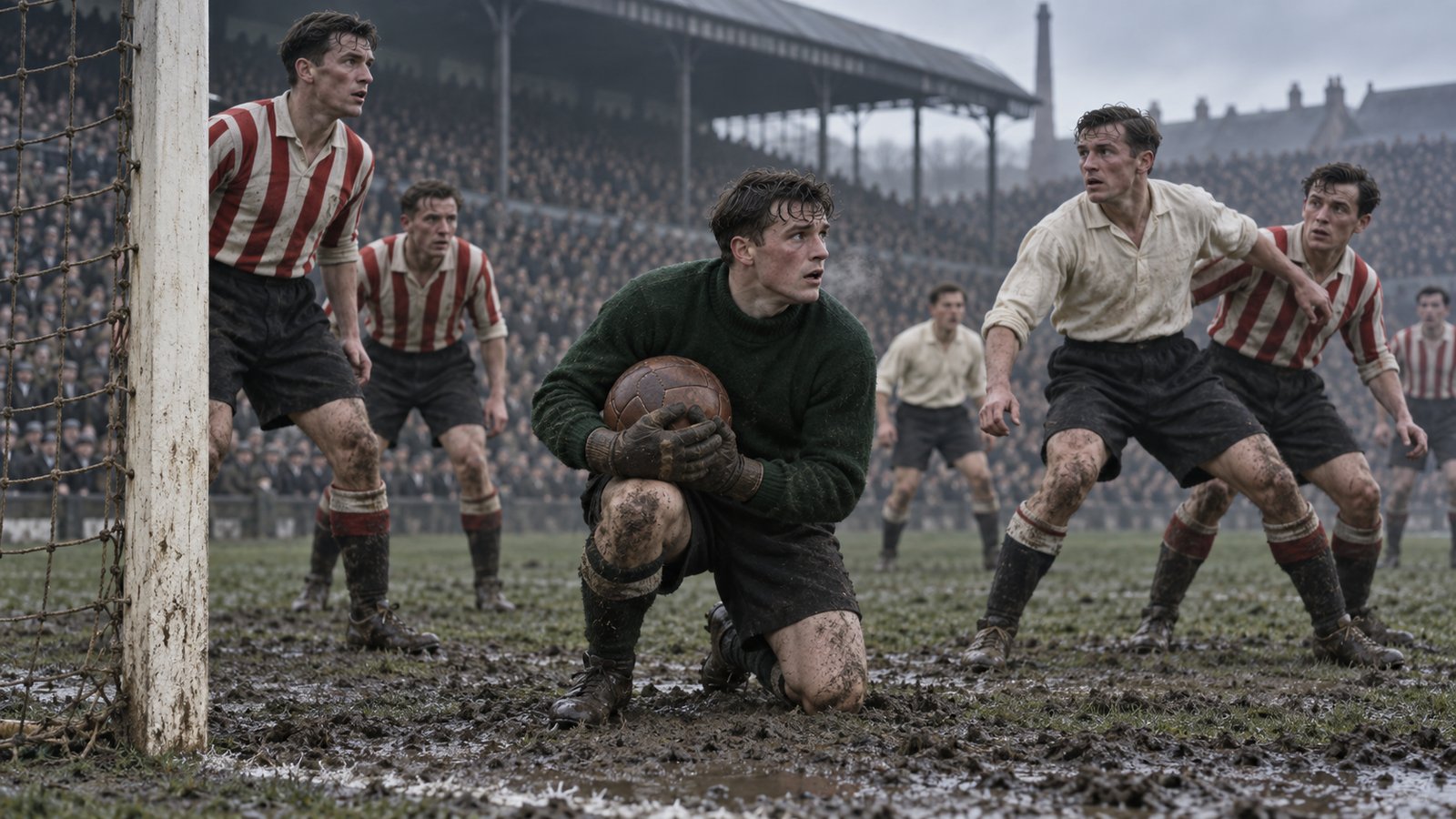
The first verdict arrived before anyone knew Jimmy Thorpe was dying. Sunderland had led Chelsea at Roker Park, yet the match on 1 February 1936 ended 3–3 after two late goals involving the home goalkeeper. Spectators left angry. A newspaper report blamed “atrocious goalkeeping” for the lost point. To people following only the ball, two errors had changed a routine league afternoon.
Four days later, Thorpe died at 22.
Between those moments, the meaning of the match reversed. The goalkeeper had been kicked and crowded after gathering the ball, appeared disoriented, leaned against a post, and still completed the ninety minutes. The criticism that followed him out of the ground had mistaken evidence of distress for poor technique. Thorpe’s story is therefore more than a grim episode in goalkeeping history. It is a record of how quickly certainty collapses when a match is reconstructed from the player’s body rather than the scoreline.
Roker Park judged what it could see
Sunderland entered the afternoon as the leading force in the First Division. Raich Carter captained a side moving toward the championship, while Thorpe had already established himself in the team. Born in 1913, educated at Jarrow Central School and signed by Sunderland at 17, he became a regular while still a teenager. By the Chelsea match he had built a run of dependable appearances rather than a reputation for theatrical mistakes.
The game itself became rough. Chelsea’s attack included Joe Bambrick, Bill Barraclough and Harry Burgess. According to the contemporary material gathered by Roker Report, Thorpe made several strong saves before the decisive second-half sequence. He collected the ball in his area and went down over it. Three opponents converged. Kicks landed around his head, neck and upper body before Sunderland defenders reached the scene.
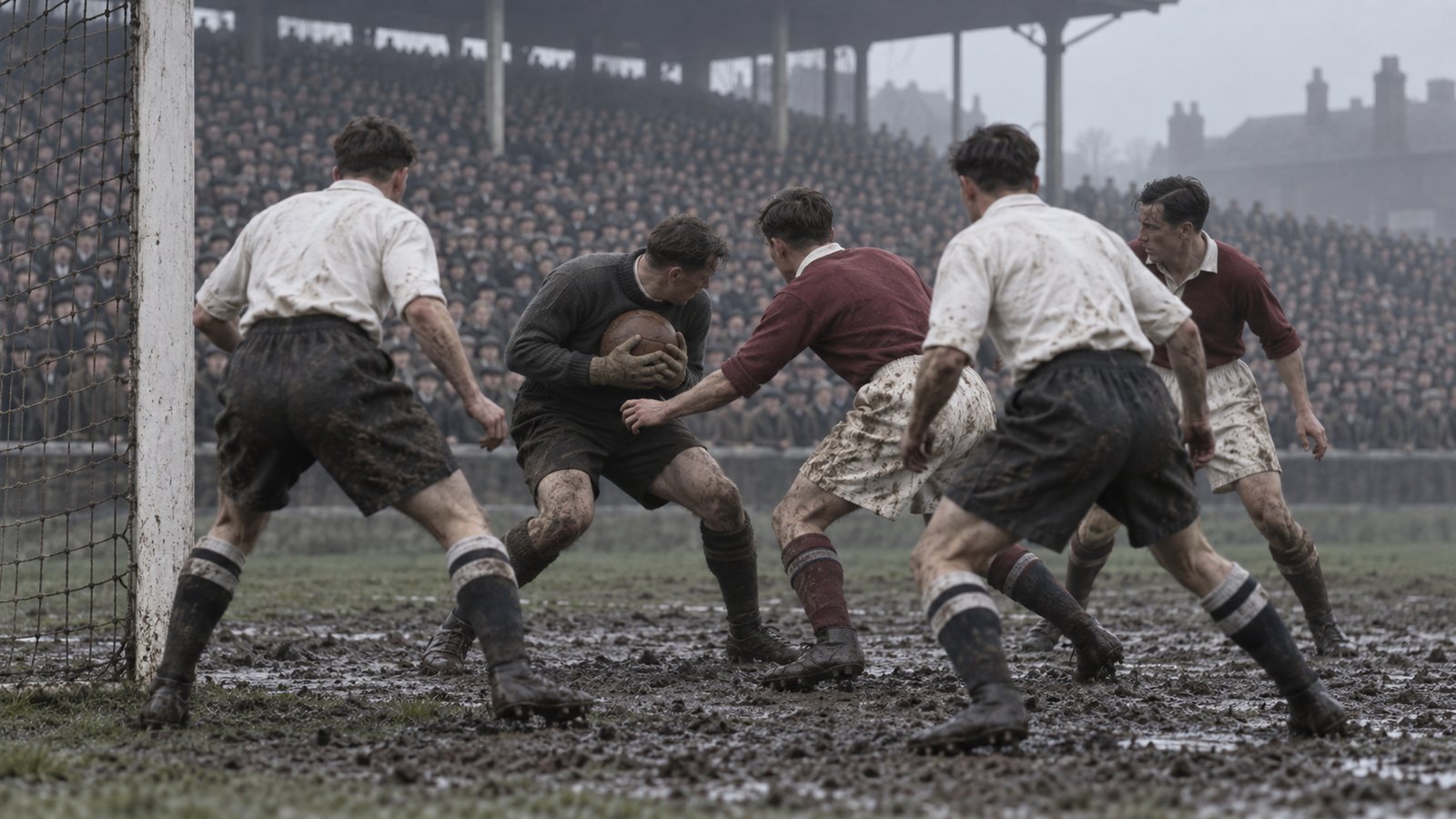
Referee H. S. Warr allowed play to continue long enough for the collision to become the central fact of the day, although it was not initially treated that way. A later sending-off for Chelsea’s Billy Mitchell, following a foul on Alex Hastings, increased the hostility in the ground. Warr needed police protection when he left. Yet the argument among supporters still followed the familiar grammar of football: foul, decision, mistake, goal.
Thorpe remained on the pitch because football then offered no substitute who could replace an injured goalkeeper. Witnesses described him pausing and using a goalpost to steady himself. He subsequently failed to deal with a rebound, allowing Bambrick to score, and then lost a backpass from Bert Johnston in a tangle that produced Chelsea’s equalizer. The final score fixed those moments in public view. The damage behind them was invisible.
A match report had to be read backward
The initial newspaper criticism is one of the most revealing parts of the episode. A Sunderland Echo correspondent focused on Thorpe’s failures and wrote that his goalkeeping had cost the leaders a point. That was a conventional judgment made from conventional evidence: the reporter saw a goalkeeper concede goals he might normally have prevented.
After the match, Thorpe went home with a swelling on his forehead. His condition deteriorated over the weekend. His face was bruised, an eye socket was swollen and he was seriously ill. He entered Monkwearmouth and Southwick Hospital on Monday 3 February. He died on Wednesday 5 February.
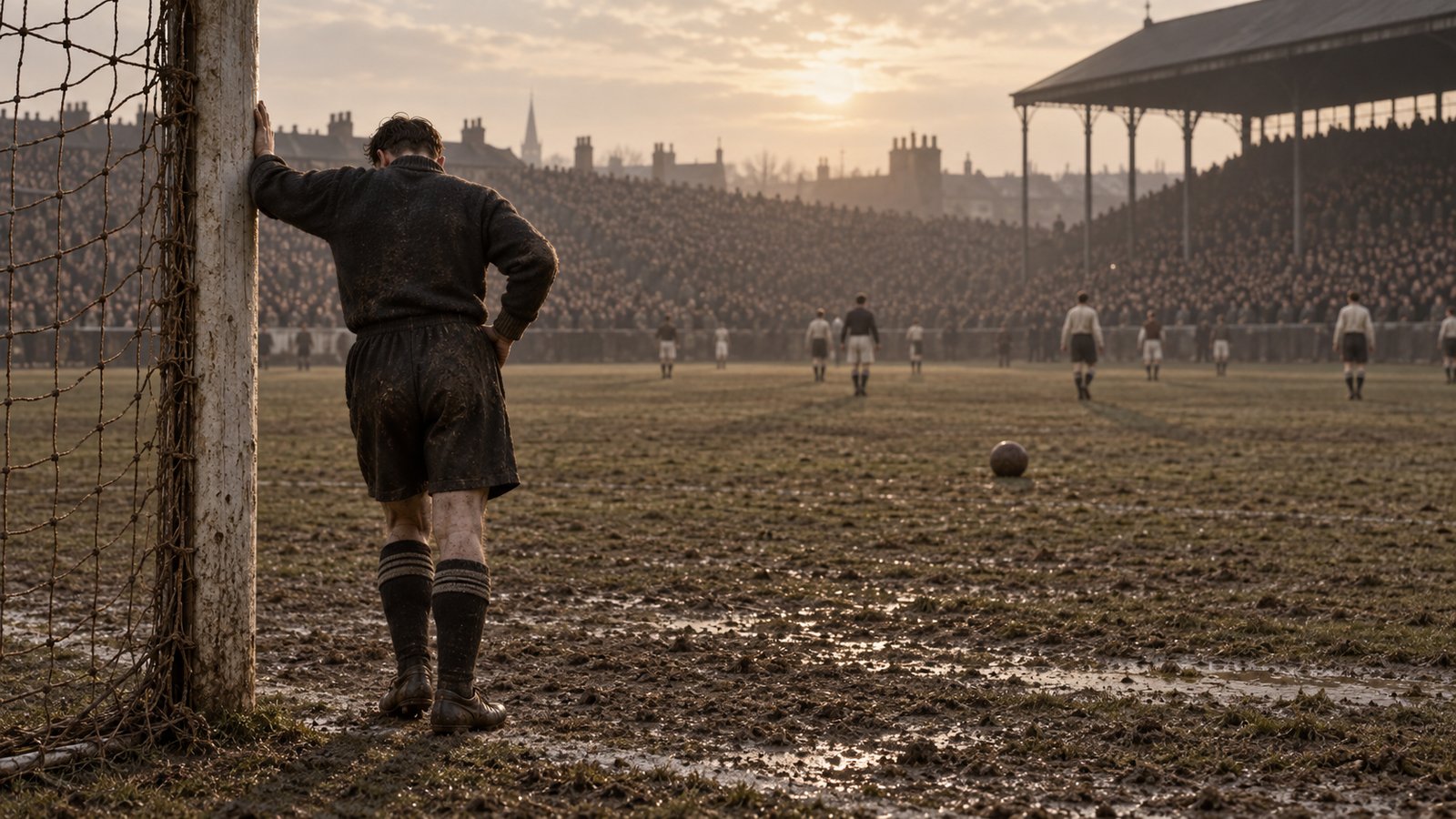
The Echo writer then apologized. He wrote that the people who had cursed Thorpe’s failures did not know the goalkeeper had been “a hero to carry on at all,” and admitted that he had not known either. The correction did more than withdraw a harsh assessment. It changed the order in which every observable moment had to be understood. Leaning on the post was no longer a pause between attacks. The mishandled rebound and lost backpass were no longer isolated technical faults. They followed trauma and visible disorientation.
Carter later recalled that Thorpe appeared all right when the players left the ground and made no complaint. The captain learned of his death when the team reported for training on Wednesday. That memory resists a tidy dramatic script. There was no universally recognized collapse under the crossbar and no immediate shared realization. Different people carried away different fragments: a crowd’s anger, a reporter’s criticism, a teammate’s impression that Thorpe seemed well enough to go home. The full picture emerged only after the final whistle had become irrelevant.
That is what separates this story from the more familiar emergency in which a reserve is suddenly forced into goal. When Nigel Spink faced Bayern after one first-team appearance, the surprise was visible and the football response was immediate. Thorpe’s crisis remained hidden inside his continued participation. The game treated his presence as proof that he could continue.
The inquest split cause from blame
An inquest convened at Sunderland Central Police Station on 7 February. Medical evidence did not reduce Thorpe’s death to a single blow. The recorded causes were diabetes mellitus and heart failure. The pathologist testified that the rough treatment described to him would tend to precipitate a diabetic coma. The careful formulation matters: Thorpe had a medical condition, and the violence he experienced could accelerate the fatal crisis.
The Football Association opened a commission on 17 February. Its conclusion created a second controversy. Sunderland was criticized for fielding a player in poor health, while the referee and Chelsea players were cleared. Roker Report’s reconstruction argues that the process failed to consult important medical evidence and left the club carrying institutional blame. Whatever judgment is made about that inquiry, its existence shows that the match could no longer be filed as an ordinary 3–3 draw.
Thorpe had played 139 times for Sunderland, his only senior club. He had completed 52 consecutive games before his death. Those numbers do not settle the medical question, but they explain why teammates and club officials did not see him as a visibly failing player before kickoff. Diabetes existed in the case; so did the kicks, the disorientation and the decision to let play continue. A responsible account has to hold those facts together rather than selecting the one that produces the simplest villain.
The inquiry also exposes the limits of 1930s football procedure. There was no concussion protocol, no independent medical removal and no substitute. Once Thorpe remained upright, the match demanded goalkeeping from him. The scoreboard then converted his impaired actions into responsibility for two goals. The institution could debate health and discipline later. During play, the only operational answer was to carry on.
The rule book finally entered the goalmouth
In April, the Referees’ Committee proposed explicit protection for a goalkeeper holding the ball. Its motion stated that although an opponent could charge a goalkeeper in possession under the laws of the period, kicking or attempting to kick either ball or man in those circumstances was impermissible and should be treated as violent conduct. The FA Council approved the change on 24 April.
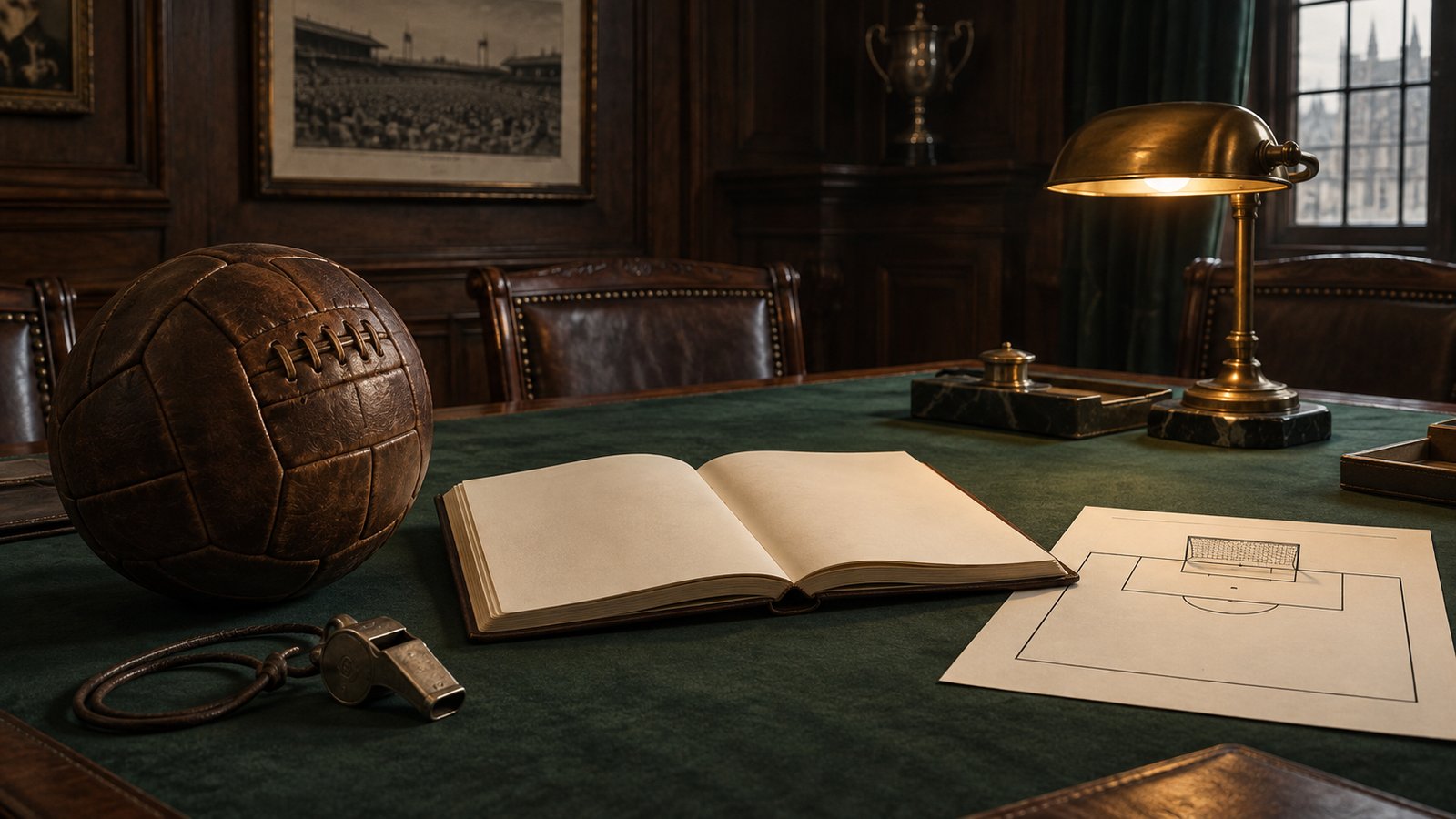
The wording is striking because it describes the boundary that had failed Thorpe in plain physical terms. Possession did not make a goalkeeper untouchable under every interpretation of the old game, but it could no longer leave him exposed to raised boots aimed through his body at the ball. The clarification did not create modern goalkeeper protection in one stroke. It marked a line football had been forced to see.
Sunderland finished the 1935–36 season as First Division champions, eight points clear in the two-points-for-a-win era. Thorpe was absent from the celebration he had helped make possible. At the club dinner on 7 May, his widow May and their three-year-old son Ronnie received his championship medal. That scene gives the season two endings: Carter lifting the title as Sunderland’s young captain, and a family accepting the medal earned by a goalkeeper who did not live to see the table completed.
Memory took longer to catch up. Thorpe’s grave in Jarrow remained without a headstone until a campaign involving family, supporters and historians succeeded in 2011. On the 75th anniversary of his death, Sunderland and Chelsea’s goalkeepers wore black armbands. These acts did not repair the judgments made on 1 February. They did insist that the player be remembered as more than the man beside two late goals.
The enduring warning is not a slogan about toughness. It is the sequence itself. A player took punishment, stayed in position, made mistakes, went home, entered hospital and died. Only then did the match report become evidence of something its author had not understood. Football eventually altered the rule. Thorpe never received the protection in time.
Sources
Roker Report; RSSSF English league tables; Wikipedia biographical reference, checked against the detailed club-history account.