
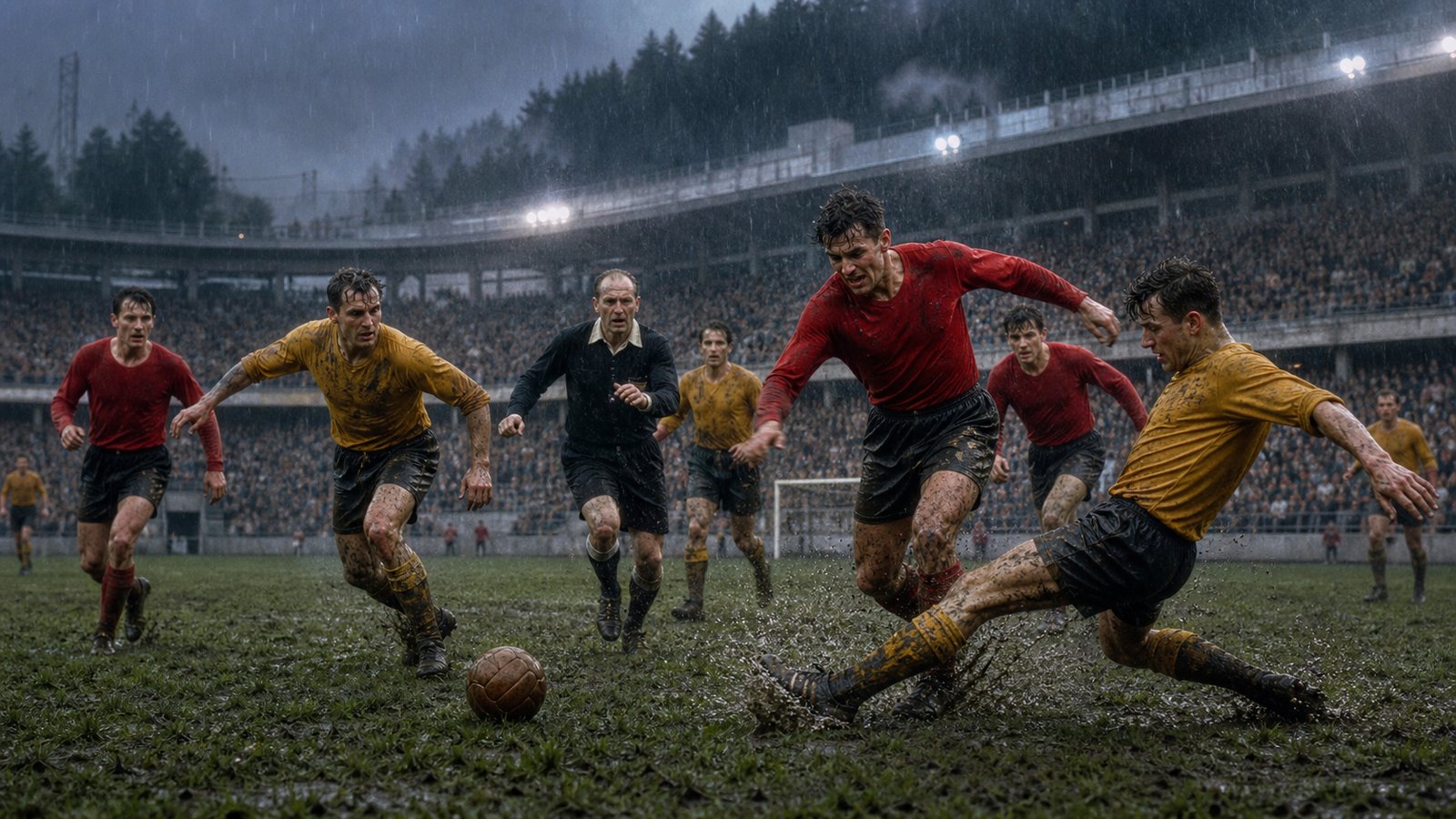
Seven minutes were enough for Hungary to lead Brazil by two goals in Berne. The next eighty-three minutes refused to become simple. A penalty pulled Brazil back. Another restored Hungary’s cushion. Julinho cut it again. Between those changes, tackles became confrontations, two players fought, a third Brazilian was dismissed, and referee Arthur Ellis gradually exchanged the ambition of managing a great quarter-final for the smaller task of getting everybody to the final whistle.
The match played at the Wankdorf Stadium on 27 June 1954 survives under a name that can flatten everything inside it: the Battle of Berne. There was violence, and the fighting continued beyond the field. Yet the football explains why the temperature stayed so high. The score kept offering Brazil a route back against the outstanding national side of the age. Each time that route narrowed, the contest became less governable. Hungary’s 4–2 victory was both a coherent World Cup match and a breakdown happening around it.
Two Heavyweights Arrived With Different Kinds of Pressure
Hungary came to Switzerland as Olympic champion and had assembled a 32-match unbeaten run. Its 6–3 win over England at Wembley in 1953 had provided the most famous demonstration, but the World Cup group stage was just as severe: nine goals against Korea Republic, then eight against West Germany. Even without the injured Ferenc Puskás for the quarter-final, Nándor Hidegkuti, Sándor Kocsis and Zoltán Czibor gave Hungary several ways to move and finish.
Brazil carried a different recent memory. Four years earlier, defeat by Uruguay in the decisive match in Rio had denied it the World Cup on home ground. The 1954 squad had changed, and the new yellow shirt already signalled an attempt to move beyond that loss. Brazil beat Mexico 5–0 and drew 1–1 with Yugoslavia before the draw placed it opposite the strongest attacking side in the tournament.
Those backgrounds created an uneven kind of urgency. Hungary was expected to confirm supremacy. Brazil had to prove that another encounter with the world’s best would end differently from 1950. Readers who want the two longer arcs can follow our accounts of Hungary’s Wembley demonstration and the match that scarred Brazil at the Maracanã. In Berne, those histories met on a wet afternoon with no room for a gradual opening.
Seven Minutes Made Every Remaining Decision Feel Urgent
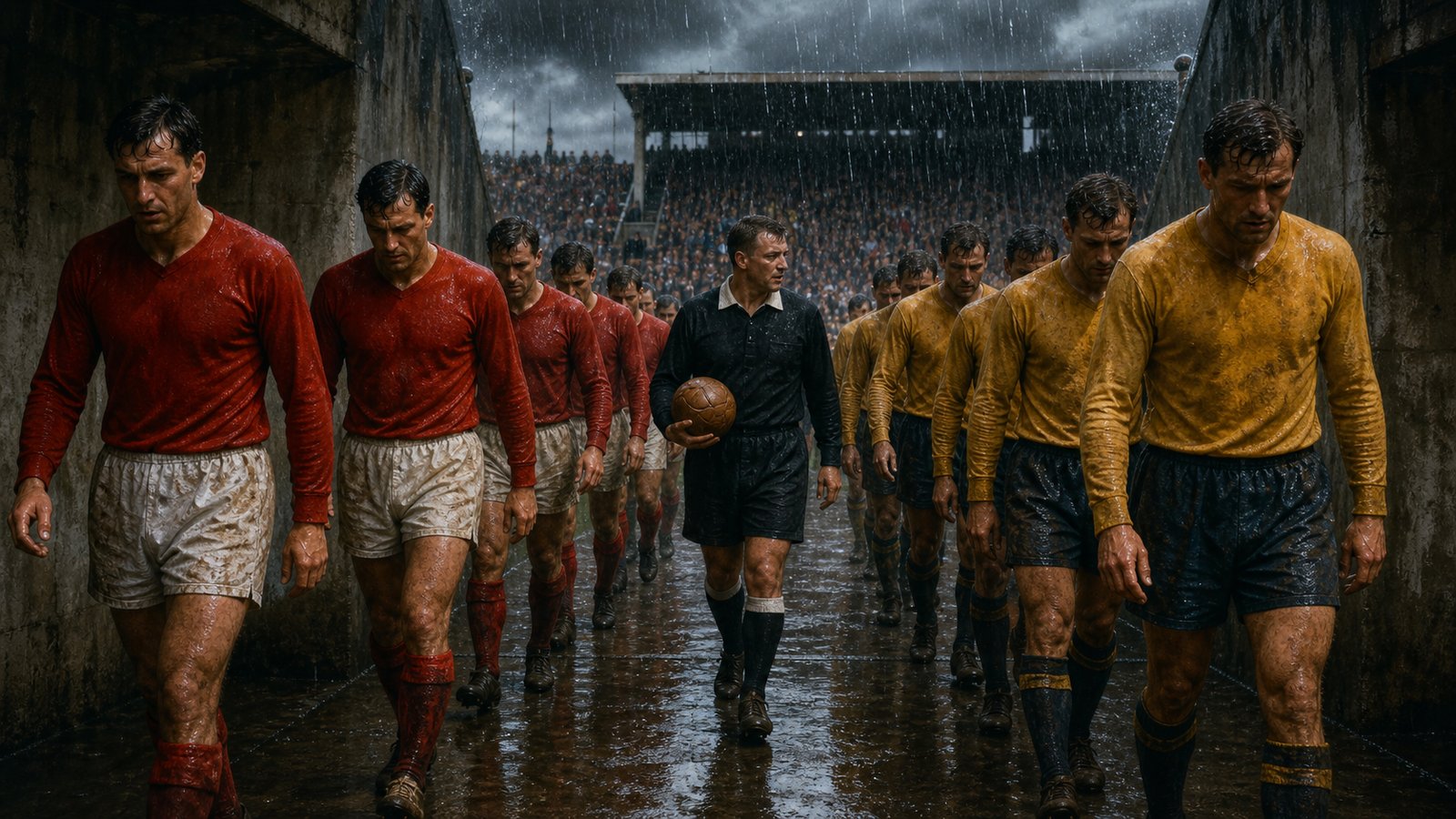
Hidegkuti struck first. Castilho saved the initial effort, but the Hungarian forward put away the loose ball. Kocsis then headed the second. Hungary’s advantage after seven minutes was not merely an early lead; it threatened to reproduce the scale of the 9–0 and 8–3 scores already attached to this team.
Brazil’s answer arrived from the penalty spot in the 18th minute. The detail Djalma Santos later remembered is wonderfully human: Didi walked away, Julinho walked away, and the bench told the right-back to take it. He asked whether they really meant him, then scored. The kick transformed the pressure inside the quarter-final. At 2–0, Brazil could fear a rout. At 2–1, every clearance, tackle and whistle could be interpreted as protecting or obstructing a possible recovery.
The score stayed there until half-time. That pause matters. Hungary had delivered the first shock, but Brazil had not been removed from the contest. A match between two gifted attacking teams remained available beneath the accumulating irritation. Ellis still had a football game to referee, not only a series of offences to punish.
The rain added a physical complication without deciding the behaviour. The ball skipped, footing became less certain, and contact could look or feel worse at speed. None of that excuses a punch or a reckless challenge. It does help explain why technical pressure and bodily risk occupied the same patch of grass from the opening minutes.
Two Penalties Kept Resetting the Edge of the Contest
On the hour, Pinheiro handled inside the area and Mihály Lantos converted Hungary’s penalty. The two-goal distance returned: 3–1. Five minutes later Julinho drove a cross-shot beyond Gyula Grosics and made it 3–2. The quarter-final had now produced two different two-goal Hungarian leads and two Brazilian replies.
This is the part lost when the match is described only as mayhem. Julinho’s goal ensured that the next Brazilian attack still carried sporting meaning. Hungary could not simply wait for the disturbance to exhaust itself. Brazil was one goal from level terms, while Kocsis and Hungary’s forwards remained capable of ending the argument with the next clean chance.
The repeated resets also raised the cost of each officiating call. A free-kick near midfield was not isolated from the scoreboard. A penalty decision had already altered the margin twice. A late challenge could interrupt the attack that might decide a World Cup place. FIFA’s retrospective counts 42 free-kicks in total, a figure that suggests how often Ellis had to stop, separate and restart a contest that would not settle.
The Referee’s Job Shrunk From Judgement to Completion
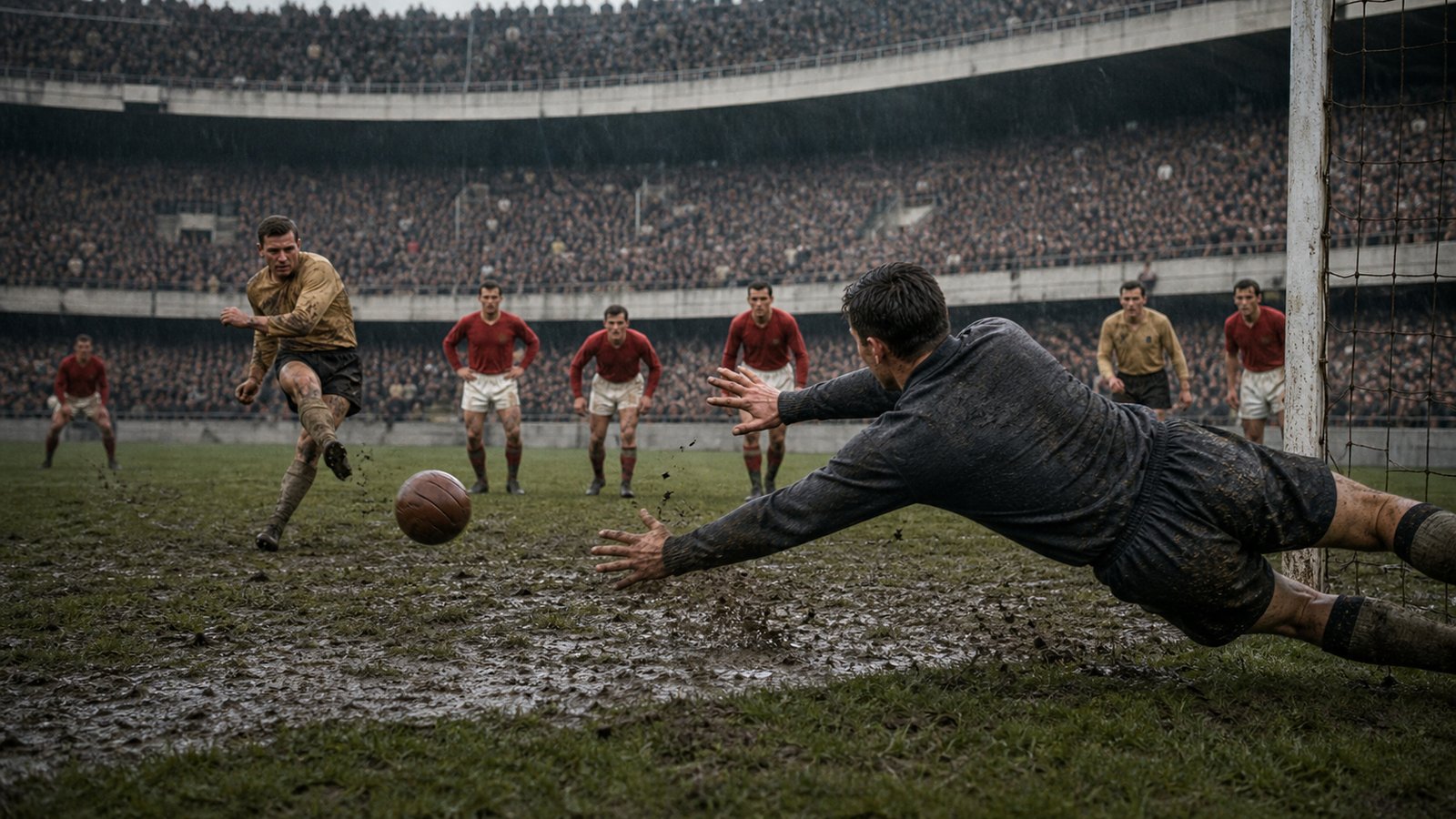
The decisive break in discipline came when Brazil’s Nilton Santos and Hungary’s József Bozsik fought. Ellis sent off both men. The symmetry of the dismissals did not restore calm. It removed two players while leaving the grievance, the score and the place in the semi-final unresolved.
With eleven minutes remaining, Humberto fouled Gyula Lóránt and became the third player dismissed. Brazil now had nine men against Hungary’s ten. The referee who had begun with two full teams and the possibility of a classic was counting bodies, monitoring retaliation and trying to preserve enough order for play to continue.
Ellis later expressed that contraction in stark terms. He had expected to see the best match of his life; by the end, his only thought was to ensure it reached its conclusion. It is a revealing measure of lost control. A referee normally tries to create conditions in which skill can decide the result. Here, completion itself had become the attainable standard.
Yet skill did supply the last change to the score. Kocsis found Hungary’s fourth late on, his second goal of the afternoon. Amid three dismissals and dozens of stoppages, one of the tournament’s great finishers closed the quarter-final in the conventional currency of football. Hungary led 4–2, and the whistle confirmed a result that the final scenes threatened to obscure.
The Whistle Ended the Score but Not the Confrontation
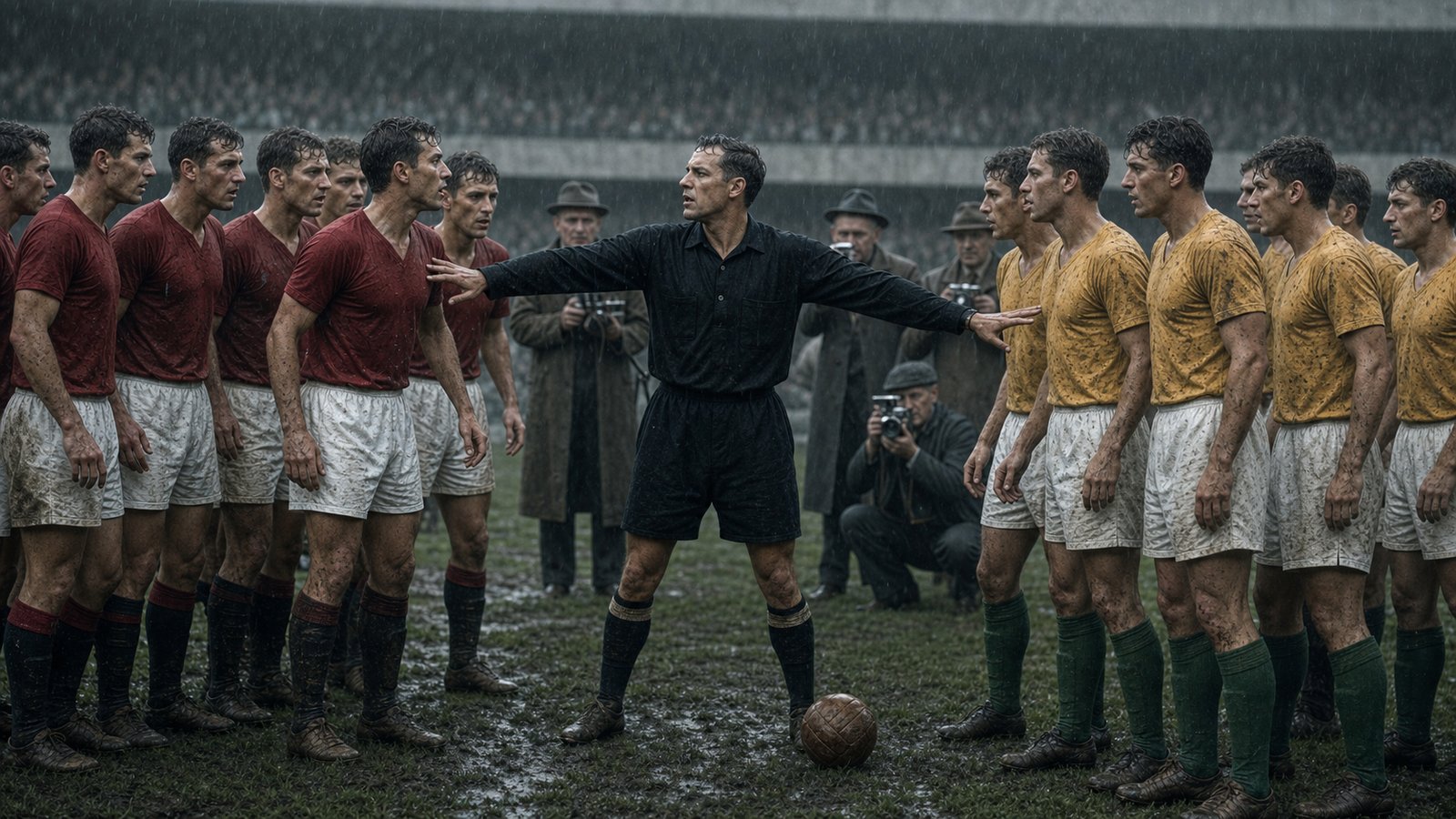
Players, officials, photographers and bystanders became involved after full time. The disorder moved from the field into the dressing-room area and beyond the stadium. The quarter-final therefore acquired its enduring title honestly. This was not a later nickname pasted onto a merely rugged game; the conflict physically outlived the play.
Still, the name should not erase the sequence that produced the result. Hidegkuti’s follow-up, Kocsis’s header, Djalma Santos accepting a penalty others had declined, Lantos from the spot, Julinho’s cross-shot and Kocsis again: these are six football actions, not footnotes to a fight. They gave the afternoon its alternating pattern of threat, recovery and separation.
Hungary advanced without Puskás and then beat Uruguay 4–2 after extra time, with Kocsis scoring twice more. The final supplied the reversal that gives 1954 its deepest irony. West Germany, beaten 8–3 by Hungary in the group, won 3–2 when the teams met again for the trophy. The brilliant unbeaten run ended one match after the encounter in which reaching the whistle had seemed like victory enough.
Brazil’s future also resists a neat moral. The defeated side of Berne would win its first World Cup four years later. The violent quarter-final was neither a necessary step toward that success nor proof that one football culture had replaced another. It was a specific collision between two elite teams under enormous pressure, with a live scoreboard continually preventing either certainty or escape.
That is the better way to remember the Battle of Berne. Do not look away from the blows or the dressing-room pursuit. But keep the score visible. At 2–1 and again at 3–2, Brazil could still imagine a semi-final. Hungary could still see the danger of losing control of a match it had opened brilliantly. The contest became infamous because footballing possibility survived long enough to feed the confrontation around it.
Sources
FIFA, “The Battle of Berne”; RSSSF, “World Cup 1954 finals”; Wikipedia, “Battle of Berne (1954 FIFA World Cup)” for contextual cross-checking.