
The Maracanazo is usually remembered by its sound: the huge Brazilian crowd falling into a silence so complete that it became part of football folklore. That memory is powerful, but it can make the match feel like a supernatural punishment rather than a football event. Uruguay’s 2-1 win over Brazil on 16 July 1950 was shocking because of the setting, the tournament situation, and the expectation around the hosts. It was also a match with mechanisms inside it: emotional control, compact defending, patience after conceding, and a sudden transition that turned a national celebration into a contest.
Brazil did not need to win the final-round match to become world champions. A draw was enough because the 1950 tournament ended with a four-team final group rather than a single knockout final. Brazil had already beaten Sweden 7-1 and Spain 6-1 in that group. Uruguay arrived at the Maracanã as the side expected to resist bravely before the home machine completed its coronation. The easy version says the favorite froze and the outsider found destiny. The better version asks how Uruguay kept the match close enough for destiny to have room.
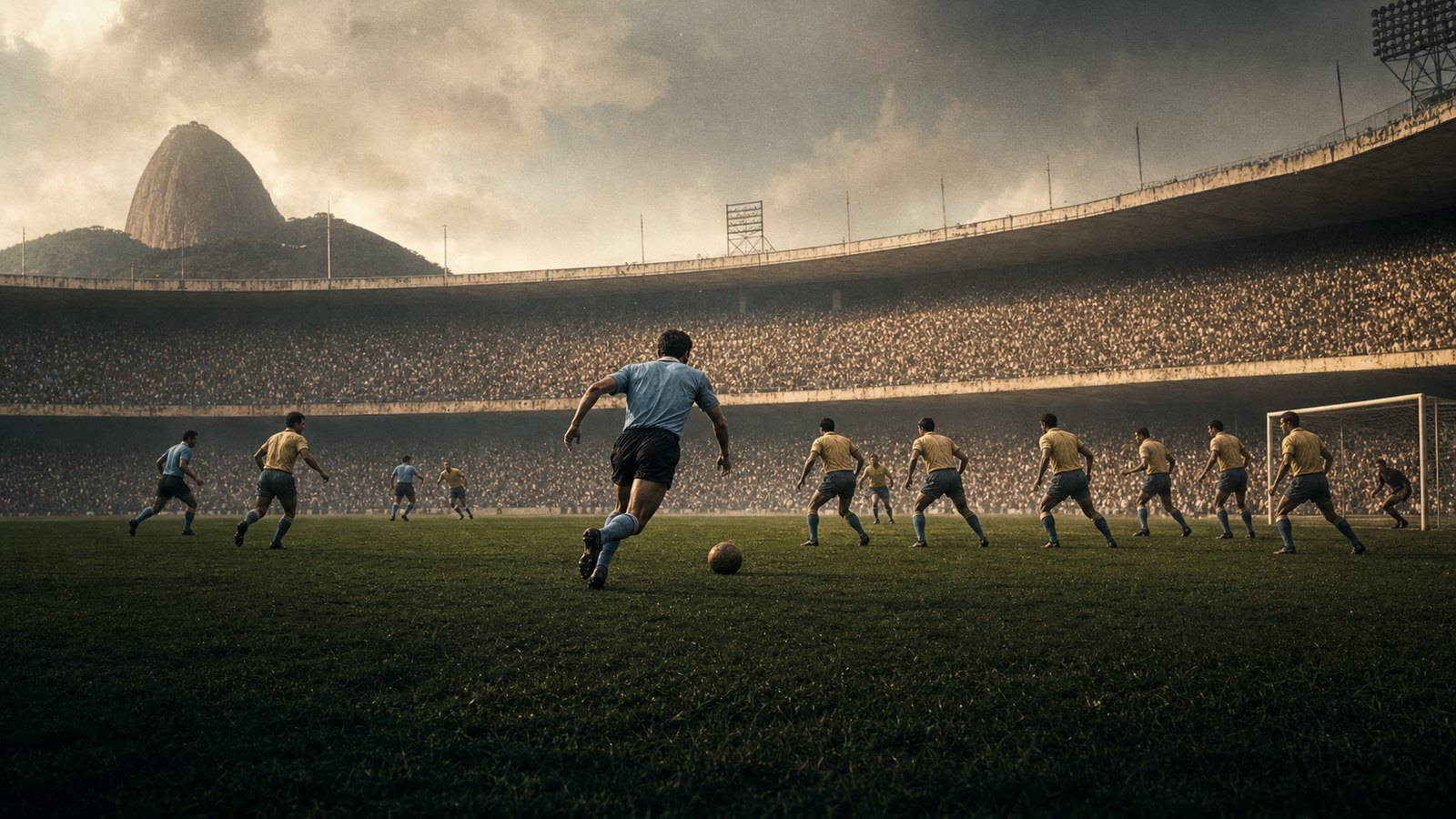
The format made Brazil powerful and vulnerable at the same time
The 1950 World Cup’s final group created a strange psychology. Brazil’s position was strong because a draw would do, but the country did not feel like a team protecting a point. The mood around the Maracanã was coronation. Brazil had scored freely, the crowd was enormous, and the expectation was not just victory but confirmation. That kind of atmosphere can lift a team, but it can also narrow the emotional options once the match refuses to follow the script.
Uruguay’s first task was therefore not to outplay Brazil for ninety minutes. It was to prevent the first wave from deciding the match. Juan López’s side had to compress space, protect the central areas, and make Brazil keep asking questions instead of receiving quick proof. Obdulio Varela became the symbol of that resistance because captains matter most when the crowd is trying to write the match for everyone else. His leadership is remembered partly because Uruguay did not behave like a team waiting to be overwhelmed.
Friaça scored, but the match did not end emotionally
Brazil took the lead early in the second half through Friaça, and that moment could have completed the expected story. In front of that crowd, with Brazil needing only a draw, 1-0 should have felt enormous. Uruguay’s response is the hinge of the match. They slowed the emotional surge, argued for the ball to be placed correctly before the restart, and forced the stadium to wait. Whether every detail of that pause has grown in the telling is less important than the football truth behind it: Uruguay needed to make the next minutes smaller.
That is often how underdogs survive a favorite’s breakthrough. They do not erase the goal. They reduce its aftershock. A side that panics after conceding can quickly concede again, especially against an opponent backed by a huge crowd. Uruguay instead kept enough structure for Brazil to feel that the second goal was not arriving automatically. The home side still had the advantage, but the emotional temperature had changed. The match was no longer a parade. It was a negotiation.
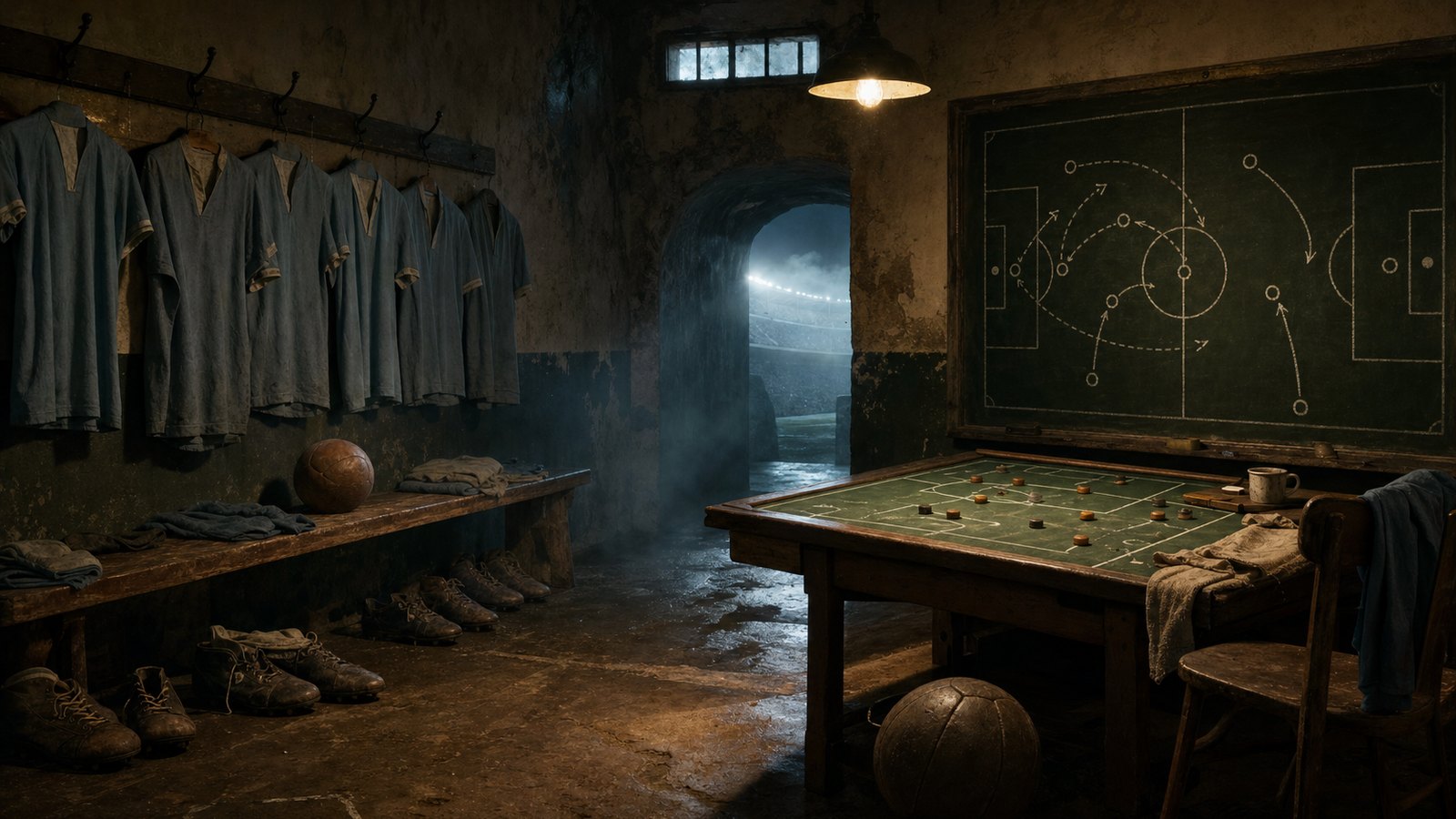
Schiaffino’s equalizer changed the shape of risk
Juan Alberto Schiaffino’s equalizer made the tournament situation suddenly uncomfortable for Brazil. At 1-1, Brazil were still champions if the score stayed there, but the match’s meaning had shifted. The home side now had to decide whether to protect the draw that was enough or chase the victory the occasion seemed to demand. That is a dangerous psychological split. Uruguay had created a state in which Brazil’s strongest position, needing only a draw, could begin to feel like an invitation to hesitation.
The goal also confirmed that Uruguay were not merely surviving. They had found a way to threaten the spaces behind Brazil’s confidence. Ghiggia’s work on the right, Schiaffino’s timing, and the team’s willingness to keep attacking moments alive meant Brazil had to defend transitions as well as dominate possession. The favorite’s pressure was real, but pressure that does not settle the match can become tiring. Every minute that passed without Brazil restoring order made Uruguay’s compactness feel less like resistance and more like a trap.
Ghiggia punished the one corridor Brazil could not close
Alcides Ghiggia’s winning goal is one of the most replayed actions in football memory because it feels so simple: a run down the right, a goalkeeper expecting a cross, a shot squeezed inside the near post. Simplicity is exactly why it hurts. Brazil’s dominance, crowd, and expectation all came down to one corridor that Uruguay had kept available long enough to use. The finish did not need to be spectacular in the modern highlight sense. It needed to be decisive before Brazil could reorganize emotionally or physically.
Moacir Barbosa’s name became unfairly attached to the trauma for decades, but reducing the goal to one goalkeeper’s mistake is another way of flattening the football. Ghiggia had already been a problem. Uruguay’s right-side route had forced Brazil to keep accounting for a threat that did not match the crowd’s expectation of one-way pressure. The near-post shot was possible because the match had trained Brazil to anticipate a different action. In that gap between expectation and execution, the entire tournament turned.
The silence was real, but it was produced by football
The silence after Uruguay’s second goal became the myth because it gave the result a physical form. A stadium that had been built for Brazil’s arrival as world champions suddenly had to process another country taking the trophy. Yet the silence was not just an emotional accident. It was the sound of a match mechanism becoming visible too late. Brazil had carried expectation; Uruguay had carried a way to stay alive inside it. When the underdog’s plan finally produced the winning action, the crowd was not only shocked by the score. It was shocked by the discovery that the coronation had always contained a contest.
That is why the Maracanazo still matters beyond national tragedy or romance. It shows that a favorite can be most vulnerable when the story around the match becomes larger than the match itself. Brazil’s talent and prior results were not illusions. The 7-1 and 6-1 wins in the final group were real warnings of how dangerous the side could be. Uruguay’s achievement was to move the decisive game into a different emotional and tactical register: fewer open spaces, more doubt after the first goal, and enough courage to attack when the safer historical role would have been noble defeat.
The lesson is not that belief beats quality
Belief alone did not beat Brazil. Uruguay had pedigree, including the 1930 World Cup title and deep South American competitive culture. They were not a village side wandering into the Maracanã. The lesson is sharper: belief becomes dangerous when it is attached to structure. Varela’s authority mattered because the team around him could still defend distances. Schiaffino’s quality mattered because Uruguay could get him into a decisive moment. Ghiggia’s nerve mattered because the right-side channel had not disappeared.
The Maracanazo survives because it joins all of those elements to an unforgettable setting. It is crowd noise, national expectation, and postwar football theatre, but it is also a tactical and psychological case study. A team expected to be background scenery kept the match small enough for its best actions to count. Then, in the one stadium where Brazil expected football to confirm a national dream, Uruguay made the sport do what it always can: ignore the script if the match itself has been prepared differently.
Sources
FIFA World Cup archive; RSSSF 1950 World Cup records; AUF historical material; Jonathan Wilson, Inverting the Pyramid; David Goldblatt, The Ball Is Round.