
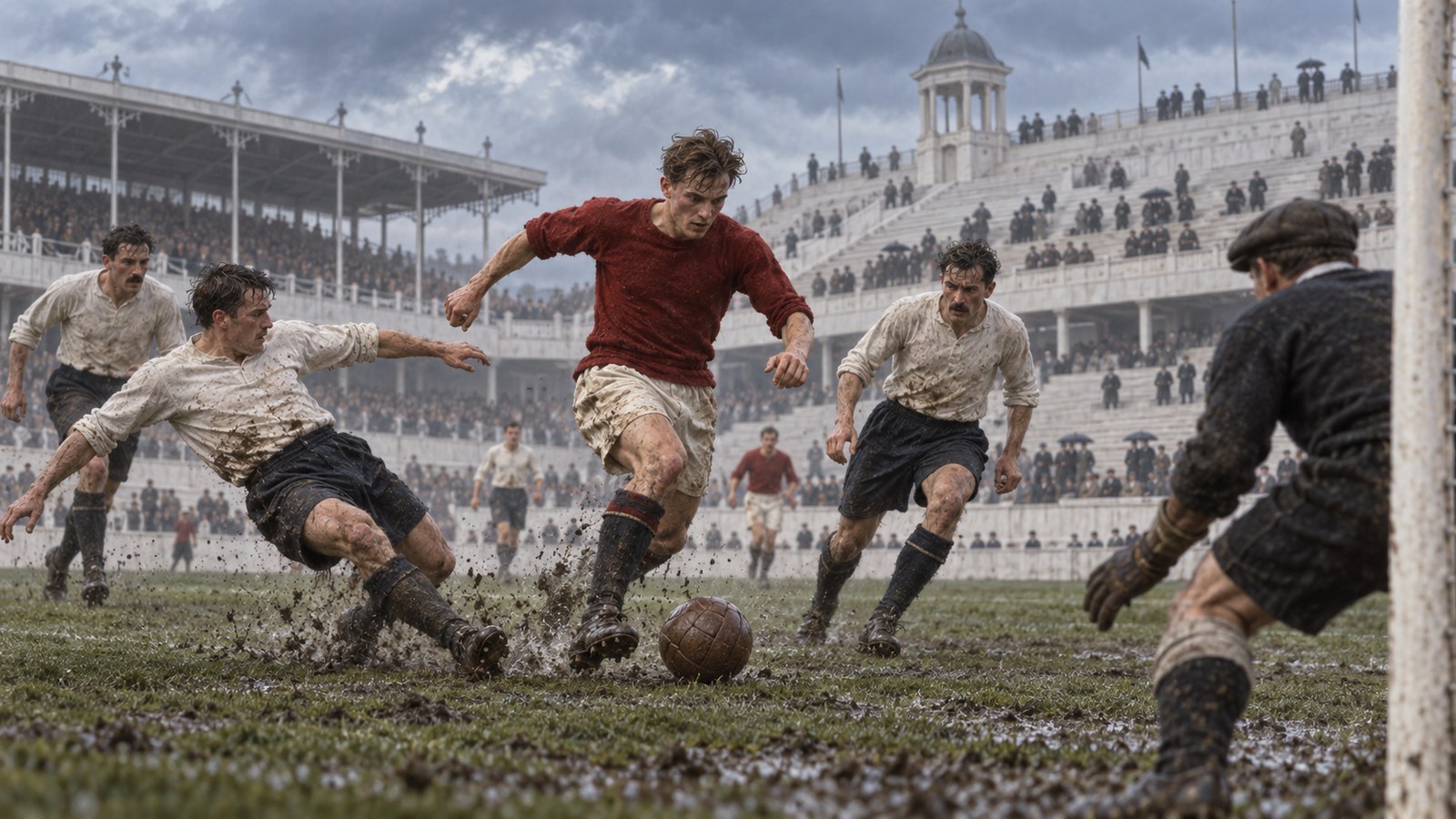
At White City Stadium on 22 October 1908, Sophus Nielsen scored in the third minute, then again in the fourth, then again in the sixth. Denmark’s Olympic semi-final against France A was only beginning, but the match had already acquired a pace that the visitors could not slow. By full time the score was 17–1, and one Danish forward had supplied ten of the goals.
The number is the obvious attraction. Yet the score sheet becomes more revealing when read as a sequence rather than a curiosity. Nielsen’s ten goals arrived in clusters, separated by the only French goal and by contributions from three Danish teammates. It records a contest between a settled side and a French team making a same-day journey across the Channel during an Olympic tournament whose shape was still being improvised.
Three Goals Before France Could Breathe
Nielsen was twenty years old and playing for Boldklubben Frem in Copenhagen. This was only his second senior international. Three days earlier, Denmark had opened the tournament by beating France B 9–0. Nielsen scored the ninth goal in the 78th minute, while Vilhelm Wolfhagen scored four and Harald Bohr and Nils Middelboe each scored twice.
The semi-final against France A began differently. Nielsen did not wait for the match to open around him. The surviving Danish match record places his first three goals in the third, fourth and sixth minutes. It was an extraordinary compression: three changes to the score before ten minutes had passed, all from the same forward.
France did answer. Émile Sartorius scored in the 16th minute, making it 3–1. That detail matters because the final score can make the match look like an uninterrupted Danish procession. For a short interval, France had stopped the opening rush and put a goal of its own on the board.
Then Denmark widened the gap again. August Lindgreen scored in the 18th and 37th minutes. Nielsen added his fourth in the 39th. The half-time score was 6–1, already decisive but still far short of the number by which the game would be remembered.
What the Scorecard Actually Shows
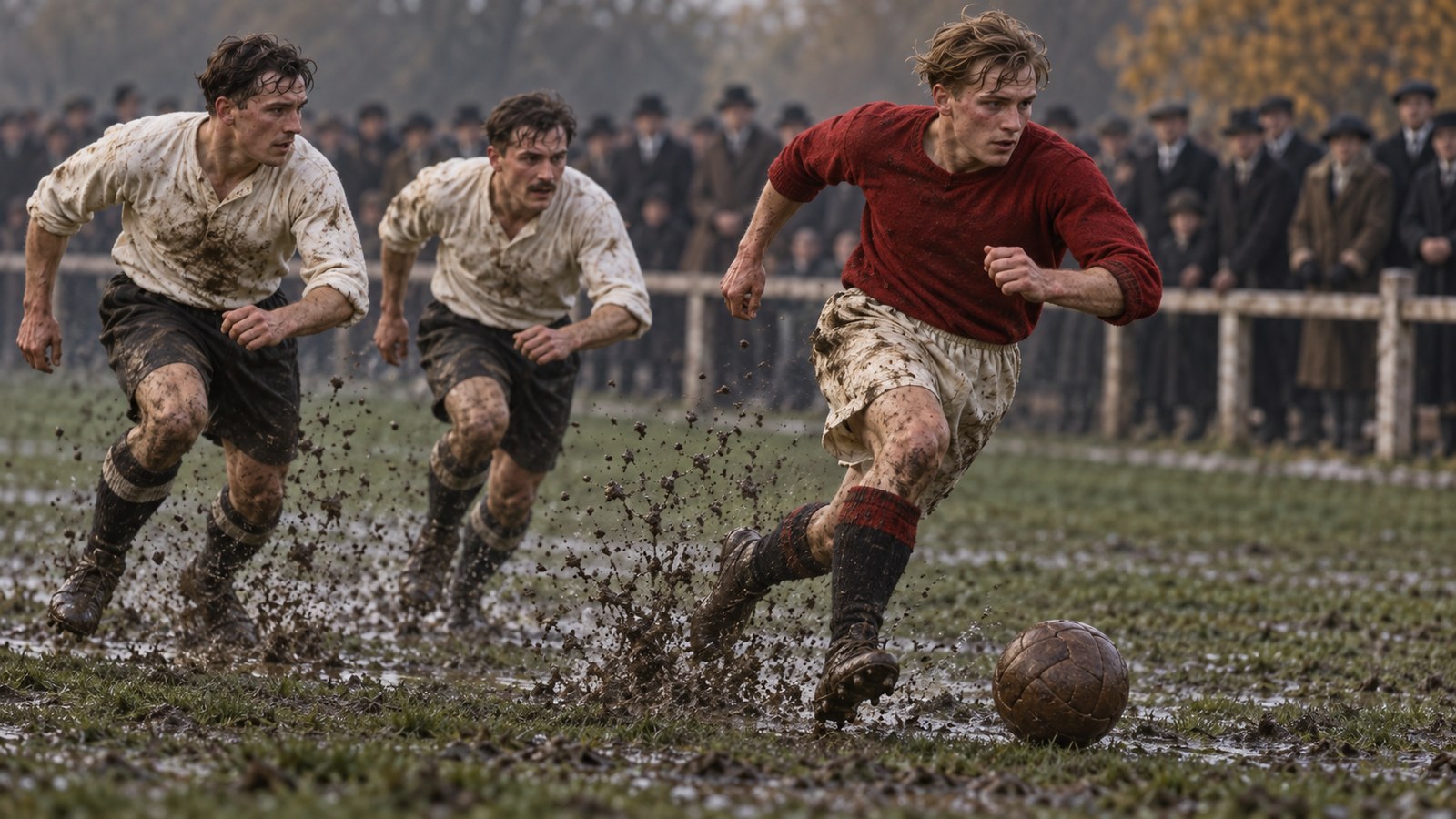
The second half turned the match from a heavy defeat into a record. Nielsen scored immediately after the restart, in the 46th minute, then again in the 48th and 52nd. In six minutes he moved from four goals to seven. France had faced one opening burst and now met another.
Wolfhagen made it 10–1 on the hour. Nielsen then scored in the 64th and 66th minutes. Nils Middelboe added Denmark’s thirteenth in the 68th. Wolfhagen scored again in the 72nd, Nielsen reached ten personal goals in the 76th, and Wolfhagen completed the scoring with goals in the 82nd and 89th minutes.
That distribution explains why Nielsen’s feat was part of a larger attacking performance rather than a solitary exhibition. Wolfhagen scored four, Lindgreen two and Middelboe one. Denmark had multiple routes to goal, but the forward from Frem repeatedly occupied the decisive space when attacks reached the penalty area.
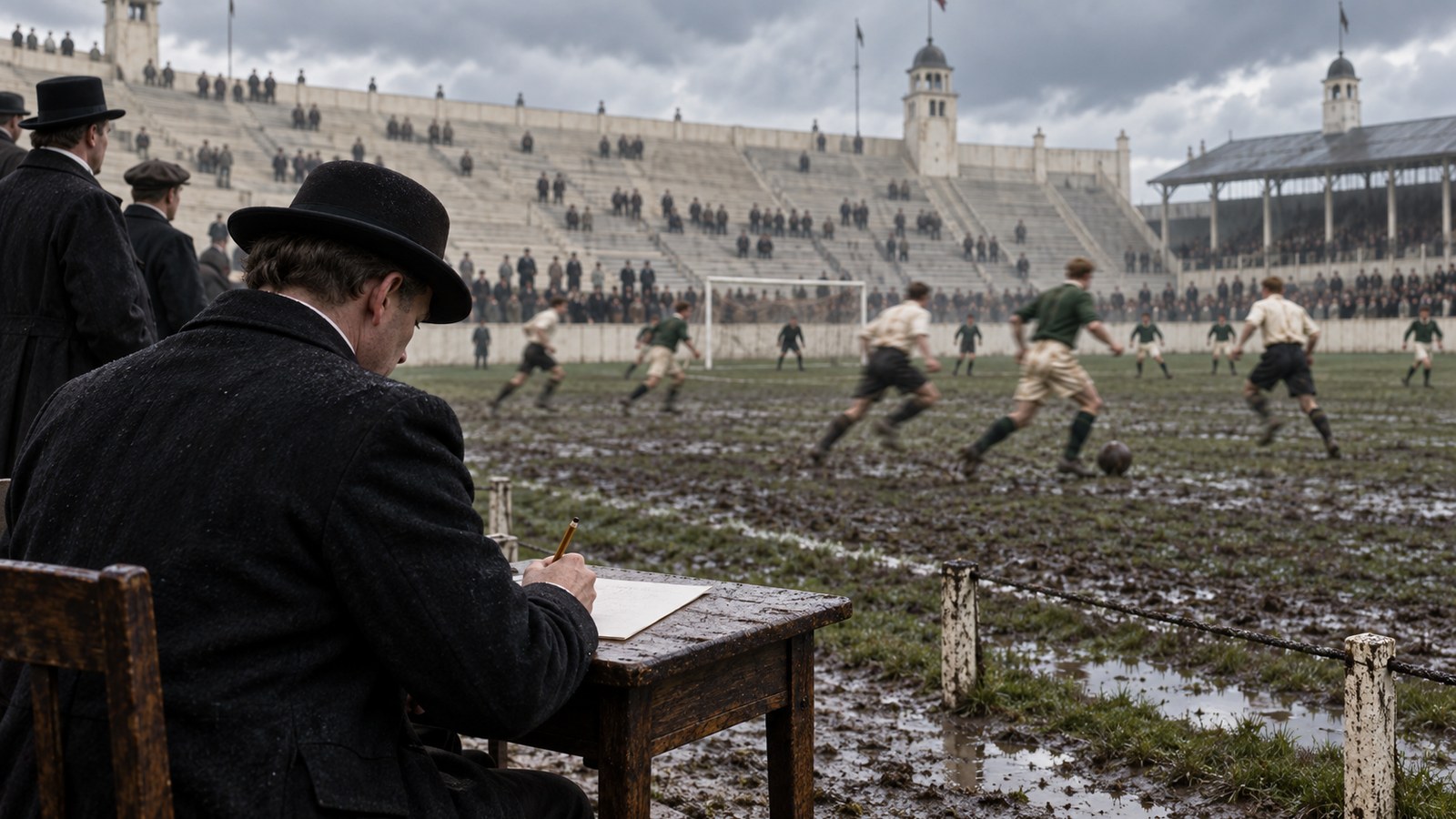
The official Danish record lists only 1,000 spectators. The score therefore did not begin life before a vast crowd or in a modern global broadcast. It survived because international football keeps unusually durable ledgers. Ten entries beside one player’s name gave the match a second life long after the noise at White City had disappeared.
A Tournament Still Finding Its Shape
The football competition at the 1908 London Games was the first one now treated as an official Olympic tournament. Its arrangements were far removed from a contemporary finals event. Eight sides entered the draw, but Hungary and Bohemia withdrew before playing. France had entered two teams, France A and France B, while the British entry was an all-English amateur side selected by the Football Association.
Travel also shaped the French preparation. The RSSSF tournament history, drawing on contemporary reports, says both French sides crossed the Channel on the morning of their matches and returned home immediately afterward rather than staying overnight in London. France B lost 9–0 on 19 October. France A arrived for the semi-final three days later and met a Danish team that had already played on the same ground.
That context does not erase Denmark’s football or Nielsen’s finishing. It does explain part of the physical imbalance visible in the score. One side had continuity, a previous tournament match and a forward line already sharing goals. The other had travelled on match day into a format that had been thinned by withdrawals and complicated by multiple entries.
The competition even contained plans for a consolation tournament for eliminated teams. Those plans largely dissolved after the French sides left and did not return. The Netherlands eventually beat Sweden for bronze, while Denmark advanced to face Great Britain for gold.
Denmark’s two French matches also reveal how sharply one tournament could change within three days. Against France B, the goals were spread across Wolfhagen, Bohr, Middelboe and Nielsen. Against France A, Nielsen supplied the opening burst and then resumed immediately after half-time. The same Danish team framework produced two emphatic wins, but the second score grew around one finisher’s repeated returns to the record.
Two Days Later, a Different Match
Denmark’s final took place on 24 October, only two days after the 17–1 semi-final. Nielsen started again, but the scoring flood did not travel with him. Great Britain won 2–0 through goals from Frederick Chapman in the 20th minute and Vivian Woodward immediately after half-time.
The recorded attendance was 12,000, twelve times the figure listed for Denmark’s semi-final. Nielsen ended his first Olympic tournament with eleven goals in three matches: one against France B, ten against France A and none in the final. Denmark received silver, and Nielsen would win another Olympic silver medal in Stockholm in 1912.
His international record was compact. Olympedia lists him at fourteen appearances and sixteen goals, which means the White City semi-final supplied well over half of his total. The match was not merely his best scoring day. It dominates the arithmetic of his national-team career.
That concentration separates Nielsen from players whose international totals accumulated over long qualifying campaigns. He reached eleven Olympic goals in his first three Denmark appearances, then returned four years later for another silver medal. The record belongs to a brief national-team career, while his much larger club output for Frem and Holstein Kiel shows that the scoring instinct was not confined to one London afternoon.
The Record Outlived the Match
Nielsen’s ten-goal international mark was equalled at the next Olympic tournament. In 1912, Germany’s Gottfried Fuchs scored ten against Russia. For nearly a century, those performances remained the benchmark for goals by one player in a senior international.
Archie Thompson finally exceeded it in 2001, scoring thirteen for Australia in the 31–0 World Cup qualifier against American Samoa. The comparison links two matches separated by ninety-three years, but it also warns against treating record scores as interchangeable. Australia’s result belonged to a modern qualifying structure with its own competitive imbalance. Denmark’s belonged to an Olympic competition still deciding who could enter, who could travel and what happened to teams after elimination.
Nielsen returned to club football with Frem, where the club archive credits him with approximately 125 goals in 137 matches. It also records a remarkable 1911 spell with Holstein Kiel: 72 goals in 18 matches. Those club figures reinforce the picture of an unusually prolific forward, but no other line in his career can compete with the minute-by-minute strangeness of White City.
The 17–1 score is too large to feel normal, and that is precisely why the order of events matters. France scored after Nielsen’s opening hat-trick. Denmark reached half-time at 6–1 rather than racing straight to seventeen. Then Nielsen struck three times in seven minutes after the restart and added three more before the 76th minute. The record was built in waves. Reading those waves restores a football match where a trivia number might otherwise flatten everything.
Sources
Olympedia; RSSSF; Danish national-team match archive; Boldklubben Frem historical archive.