
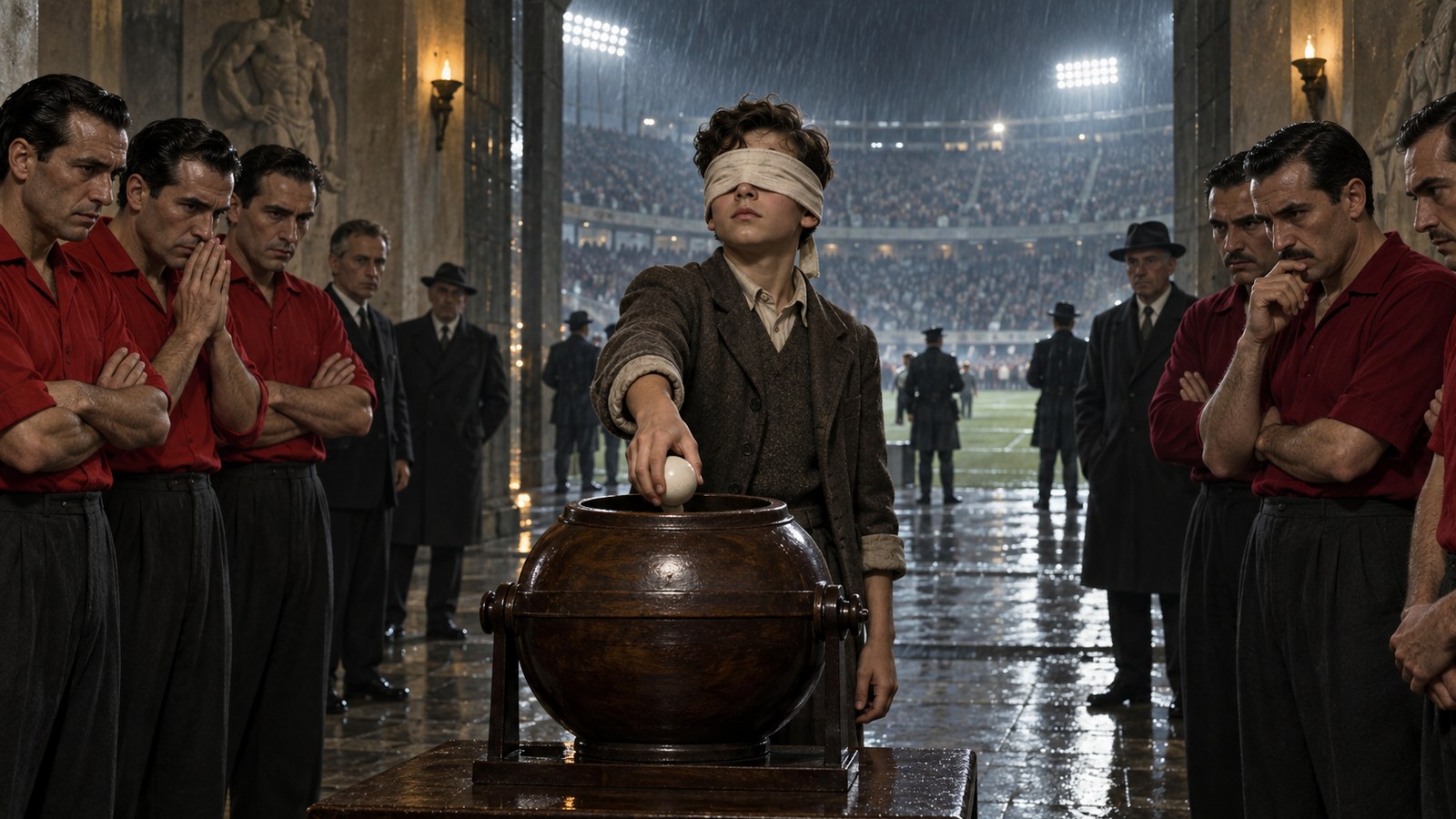
The 1954 World Cup place was sitting inside a drum in Rome. Spain and Turkey had played each other twice, then played a neutral-site decider for 120 minutes. Spain had scored more goals across the series. Turkey had won one match, Spain had won one, and the playoff had ended level. Nothing the players did next could separate them.
Officials summoned Luigi Franco Gemma, a 14-year-old whose father worked at the Stadio Olimpico. A New York Times history says the boy was blindfolded before he reached into the drum. He pulled out a ball carrying Turkey’s name. One national team was sent to Switzerland; the other went home.
The draw looks like an eccentric relic, but it only came after the competition had exhausted every separator it recognized. Group points counted results rather than aggregate dominance. A hurried playoff supplied four goals but no winner. Penalty shootouts did not yet exist in football’s laws. By the time Gemma raised his hand, chance was not interrupting the process. Chance was the process.
Spain’s Three-Goal Win Settled Less Than It Appeared
European qualifying Group 6 contained only Spain and Turkey. They would meet home and away, with the winner taking a place at the finals in Switzerland. Spain began as the clear favorite and appeared to confirm the difference in Madrid on 6 January 1954. A 4–1 victory gave the Spanish side a large margin before the return.
Modern eyes naturally add the scores. On aggregate, Spain was already three goals ahead. The group rules did not treat that margin as a cushion to carry into Istanbul. Match results produced the decisive points, and there was no away-goals rule waiting behind them. Turkey could force another game by winning the return, even by the narrowest score.
On 14 March, Turkey did exactly that. Its defence kept Spain scoreless, while Burhan Sargın found the only goal. The two-leg ledger now read Spain 6, Turkey 2, but each side owned one victory. A 4–1 and a 1–0 had equal value in the column that mattered. The qualification place moved to a playoff.
That distinction is the hinge of the story. Turkey did not erase Spain’s advantage goal by goal. It reached Rome because the competition asked a simpler question: who won each match?
The final group table preserved the oddity in numbers. After the playoff, both countries had played three times, won once, drawn once and lost once. Both held three points. Spain’s goals-for and goals-against columns, six and four, were better than Turkey’s four and six, but goal difference was not promoted into a final separator. The table recorded Spain’s superiority without allowing it to settle qualification.
Rome Had Three Days to Produce a Winner
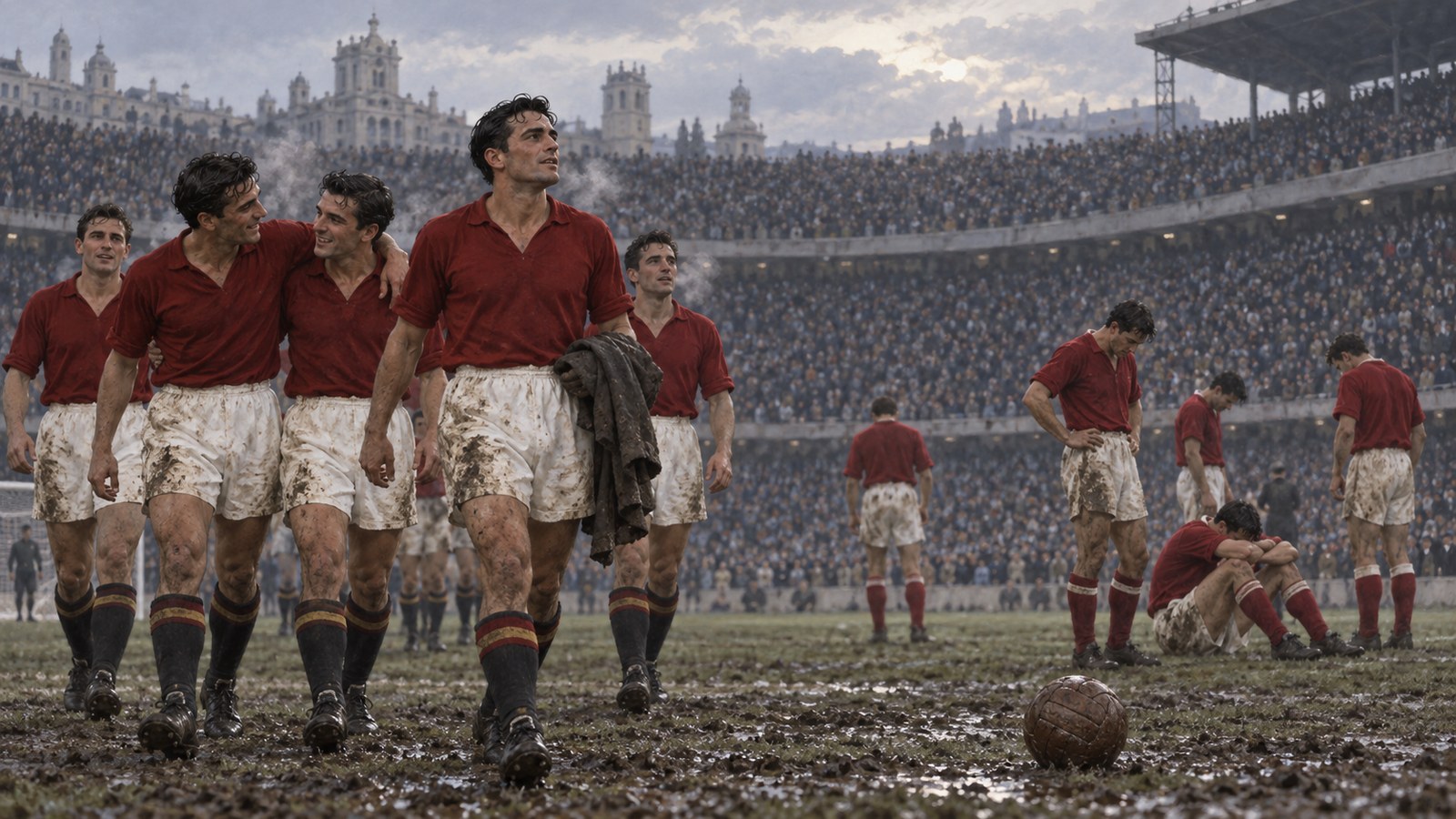
The playoff followed almost immediately. Three days after the return in Istanbul, the teams entered the Stadio Olimpico on 17 March. FIFA’s retrospective puts the crowd at roughly 60,000, an extraordinary audience for a qualifier relocated to neutral ground at short notice.
Spain struck first. José Luis Arteche scored in the 18th minute, restoring the favorite’s control. Sargın answered in the 32nd, adding an equalizer to the goal that had won the Istanbul match. The sides reached half-time at 1–1, with the World Cup place still balanced despite everything Spain had done in Madrid.
Around the hour, Suat Mamat put Turkey ahead. Spain now faced elimination after having led the three-match series by four aggregate goals at one stage. Adrián Escudero rescued the situation in the 79th minute. His equalizer made it 2–2 and extended the contest beyond normal time.
Extra time added another half-hour but no fifth goal. Players had now contested 300 minutes across ten weeks: ninety in Madrid, ninety in Istanbul and 120 in Rome. Spain had scored six times to Turkey’s four. The only tally still empowered to decide the group remained perfectly even.

A Boy Replaced the Shootout Football Had Not Invented
There would be no procession of takers toward the penalty spot. FIFA notes that shootouts entered the Laws of the Game through IFAB only in 1970. In 1954, another match was impractical and the regulations permitted a draw of lots. Administrative chance would finish what open play could not.
Gemma was not a dignitary brought to Rome for the ceremony. He was a stadium employee’s 14-year-old son. The later New York Times account describes him blindfolded, reaching into a drum for one of the balls placed inside. Turkey’s name emerged in his hand.
The blindfold mattered because the ceremony had to make ignorance visible. Gemma could not choose between the countries, read a label or respond to anyone in the room. The same officials who had supervised a match of 60,000 spectators now needed a child to demonstrate that the last decision was random. His lack of authority made him useful: neither side could plausibly say that the selector carried a football interest.
The Spanish players did not watch the selection from the field. Escudero later remembered them shut inside the dressing room, already dispirited and convinced that the day had gone against them. He had scored the goal that kept Spain alive, yet he could exert no influence over the final act. His recollection centered on helplessness: the boy chose Turkey, and there was nothing left to play.
Football would use lots again. Fourteen years later, Italy reached the 1968 European final on a coin toss. The Rome draw was even more severe. It did not merely set a bracket position or resolve a secondary ranking. It removed Spain from the World Cup.
Turkey’s First Finals Trip Began With a Second Playoff
The ball sent Turkey to its first World Cup. Switzerland then delivered another format that feels unfamiliar today. Turkey entered a group with Hungary, West Germany and South Korea, but the seeded structure did not require every team to face every other team.
Turkey lost 4–1 to West Germany and beat South Korea 7–0. It did not play Hungary, the group winner. Level with West Germany in the relevant standings, Turkey had to contest another playoff—this time on the field. West Germany won 7–2 and eliminated the Turkish side.
The opponents surrounding Turkey make the route look harsher in retrospect. Hungary and West Germany went on to contest the final, the match remembered as the Miracle of Bern. Turkey’s first appearance lasted only three games, two of them against the eventual champions.
Yet qualification itself had changed the country’s football record. Spain owned the better aggregate score and the larger first-leg victory. Turkey owned the return result, survived the Roman playoff and then received the only favorable decision left to receive.

The Rules Preserved Results Until Only Luck Remained
The striking part of the episode is not simply that a child decided a World Cup place. It is how many reasonable-looking rules were stacked before him. Victories mattered more than the size of victory. A neutral playoff protected both teams from home advantage. Extra time gave the players another chance to settle it. Each step was defensible on its own.
Together, those steps produced an ending detached from football skill. Spain’s six goals across three matches could not outweigh Turkey’s four. Escudero’s late equalizer prevented defeat without securing qualification. Gemma’s draw had greater force than every goal because the regulations had run out of sporting tests.
Penalty shootouts later moved this kind of decision back onto the pitch, where technique and goalkeeping could at least shape the outcome. They did not remove luck, but they gave players the final touch. Rome offered no such compromise in 1954. After 300 minutes, the decisive action belonged to a blindfolded 14-year-old and a ball inside a drum.
Sources
FIFA; The New York Times; Athlet.