
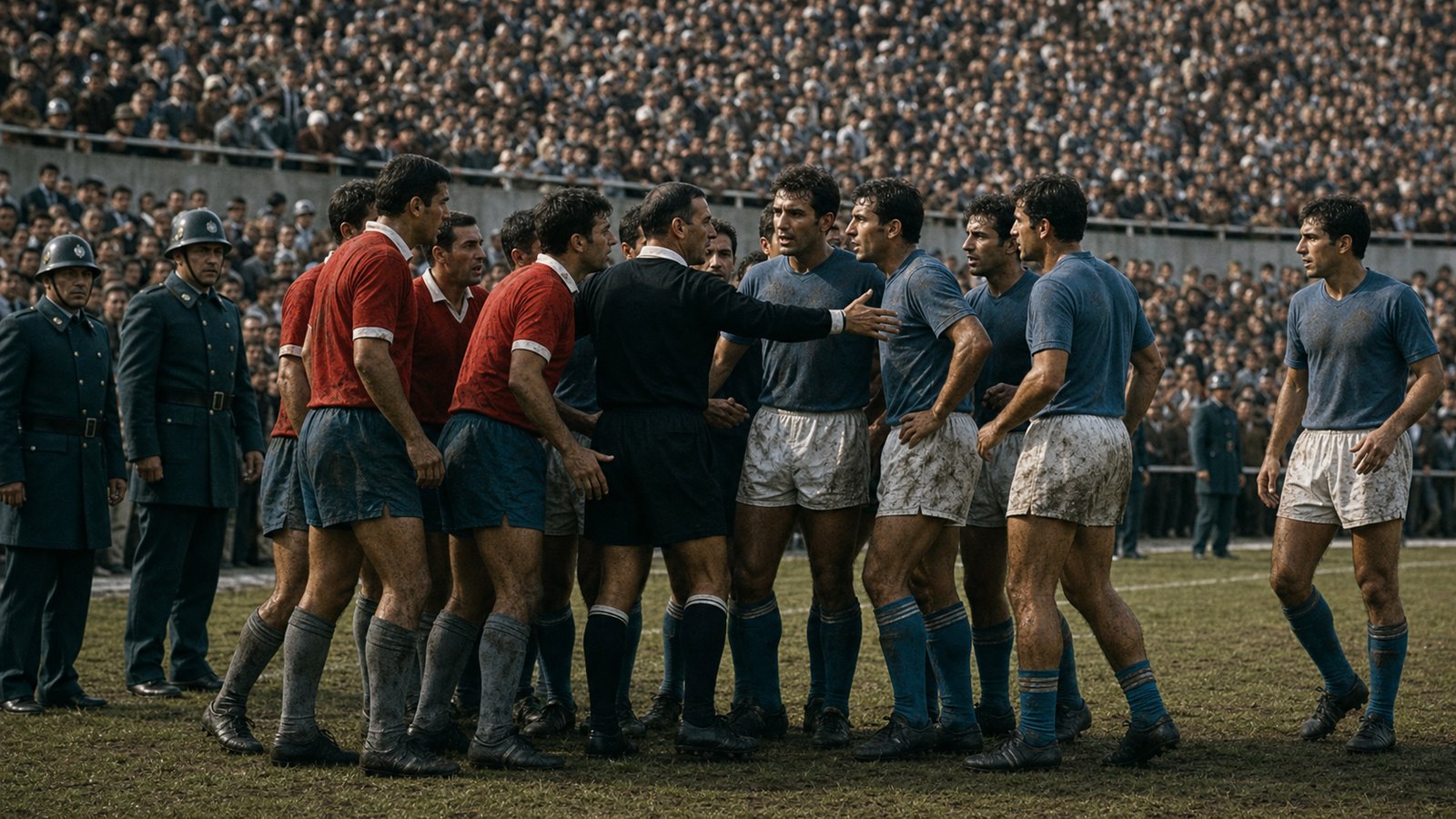
Before Chile and Italy kicked a ball in Santiago on 2 June 1962, the referee already knew he was not walking into an ordinary World Cup match. The tournament had opened in a climate of hard fouls and damaged bodies. The Italian press had insulted the host city in language that travelled faster than any attempt to calm it. FIFA had changed the referee after Italy objected to the original appointment. Inside the Estadio Nacional, 66,057 people were waiting.
Ken Aston had a whistle, two assistants and the authority written into football’s laws. What he did not have was a clear visual language for punishment, instant video evidence, neutral fourth officials or a security plan capable of keeping police outside the contest. The first foul came after 12 seconds. Within minutes, the match had become an argument that the laws alone could not settle.
The “Battle of Santiago” is usually remembered as a catalogue of punches and expulsions. Its more revealing legacy is institutional. It showed what happens when a global sport has rules but lacks reliable ways to communicate, enforce and explain them under pressure.
A World Cup Already Close to the Edge
The violence did not materialise from a calm tournament. Contemporary reporting collected by the Guardian described the first eight matches of the 1962 World Cup as producing four dismissals, three broken legs, a fractured ankle and cracked ribs. Argentina’s meeting with Bulgaria generated 69 free-kicks, roughly one every 78 seconds. In the Soviet Union’s game against Yugoslavia, Eduard Dubinski suffered a broken leg; Yugoslavia’s association later suspended Muhamed Mujić for a year even though he had not been sent off.
That context matters because it changes the Battle of Santiago from an isolated eruption into the most visible failure of a wider disciplinary problem. Players knew physical intimidation could shape a match. Officials had limited support, and punishment during play depended almost entirely on what the referee or a linesman happened to see.
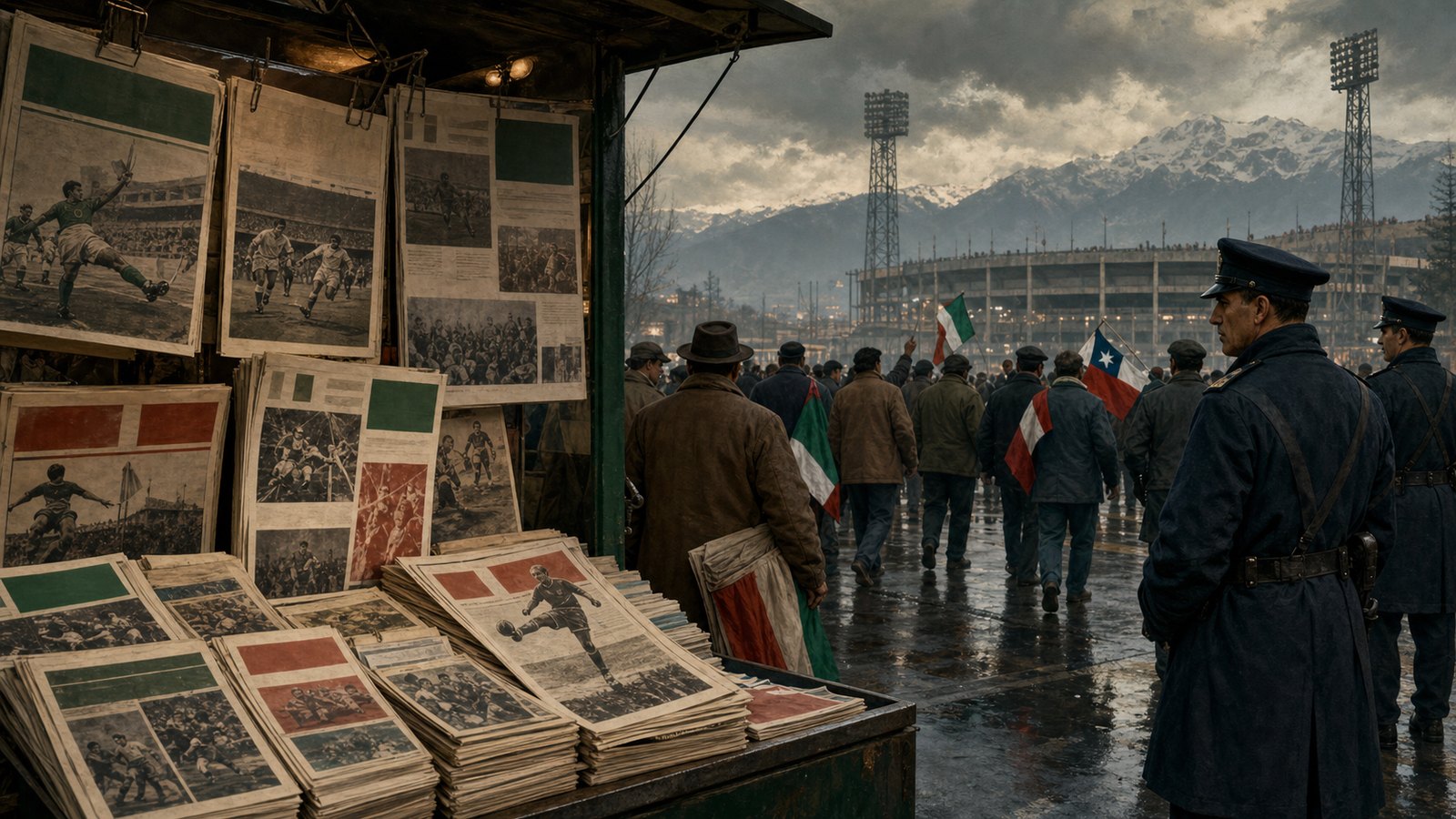
Chile against Italy then added a political charge. Italian reports in La Nazione and Corriere della Sera portrayed Santiago as backward, poor and dysfunctional. Corrado Pizzinelli wrote that “Santiago is terrible.” The journalists involved had to leave the country, and an Argentinian journalist mistaken for an Italian was beaten in a bar and hospitalised. A group-stage game had acquired the emotional weight of a national insult before either team entered the stadium.
Twelve Seconds to the First Warning
FIFA appointed the experienced English official Ken Aston after Italy complained about the original choice of a Spanish referee. Aston had already handled Chile’s opening match, so the replacement did not remove Italian suspicion. It merely placed one man at the centre of a conflict in which neither side expected to be treated generously.
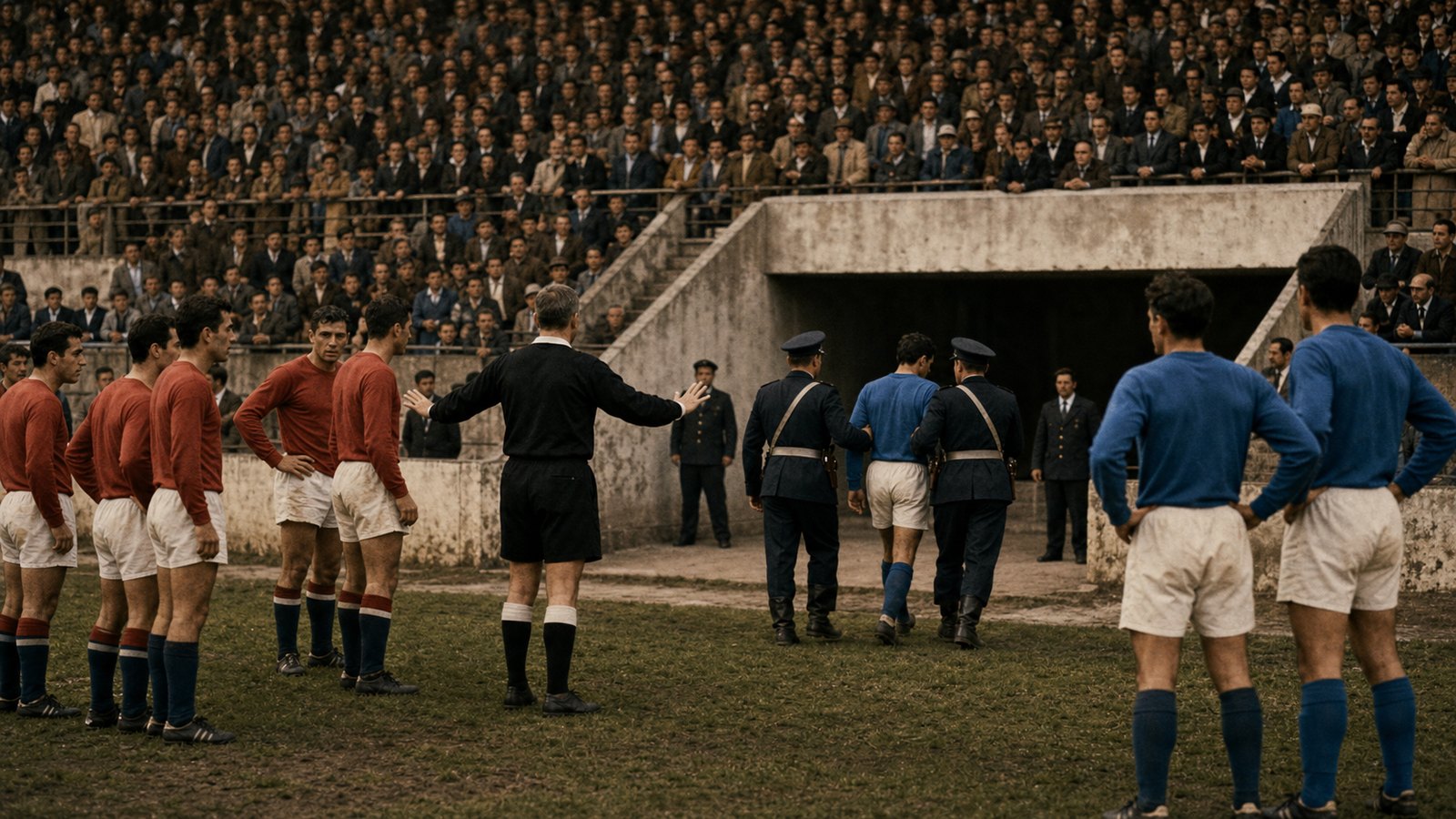
The first whistle for a foul came after 12 seconds. The first dismissal followed after four minutes in the Guardian’s reconstruction. Italy’s Giorgio Ferrini refused to leave, and the game stopped for about ten minutes while armed police removed him from the field. A referee’s decision had become physically unenforceable without state authority stepping over the touchline.
That image explains more than a list of cards ever could. A sending-off today is instantly understood by players, crowd and cameras through a red rectangle held above the referee’s head. In 1962, Aston had to deliver the message verbally and by gesture amid noise, anger and distrust. Ferrini’s refusal turned a disciplinary ruling into a public negotiation.
Police involvement did not restore a shared understanding. It restored motion. The match continued, but its participants were no closer to accepting the same boundaries.
The Punch Aston Did Not See
The most notorious incident exposed a second limit: authority cannot punish evidence it does not possess. Chile’s Leonel Sánchez struck Italy captain Humberto Maschio and broke his nose, according to the Guardian’s account. Aston did not see the blow. He later said that if neither referee nor linesman reported an incident, nothing could be done.
Sánchez later struck Mario David. David retaliated and was dismissed. To Italian eyes, the sequence looked like proof that provocation could escape while the visible response drew punishment. To Chilean eyes, the match was being fought in the shadow of insults to their country. Every decision therefore arrived inside a story the opposing side already believed.
Aston described the practical loneliness of the assignment in stark terms: it felt like him against 22 players. The line is useful because it strips away the romance often attached to old refereeing. One official could not monitor every collision, translate every instruction, judge every off-ball act and maintain legitimacy in front of more than sixty-six thousand spectators.
The missing blow did not merely produce an unfair moment. It weakened every ruling that followed. Once players concluded that justice depended on which action happened to be visible, retaliation became its own crude review system.
Chile Won After Football Had Nearly Disappeared
There was still a score. Sánchez took the free-kick from which Jaime Ramírez put Chile ahead in the 73rd minute against nine men. Jorge Toro scored the second, and the hosts won 2–0. Those facts make the match look conventional in a results table: date, venue, attendance, two scorers, two dismissals.
The surviving film tells a different story. Highlights took two days to reach Britain. BBC presenter David Coleman introduced them by calling the game the most “stupid, appalling, disgusting and disgraceful exhibition of football” he had seen. The delay allowed reports to build the match into legend before viewers could inspect the pictures themselves.
Its nickname stuck because the images were stronger than the tactical content: police on grass, players surrounding Aston, bodies and arguments interrupting play. The score decided a group match, but the broadcast gave football a warning. A World Cup could carry a contest around the planet while still relying on disciplinary methods designed for a much smaller, quieter game.

From a Whistle to a Visible Language
It would be too simple to say that Santiago directly created yellow and red cards. Aston’s famous traffic-light idea came later, after another communication crisis at the 1966 World Cup. As a member of the refereeing structure at that tournament, he helped calm Argentina captain Antonio Rattín after a disputed dismissal against England. Driving on Kensington High Street afterward, Aston connected amber with caution and red with stopping.
FIFA introduced yellow and red cards at the 1970 World Cup in Mexico. Their power was not that they changed the offences. Their power was that they made the decision portable. A player, supporter or television viewer did not need to hear the referee’s words or share his language. The colour carried the ruling across the stadium.
Santiago belongs in that history as an earlier demonstration of the problem. Aston had formal authority but struggled to make it visible, accepted and enforceable. Armed police entered the field on three occasions according to FIFA’s account of his career. He dismissed two Italians and broke up repeated confrontations, yet the match never acquired a stable boundary between play and reprisal.
Modern football has added assistants, fourth officials, electronic communication and video review. None guarantees agreement. They do, however, recognise the lesson that one whistle and one viewpoint are not enough when stakes, speed and audience become global.
The Real Lesson of the Battle
The Battle of Santiago survives because it is shocking, but shock alone makes it easy to treat as a grotesque antique. The more useful reading is about systems under stress. Hostile reporting supplied the grievance. A violent tournament supplied permission. Limited officiating sightlines supplied uncertainty. Weak communication supplied room for refusal. Police supplied the enforcement that football itself could not.
Chile’s 2–0 victory remained valid, and the tournament continued. Yet the match revealed a gap between having laws and having legitimacy. Players must know what has been decided. Spectators must be able to recognise it. Officials need enough support that an unseen punch does not poison every later call. A dismissal cannot depend on a ten-minute physical removal.
In Santiago, football had a rulebook but no universal signal for its most serious judgments. Eight years later, a referee could raise a red card and make “you are off” understandable without a sentence. The coloured card did not eliminate fury or injustice. It gave the sport a shared piece of language that the Estadio Nacional had conspicuously lacked.
Sources
The Guardian, “World Cup stunning moments: The Battle of Santiago”
FIFA, “Ken Aston — the inventor of yellow and red cards”
FIFA Match Centre, “Chile vs Italy, 1962 FIFA World Cup”
Wikipedia, “Battle of Santiago (1962 FIFA World Cup)”