
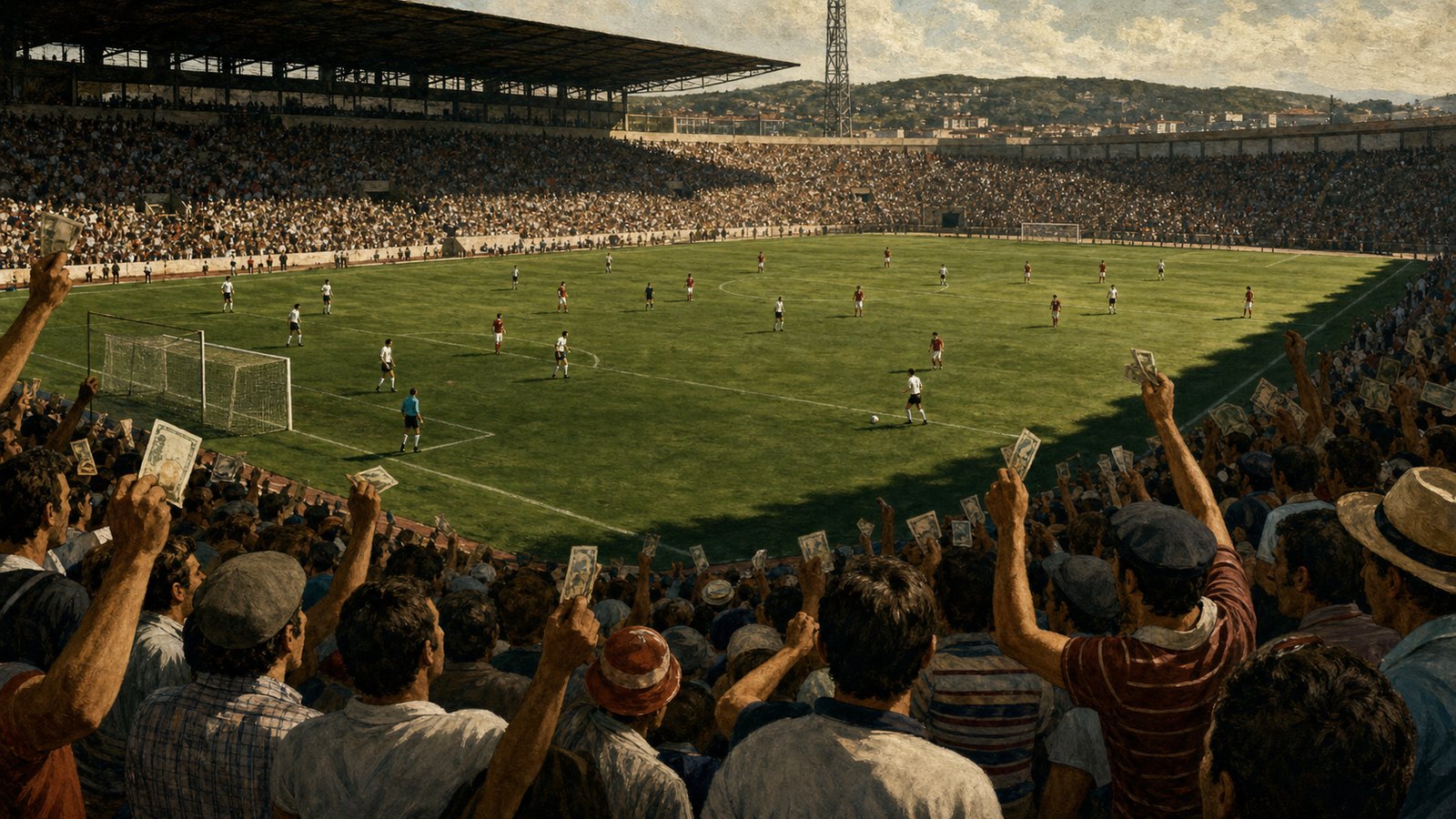
At 17:15 on 25 June 1982, the last match in World Cup Group 2 began at El Molinón in Gijón. West Germany needed to win. Austria could afford to lose, but not too heavily. Algeria had already completed its three games and could only watch. Ten minutes later Horst Hrubesch scored, and the arithmetic snapped into its most poisonous shape: 1–0 sent both European teams through and sent Algeria home.
The scandal that followed is often told as a simple tale of two neighbours conspiring against an outsider. The surviving evidence does not establish a secret pre-match agreement, and the players denied one. The more durable lesson is sharper. The tournament itself gave the last two teams perfect knowledge of the result they both needed. Once the useful score arrived, sporting ambition and competitive self-interest pointed in different directions. Gijón became the match that forced the World Cup to change its clock.
Algeria broke the script before Gijón
For the trap to work, Algeria first had to make the group genuinely dangerous. West Germany arrived in Spain as reigning European champions. They had won all eight of their qualifiers, scoring 33 goals and conceding three. Their squad included Karl-Heinz Rummenigge, Paul Breitner, Uli Stielike and Felix Magath. Algeria, making its World Cup debut, was treated as an opening formality rather than an opponent.
The condescension was public. Algerian full-back Chaabane Merzekane later recalled a German player joking that he would play with a cigar in his mouth. Coach Jupp Derwall admitted that he had not shown his team available footage of Algeria because he expected the players to laugh. That refusal to prepare mattered more than the jokes. Algeria had qualified by beating Nigeria home and away, and a core of players had developed together because domestic rules limited early moves abroad. Their fluency was not a tournament accident.
On 16 June in Gijón, Rabah Madjer put Algeria ahead. Rummenigge equalised, but Lakhdar Belloumi restored the lead almost immediately. The 2–1 result was the first World Cup victory by an African team over European opposition. Merzekane was named man of the match. The favourite had been beaten not by chaos but by a team capable of moving together at speed.
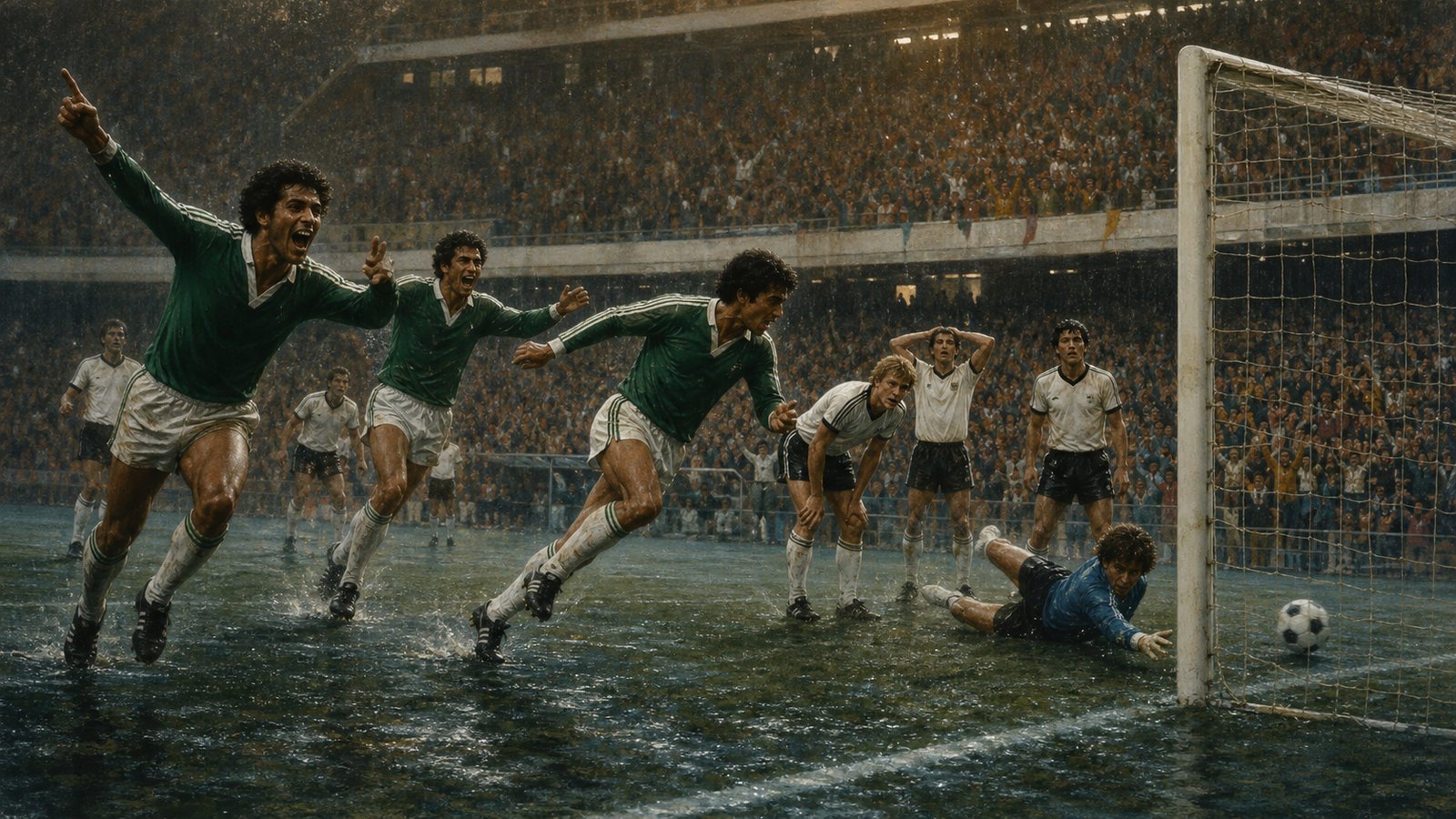
Algeria then lost 2–0 to Austria before defeating Chile 3–2. Two wins in a debut World Cup should have created control over their own fate. Instead, the timetable left them exposed. Their match against Chile was played on 24 June. West Germany and Austria met one day later with Algeria’s final points, goals scored and goal difference already fixed.
A delayed kickoff turned the table into a menu
The scoring system awarded two points for a win. Austria entered the last match with four points, Algeria had four, and West Germany had two. A draw or an Austrian win would eliminate West Germany. A West German victory by one or two goals would leave all three teams on four points and qualify West Germany and Austria on goal difference. A West German win by four or more would send Austria out and Algeria through. The precise margins were visible before kickoff.
This was not merely the normal pressure of a final group game. One side knew it had to score; the other knew exactly how much damage it could absorb. Both knew when to stop taking risks. Algeria, whose place depended on their behaviour, had no way to alter the calculation. The schedule had converted information into an advantage.
There were still reasons for Austria to compete. A win or draw would put them first in the group, and players do not usually enter a World Cup match intending to shrink it. West Germany also needed the opening goal before any comfortable equilibrium could exist. The first ten minutes therefore carried real urgency. Pierre Littbarski attacked from the left, and Hrubesch converted the cross for 1–0.
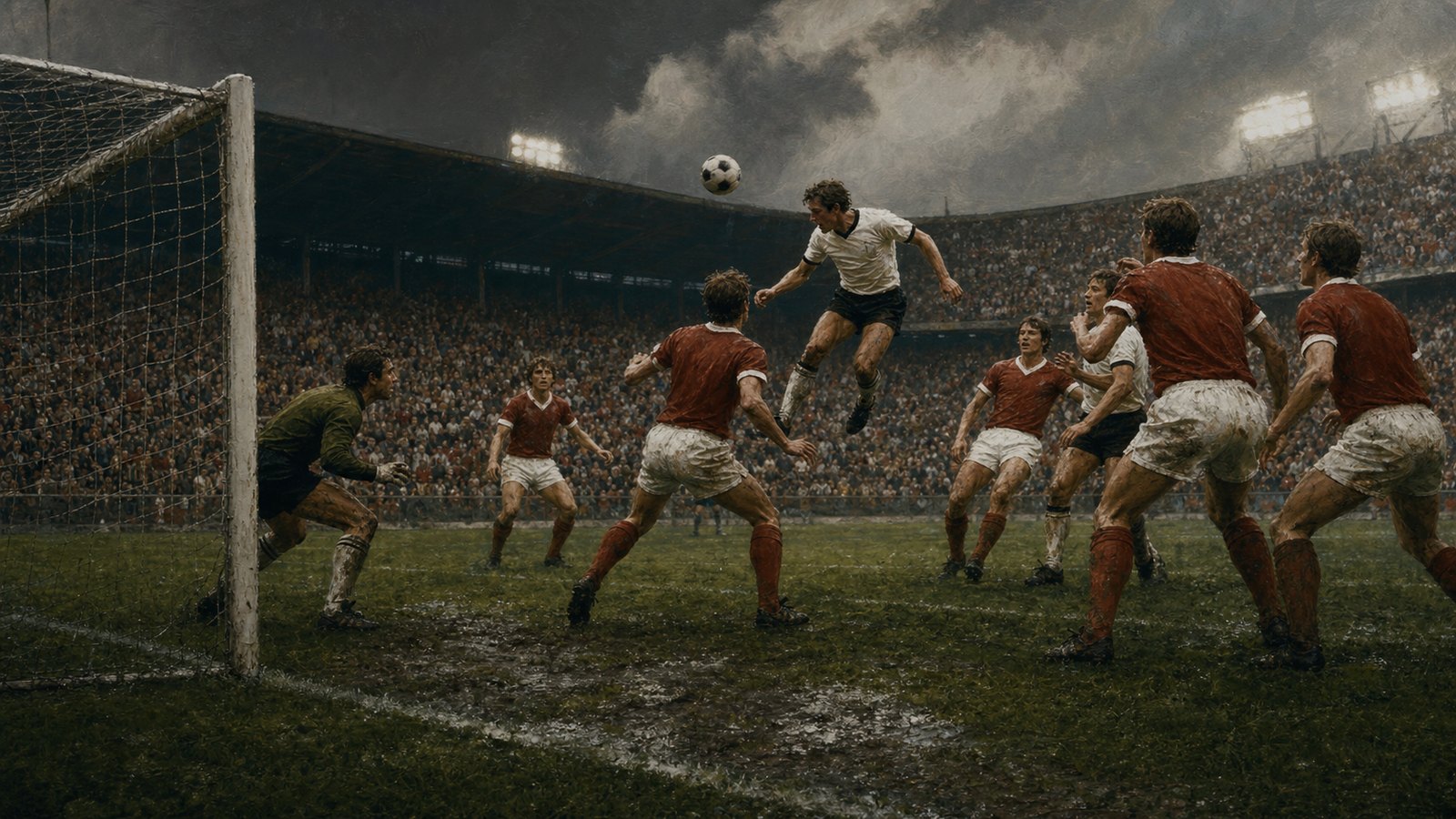
Now the incentives reversed. A West German equaliser was impossible because they led; an Austrian equaliser would knock West Germany out; a second or third German goal would still qualify Austria, but each step toward a fourth increased Austrian danger. The safest shared strategy was suddenly visible on the scoreboard, even if nobody had arranged it in advance.
The spectacle died by degrees, not at the whistle
The popular memory compresses the match into ten minutes of football followed by eighty minutes of standing still. Contemporary accounts describe something more gradual, which makes the mechanism more revealing. There were further German chances before half-time. Wolfgang Dremmler forced goalkeeper Friedrich Koncilia into what became the second and final shot on target. Breitner missed opportunities. In the 57th minute, Hrubesch miscontrolled a chipped pass that might have left him with a clear chance.
Yet the overall pattern became unmistakable. Possession was circulated safely in defensive areas. Long balls carried little conviction. Tackles became rare. Austria’s Walter Schachner was one of the few players who continued trying to inject urgency, and Bernd Krauss made a late run into the German box, but neither side sustained pressure. A goal for Austria would have eliminated West Germany; reckless German pursuit of more goals could have endangered Austria. Every ordinary football instinct now carried a tournament cost.
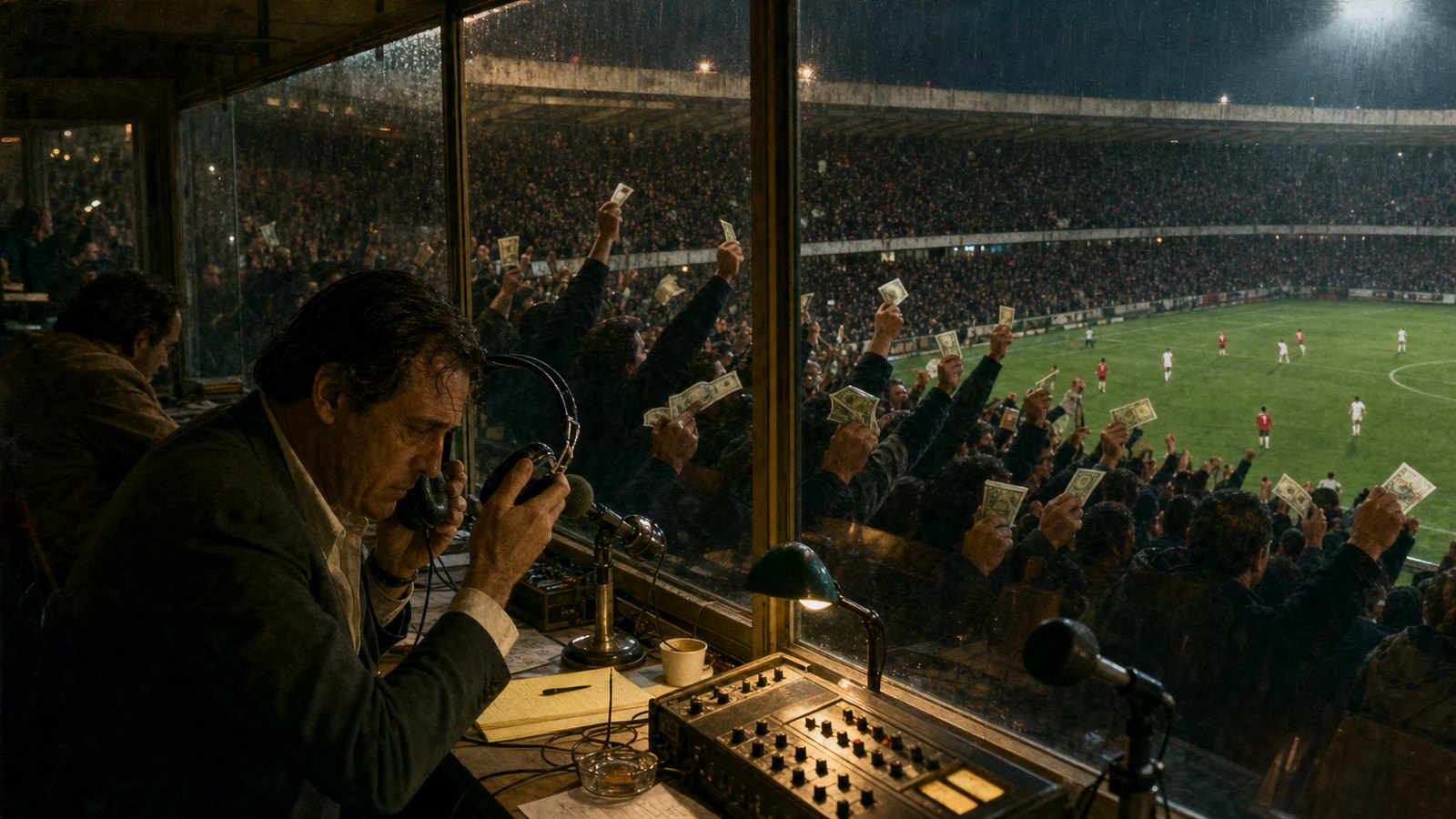
The crowd understood. Spanish spectators chanted for Algeria and shouted for the teams to leave. Algerian supporters waved banknotes toward the pitch. The gesture did not prove money had changed hands. It expressed something more immediate: spectators believed they were watching a competition abandon the promise that made the ticket meaningful.
The broadcasters made the disgust audible. West German commentator Eberhard Stanjek stopped describing the play for a time. Austrian commentator Robert Seeger urged viewers to turn off their televisions. The local newspaper El Comercio reportedly placed its account in the crime section. Anger crossed national loyalties because the offence was not losing, defending or tactical caution. It was the visible disappearance of uncertainty.
FIFA could condemn the outcome but not punish the method
Algeria lodged a formal protest. FIFA rejected it because the match had not supplied a clean rules violation. Passing backwards, declining a risky tackle and protecting a favourable score are all legal actions. The referee, Scotland’s Bob Valentine, could manage fouls and time, but he could not order either team to attack. A legal vocabulary built for incidents was poorly equipped for a collective withdrawal of ambition.
That distinction matters when calling Gijón a fix. It is reasonable to describe the contest as manipulated by incentives, and the performance was condemned around the world. It is harder to prove an explicit pact. Almost all participants denied an agreement. Later recollections suggested that the mood simply took hold once every player understood the table. The score became self-enforcing.
Three starters also carried bookings that could have triggered suspensions with another yellow card: Hrubesch for West Germany, Josef Degeorgi and Roland Hattenberger for Austria. That added a smaller layer of caution to the larger calculation. The system did not need a whispered bargain. It had already aligned the teams’ safest choices.
West Germany won 1–0. They, Austria and Algeria finished level on four points. Goal difference sent the two European teams onward. West Germany eventually reached the final; Algeria went home after becoming the first African side to win twice at a World Cup. The table recorded an ordinary tiebreak. The stadium had seen why that tiebreak could not be separated from the order of play.
The World Cup solved the scandal with simultaneity
FIFA’s lasting response was not a new rule demanding visible effort. Such a rule would be subjective, difficult to enforce and easy to evade. Instead, from the next World Cup onward, the final games in each group were scheduled to start simultaneously. The change attacked the information advantage rather than trying to judge a player’s intent.
Simultaneous kickoffs do not eliminate strategic caution. Teams still receive scores from the other match, and late moments can create mutually useful outcomes. But neither pair begins with a completed result from the rival game. The arithmetic moves while the players are acting. A single goal elsewhere can destroy a safe arrangement, so waiting becomes riskier.
The reform is one of football’s clearest examples of tournament design changing because legal behaviour produced an intolerable contest. Gijón did not teach administrators that players could be cynical; football already knew that. It showed that a schedule could manufacture cynicism by making the optimal score obvious to both teams and denying the injured third side any reply.
That is why the image of Algerian supporters waving banknotes remains so powerful. Their team had beaten West Germany, won twice and completed every assigned match. What defeated them at the end was not a forbidden tackle or a missed penalty. It was an information structure. After Gijón, the World Cup changed the clock so that no team would again have to watch two rivals play with tomorrow’s answer already in their hands.
Sources
The Guardian, “The day in 1982 when the world wept for Algeria”; The Guardian, “West Germany 1–0 Austria in 1982”; The Irish Times, “1982’s ‘Disgrace of Gijón’”; FIFA Match Centre, “Germany FR vs Austria”; R. Caruso, “The Economics of Match-Fixing”; BBC Sport, “Japan go through but final group game ends in ‘mind-boggling farce’.”