
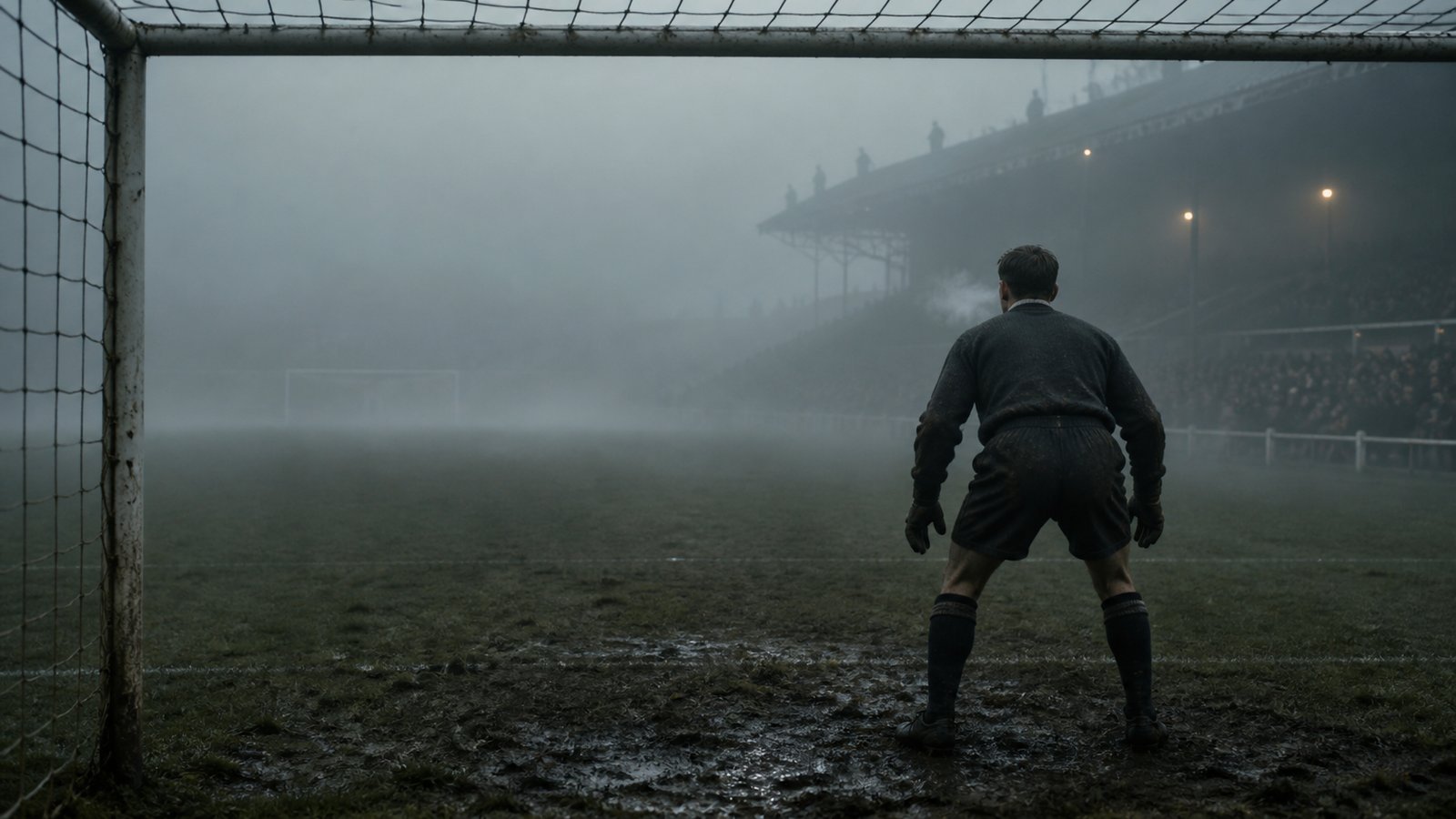
By the time a policeman emerged from the fog at Stamford Bridge, Sam Bartram had invented a perfectly reasonable explanation for the silence. Charlton Athletic were attacking so relentlessly, he thought, that Chelsea had no chance to send the ball back toward his goal. He stamped his feet against the Christmas cold, walked his line and kept watching a wall of grey.
The policeman had a less flattering explanation. The match had been abandoned roughly fifteen minutes earlier. The other players had left the field, bathed and changed while Charlton’s goalkeeper remained at work in an empty stadium bowl. Bartram’s teammates greeted him with laughter when he finally reached the dressing room.
It sounds like a story polished for the internet, and a famous photograph has often been attached to it. The incident itself is well supported; the photograph is not. The real episode, on Christmas Day 1937, was stranger than the mislabeled image because it came from the habits of a serious goalkeeper in a team rising at extraordinary speed. Bartram did not merely get lost. He read the evidence available to him, trusted the shape of the match and reached the wrong conclusion.
The fog advanced from the opposite goal
Charlton were playing Chelsea at Stamford Bridge with the score at 1–1. Bartram later described fog thickening first around Chelsea goalkeeper Vic Woodley, then travelling down the pitch toward him. The referee stopped play, restarted it when visibility improved and eventually abandoned the match after 61 minutes.
At Bartram’s end, those decisions arrived as fragments. He could see fewer bodies as Charlton pressed away from him. When no Chelsea attacker appeared, he interpreted absence as territorial control. In his autobiography he remembered thinking that his teammates “must be giving the Pensioners the hammer.” It was a goalkeeper’s private reading of a game he could no longer see.
He also had practical reasons to remain alert. Fog did not stop a loose ball from arriving without warning. Bartram paced, peered toward the edge of his penalty area and waited for players to return after a goal. Nobody came. The longer the emptiness lasted, the more he credited Charlton’s pressure rather than considering that the contest had ceased.
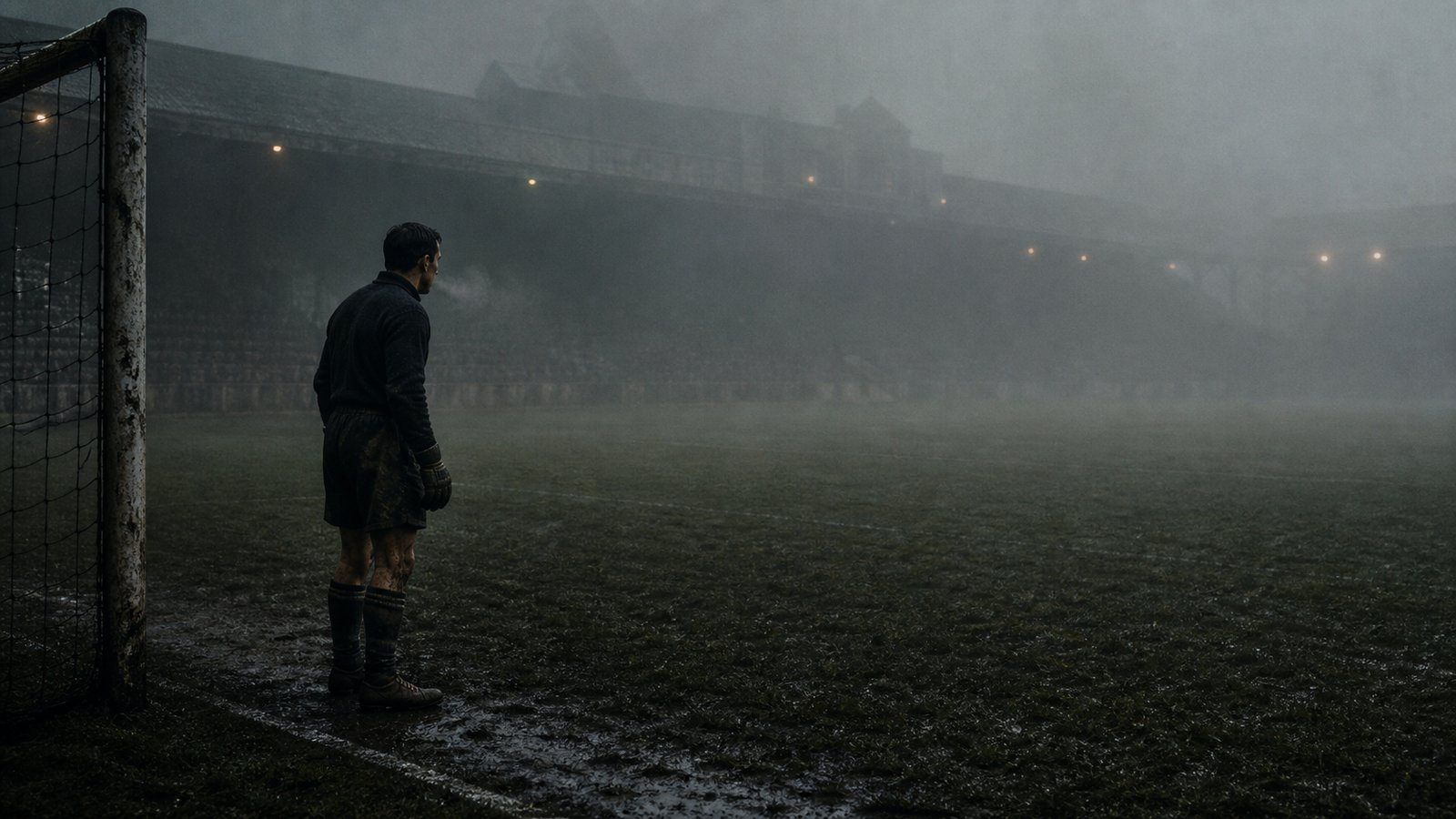
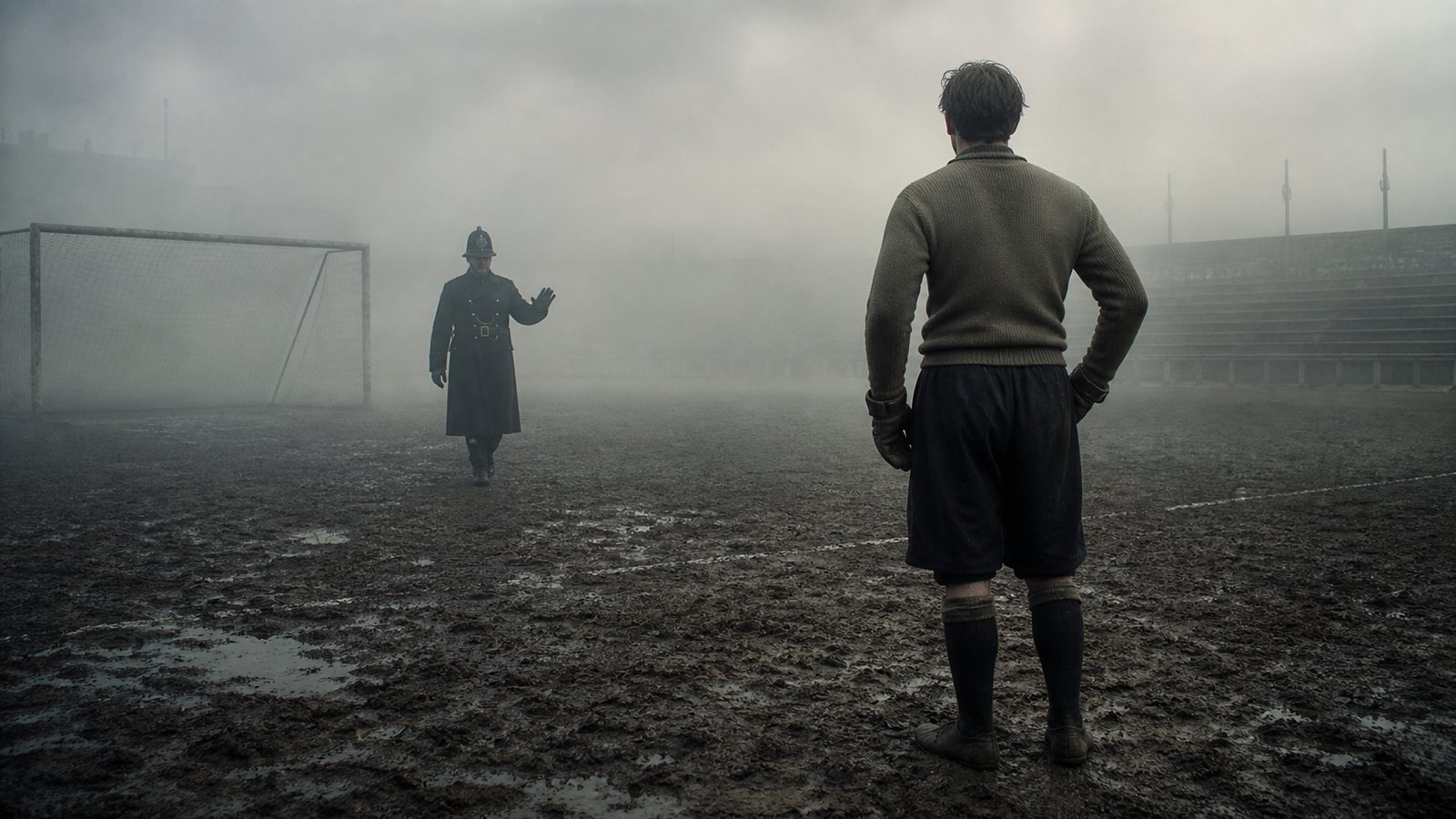
Then a figure formed in the murk. The policeman asked what he was doing there and told him that the field was completely empty. Bartram had guarded his goal for about a quarter of an hour after everyone else departed. His error was comic, but it was not idle confusion: he had maintained the exact concentration his position demanded, after the match no longer demanded it.
A 1937 news report caught the story before legend could
Stories this neat deserve suspicion. Snopes examined the episode because social posts paired it with a dramatic black-and-white photograph of a solitary goalkeeper. Its verdict separated two questions that had been carelessly joined. Bartram really was left on the field after the Christmas Day abandonment, but the widely shared photograph was made decades later and showed somebody else.
The distinction matters. Removing the false image does not remove the event. Snopes located an Associated Press item published on December 27, 1937, only two days after the match. The report joked that Bartram believed a good defence was the backbone of a side and said a searching party eventually found him at his post. That contemporary notice supports the core of the later autobiographical account.
Bartram’s own version supplied the sensory detail: the advancing fog, the cold feet, the missing figures and the policeman’s incredulous question. Memory can sharpen dialogue, so the early report is valuable precisely because it is plainer. Together they establish an abandoned match, an uninformed goalkeeper and an interval long enough to become news before Bartram had decades in which to refine the tale.
The fake photograph reveals how football memory often works. A true anecdote acquires a convenient image; repeated sharing makes the pairing feel like evidence. In this case the safest reconstruction is more imaginative, not less. There is no perfect visual record to lean on. The scene has to be rebuilt from weather, testimony and a short wire report.
Charlton had found him after a fatal vacancy
Bartram’s presence in that goal began with tragedy. Charlton’s official history records that goalkeeper Alex Wright died after breaking his neck in a freak diving accident at Torquay. Manager Jimmy Seed needed a replacement. Less than two weeks later, acting on his brother’s recommendation, Seed brought Bartram to the club.
Bartram made his debut in 1934 and entered a team moving with rare momentum. Charlton won the Third Division South title in 1934–35, finished second in the Second Division the following season and climbed into the top flight for the first time. In 1936–37, their first First Division campaign, they finished second to Manchester City by three points.
That ascent changes the scale of the fog story. Bartram was not an obscure amateur who wandered into a comic mishap. He was the goalkeeper for a side that had travelled from the third tier to a title challenge in consecutive seasons. His expectation that Charlton might be pinning Chelsea back belonged to a team accustomed to making unlikely progress look normal.
Jimmy Seed’s Charlton had compressed years of institutional growth into a short run of promotions. Goalkeepers in such teams experience long stretches differently from outfield players: the action may be distant, but the next mistake remains theirs. Bartram’s lonely vigilance was a professional reflex learned inside a side whose ambitions had outrun its recent status.
His record is larger than the anecdote
The fog became Bartram’s most portable story because it can be told in a minute. His Charlton career resists that compression. The club credits him with 623 appearances, still its record, across 22 years. He also lifted the FA Cup in 1947, a decade after the Stamford Bridge abandonment.
Bartram’s career crossed the Second World War and extended deep into the post-war period. The goalkeeper who waited alone in 1937 was still part of Charlton’s defining public moments years later.
Charlton’s rise also filled The Valley on a scale difficult to reconcile with the intimate fog scene. The club records an attendance of 75,031 for an FA Cup tie against Aston Villa in February 1938, less than two months later. One week Bartram could be isolated from every person by weather; soon afterward he was playing before the largest recorded crowd in the ground’s history.
That contrast helps explain why goalkeeping produces such durable folklore. The position is publicly exposed and physically separate. Bartram’s career supplied the record and trophies; the fog supplied a perfect image of the job’s solitude, even though the image circulated online was the wrong one.
The joke survives because the mistake was professional
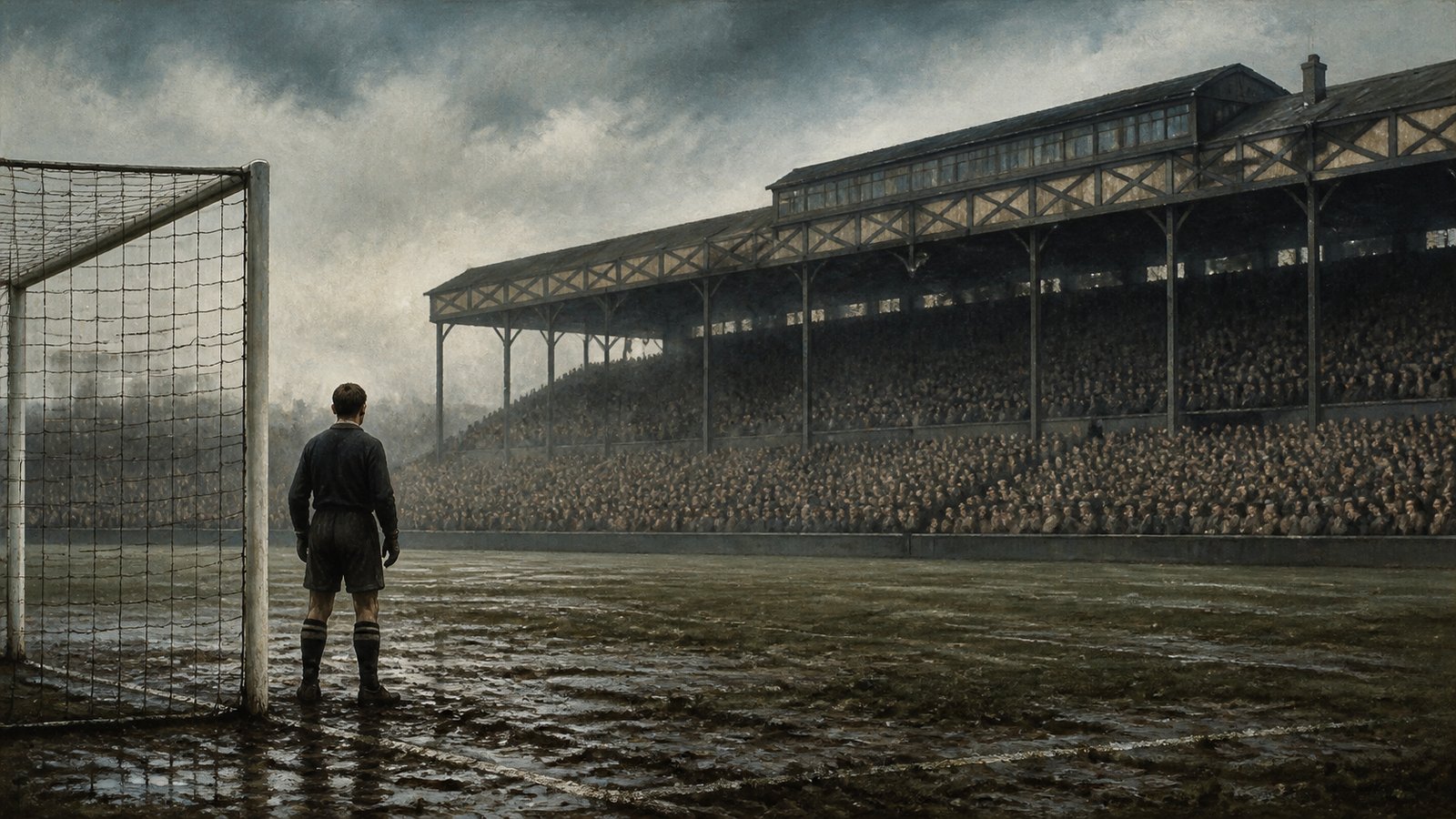
Bartram could have left his line to investigate sooner. Yet doing so would have violated the immediate logic of his role. He had not heard a final signal, could not see the referee and knew that play had already stopped and restarted once. Remaining ready was safer than assuming the match had ended.
The episode therefore turns on information rather than foolishness. The referee and players knew the match was abandoned; Bartram possessed fog, silence and an inference that Charlton were attacking. Until the policeman reached him, no message connected those realities. Stamford Bridge in 1937 left one man beyond the communication chain.
His teammates’ laughter completed the story, but it did not diminish him. They laughed because Bartram’s concentration was recognizable. The best version of the anecdote keeps both sides: a goalkeeper absurdly guarding nothing and a professional refusing to abandon his responsibility without evidence.
The false photograph should be discarded rather than excused as illustration. Bartram does not need borrowed proof. Charlton’s records list 623 appearances; his autobiography preserves the policeman coming through the grey; a contemporary report confirms the search. The authentic pieces are enough: Christmas fog, an empty pitch and a goalkeeper still preparing for the next attack.
Sources
- Charlton Athletic Football Club, “1929–1943: Pre-World War Two”
- Charlton Athletic Football Club, “Men’s Honours & Records”
- Snopes, “Is This Soccer Goalkeeper ‘Lost in the Fog’?”
- The Guardian, “Grave indifference”
- Associated Press report, December 27, 1937, as reproduced by Snopes
- Sam Bartram, autobiography excerpt reproduced by Snopes