
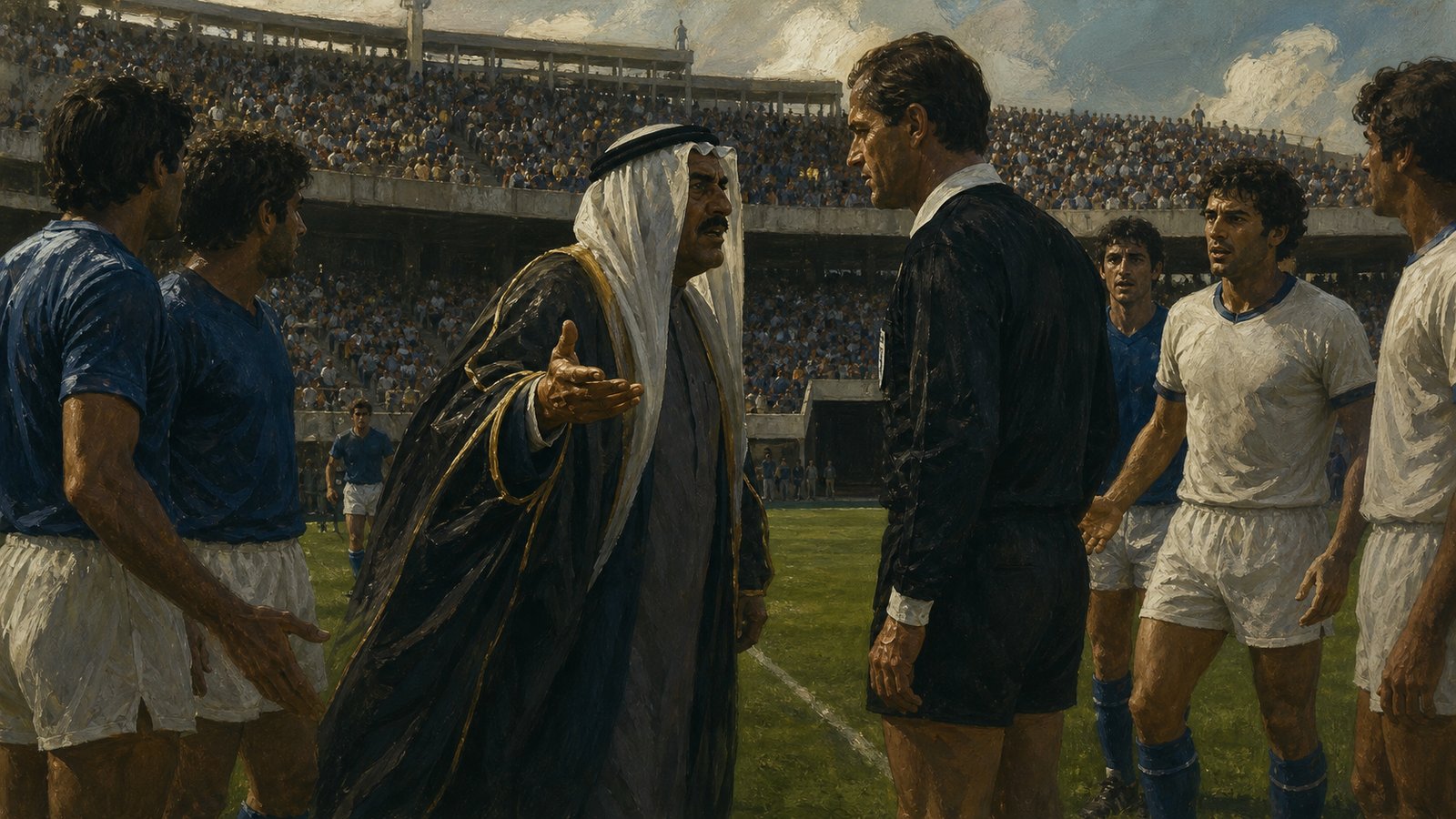
The official score in Valladolid says France beat Kuwait 4-1 on 21 June 1982. It does not show the French goal that the referee first awarded, then removed after a royal spectator left the stands and entered the argument on the pitch.
For several minutes, the match stopped belonging only to the players and officials. Kuwait’s team said a crowd whistle had made them halt. Alain Giresse continued and scored. Referee Myroslav Stupar initially held his ground. Then Sheikh Fahad Al-Ahmed Al-Jaber Al-Sabah, president of the Kuwait Football Association and a member of the royal family, entered the argument from the stands. The decision changed.
The incident is often remembered as an eccentric scene from an older World Cup. Seen inside the match, it was more uncomfortable than quaint. It exposed a contest between three kinds of authority: the referee’s whistle, the crowd noise that imitated it, and the political weight of a man who was not listed on either team sheet.
France arrived needing the ordinary part of the match to work
France had opened Group 4 with a 3-1 defeat by England. Bryan Robson scored after only 27 seconds, and although Gérard Soler equalized, England pulled away in the second half. Kuwait’s first appearance had been less damaging: a 1-1 draw with Czechoslovakia in which Faisal Al-Dakhil scored the equalizer in the 27th minute.
France needed a win to recover control of its tournament. Kuwait had already earned a point. More than 30,000 spectators entered the new José Zorrilla stadium for a 17:15 kickoff.
The teams carried distinct forms of experience. France had Platini as captain, Genghini and Giresse in midfield, and Six, Lacombe and Soler ahead. Kuwait, coached by Carlos Alberto Parreira, had Ahmad Al-Tarabulsi in goal and Fathi Kameel Al-Houti as captain.
The first half followed France’s preferred script. Genghini scored from a free kick in the 31st minute. Platini made it 2-0 in the 43rd, close enough to the interval to deny Kuwait much time for a reply. Three minutes after the restart, Didier Six added a third. At 3-0, the points appeared secure and the remaining question seemed to be the size of the margin.
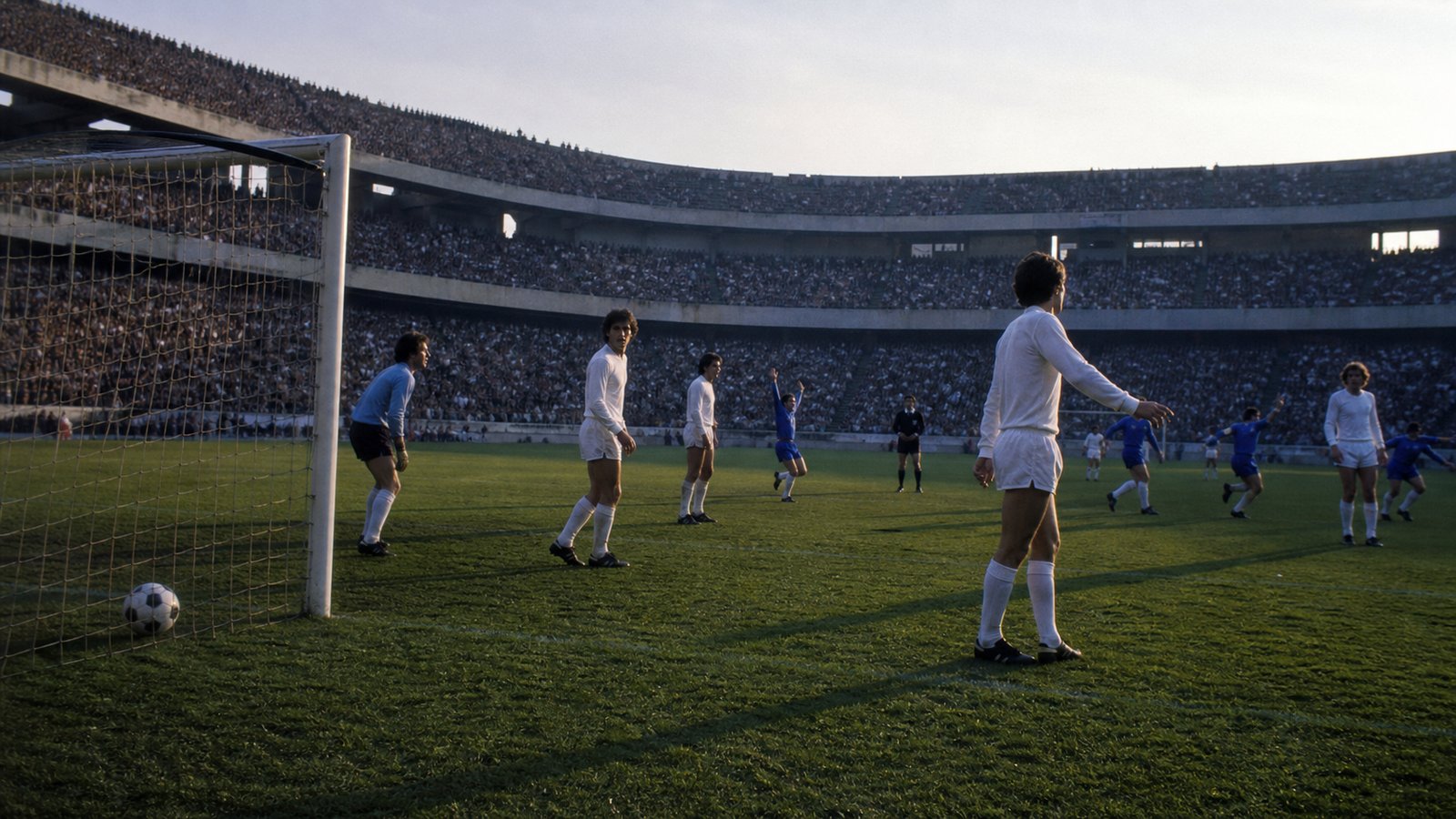
Kuwait’s 75th-minute goal reopened a contest that looked finished
Abdullah Al-Buloushi scored for Kuwait in the 75th minute. The goal did not make France’s lead precarious, but it altered the emotional temperature. A 3-1 score gave Kuwait a reason to press and France a reason to finish the game cleanly rather than merely let the clock expire.
The next French opening came with roughly ten minutes left. Giresse broke through, the defence stopped, and he scored what appeared to be France’s fourth. The ball crossed the line; the referee awarded the goal. Under the usual chain of events, France would have walked back toward halfway and the restart would have fixed the moment into the record.
Kuwait’s players did not accept that chain. They said they had heard a whistle and stopped. The sound, according to contemporary and later accounts, came from the crowd rather than Stupar. Their complaint therefore rested on a real disruption but an unusual remedy. Players are normally instructed to continue until the referee signals. Here, the defending team argued that an imitation signal had changed their behaviour enough to invalidate what followed.
Stupar first refused to alter his decision. That detail matters because the famous reversal was not an immediate act of uncertainty. The official had seen the play, awarded the goal and resisted the players’ protest. Only then did the encounter acquire a participant who had begun it in the stands.
Sheikh Fahad crossed the boundary between delegation and field
Sheikh Fahad was not simply an excited supporter. He was president of Kuwait’s football association, a member of the country’s royal family and the visible head of its delegation. Contemporary reporting described him coming from the stands to the edge of the field in flowing black robes. His entrance gave the protest a form no ordinary player could supply.
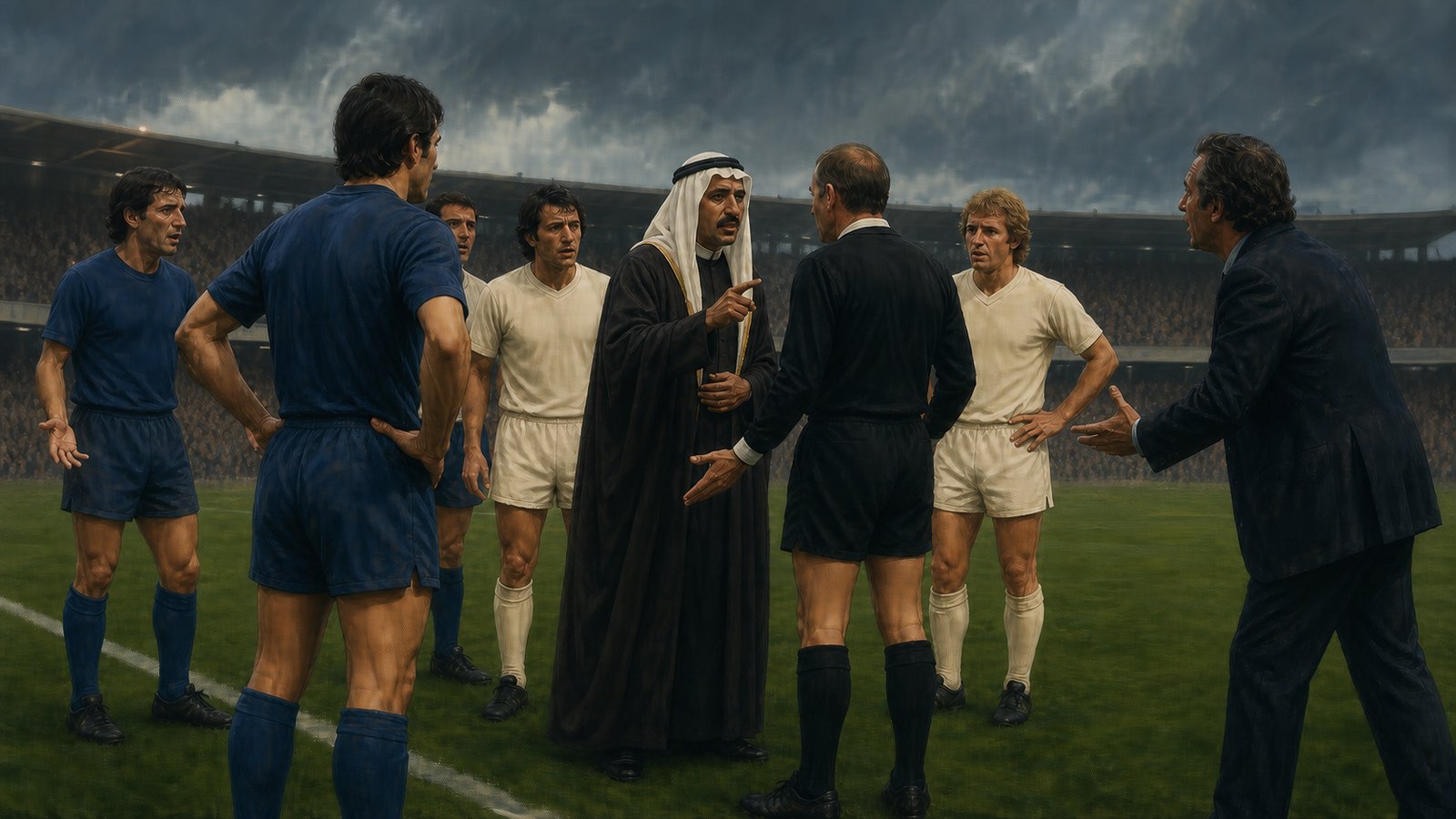
The physical details made the hierarchy impossible to miss. Players clustered around an official in match kit. France manager Michel Hidalgo protested from the other side. Police and tournament personnel were present. Above them were the seats Sheikh Fahad had left; ahead of him was the grass reserved for the match. By crossing that strip, he transformed influence from something implied by status into something visible to everyone in the stadium.
The dispute was not a formal video review—football had no such process in 1982. There was no second screen, no replay protocol and no written route for a delegation president to appeal a goal during play. The referee had only the information from his officiating team, the claims of the Kuwaiti players and the pressure of an interruption that could not be hidden from the crowd.
After speaking with Sheikh Fahad, Stupar withdrew Giresse’s goal. The score returned to 3-1. Hidalgo was furious, while Sheikh Fahad left the confrontation having obtained the outcome Kuwait wanted. A crowd whistle had produced confusion; a royal intervention had converted that confusion into an official reversal.
Bossis restored the fourth goal without erasing the withdrawn one
Play eventually resumed. France still led, and Kuwait still faced the same numerical deficit it had carried before Giresse’s finish. The interruption had changed the scorebook, but it had not supplied Kuwait with the two goals needed to draw.
In the 89th minute, Maxime Bossis scored. This one remained. The official result became 4-1, assembled from Genghini in the 31st minute, Platini in the 43rd, Six in the 48th and Bossis at the end. Al-Buloushi’s 75th-minute reply was Kuwait’s only official goal.
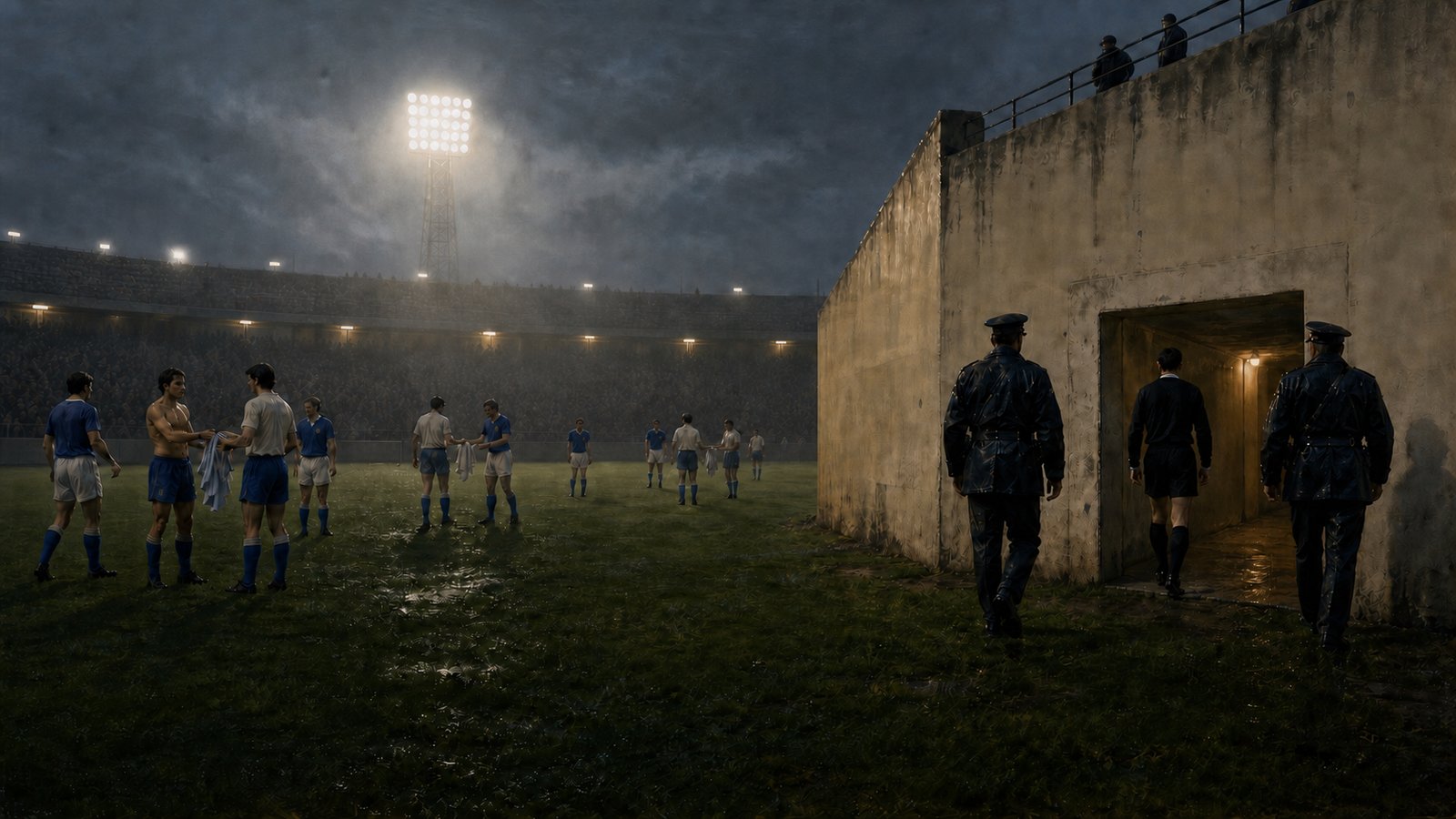
After the final whistle, players exchanged shirts, while Stupar required a police escort from the field. The contrast was sharp: the teams could return to the rituals of a completed match, but the official could not leave as though nothing exceptional had happened.
France drew 1-1 with Czechoslovakia in its final group game and advanced to the next phase. Kuwait lost 1-0 to England and went home with one point from three matches. The French campaign continued through Austria and Northern Ireland, then a semi-final against West Germany that ended 3-3 before a penalty-shootout defeat.
A referee’s authority depends on more than the laws written in a book. It depends on everyone inside the stadium accepting where a decision originates and when argument must stop. The false whistle blurred the first boundary. Sheikh Fahad’s walk from the stands blurred the second. Stupar’s reversal made both ambiguities part of the match itself.
Only the referee could change the formal decision, and Stupar did so. The troubling point is that an authorized official reversed himself after an unauthorized intervention by somebody whose institutional power was obvious.
Valladolid preserved a missing goal more clearly than many official ones
The official match record is orderly: date, venue, teams, scorers, cards and a 4-1 result. Giresse’s finish sits outside those columns. To reconstruct it, the reader needs contemporary reporting and retrospective footage rather than the list of goals alone.
That absence is what gives the incident its lasting clarity. A normal goal can dissolve into a statistic once the tournament moves on. The missing one requires the surrounding scene: defenders reacting to a sound from the stands, the referee pointing toward a restart, the delegation president approaching from beyond the touchline, and the award disappearing after the discussion.
France did not lose the match, and Kuwait did not escape elimination. Bossis even restored the three-goal margin in the 89th minute. The intervention therefore achieved almost nothing in the table. What it changed was the visual record of authority. For several minutes, the most powerful figure near the decision was neither the player who scored nor the referee who awarded it, but the man walking down from the seats.
Valladolid’s strangest goal is remembered because it was removed. The scoreboard returned to 3-1, then advanced to 4-1 by another route. The tournament continued, but the interruption left a question that the official result cannot answer: how much independence can a decision retain when power is allowed to step onto the field and stand beside it?
Sources
- Rec.Sport.Soccer Statistics Foundation
- United Press International contemporary match report
- BBC Sport World Cup retrospective
- 11v11 match record