
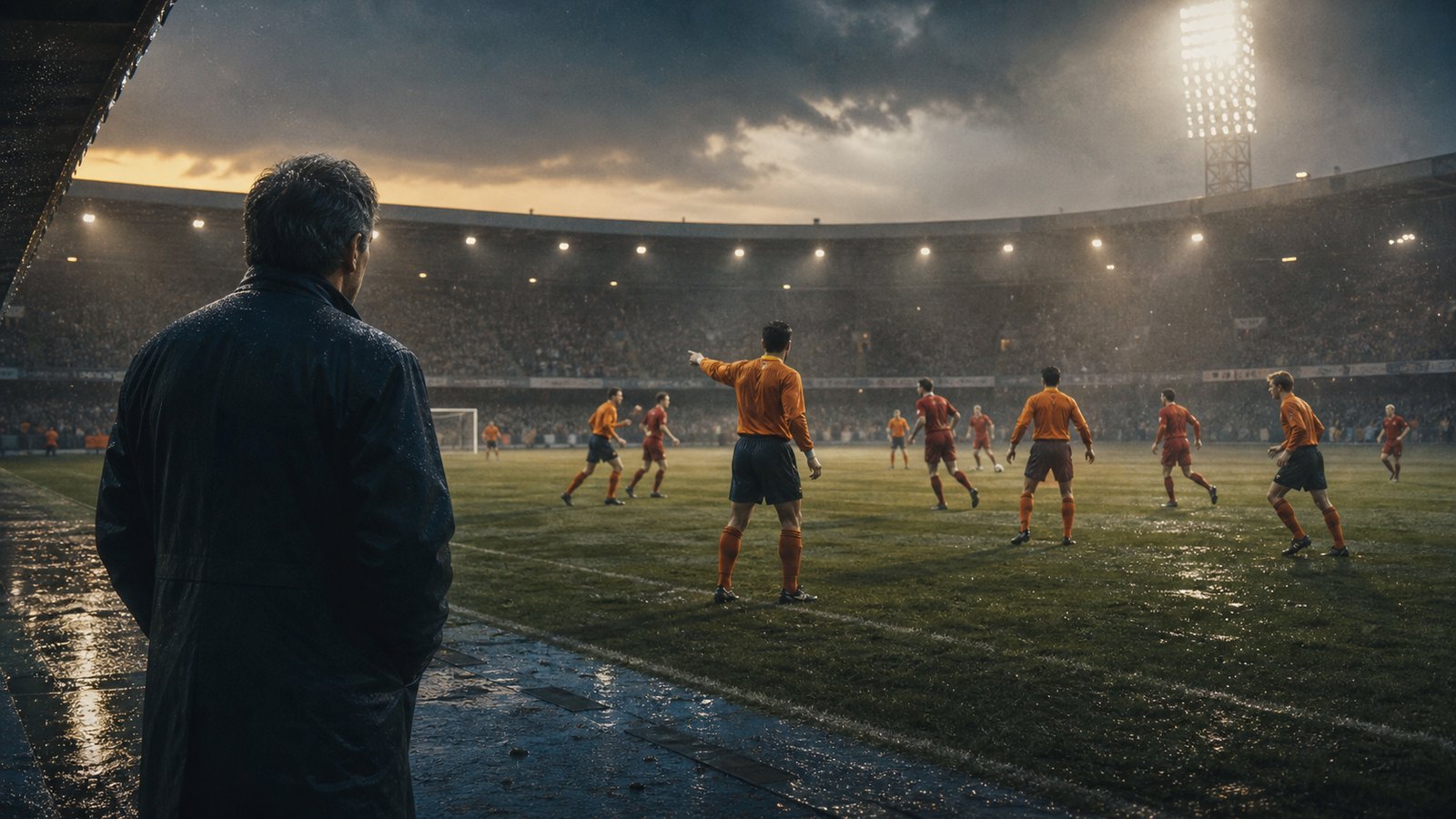
Marco van Basten began the Netherlands’ first match at Euro 1988 on the bench. That detail feels impossible now because the tournament is remembered through his body in flight: leaning toward Arnold Mühren’s high cross in the final, striking from an angle that seemed to offer no shot at all, and sending the ball beyond Rinat Dassayev into the far side of the Soviet net.
But the famous volley was the end of the story, not its explanation. Thirteen days earlier, the same Soviet side had beaten the Dutch 1–0 in Cologne. Van Basten entered only after the hour mark. The Netherlands had returned to a major tournament after missing the 1982 and 1986 World Cups and Euro 1984, yet their opening performance offered no guarantee that the celebrated generation would survive the group.
What followed was not a smooth march by a finished masterpiece. It was a short tournament of selection decisions, late goals, ugly pressure and adaptation. Rinus Michels did not simply release a collection of stars. He found the right centre-forward in competition, accepted that the Dutch would sometimes have to endure rather than dominate, and built a route to the country’s first senior international trophy one correction at a time.
The tournament opened with the wrong result
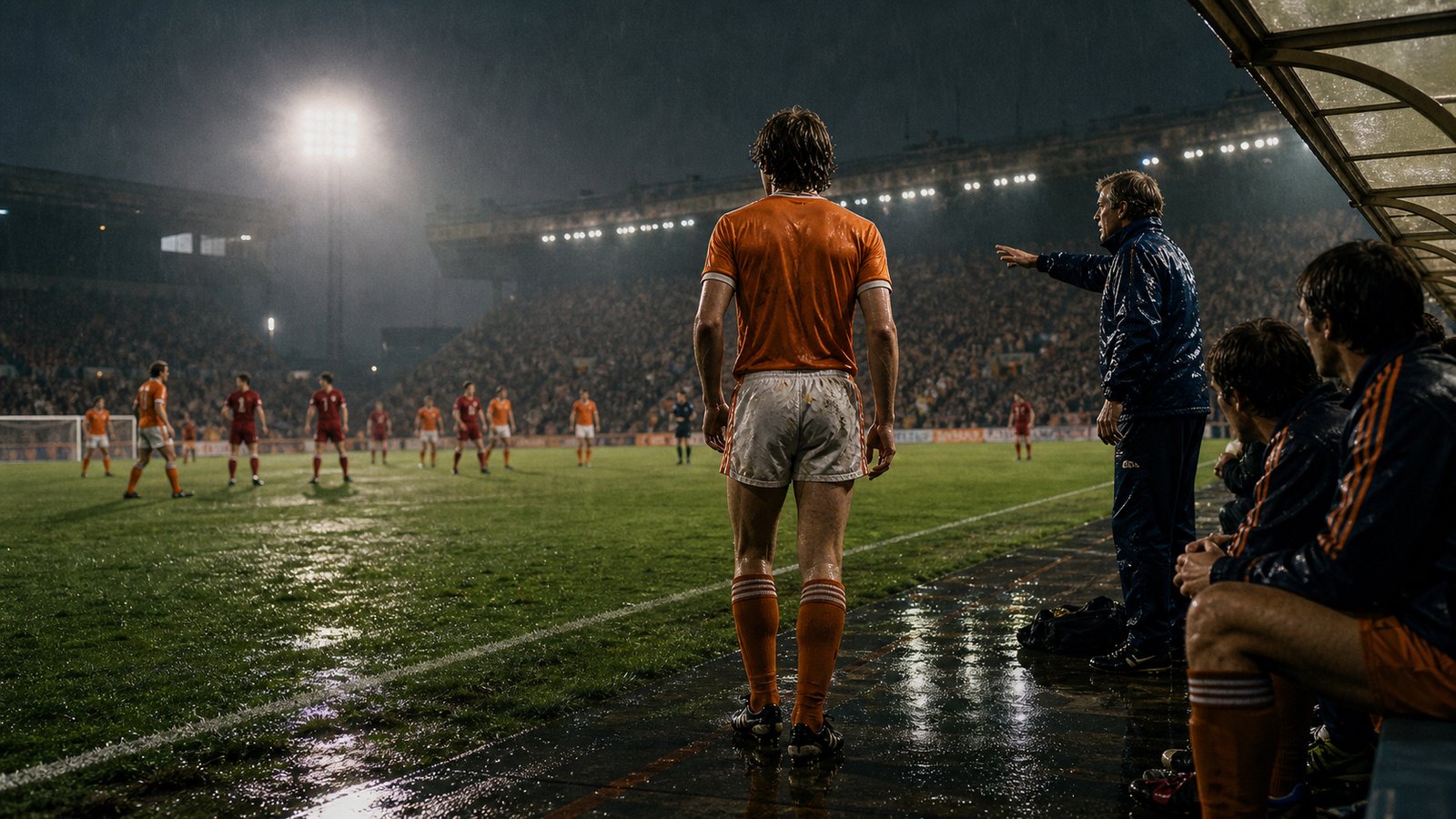
The opener on 12 June was a tactical warning. Vasyl Rats scored for the Soviet Union early in the second half, and Valeriy Lobanovskyi’s team protected the advantage. The Dutch could move the ball, but movement without a reliable penalty-box reference kept becoming possession at a safe distance. Michels had started John Bosman at centre-forward. Van Basten replaced him in the second half, but the score did not move.
The defeat mattered because the eight-team format allowed little room for recovery. Only two teams from a four-team group advanced. England and the Republic of Ireland were still waiting, and Ireland had already beaten England in Stuttgart. One more poor result could reduce the Dutch return to tournament football to a three-game cameo.
Van Basten was not an obvious risk-free answer. His first season with AC Milan had been interrupted by ankle trouble, limiting his rhythm and his league appearances. The talent was unquestioned; the durability was not. Michels nevertheless changed the front line for the match against England. It became the selection decision that redirected the tournament.
Three finishes changed the hierarchy
In Düsseldorf on 15 June, England hit the woodwork and created enough danger to make the eventual score look cleaner than the contest felt. Then Van Basten demonstrated why a striker can alter a team without monopolising the ball. He scored shortly before half-time, taking Ruud Gullit’s pass, turning away from Tony Adams and finishing low. After Bryan Robson equalised, Van Basten added two more in the second half to complete a hat-trick in a 3–1 win.
The goals were different problems solved quickly: receiving under contact, attacking the space around the six-yard box, reacting before a defence reset. They gave the Dutch more than points. Gullit could roam rather than serve as the fixed target. Gerald Vanenburg and Mühren could deliver with the expectation that someone would arrive. Ronald Koeman and Frank Rijkaard could begin attacks knowing possession now had a sharp endpoint.
The group was still not secure. Against the Republic of Ireland in Gelsenkirchen, the Netherlands were trapped in a tense goalless match while Jack Charlton’s side defended their qualifying position. The breakthrough came in the 82nd minute from Wim Kieft, whose looping header crept inside the post. It was not a display that resembled a football manifesto. It was a late escape, and it sent the Dutch into the semi-final ahead of Ireland.

Hamburg demanded control of emotion
The semi-final against West Germany carried weight beyond the bracket. The hosts had eliminated the Netherlands in the 1974 World Cup final, the match that shadowed Dutch football’s global image. Michels had coached that side too. In Hamburg, a place in another final required his team to manage a hostile stadium and a match that tilted through two penalties.
Lothar Matthäus put West Germany ahead from the spot in the 55th minute. Ronald Koeman equalised with a Dutch penalty in the 74th. The decisive moment arrived with two minutes remaining: Jan Wouters slid the ball into the area and Van Basten stretched ahead of Jürgen Kohler to guide it past Eike Immel. It was not the spectacular image that would define the final. It was a striker’s goal measured in half-steps, body position and nerve.
The 2–1 victory did not erase 1974, and it did not need to. Its practical achievement was more immediate. The Dutch had recovered from a goal down against the hosts, survived the emotional temperature of the match and reached a final against the only team that had already beaten them. The rematch gave Michels a rare gift in tournament football: direct evidence of the first plan’s failure.
The final reversed the first meeting
On 25 June, Munich’s Olympiastadion held a final between two coaches whose ideas had shaped elite football. Lobanovskyi’s Soviet Union brought coordinated pressure and a core of Dynamo Kyiv players. Michels’ Netherlands had individual brilliance, but their route through the group had taught them not to confuse beauty with control.
The first goal arrived in the 32nd minute. A Dutch corner was recycled, the ball came back across the area, Van Basten headed it toward the centre and Gullit powered a header past Dassayev. It was the captain’s authority in one action: timing the run, attacking the dropping ball and giving the Dutch a lead they had never held in the opening meeting.
Then came the image that swallowed the rest of the match. Eight minutes into the second half, Mühren lifted a diagonal cross from the left toward the far side of the penalty area. Van Basten met it first time from a brutally narrow angle. A safer touch might have killed the chance. The volley instead arced over Dassayev and dropped inside the far post. Michels later described his astonishment; Van Basten himself acknowledged the good fortune involved. Its greatness lies partly in that tension between technique and improbability.
A save preserved more than the clean sheet
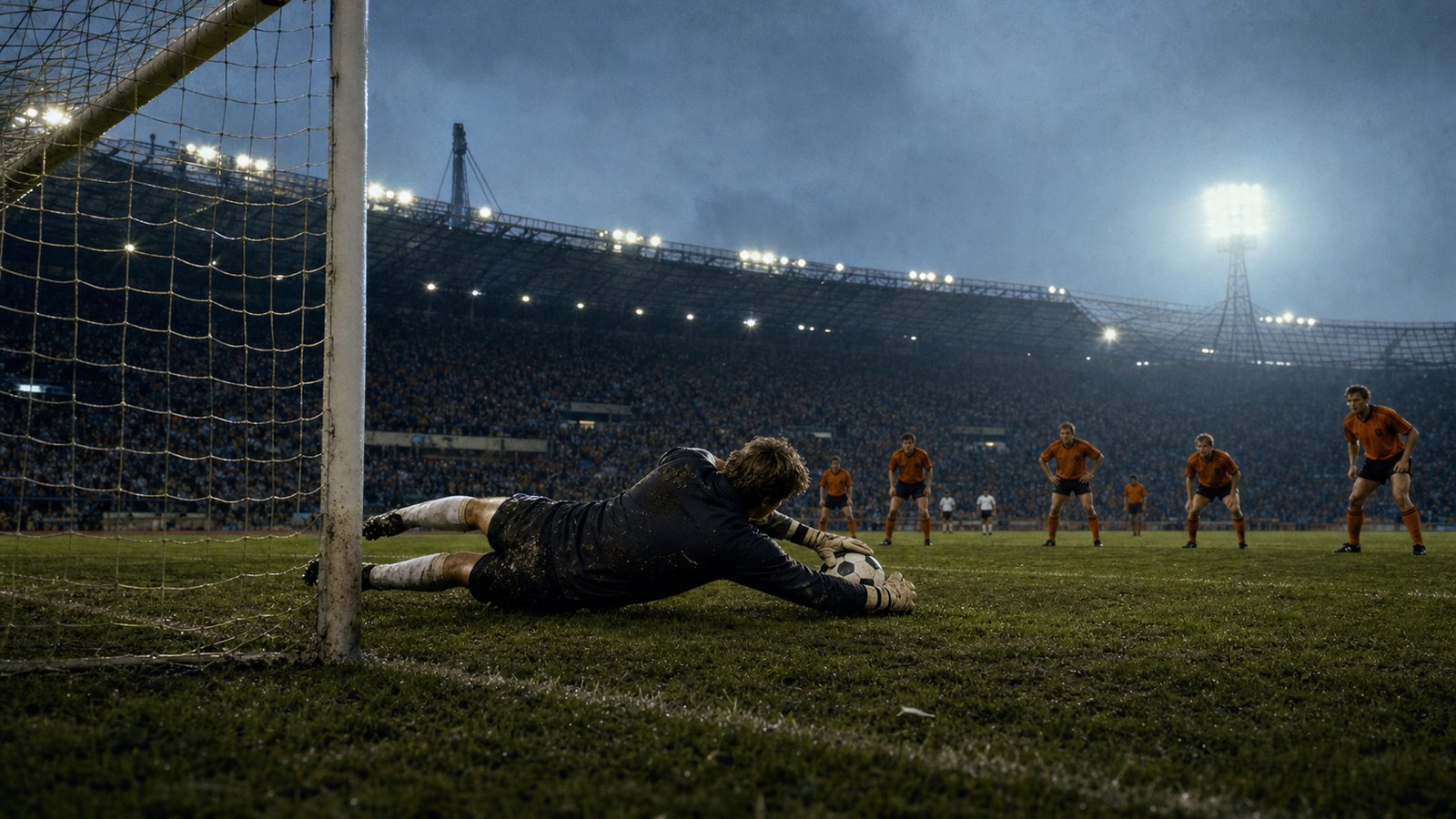
The final did not end with the volley. The Soviet Union received a penalty when Sergei Gotsmanov was fouled. Igor Belanov, the 1986 Ballon d’Or winner, took it. Hans van Breukelen dived low and saved. That moment matters because it restores the danger removed by highlight packages. At 2–0, one goal could have turned a controlled celebration into a frantic final half-hour.
The Netherlands closed the match, won 2–0 and lifted the Henri Delaunay Trophy. Van Basten finished as the tournament’s leading scorer with five goals. Gullit lifted the cup. Michels, fourteen years after the pain of the 1974 World Cup final, had coached the country to its first major senior title.
The trophy is often filed under a familiar Dutch story: Total Football finally receiving a prize, with the volley as visual proof. Euro 1988 was less tidy. The champions lost their opener. Their decisive forward did not start it. They needed an 82nd-minute group-stage goal, came from behind in the semi-final, and required a penalty save after the famous strike in the final.
That uneven route is the useful memory. Tournament teams are rarely complete when the first whistle sounds. Michels won because he treated the opening defeat as information rather than a verdict. Van Basten did not rescue a broken side by himself, but his movement changed what every Dutch possession could become. The Netherlands’ only major men’s trophy was secured not by preserving a perfect idea, but by changing the team quickly enough for its best idea to emerge.
Sources
- UEFA, “Euro 1988: all you need to know”
- UEFA, “Van Basten volley crowns Netherlands’ Euro 1988 final win against USSR”
- UEFA, “Ten great EURO moments: Van Basten’s volley”
- RSSSF, European Championship 1988
- BBC Sport, “Euro 1988: Valery Lobanovsky’s last stand for Soviet Union”
- The Guardian, “On Second Thoughts: England at Euro 88”