
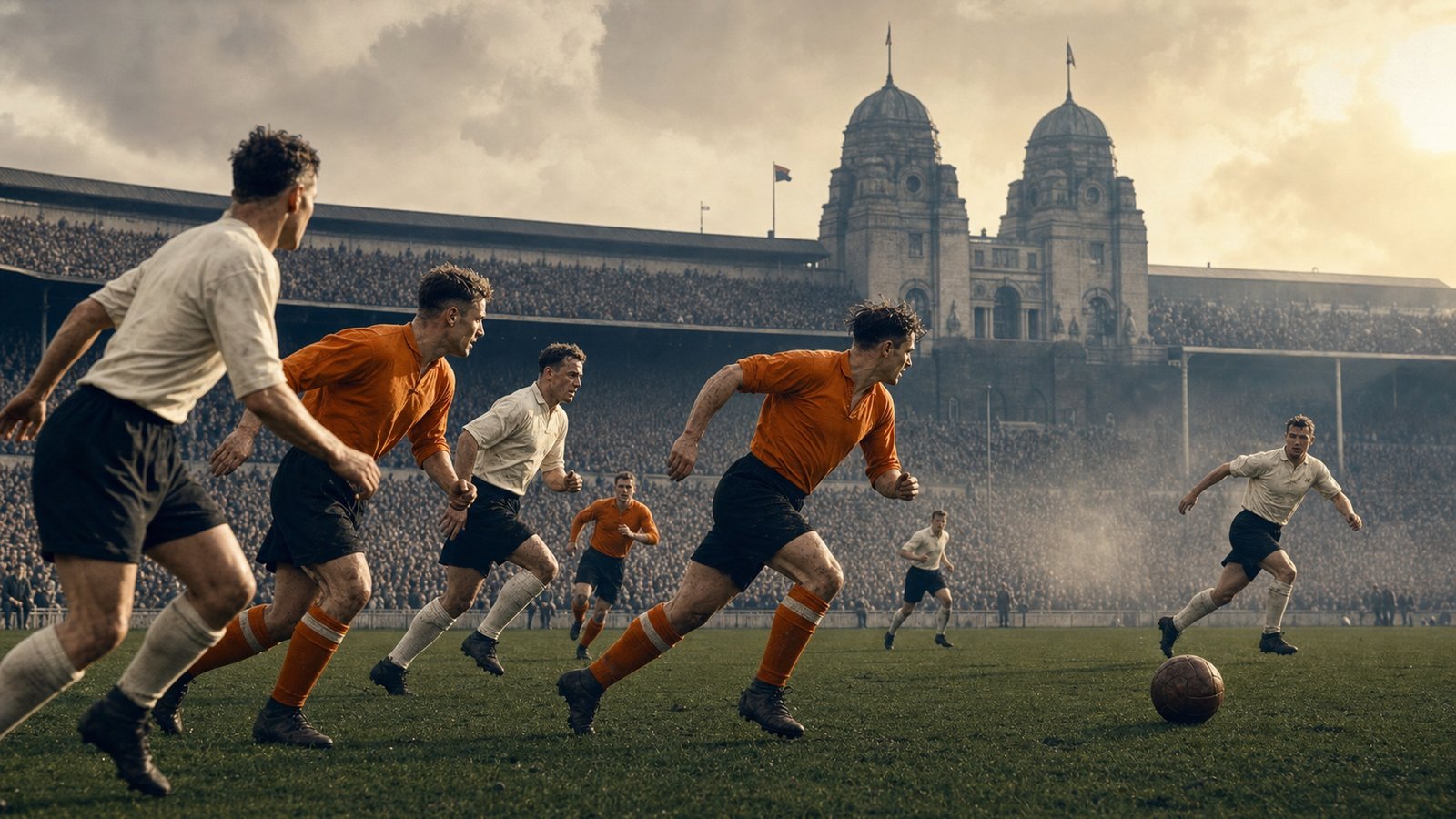
Three minutes from the end at Wembley, the 1953 FA Cup final still belonged to Bolton Wanderers. They had led after roughly 75 seconds, survived an injured player becoming almost immobile, and carried a 3–2 advantage into the last stretch. Then Stan Mortensen drove a free kick into the top-left corner for his third goal. In stoppage time, Bill Perry scored Blackpool’s fourth. The match ended 4–3 and entered football history under the name of a man who had scored none of the seven goals.
Calling it the “Matthews Final” was not absurd. Stanley Matthews, 38 years old and twice a losing finalist, tore into Bolton’s weakened left side and supplied the final cutback. Yet the nickname performs a revealing act of compression. Mortensen’s hat-trick, Perry’s finish, Ernie Taylor’s passes and Bolton’s injuries all become supporting detail in one star’s redemption. Reconstructing the score shows why Matthews owned the memory—and how much of the match that memory leaves outside the frame.
Bolton Needed Barely a Minute to Take Control
Nat Lofthouse arrived at Wembley as the newly named Footballer of the Year. He had scored in every round of Bolton’s cup run, and he required little time to extend the sequence. After about 75 seconds, his shot slipped past Blackpool goalkeeper George Farm. A final built in advance around Matthews’s third attempt to win the trophy had opened with Bolton’s centre-forward imposing his own story.
Mortensen equalised before half-time with a cross-shot that took a deflection. The response briefly restored Blackpool’s footing, but Bolton regained the lead through Bobby Langton. They entered the interval 2–1 ahead. The score did not reflect a ceremonial afternoon prepared for an ageing genius. It reflected a team that had been sharper at the decisive moments and had made Blackpool chase.
Eric Bell’s Header Made the Score 3–1
Ten minutes after the interval, Eric Bell headed Bolton’s third goal. A two-goal lead in a final would normally invite control: shorten the match, protect the central spaces and let the opponent’s urgency create mistakes. Bolton’s difficulty was that Bell’s body was already changing the arithmetic.
He had torn a hamstring. In 1953, Bolton could not replace him with a substitute, so he remained on the field as what the BBC later called a virtual passenger. Ralph Banks, the left-back behind him, also deteriorated physically as the game continued. Bolton still had eleven names on the pitch, but not eleven functioning defenders. Every Blackpool attack toward their left flank demanded another turn, chase and clearance from men losing the ability to produce them.
The injury was not a tactical curiosity. It shaped the comeback’s location. Matthews operated from Blackpool’s right wing, directly against the part of Bolton’s side becoming least capable of surviving him. He had been inconsistent earlier, carrying the ball into threatening positions without always finding the final delivery. At 3–1, repetition became more important than perfection. Blackpool kept feeding him because each duel added fatigue to an opponent who could not be replaced.
Mortensen Put His Body Into the Second Goal
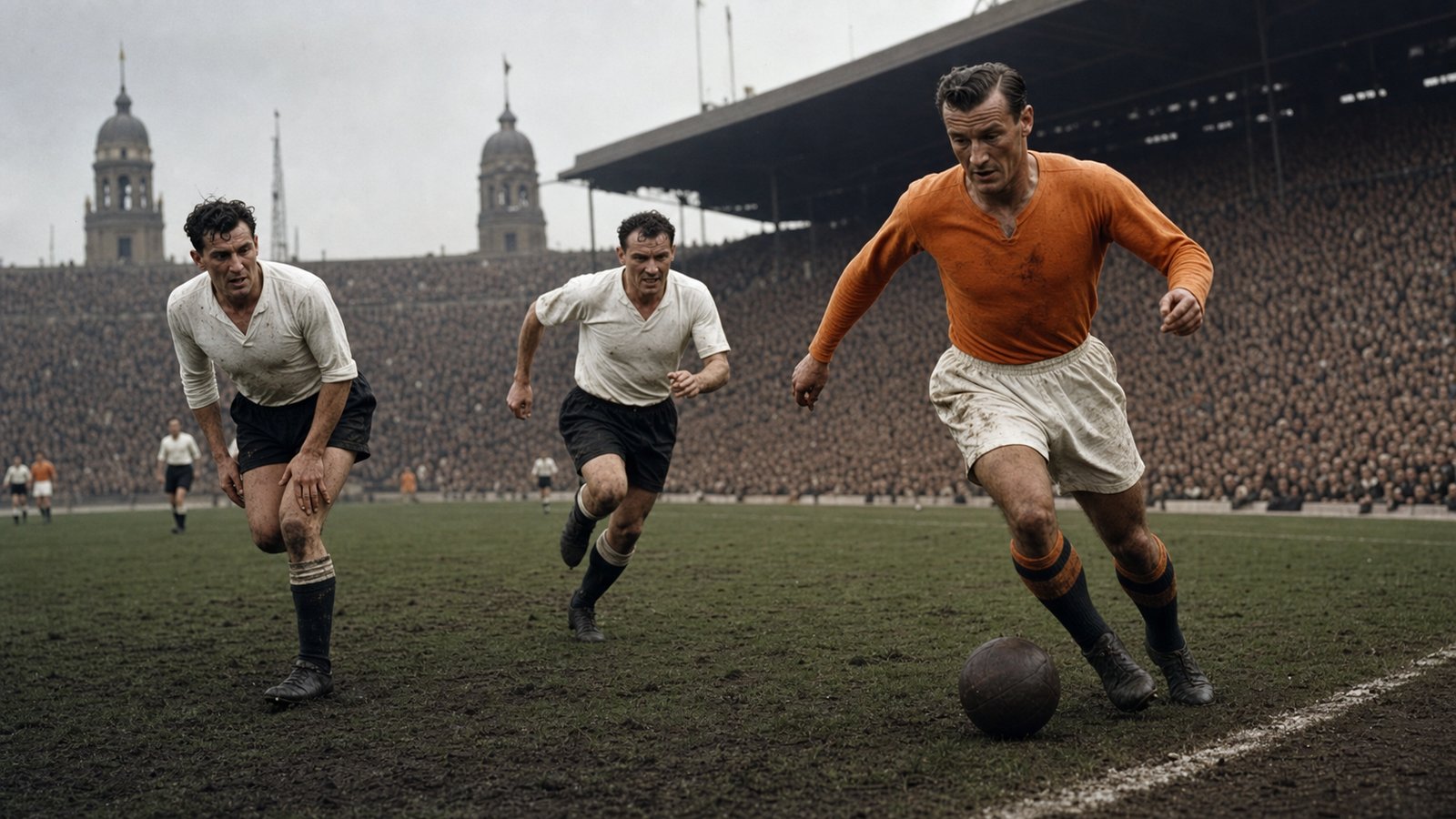
With roughly 22 minutes remaining, Matthews finally produced the delivery Blackpool needed. He accelerated beyond Banks on the right and crossed toward the far post. The ball escaped goalkeeper Stan Hanson’s grasp, and Mortensen forced it over the line from close range. His momentum carried him into the post. For several seconds, the scorer lay hurt beside the goal he had made possible.
Bolton’s physical margin kept shrinking. Bell laboured on one leg. Banks needed treatment. Lofthouse also took knocks while trying to give his defence relief upfield. Willie Moir’s side could still break when Blackpool committed men forward, but the distance between winning the ball and keeping it became harder to cover. Blackpool’s pressure was now both tactical and cumulative: Matthews stretched the flank, Taylor searched for the next pass, and Mortensen stayed close enough to punish every unstable clearance.
The Hat-Trick Arrived From a Dead Ball
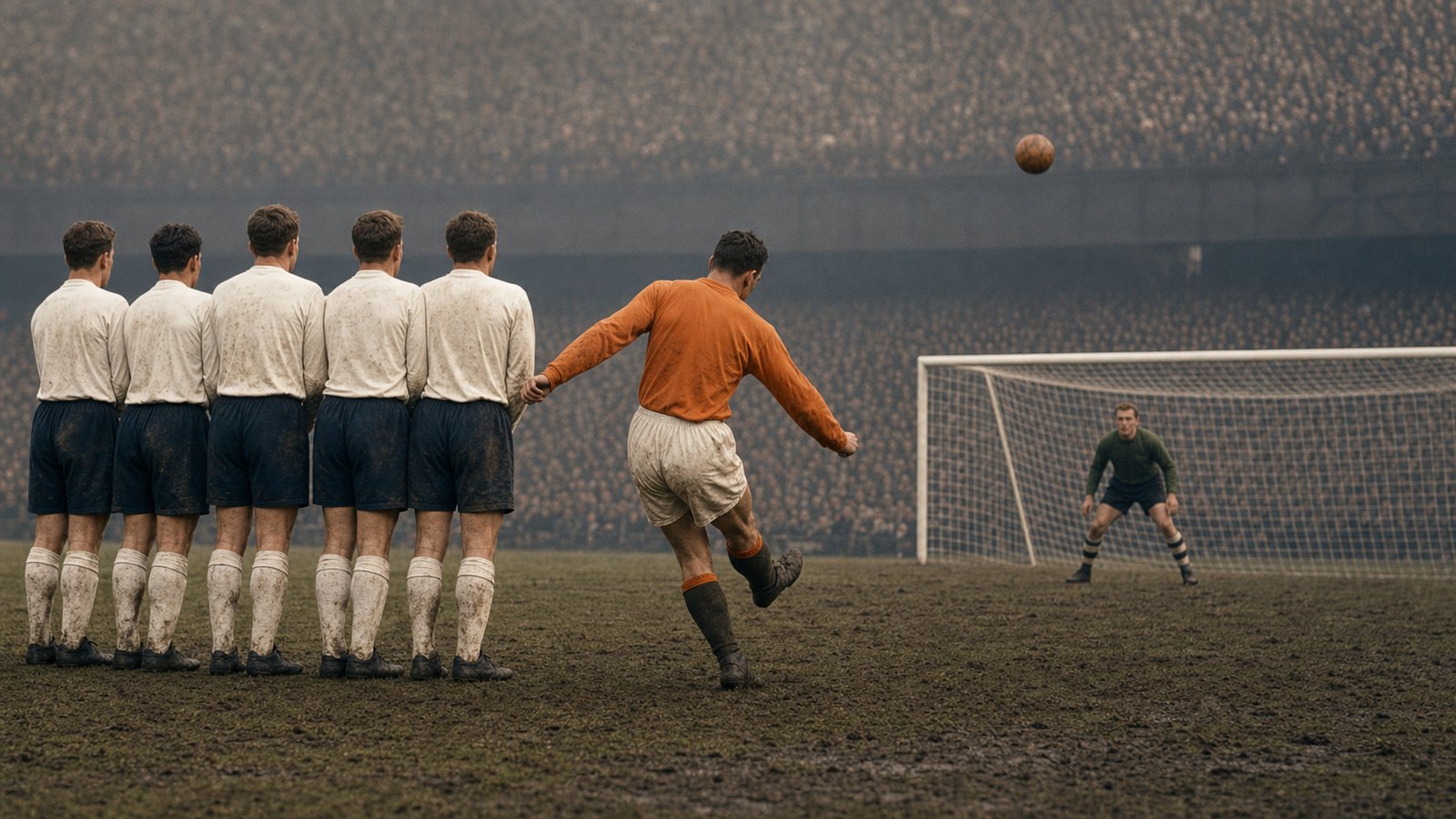
In the 88th minute, Matthews crossed again. Bolton cleared only as far as Jackie Mudie near the edge of the area, where a challenge produced a free kick. The decision looked generous to some observers, but Mortensen did not hesitate over the opportunity. He placed the ball, ran up and drove a right-footed shot into the top-left corner. Hanson barely moved before the net billowed.
It was Mortensen’s third goal and the first hat-trick scored in an FA Cup final at Wembley. The achievement should have been large enough to name almost any match. He had supplied Blackpool’s first answer, forced in the second after Matthews’s cross and then struck the equaliser himself from a stationary ball. No single pattern explains all three goals. Together they reveal a centre-forward adapting to whatever the final offered: a deflection, a collision at the post and one clean swing under maximum pressure.
At the centre circle, Mortensen bent forward with his hands on his knees. A draw would have sent the exhausted teams into extra time. Bolton were trying to recover their shape with injured players scattered across it. Blackpool, having reached 3–3 so late, could have accepted the reprieve. Instead they treated the restart as another chance before Bolton could breathe.
Ernie Taylor Found the Pass Before Perry Found the Corner
The winning move began with Ernie Taylor around halfway. He shifted play toward Matthews, received the next phase and returned a first-time diagonal pass into the right channel. Matthews faced Banks once more. A drop of the shoulder created the yard he needed. He reached the byline and pulled the ball backward rather than lifting another hopeful cross.
Bill Perry arrived onto the cutback and drove it into the bottom-left corner. The winner belonged to three distinct actions: Taylor’s pass split the defence, Matthews won the final duel, and Perry supplied the finish. None can be removed without breaking the move. Blackpool had gone from 3–2 down to 4–3 ahead in a matter of minutes, too quickly for Bolton’s depleted side to regain control.
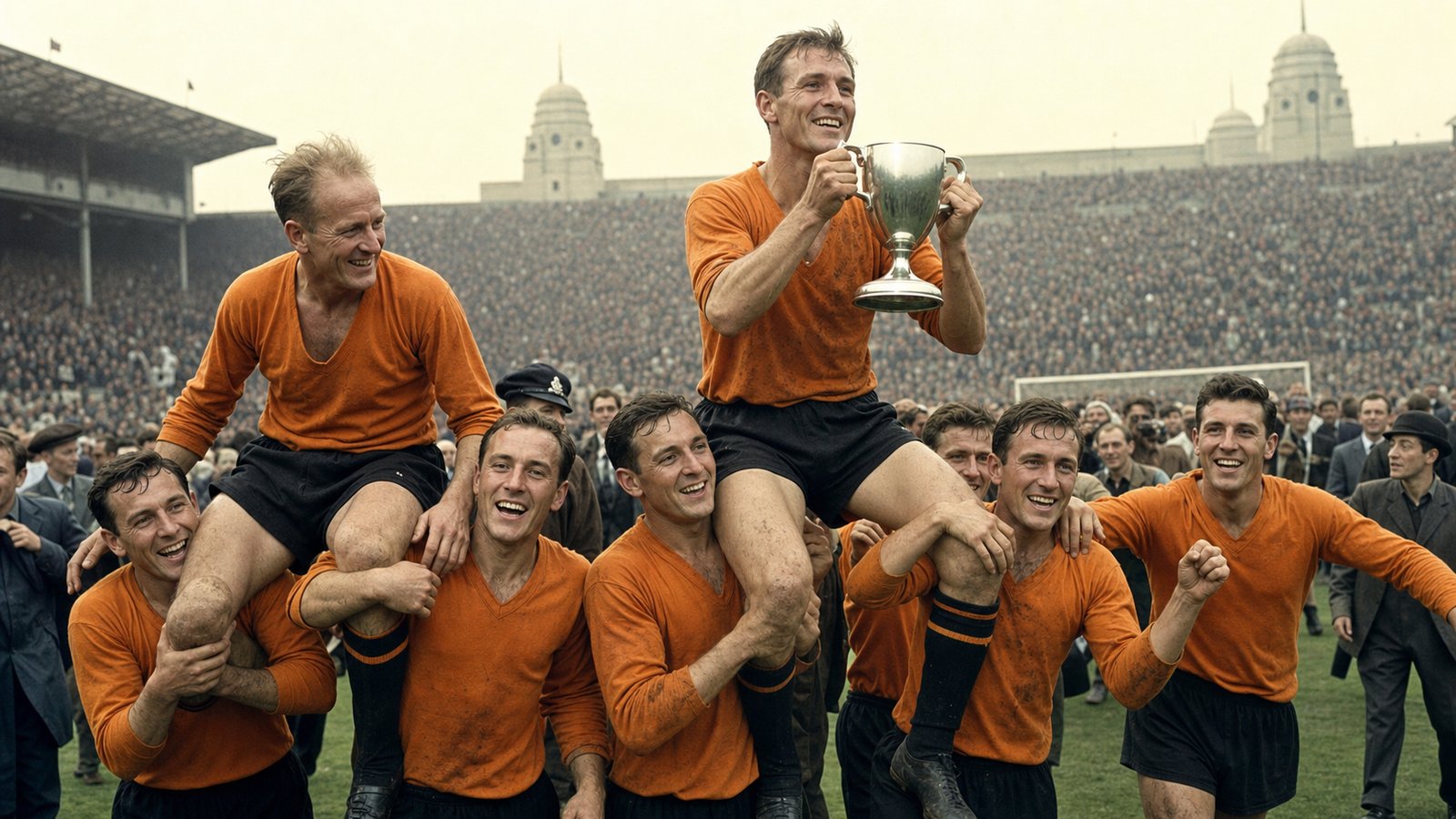
The scenes after the whistle fixed the emotional hierarchy. Blackpool captain Harry Johnston climbed Wembley’s 39 steps and received the cup. Matthews, whose two previous finals had ended in defeat, was carried shoulder-high alongside him. The image answered the question most viewers had brought to Wembley: would England’s most celebrated winger finally win the trophy? The answer was vivid enough to become the match’s permanent label.
Bolton’s dressing room held the other ending. Captain Willie Moir later recalled players sitting in the bath with tears rolling down their faces. He said they were “all jiggered.” It was a blunt summary of the final’s physical mechanism. Bolton had not merely failed to defend a lead through a lapse of nerve. They had tried to preserve it while injuries reduced movement across the side that Matthews kept attacking.
The Nickname Chose the Hero, Not the Whole Match
The 4–3 score equalled the record for the highest-scoring FA Cup final, set in 1890. Mortensen became the first Wembley final hat-trick scorer. Perry delivered one of the competition’s latest and most dramatic winning goals. Taylor shaped the move that created it. Bolton contributed three goals, a 75-second opening and a defence forced to continue without substitutions. There were enough claims to immortality for several matches.
Matthews nevertheless took the name because his story organised the emotion. He was 38. He had lost twice on this stage. The right wing became the visible route through which Blackpool’s late pressure turned into chances, and his byline cutback created the winner. Spectators did not need a statistical argument to understand why he was lifted from the grass.
The more complete memory can hold both truths. Matthews earned the celebration by repeatedly confronting the weakest part of Bolton’s damaged shape and producing the decisive pass. Mortensen, Perry and Taylor earned equal space in the explanation of how Blackpool won. The 1953 final carries Matthews’s name, but its seven goals belong to a match far larger than one man.
Sources
BBC Sport; The Guardian; Rec.Sport.Soccer Statistics Foundation.