
The 1994 Champions League final is usually introduced as a shock because of what everyone expected Barcelona to be. Johan Cruyff’s side had the aura of a dream team, a European champion two years earlier and a league power built around possession, confidence, and attacking imagination. AC Milan, by contrast, arrived in Athens with suspensions, injuries, and the heavy suspicion that their great early-1990s cycle had lost too many parts at once. The scoreline, 4–0 to Milan, still looks like a misprint if the final is reduced to reputation.
But the night was not simply a favourite collapsing. It was a tactical ambush carried out with extraordinary clarity. Fabio Capello’s Milan did not beat Barcelona by pretending to be more romantic. They beat them by turning control into pressure, by attacking the spaces Barcelona left when they assumed the ball would protect them, and by making the final feel brutally practical. Athens was the night a supposedly weakened side gave one of the cleanest demonstrations in European Cup history of how a system can survive missing stars if its collective habits are strong enough.
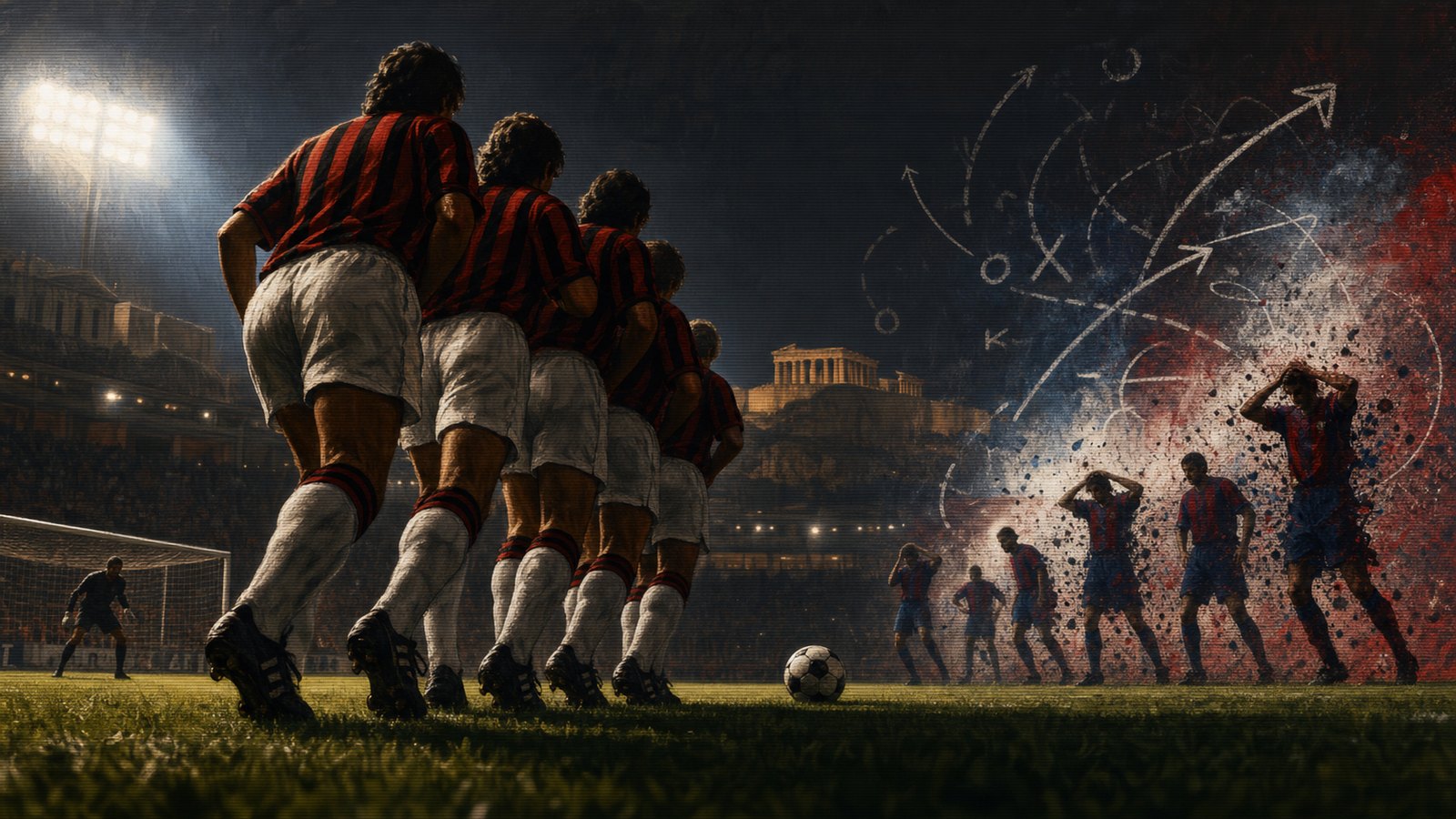
Milan looked weakened, but the structure was still alive
The pre-match conversation was shaped by absences. Franco Baresi and Alessandro Costacurta were suspended, which meant Milan lacked two pillars of the defensive line most associated with the club’s European authority. Marco van Basten’s injury problems had already taken away the glamorous attacking reference point of the earlier Sacchi years. On paper, it was easy to see vulnerability. Barcelona were expected to ask questions Milan could no longer answer.
That reading missed the depth of Milan’s learned behaviour. Capello had changed the emotional temperature of the side from Arrigo Sacchi’s revolutionary pressing to something more controlled, but he had not inherited a blank sheet. Milan still understood distances. They still understood how to step together, how to compress the pitch, and how to turn a defensive action into the start of an attack. The names mattered, yet the choreography mattered too.
In Athens, Filippo Galli and Paolo Maldini had to carry enormous responsibility in the centre and left of the defensive unit, while the midfield in front of them had to stop Barcelona’s possession from becoming comfortable. The point was not to camp in the penalty area and hope. Milan pressed selectively, guarded central lanes, and attacked with a speed that made Barcelona’s rest defence look alarmingly thin. The weakened team still had a spine because the system gave players shared instructions under stress.
Barcelona’s confidence became a tactical risk
Cruyff’s Barcelona were not careless by accident. Their style was built on the idea that the ball, if used well, could organise the match. Width stretched opponents. Passing rhythm moved defenders. Technical superiority made pressure feel temporary. That approach had produced trophies and a new identity, but it also carried a risk: when possession broke down, the spaces behind the ball could be enormous.
Milan understood that risk. They did not need to win a philosophical debate about beauty. They needed to make Barcelona defend the consequences of their own ambition. Every time Milan recovered possession with runners already positioned to move forward, the final tilted. Barcelona’s structure, so confident when the ball was secure, looked exposed when Milan played through the first wave quickly. The Italian side’s attacks were not random counters. They were prepared exits into the zones Barcelona were slow to protect.
The first half made the lesson obvious. Daniele Massaro scored twice, and both goals carried the feeling of a match plan becoming visible. Milan were not merely taking chances. They were creating the kind of chances Barcelona’s shape was vulnerable to conceding: quick, direct, and arriving before the dream team could turn possession into pressure again.
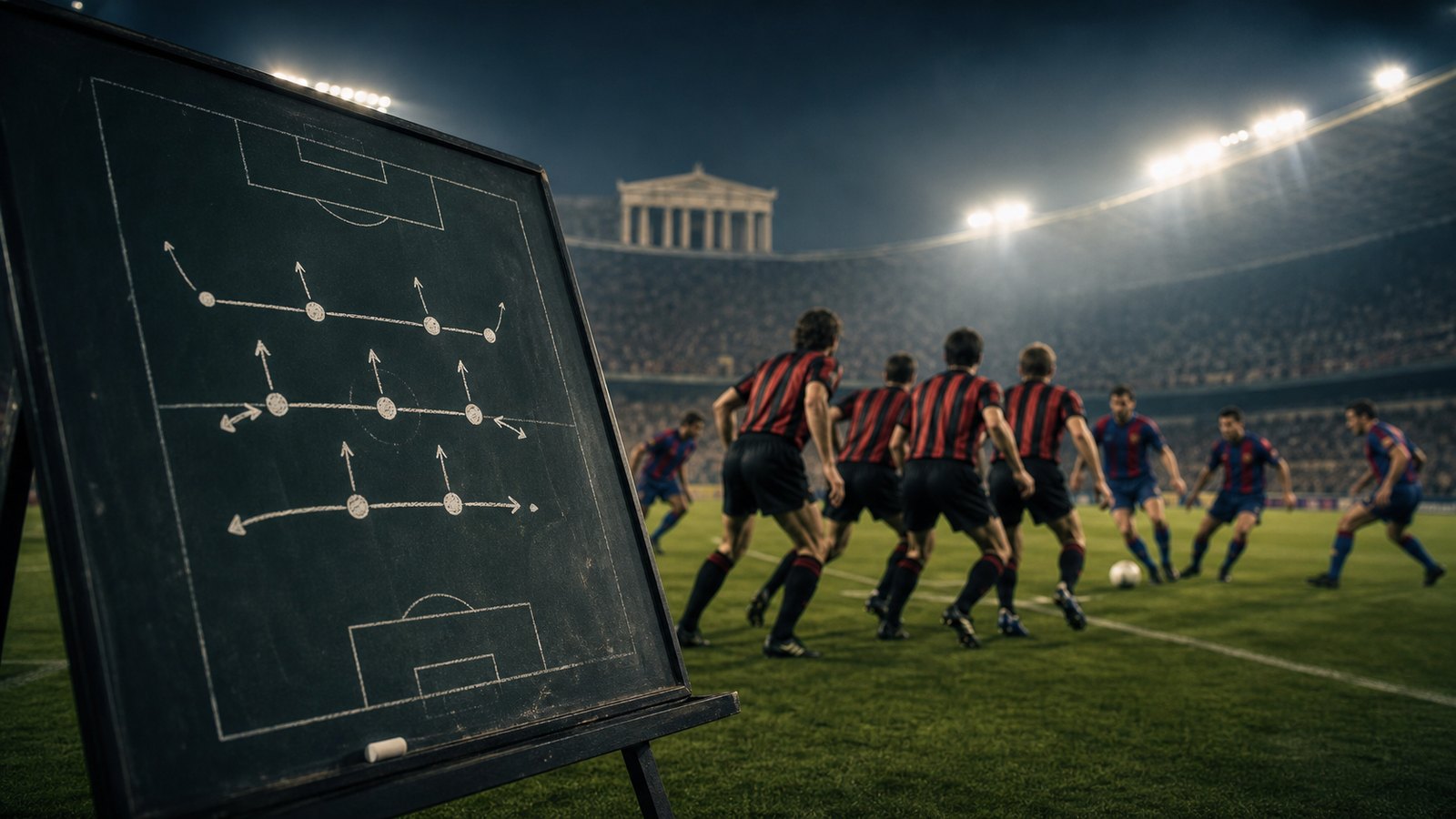
The final was won in the spaces between pressing and patience
Milan’s great trick was balance. A purely defensive side might have invited Barcelona to grow into the game. A reckless pressing side might have been played through. Milan lived between those extremes. They stepped out when the cue was right, then dropped into compact distances when Barcelona circulated away from danger. This made the match psychologically uncomfortable for Cruyff’s team. They could have the ball, but not always the ball they wanted. They could move wide, but not always with the central passing lane open. They could attack, but every lost possession carried a threat.
Dejan Savicevic’s role captured that balance. He was not just a decorative attacker waiting for one moment of genius. His movement gave Milan an outlet that Barcelona had to respect. When he scored early in the second half with an extraordinary lifted finish, the goal felt like a punishment for Barcelona’s assumptions. The space, the awareness, the execution: all of it turned the final from an upset into a statement.
Marcel Desailly’s later goal completed the transformation. A midfielder known for power and defensive range surged through to finish like the match had opened specifically for him. By then Barcelona were chasing not only goals but also the collapse of their own certainty. Milan had forced them into a game where each problem solved created another problem behind it.
Capello did not reject Sacchi; he weaponised the inheritance
It is tempting to frame the 1994 final as Capello’s pragmatism defeating Cruyff’s idealism. That is too simple. Capello’s Milan were pragmatic, but they were not primitive. Their spacing, defensive timing, and transitions came from a club culture shaped by Sacchi’s earlier revolution. The difference was tone. Sacchi had made Milan feel like a theory brought to life. Capello made them feel like a machine that no longer needed to explain itself.
That is why the absences did not break them. Milan’s defensive habits were not private property belonging only to Baresi and Costacurta. Those players were exceptional, but the team’s principles had spread. When others entered the structure, the demands were clear: stay compact, trust the line, protect the centre, and make the next pass hurt. In Athens, the replacements and remaining stars did not imitate the missing men. They performed the system’s logic.
The result also complicates how we remember Barcelona. The dream team was not exposed as a fraud. It was exposed as a great side at the end of a cycle, facing an opponent perfectly equipped to punish the parts of its game that age, familiarity, and confidence had made vulnerable. Great teams can be beaten most dramatically when their strengths turn into habits and those habits become predictable.
A 4–0 final that still teaches modern football
The Athens final remains useful because it refuses easy categories. It was not defence against attack in the cartoon sense. It was one possession system being denied comfort by another system that knew exactly where to apply pain. Milan defended brilliantly, but they also attacked with precision. Barcelona had the ball often enough to suggest control, but not enough good possessions to command the night. The scoreboard was huge because the tactical margin, once opened, kept widening.
Modern football still recognises the lesson. Possession without rest defence is a dare. Pressing without structure is a gamble. Missing stars are damaging, but a deeply internalised system can carry a team through a crisis. Finals are not always won by the side with the cleanest mythology. Sometimes they are won by the side that understands the opponent’s mythology well enough to turn it against them.
Milan’s 4–0 did not end Cruyff’s influence on football. If anything, the long-term game moved toward many of his ideas. But Athens showed that ideas need protection. They need spacing behind the ball, humility in transition, and solutions when the opponent refuses to admire them. Capello’s Milan gave Barcelona no admiration. They gave them pressure, speed, and a scoreboard that made every assumption visible.
Sources
UEFA Champions League final archive; AC Milan official history; FC Barcelona historical records; 1994 European Cup final match reports; tactical retrospectives on Capello, Cruyff, and the Dream Team era.