
The European Cup final of 1982 can look, from a distance, like a single English upset in a decade full of them: Aston Villa beat Bayern Munich 1–0 in Rotterdam, Peter Withe turned in the decisive goal, and another First Division club carried the trophy home. That version is true, but it is too neat. Villa’s win was not a romantic flash that appeared from nowhere. It was the last night of a compact machine built in the previous league season, held together by a small squad, a hard defensive rhythm, and a dressing room that had already learned how to win while looking permanently under-resourced.
The strange part is how fragile that machine looked on the night it became immortal. Villa lost their starting goalkeeper, Jimmy Rimmer, early in the final. They were facing a Bayern side with European pedigree, international quality, and the kind of possession pressure that could make a side retreat into panic. Instead, a substitute goalkeeper, Nigel Spink, was pushed into the biggest match of his career, and Villa’s outfield players narrowed the final into a contest of blocks, angles, and patience. The story is not simply that Villa scored. It is that they kept turning the match back into something they could survive.
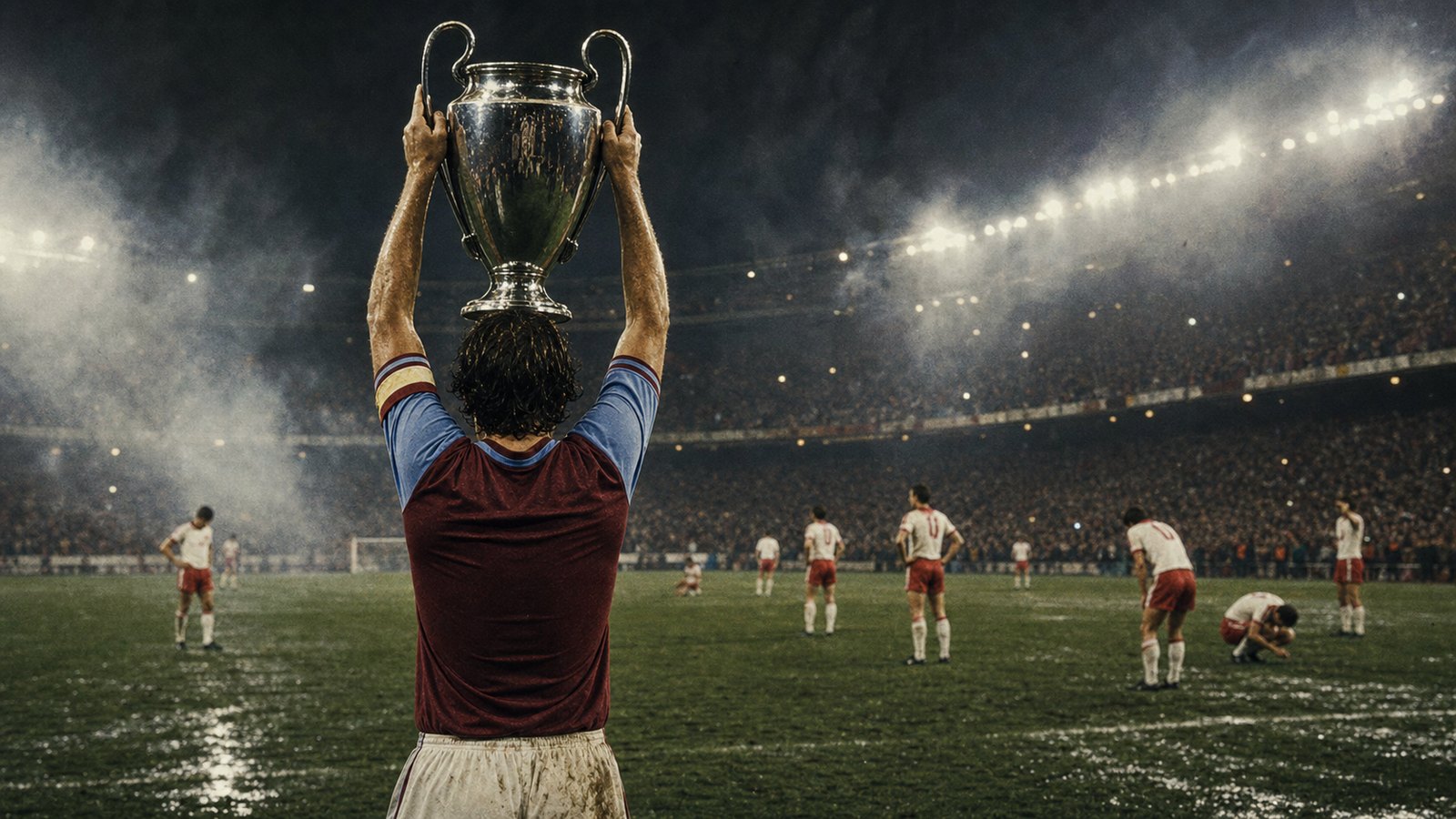
The champions who were already running on fumes
Villa had won the 1980–81 English league title with a famously lean squad. That matters because it explains the psychology of Rotterdam. This was not a club rotating through a modern roster or solving problems with specialist depth. The league title had been won through continuity, resilience, and a core group who understood one another’s habits. The team’s authority came from repetition. Defenders knew when midfielders would screen them. Wide players knew when to hold the ball rather than turn a possession into a race. Forwards knew that one clean break could be enough if the back line kept the match intact.
By the time Villa reached the European Cup final a year later, the aura of that league-winning side was still present, but so were signs of exhaustion. The campaign had carried managerial change, fixture pressure, and the mental burden of defending a domestic breakthrough while learning the demands of Europe. Tony Barton, who had taken over from Ron Saunders during the season, did not rebuild the side into something new. His task was closer to preservation: keep the best parts of the old rhythm alive long enough for one more European night.
That makes the final easier to understand. Villa did not need to dominate Bayern in every phase. They needed to reduce the number of moments in which Bayern’s greater continental experience could become decisive. The team’s shape was less glamorous than the trophy it won. It was about keeping the back four connected, making second balls ugly, and refusing to let one Bayern spell become a flood.
Rotterdam turned the plan into a goalkeeper test
The most famous complication arrived almost immediately. Jimmy Rimmer, carrying an injury, could not continue. Nigel Spink came on after only a handful of minutes, entering a final against Bayern with almost no time to feel the match. Goalkeeping substitutions are different from tactical substitutions because they announce vulnerability. The opposition sees uncertainty. The defenders feel a new voice behind them. Crosses, rebounds, and back passes suddenly carry a different weight.
Villa’s achievement was to stop that emergency from becoming the whole match. Spink had to make important saves, but the structure in front of him mattered as much as the saves themselves. Bayern were pushed into areas where shots could be contested. Villa’s defenders fought to keep the ball in front of them. When the German side circulated possession, Villa’s midfield did not chase every pass as if the match could be won by emotion alone. They waited for triggers, squeezed the next touch, and made Bayern restart attacks that seemed ready to accelerate.
That is why the final feels different from a pure underdog heist. Villa were under pressure, but not helpless. The team absorbed the shock of the goalkeeper change because the collective rules were already strong. Spink became a hero partly because he performed under impossible pressure, and partly because the side gave him a match in which heroism did not have to mean facing a clean shot every two minutes.
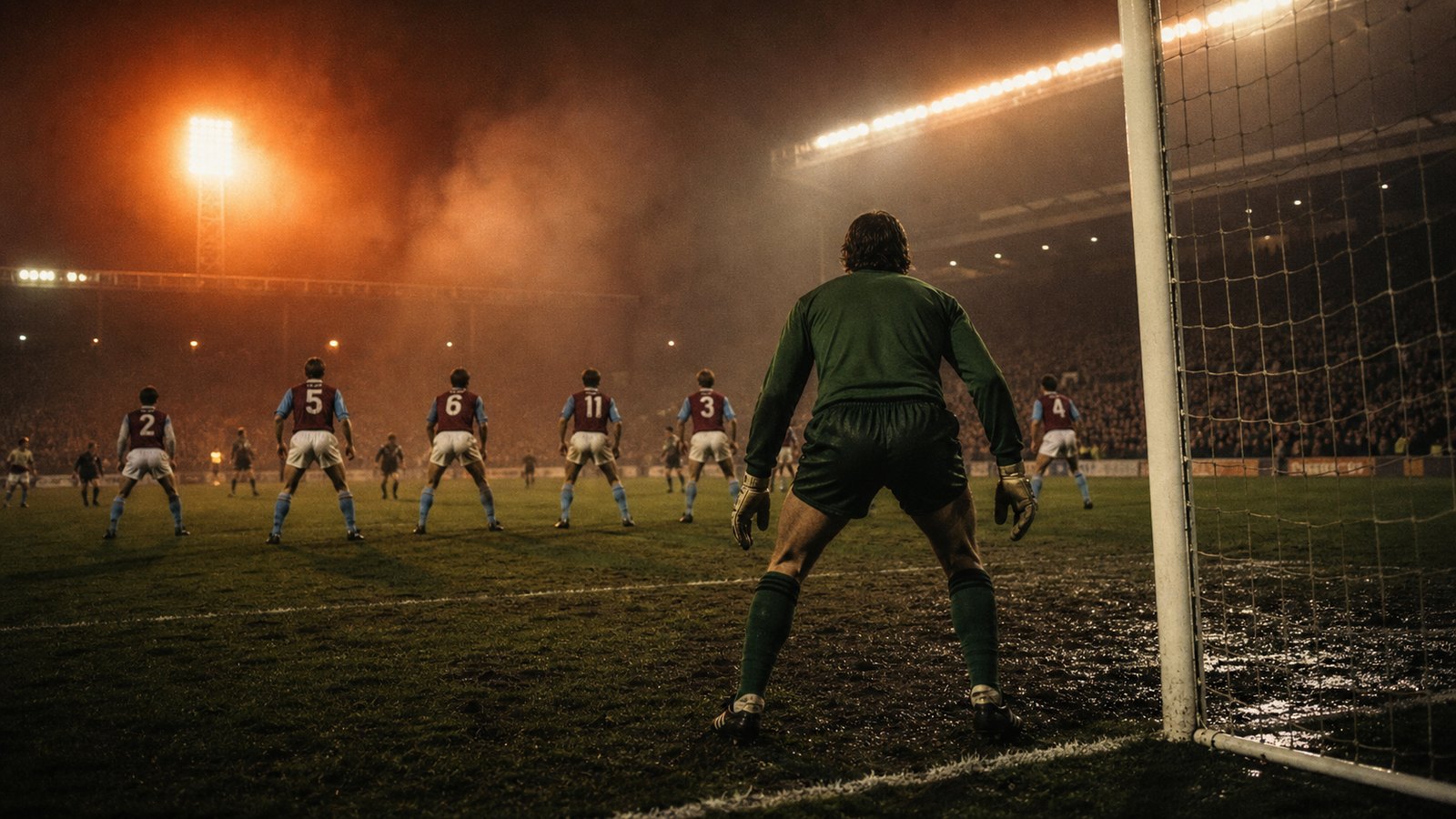
The winning goal was a system moment, not a loose miracle
Peter Withe’s goal is often remembered as a simple finish, and that simplicity is exactly the point. Villa’s attacking threat did not depend on endless possession. It depended on moments when Bayern’s pressure left a gap, when a wide player could receive with enough time to deliver, and when the penalty area could be attacked before the defensive block reset. The final’s decisive move came from that kind of opening. Tony Morley found the space to carry and cross. Withe arrived where a centre-forward had to be. The finish was not pretty, but European finals rarely ask whether a goal is pretty before they count it.
In tactical terms, the goal showed the value of Villa’s patience. A team that spends most of a final defending can become too deep to hurt anyone. Villa did not fall into that completely. They still had outlets. They still had players willing to run beyond the first safe pass. Morley’s involvement mattered because he gave Villa a route out of their own half that was not just a clearance. Withe’s presence mattered because the route had an endpoint. One spell of composure turned a night of survival into a lead.
Once ahead, Villa’s problem changed. They no longer had to imagine the upset. They had to protect it while Bayern understood exactly what was slipping away. That is often the hardest phase for a side like Villa. The temptation is to retreat so far that every clearance returns like a wave. The better answer is more disciplined: defend the box, yes, but also keep enough pressure on the ball that crosses and shots arrive under strain. Villa lived in that narrow space until the final whistle.
Bayern’s pressure exposed what Villa did well
Bayern were not a passive giant waiting to be beaten. Their pressure forced Villa to reveal the real nature of the win. It was not built on technical superiority. It was built on clarity. Bayern could move the ball and test the substitute goalkeeper, but Villa were unusually good at making each Bayern possession feel slightly less clean than it wanted to be. A runner was tracked. A passing lane was blocked. A shot was delayed long enough for a body to arrive. These are small acts, but finals are often decided by small acts repeated without panic.
The English context also matters. Villa belonged to a period when English clubs had made the European Cup feel almost domestic: Liverpool, Nottingham Forest, and then Villa extended a run that looked astonishing from the outside. But Villa’s version was distinct. Liverpool had an imperial calm. Forest had Brian Clough’s controlled audacity. Villa had something more compressed: a league-winning side trying to squeeze one last peak from a narrow core. Their final therefore carries a different emotional weight. It is not the start of a dynasty. It is the summit of a short, intense cycle.
That explains why the trophy did not lead to a long Villa reign over Europe. The conditions that made the side so coherent also made it difficult to sustain. A small group can become a beautiful machine, but it can also age together, tire together, and become hard to refresh without changing the very chemistry that made it work. Rotterdam was the night before the bill came due.
The legacy is smaller than a dynasty and bigger than a fluke
Calling Villa’s 1982 win a fluke misses the work that made the fluke possible. Calling it a dynasty exaggerates what followed. The better reading is that Villa created one of football’s most concentrated peaks: league champions in 1981, European champions in 1982, and then gradually pulled back toward the more ordinary gravity of English club life. The achievement sits between romance and mechanism.
It also belongs in the history of how clubs without endless depth can still win elite competitions. They need timing. They need a squad whose relationships are sharper than its size. They need a tactical identity that survives injuries and pressure. They need enough attacking quality to turn one break into a result. Villa had all of that in Rotterdam, even after the match tried to take their plan apart inside the first ten minutes.
The final image should not only be Withe scoring or Spink saving. It should be the whole side holding its nerve after the emergency had announced itself. A substitute goalkeeper, a narrow team, a powerful opponent, one clean cross, one awkward finish, and a long final stretch of collective refusal. Aston Villa did not merely steal the European Cup. They compressed a league-winning operating system into one last night and made Bayern Munich live inside it.
Sources
UEFA match archive; Aston Villa official club history; European Cup 1981–82 records; contemporary final reports from Rotterdam; Peter Withe and Nigel Spink career records.