
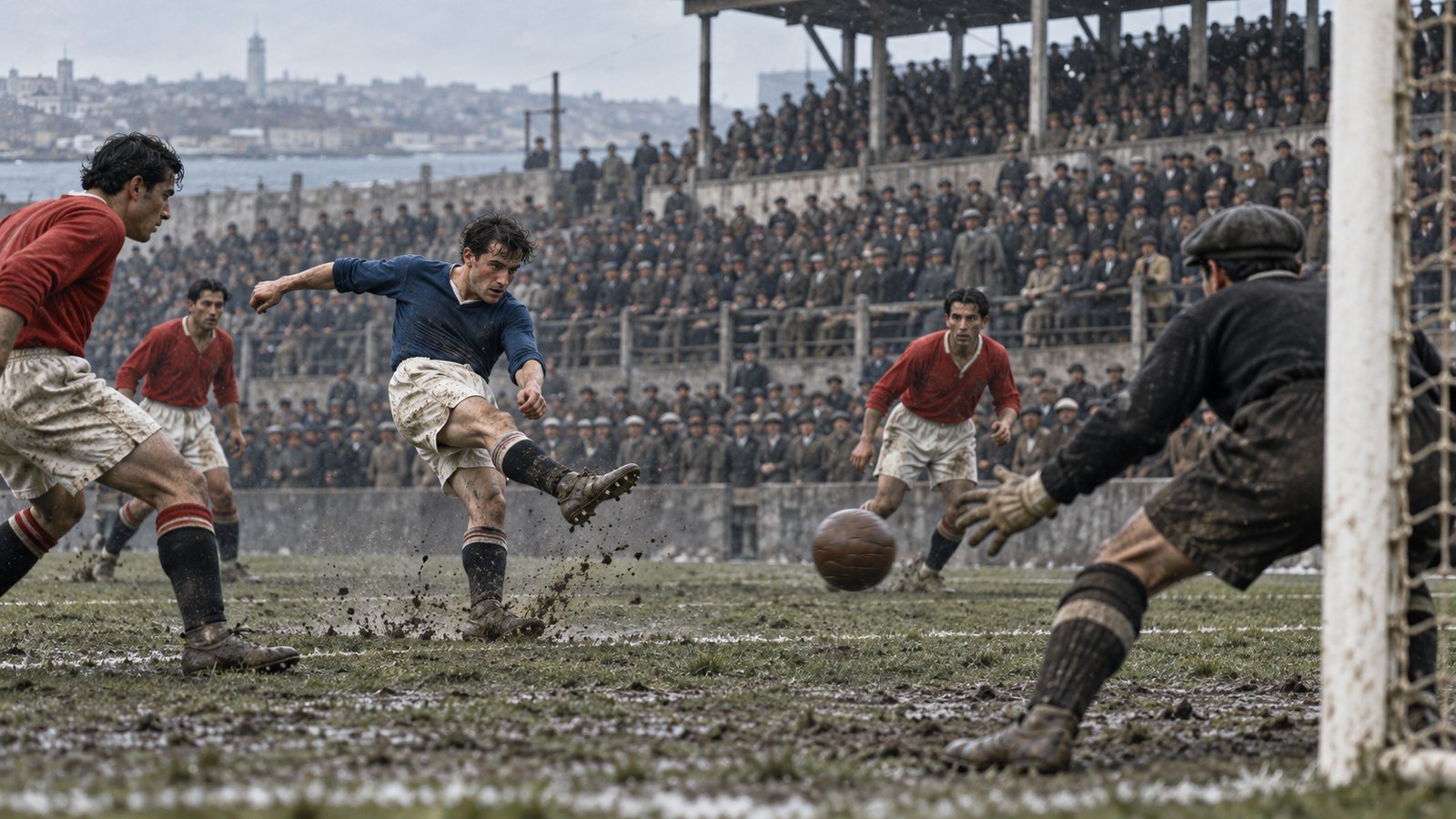
Lucien Laurent met Ernest Libérati’s cross with his right foot in the 19th minute. The ball travelled beyond Mexico goalkeeper Óscar Bonfiglio, France took the lead, and a competition with no previous goals suddenly had its first.
There was no roar carrying around a finished monument to the World Cup. The match on 13 July 1930 was played at Montevideo’s Estadio Pocitos because the new Centenario was not yet ready. Uruguay was in winter. Laurent later remembered snow falling and described a move that began with goalkeeper Alex Thépot, passed through Marcel Chantrel and Libérati, and ended with his volley from near the edge of the penalty area.
The sequence lasted seconds. Reaching it had required an Atlantic voyage, unpaid leave from a car factory and faith in a tournament whose future was unknowable. Laurent said he could not then imagine the goal’s significance. That distance between the modest occasion and everything the World Cup became is what makes his story larger than a line in a record book.
A Factory Worker Crossed the Atlantic as an Amateur
Laurent was born in Saint-Maur-des-Fossés near Paris on 10 December 1907. At roughly 1.60 metres and 65 kilograms, he was a small inside-right. He joined Cercle Athlétique de Paris as a boy in 1921 and remained there for nine years before moving to the club then known as Peugeot Sochaux.
The name described the connection precisely. Peugeot supported the team, and Laurent worked at the company’s factory. France selected him for the inaugural World Cup only months after his international debut in a 2–0 defeat by Portugal. His older brother Jean also made the travelling squad, although Jean did not appear in Uruguay.
International selection was not completely new territory. Olympedia records Laurent as part of France’s football party for the 1928 Amsterdam Olympics, where he did not start a match. Uruguay was different: he travelled as a recent senior international with a place in the side, yet still as an amateur whose everyday employment remained waiting in France.
Lucien received time away from the factory but no salary while he was gone. The French federation covered basic expenses. Professional football had not yet separated the player’s working week from his sporting identity, and the World Cup did not arrive with the financial certainty later generations would associate with it.
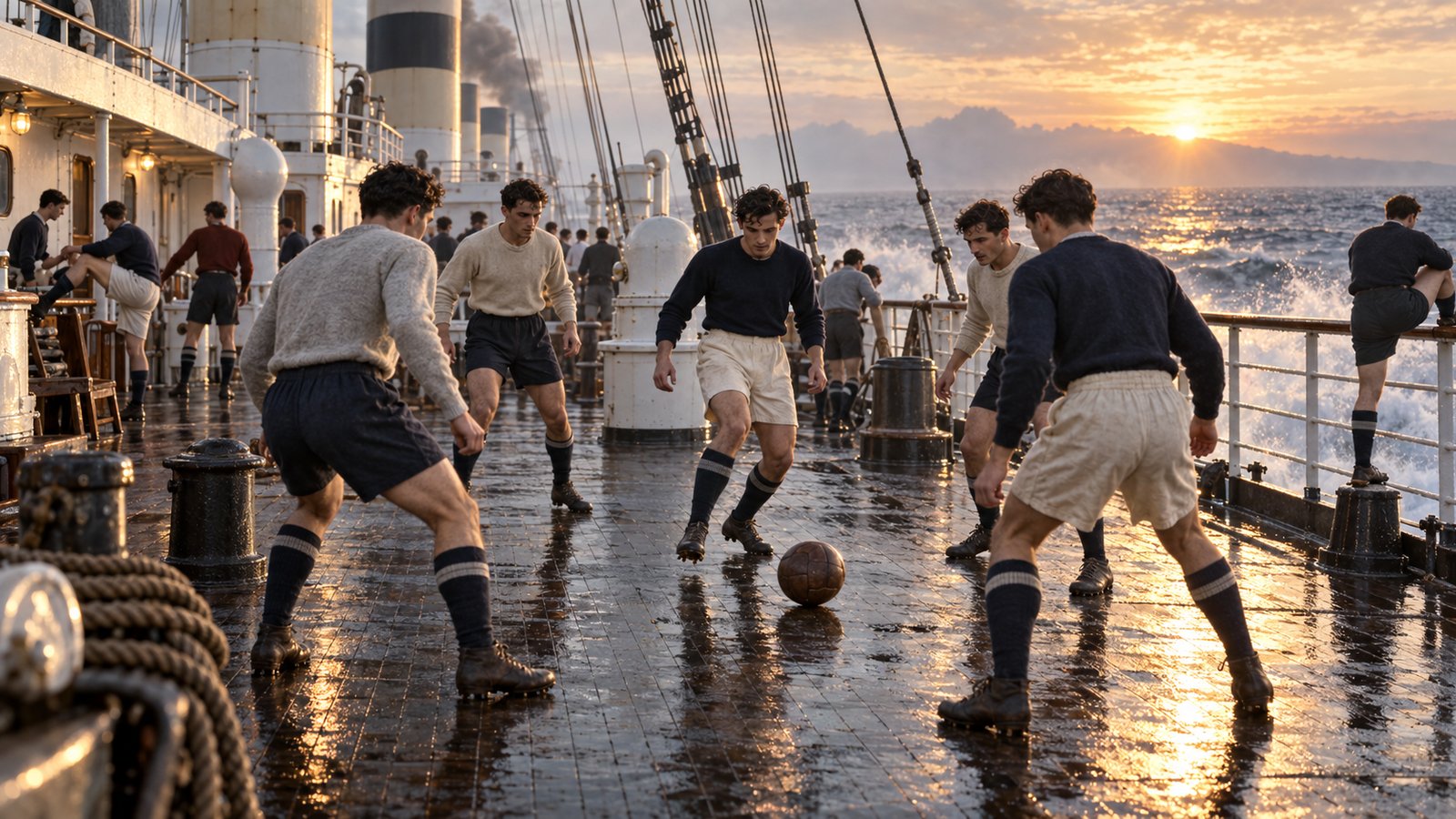
The European parties travelled to South America by ship. Belgium, Romania and Yugoslavia were represented aboard the voyage as well. France trained on deck in the mornings; Laurent remembered running on the spot later in the day, swimming, watching films and listening to onboard entertainment. The crossing placed future opponents together before the first whistle and gave the tournament the atmosphere of an expedition.
An Unfinished Stadium Sent France to Pocitos
Montevideo was building the Centenario as the centrepiece of the competition, but construction was incomplete when the opening fixtures began. France therefore met Mexico at Pocitos, the compact ground used by Peñarol. Laurent regretted never playing in the new stadium that would become the tournament’s defining structure.
The setting made the first goal feel even less ceremonial. Winter weather surrounded a match played before a modest attendance. There was no established World Cup ritual, no archive of famous openings and no way for the players to know whether the competition would survive. They were participating in an experiment rather than entering a tradition.
France nevertheless started with purpose. Thépot sent the ball out from goal. Chantrel moved it toward the right, where Libérati beat his defender and reached the goal line. His pull-back arrived for Laurent, who struck first time with his right foot. Contemporary reconstructions place him around the edge of the penalty area; Laurent later described a volley from about 12 yards. The essential shape is consistent: goalkeeper, transition down the right, low delivery, one decisive contact.
No elaborate celebration followed. Laurent recalled handshakes and a return to position. André Maschinot scored twice as France completed a 4–1 win. The first World Cup match in French history was also the country’s first World Cup victory, but the group would become harder immediately.
An Injury Made the Next Match a Test of Endurance
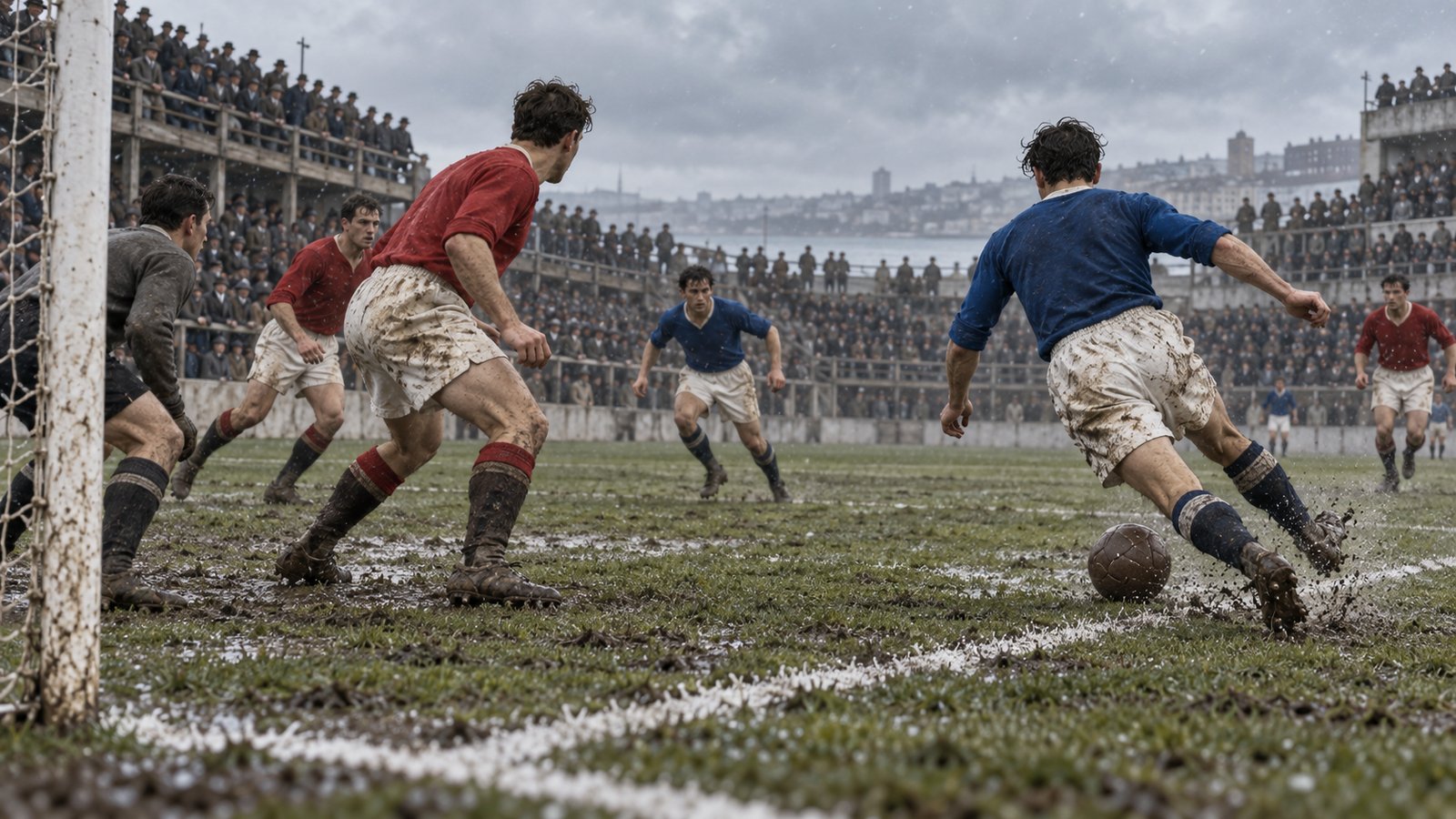
France faced Argentina two days later. Argentina were expected to advance, but the match remained goalless deep into the second half. Early in the contest, defender Luis Monti caught Laurent with a severe challenge and damaged his ankle. Substitutions were not permitted, so France could neither replace him nor restore its full attacking shape. He stayed on as what he later called a passenger.
Monti eventually scored from a free kick in the 81st minute. France were still chasing an equaliser when Brazilian referee Almeida Rego blew for full time about three minutes early. The mistake was acknowledged. Players who had begun leaving the field were called back, and the remaining time was completed after an interruption of roughly a quarter of an hour. Argentina held the 1–0 lead.
Laurent’s ankle kept him out against Chile. France lost again and exited at the group stage. The injury gave his tournament a compressed form: a winning opener and the first goal, followed by a damaged second appearance and a final match watched from outside the team.
It also corrects the temptation to treat early World Cup football as a quaint prelude. The competition was physically severe, its rules gave an injured player little protection, and administrative improvisation could unfold in the middle of a decisive match. Laurent’s record emerged from football that demanded endurance as much as novelty.
Ten France Appearances Held Two Lasting Goals
Laurent’s international career extended from 1930 to 1935 but contained only ten appearances. He scored twice. The second goal came in May 1931 when France beat England 5–2, a landmark result in Paris. He was selected for the 1934 World Cup squad but an injury prevented him from playing in Italy.
His club career moved through Sochaux, Club Français, another spell at CAP, Mulhouse, Rennes and Strasbourg. These were substantial years of football, yet none could dislodge one minute in Uruguay from the way the wider public remembered him.
The contrast never seemed to make Laurent grandiose. His own description of the goal was technical and brief. Libérati crossed; he volleyed; France continued. What changed was not the action but the size of the archive that grew behind it. Every later World Cup scorer joined a sequence whose first entry carried Laurent’s name.
The same inaugural tournament produced another intimate piece of football history when Uruguay and Argentina used a different ball in each half of the final. Both stories preserve the material scale of 1930: a ship journey, unfinished stands, disputed equipment and players who could not yet see the global institution forming around them.

The Lost Shirt Left the Memory Intact
The Second World War interrupted Laurent’s later playing career. Called into the French armed forces, he was captured and spent three years as a prisoner of war in Saxony. When he returned, he discovered that possessions stored in Strasbourg had been stolen. Among them was the France shirt he had worn at the 1930 World Cup.
He resumed football with Besançon and retired as a player in 1946, later working as a trainer and youth coach. Long after his professional years, he continued joining weekly games in Besançon. CBC reported that he played until the age of 86 and then kept attending to encourage the others from the touchline.
In 1998, Laurent was the last surviving member of France’s 1930 squad. At 90, he attended the World Cup final in Paris and watched France beat Brazil 3–0. The man who had scored when the tournament possessed no history was present when his country won it at home 68 years later.
Laurent died in Besançon on 11 April 2005 at the age of 97. He had lost the physical souvenir from Uruguay, but not the details. In old age he said that his memories were established in a corner of his head where nobody could steal them. The first World Cup goal endured in the same way: a simple football action preserved because everything that followed kept enlarging its beginning.
Sources
The Guardian; CBC Sports; Olympedia.