
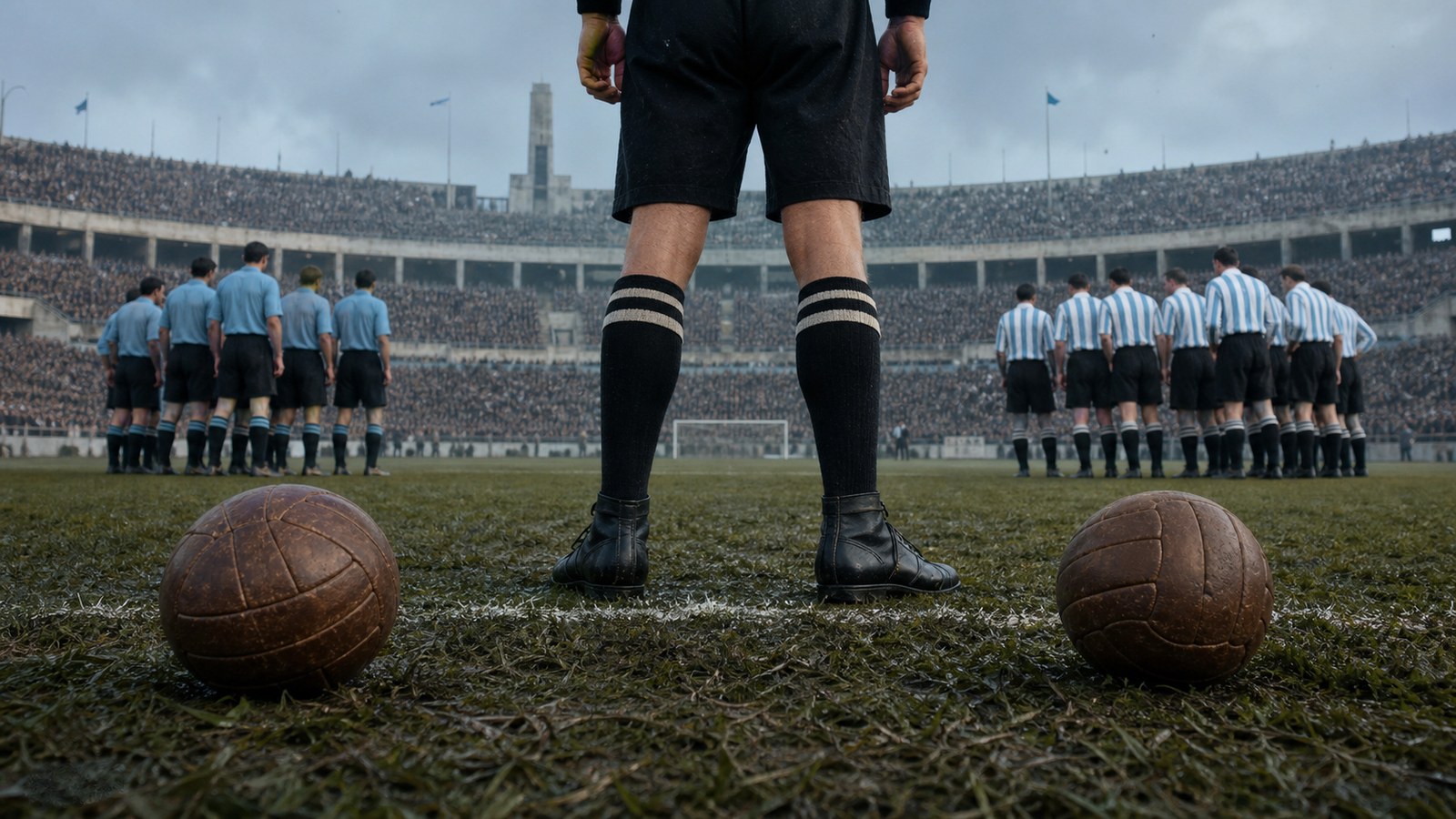
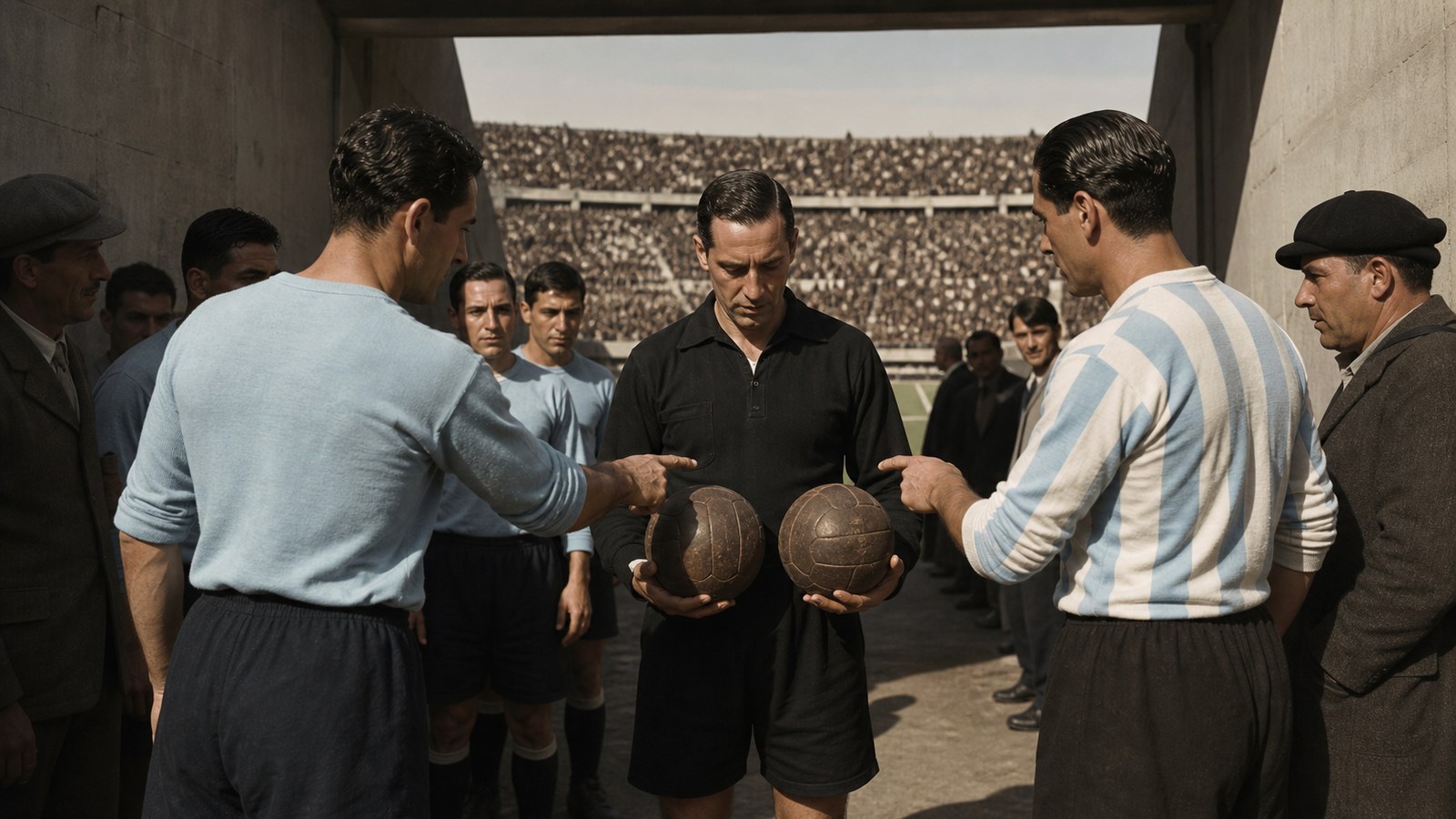
Before the first World Cup final could begin, the referee had to settle an argument about the one object every player was meant to share. Uruguay wanted its ball. Argentina wanted its own. Neither finalist accepted the other team’s choice, so FIFA approved a compromise: Argentina’s ball would be used before half-time and Uruguay’s after it.
The arrangement sounds like a detail from football before standardisation. Then the score began to follow it. Uruguay led 1–0, Argentina turned the first half around to lead 2–1, and Uruguay scored three times after the interval to become world champions. The symmetry has survived because it is irresistible. It is also dangerous. There is no serious evidence that a change of ball caused four goals or decided the match. What the dispute does reveal is more interesting: the sport’s first global final was built inside an improvised tournament, between neighbouring rivals who trusted their own equipment more than a common authority.
Two finalists arrived with one unresolved object
Uruguay and Argentina did not need an introduction. They had met repeatedly across the Río de la Plata, contested South American championships and played the 1928 Olympic final over two matches. Uruguay had won that replay 2–1 in Amsterdam. Argentina then won the South American Championship in 1929. By July 1930, their rivalry already carried the weight of a regional argument about who represented the strongest football in the world.
The new World Cup sharpened it. Thirteen invited teams entered, with only four European sides making the long Atlantic journey. Uruguay hosted as the reigning double Olympic champion. Construction of the Estadio Centenario ran so close to the competition that its first match was not staged there until 18 July, twelve days before the final.
Equipment remained less settled than the architecture suggested. Modern elite football expects an approved match ball supplied under one competition standard. In Montevideo, both finalists brought a ball and objected to the other. Belgian referee John Langenus took charge under FIFA’s compromise: Argentina’s choice for the opening half, Uruguay’s for the second. The solution did not make the teams agree. It divided possession of the argument into two timed parts.
At eight in the morning, the gates were already open
The Centenario began admitting spectators at eight in the morning on 30 July. Accounts differ on the precise crowd total, but the ground was full well before kick-off. The occasion had outgrown a normal international. For the first time, FIFA’s new competition could name a champion.
Langenus brought his own concern. Later retellings describe him seeking assurances about his safety after the match. The details have acquired dramatic polish, but the anxiety fits the setting: a Belgian official had to control a local rivalry in front of a huge Montevideo crowd. Even the ball had required international arbitration.
The teams’ routes had created confidence rather than caution. Uruguay had beaten Peru and Romania in its group before defeating Yugoslavia 6–1 in the semi-final. Argentina had won all three group matches, then beat the United States by the same 6–1 score. The finalists had scored heavily, knew one another intimately and entered with no reason to treat the match as an exercise in survival.
Argentina’s half contained a Uruguayan opening
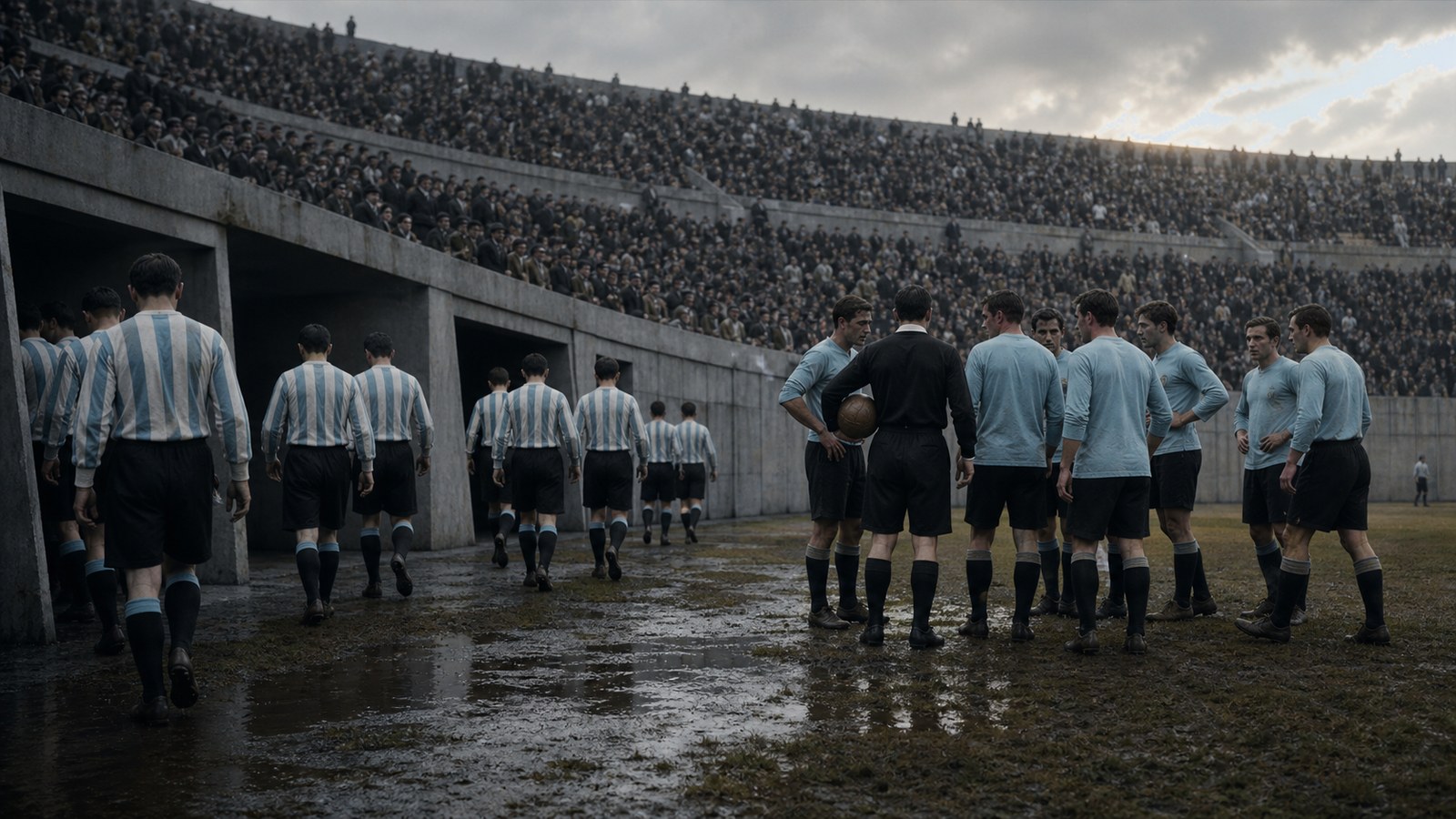
The ball arrangement did not produce a clean territorial split. Uruguay scored first in the twelfth minute while the Argentine selection was in use. Pablo Dorado finished from the right, putting the hosts ahead before the final had settled into the story later generations would tell about it.
Argentina answered eight minutes later. Carlos Peucelle drove past goalkeeper Enrique Ballestrero to make it 1–1. Then Guillermo Stábile, the tournament’s leading scorer, put Argentina in front in the 37th minute. He had arrived at the competition without the status of an automatic star and finished it with eight goals. His final contribution left Uruguay walking toward the interval behind on its own ground.
That 2–1 score is the hinge on which the ball legend turns. Argentina had supplied the first-half ball and led at the break; Uruguay would now introduce its preference. But the useful question is not whether one sphere possessed a national character. It is what changed around it. Uruguay had to play with greater urgency, Argentina had to protect a lead, and the crowd had forty-five minutes to turn uncertainty into pressure.
Pedro Cea made the second half a contest again
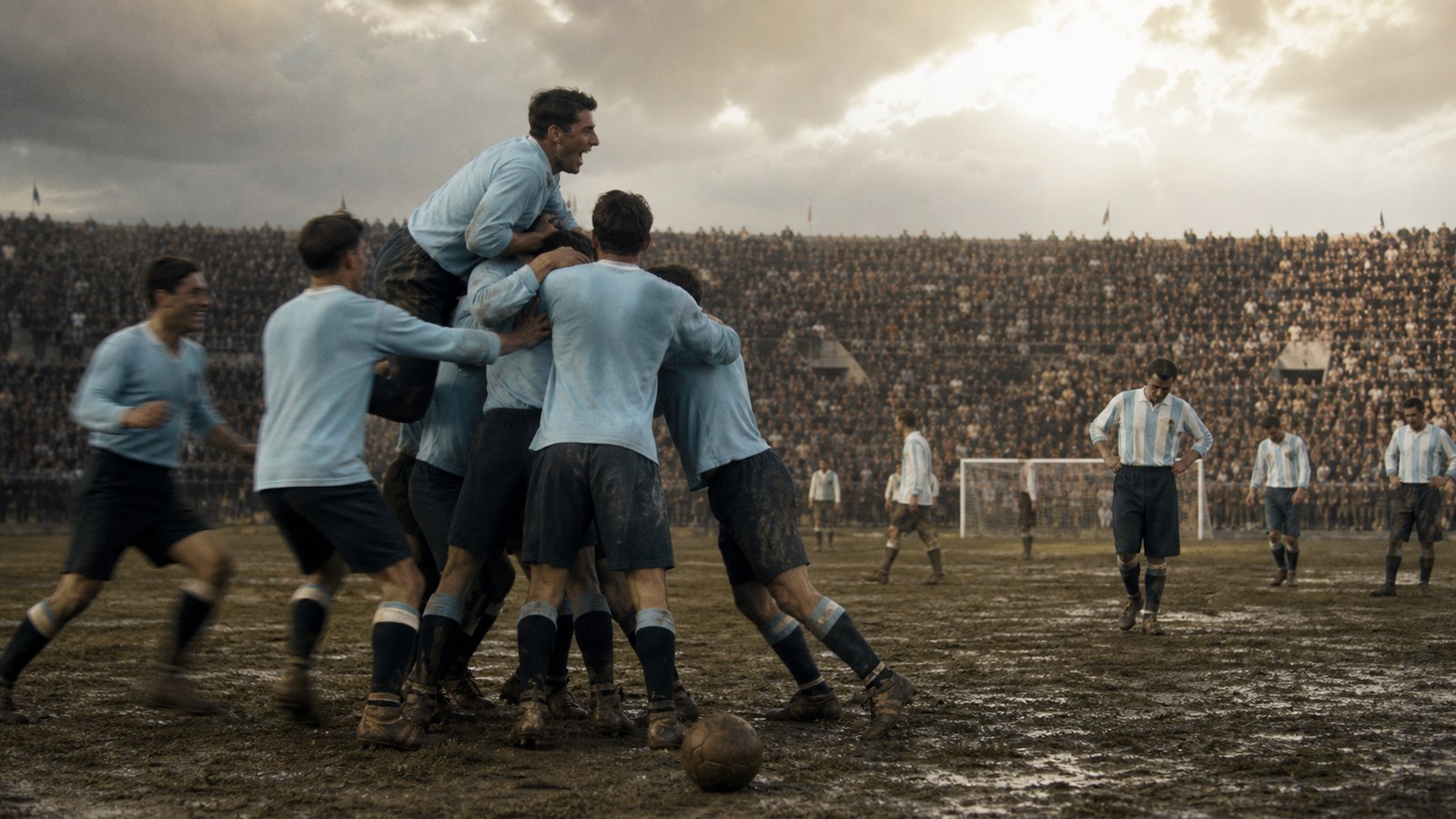
Uruguay’s equaliser came in the 57th minute through Pedro Cea. It restored more than numerical balance. The hosts no longer had to chase two events at once—the next goal and the fear that time was narrowing around Argentina’s lead. Eleven minutes later, Santos Iriarte struck to put Uruguay 3–2 ahead.
The sequence is often compressed into a claim that the heavier or more familiar Uruguayan ball transformed the match. Contemporary evidence cannot carry that conclusion. Ball construction varied in the period, and players certainly developed preferences about leather, lacing and feel. Yet the surviving result supplies correlation, not a controlled test. The teams changed ends, tactical incentives changed, fatigue accumulated, and Uruguay scored with players who had already shown their quality across the tournament.
That distinction does not make the object irrelevant. The players considered the choice important enough to dispute it before the biggest match yet staged. The honest version leaves room for that importance without assigning three second-half goals to leather and stitching.
Héctor Castro closed the first World Cup at four
Argentina still needed only one goal as the final entered its last minutes. Instead, Héctor Castro scored Uruguay’s fourth in the 89th. Castro had lost part of his right arm in a childhood accident and was known by a nickname that referred to it, a label that belongs to his era rather than modern description. On this afternoon, his defining act was a late header that removed the final’s last uncertainty.
Uruguay had won 4–2. Alberto Suppici, only 31, became—and remains—the youngest coach to win the men’s World Cup. FIFA president Jules Rimet presented the trophy, and Uruguay declared the next day a national holiday. Across the river, the defeat produced anger as well as disappointment. The final had confirmed Uruguay’s Olympic supremacy inside FIFA’s new tournament and denied Argentina revenge for Amsterdam.
The scorers created a balanced record of the afternoon: Dorado before Argentina’s comeback, Peucelle and Stábile for the visitors, then Cea, Iriarte and Castro for the hosts. Remembering only the two balls flattens six separate finishes and the decisions that produced them. Ignoring the dispute would erase the fragile organisation around those players.
The compromise became a myth because the score cooperated
Football history rewards details that divide time neatly. One ball belonged to Argentina, one to Uruguay; Argentina won one half, Uruguay won the other. The pattern feels like proof even though a single match cannot prove what caused its own reversal. It has endured because it gives the inaugural final a physical symbol that can be held, changed and blamed.
The better legacy is institutional. FIFA had created a world championship, but authority still had to be negotiated at ground level. The host stadium was newly completed. Participation depended on invitations and sea travel. A referee from Belgium stood between two South American powers. When the finalists rejected a shared ball, the governing body did not produce a universal model from a sealed box. It split the match in half.
Over time, manufacturing and competition controls made the ball an official tournament object rather than a contribution from either finalist. Montevideo preserved the moment before that certainty. The first champion was decided by outstanding players and a forceful Uruguayan recovery, with the organisers’ compromise visible at every restart.
The two-ball story matters, then, not because Uruguay’s choice can be credited with victory, but because both teams believed the choice was worth fighting over. Their argument marks the distance between a new global idea and the standards later generations would take for granted. The World Cup began with a full stadium, six goals, two rivals—and one piece of equipment the organisers could not make them share.
Sources
FIFA; BBC Sport; CBC Sports; Rec.Sport.Soccer Statistics Foundation.