
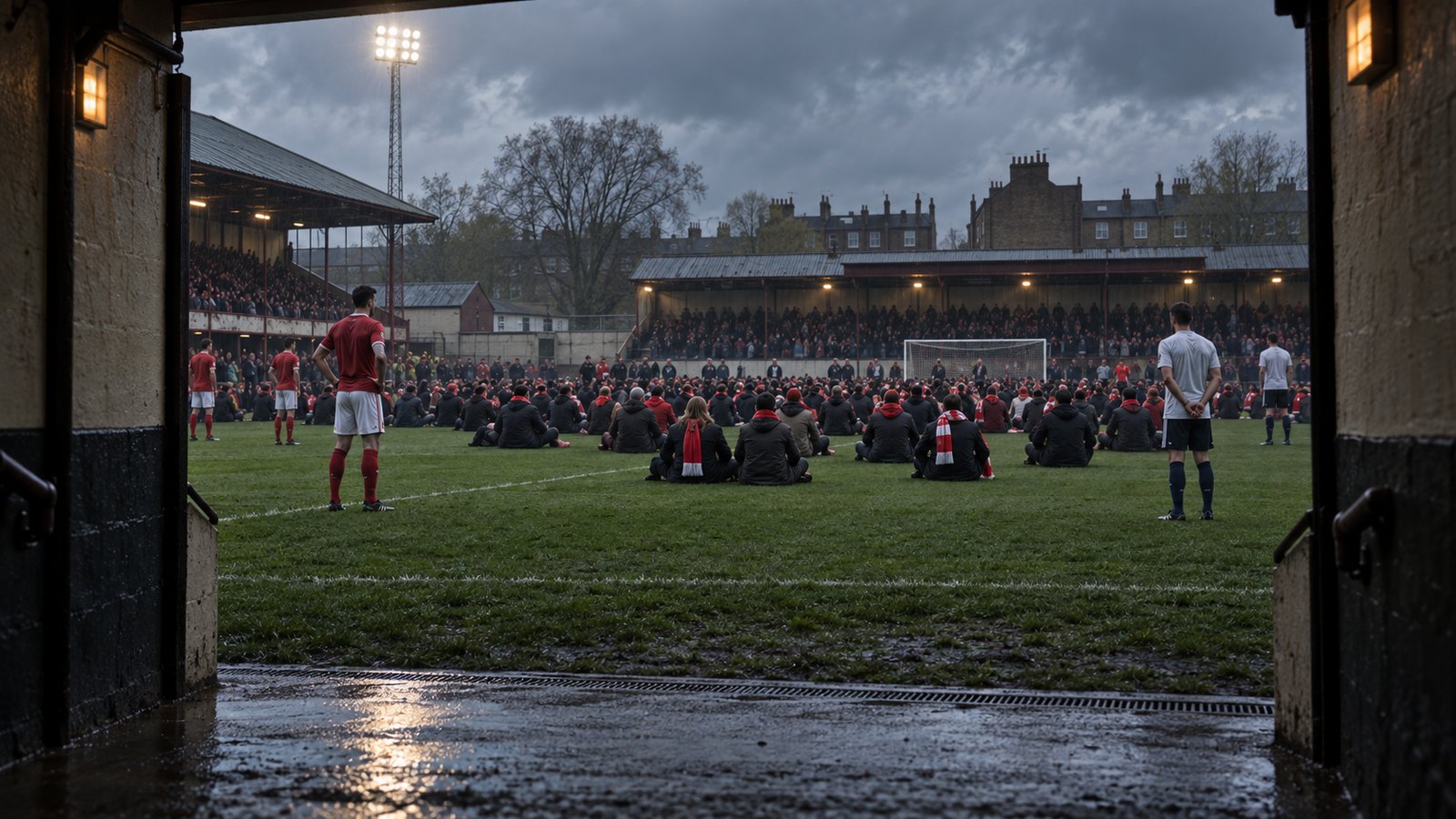
At 4:40 on a Saturday afternoon, Leyton Orient’s players walked off their own pitch. Hundreds of supporters had crossed the white line at Brisbane Road and sat on the grass. Colchester United led 3–1, the clock had reached the 85th minute, and a football match had become the one place where people inside a collapsing club could no longer be ignored.
The protest was directed at owner Francesco Becchetti, not the visiting team. Orient were already relegated. Staff had spoken publicly about unpaid wages. A winding-up petition had brought the club to the High Court. The supporters gathering near the centre circle were watching the end of a 112-year Football League stay, but their action was aimed beyond the result in front of them.
Eight minutes of football still mattered to Colchester’s play-off chase. That created an extraordinary problem: how could the authorities acknowledge a peaceful protest without allowing it to decide another club’s season? The answer involved an abandonment announcement, an empty stadium and a restart almost two hours after the players first left.
The afternoon showed supporters using the match itself as leverage. They stopped the spectacle because continuing normally would have hidden the crisis behind ninety familiar minutes.
A Wembley Miss Became a Three-Year Descent
Orient’s fall had been brutally compressed. In May 2014, they came within a penalty shootout of promotion to the Championship. Rotherham United beat them in the League One play-off final at Wembley. Weeks later, Becchetti bought the club from Barry Hearn.
The direction changed quickly. Orient were relegated from League One in 2015. Across Becchetti’s first two and a half years, ten managers were appointed. Constant changes in the dugout did not create a stable route back; they became part of the disturbance surrounding a squad sliding down another division.
By March 2017, the danger was no longer confined to the table. HM Revenue and Customs served a winding-up petition over unpaid tax, reportedly £250,000. A High Court hearing was set for 20 March. The Leyton Orient Fans’ Trust began discussing a “disaster recovery” fund with an initial target of £100,000.
The trust considered several outcomes: helping in a sale, responding to insolvency, or forming a new club if the existing one disappeared. A phoenix club was described as the last resort because it could also mean losing Brisbane Road. Supporters were therefore preparing for survival while still hoping the institution around them could be preserved.
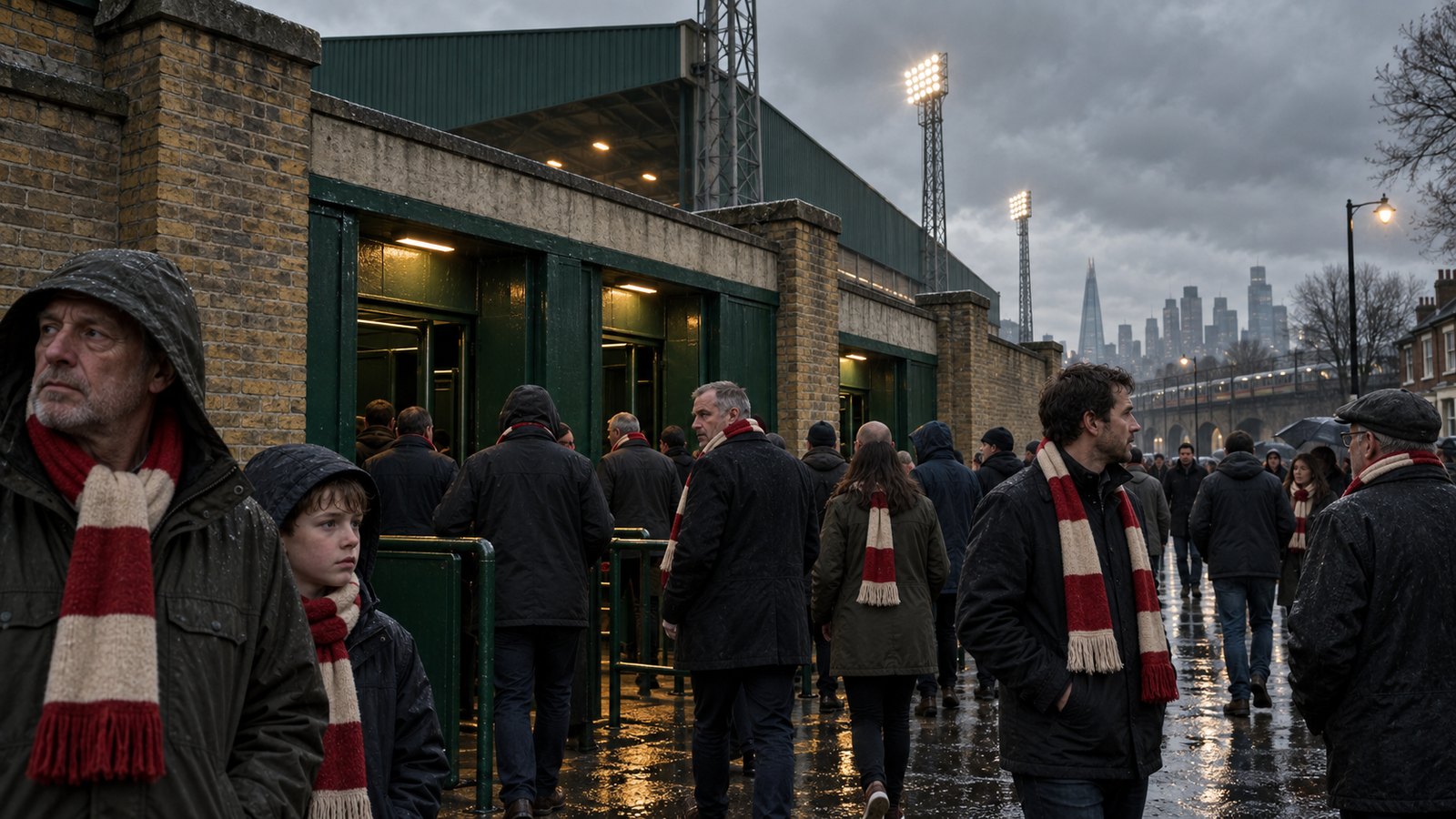
A week before the Colchester match, a 3–0 defeat at Crewe confirmed relegation. Orient’s continuous Football League membership, dating to 1905, was over. This was more than movement from the fourth tier to the fifth. It removed the club from the competition structure it had inhabited for 112 years.
Unpaid Staff Made the Crisis Tangible
League positions can make institutional failure look abstract. The staff statement of 24 April made it physical. Employees said their March salaries had still not arrived, with April pay due four days later. Some reported needing alternative living arrangements because missed wages were affecting rent and mortgage payments.
They also described repeated requests for answers meeting a wall of silence. The EFL said it shared their concern and had asked the club for a further financial commitment after receiving reassurances in March. According to the league, no response had followed.
On the same day, Hearn resigned as honorary life president. The role was ceremonial, but the gesture carried the judgment of the man who had sold his majority stake in 2014. He said he could not remain associated with a business that failed to pay its staff.
The week therefore placed three different losses side by side: league status, ordinary wages and confidence that the board would communicate. The protest against Colchester did not erupt from one poor performance. It followed public evidence that people who kept the club operating were carrying the cost of the ownership crisis.
Orient’s experience had echoes of the financial danger that later surrounded Portsmouth’s 2010 run to Wembley during administration, but the supporters at Brisbane Road were confronting their own immediate question. If routine matchday behaviour continued, what would compel anyone outside the club to look directly at the emergency?
The 85th Minute Broke the Matchday Script
Colchester’s Tarique Fosu-Henry, Chris Porter and Macauley Bonne had scored; Sandro Semedo had replied for Orient. The visitors led 3–1 and remained capable of reaching the play-offs. Then, in the 85th minute, home supporters entered the field.
Many sat down. The players went to the dressing rooms. Colchester coach John McGreal later said there had been no feeling that the players were in danger, and the EFL subsequently described the invasion as peaceful. The disruption nevertheless made ordinary play impossible.
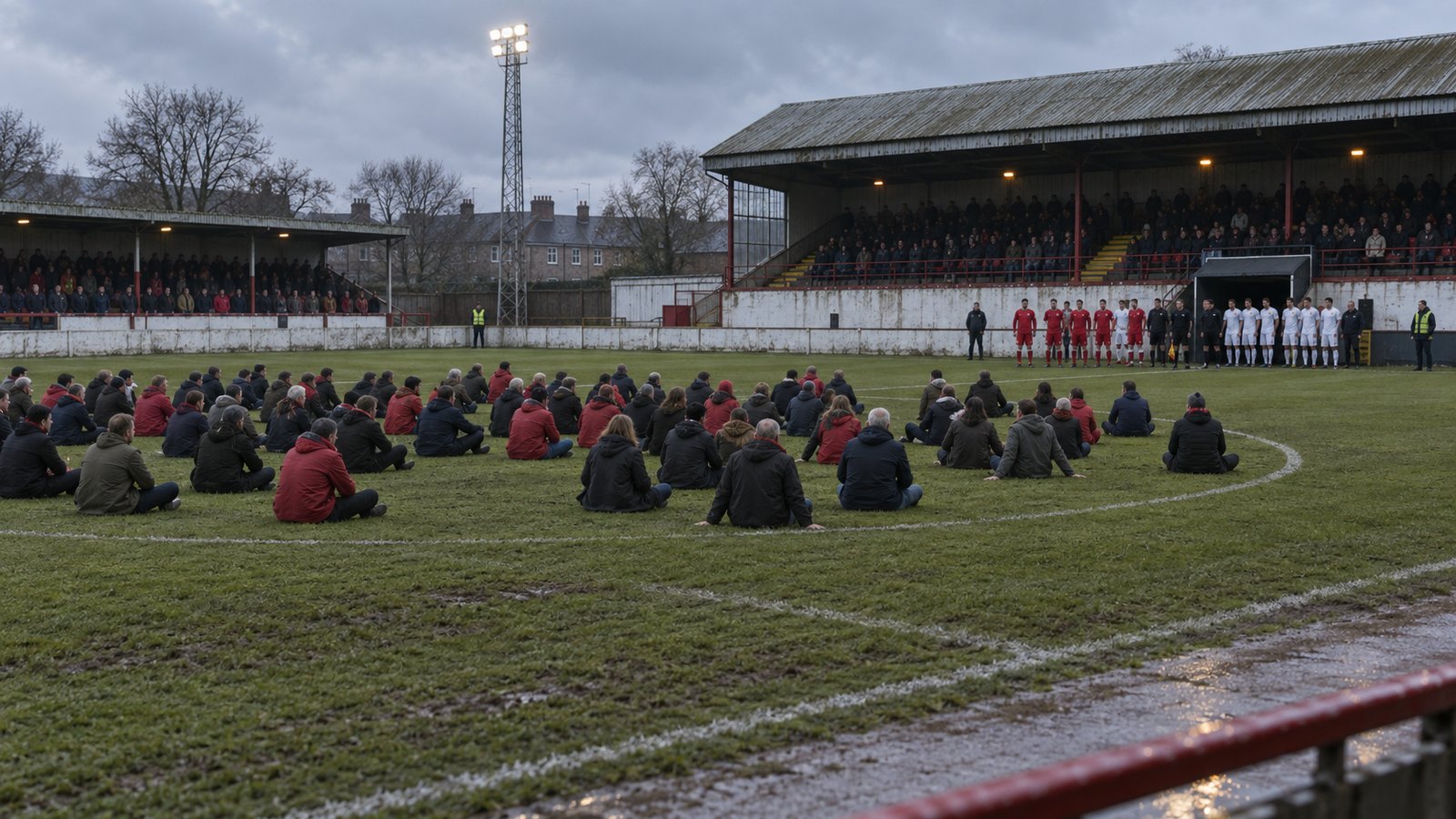
BBC Essex commentator Glenn Speller recorded the strange sequence with precise times. The players left at 4:40. At 4:48, announcements said the game had been abandoned. Supporters eventually cleared the field. More police arrived, and the ground was secured.
An abandonment normally closes an afternoon. Here it functioned as crowd management. The authorities later explained that the announcement had been made because it was expected to help empty the pitch, and it did. Yet the match had not been permanently discarded.
That distinction gave the protest its peculiar power. Supporters had interrupted the product the league was organised to deliver, and the response could not be reduced to removing a banner or waiting through a chant. For nearly two hours, the fixture had no certain ending.
Colchester’s Table Position Forced a Private Restart
The EFL’s concern was competitive integrity. Colchester still had a mathematical chance of reaching the League Two play-offs. Leaving the score at 3–1 after 85 minutes, ordering a replay, or failing to complete the fixture could each alter the conditions faced by clubs elsewhere in the table.
The league said all clubs were required to play 46 matches of 90 minutes. Both managers agreed that the remaining time should be completed, with the support of the match officials, police and stadium security. Shortly after 6:40, the players returned.
The stands were empty. The same grass that had held a mass sit-down now staged the last eight minutes for officials and essential staff. No comeback followed. Colchester’s 3–1 victory stood, moving them to within one point of the play-off places with one match remaining.
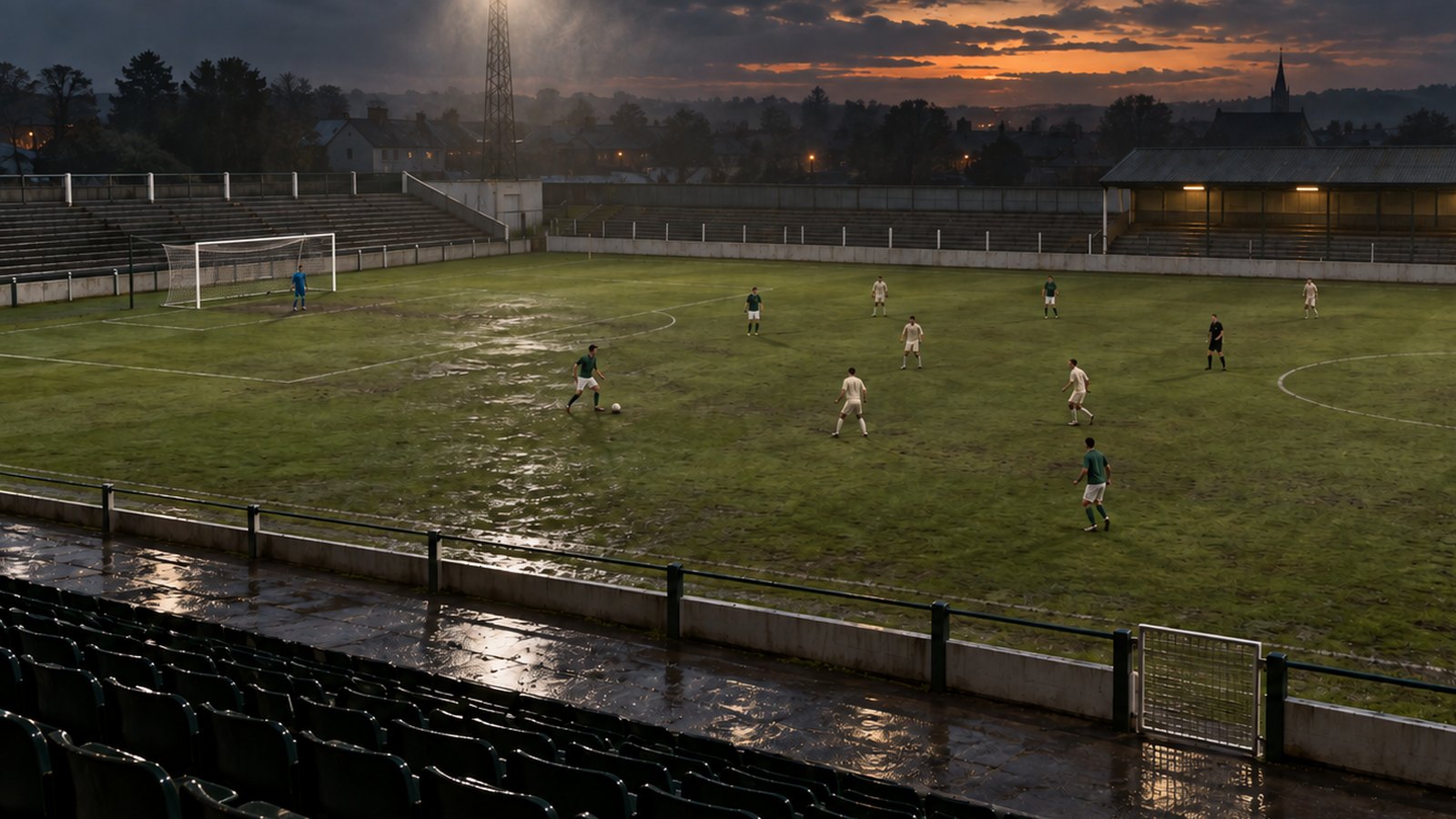
The EFL later said it had no regret over the difficult decision. It recognised supporters’ right to protest, especially amid Orient’s circumstances, but drew its boundary at actions that crossed onto the field and affected a sporting outcome. That response exposed the competing obligations packed into the afternoon: hear a club’s supporters, protect players and staff, and preserve a league table involving teams far beyond Brisbane Road.
The Empty Eight Minutes Were the Point
Pitch invasions are often remembered through celebration, anger or disorder. This one is better understood through contrast. The supporters’ occupation was visible and collective; the completion was quiet and almost audience-free. The match resumed only after the people whose presence normally gave it meaning had been removed.
The protest could not reverse relegation, pay the staff or complete a sale. It did something narrower. It forced the crisis into the fixture’s official record. Any account of Orient 1–3 Colchester now had to explain why an apparent abandonment was followed by eight minutes behind closed doors.
That interruption also distinguished the supporters’ role from passive witness. The Fans’ Trust was raising contingency money and studying what would happen if the club entered insolvency. On matchday, another group used the only stage guaranteed to attract the league, police, broadcasters and visiting club at the same moment.
The final score remained intact, which mattered to Colchester. The break in normality remained intact too, which mattered to Orient’s supporters. Neither side of the afternoon erased the other.
At 4:40, the players disappeared down the tunnel because the pitch belonged to the protest. At 6:43, they came back to finish because the result belonged to a competition. Between those times, a relegated club’s internal distress became impossible to package as just another Saturday defeat.
Sources
BBC Sport; The Guardian; English Football League statements.