
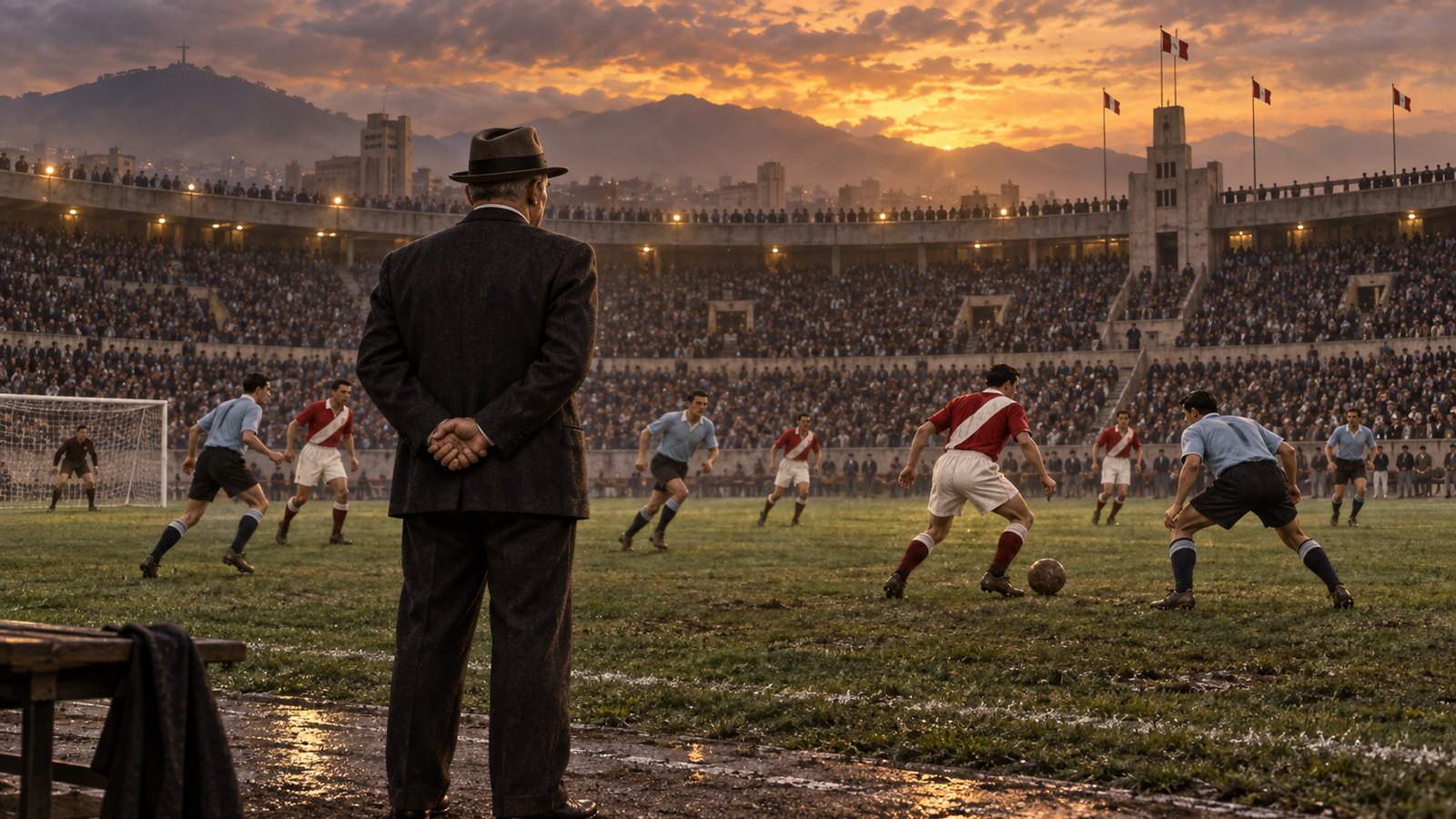
Forty thousand people filled Lima’s Estadio Nacional on 12 February 1939. Peru needed to beat Uruguay, the competition’s other unbeaten side, to finish a four-match South American Championship with a perfect record. Jorge Alcalde scored after seven minutes. Víctor Bielich made it 2–0 after 35. Roberto Porta pulled one back before half-time, but Peru held on.
The man directing the hosts was Jack Greenwell, a 54-year-old English coach who had begun work underground in County Durham. By that final afternoon, his football education had passed through a local mining-town club, Barcelona’s changing room, rival jobs across Spain, and exile prompted by civil war. Peru’s first South American title was not an exotic footnote to that journey. It was the clearest proof of Greenwell’s career-long method: cross a border, learn the players in front of him, and make a team move the ball as a connected group.
Lima staged a four-game examination
The 1939 championship was compact and unforgiving. Five teams played every match in Lima between 15 January and 12 February. Argentina, Bolivia and Brazil withdrew, leaving Peru, Uruguay, Paraguay, Chile and Ecuador. There was no knockout round and no second chance hidden behind a group phase. The table would identify the champion.
Greenwell’s side opened with a 5–2 win over Ecuador. Teodoro Fernández scored in the sixth and 34th minutes and completed his hat-trick in the 77th; Jorge Alcalde supplied the other two. A week later, Chile kept Peru scoreless through the first half, but Fernández struck in the 46th minute and then converted a penalty before Alcalde completed a 3–1 victory.
Paraguay arrived next. Fernández scored twice inside half an hour, Alcalde added a third, and Peru won 3–0. The sequence had shape as well as volume: three wins, 11 goals and only three conceded before Uruguay. It also gave Greenwell a settled competitive core. Goalkeeper Juan Honores started every match. Arturo Fernández anchored the defence. Carlos Tovar, Teodoro Fernández, Jorge Alcalde and Arturo Paredes appeared in each starting side.
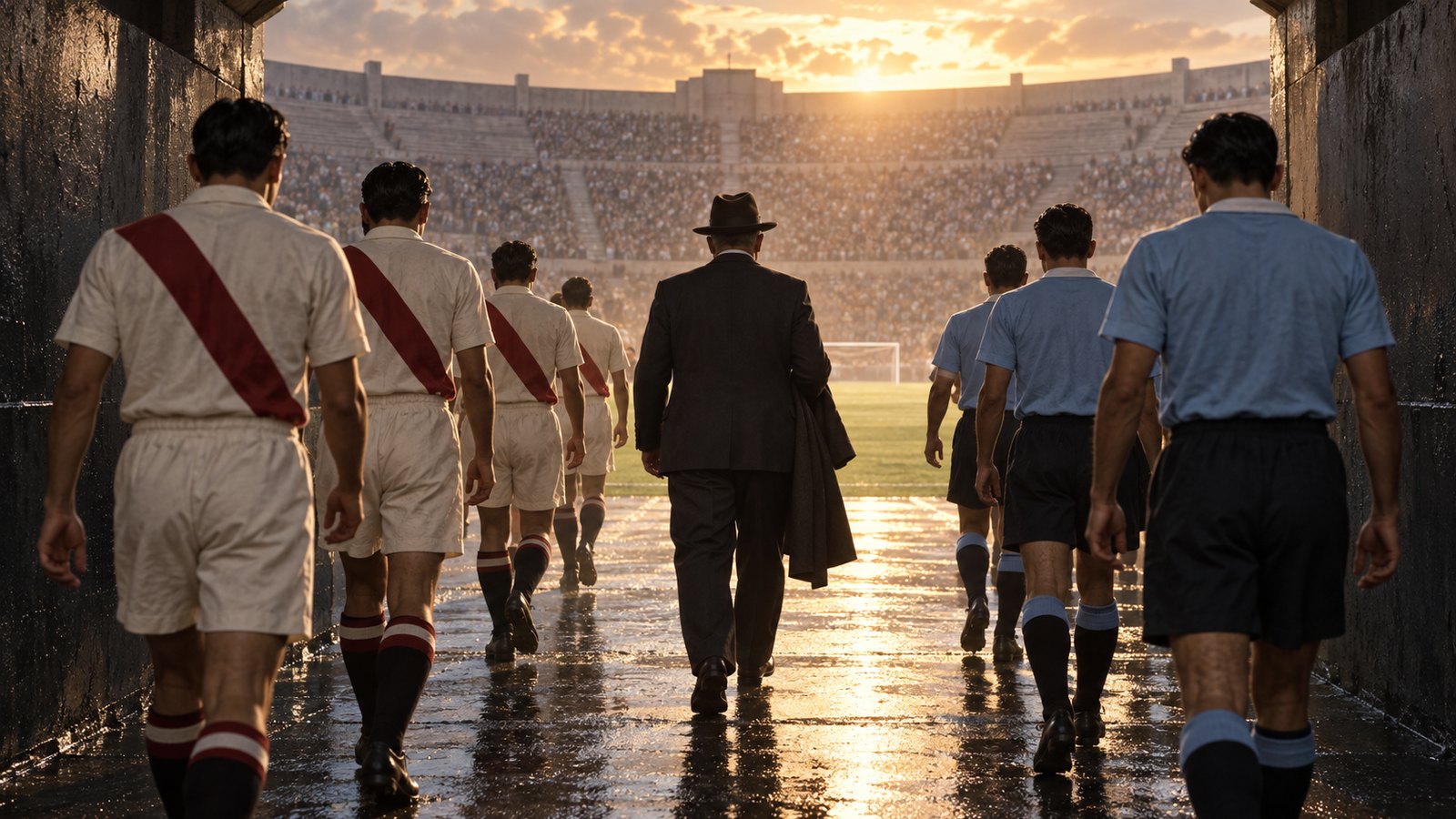
The final produced the championship’s largest recorded crowd. Alcalde’s early finish and Bielich’s goal built the margin; Porta’s 44th-minute reply forced Peru to protect it. The 2–1 result left the hosts on four wins from four, with 13 goals scored and four allowed. Fernández finished as the tournament’s leading scorer with seven. Greenwell had guided Peru through a complete round-robin without dropping a point.
A miner’s son carried Crook football to Barcelona
Nothing in Greenwell’s starting point made that Lima afternoon obvious. He was born in Crook in 1884, when collieries shaped the County Durham town. He left school for the mines and joined Crook Town as a 17-year-old winger. Across 11 seasons he won a Crook and District League title and played in the FA Cup.
In 1909 he appeared as a guest for West Auckland Town in the Sir Thomas Lipton Trophy in Italy. That tournament, sometimes presented as an early world club championship, belonged to the same north-eastern football world explored in the story of West Auckland’s trips to Turin. For Greenwell, it also showed that a player from a mining district could carry his game onto a European field.
Three years later he made a far larger move. At 28, Greenwell left for Barcelona, roughly 1,200 miles from Crook. The exact connection that produced the transfer remains uncertain, but the playing record is firm: 88 appearances, 10 goals and two Catalan championships. He had arrived as a winger from a local English club and became embedded in one of Spain’s most important football institutions.
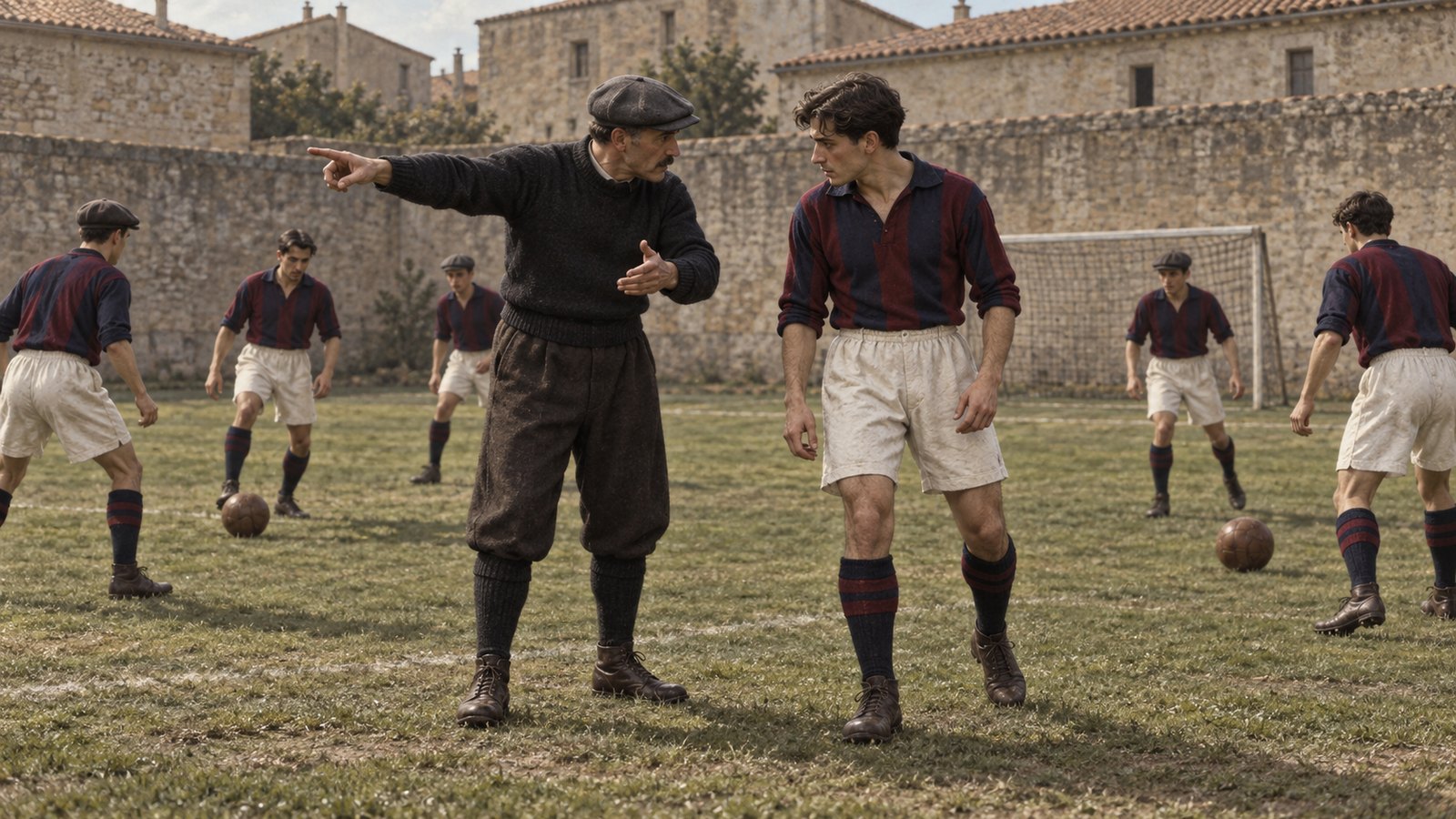
That distance matters because Greenwell did more than export a fixed English routine. He stayed long enough to be trusted with the team. Barcelona placed him in charge during the First World War era, beginning a relationship that would make him the club’s longest-serving coach by seasons. FC Barcelona’s own historical account credits him with a decade from 1913 to 1923 and a second spell between 1931 and 1933.
Passing became a coaching language
The football Greenwell entered still commonly resembled a rigid 2–3–5: two defenders, three half-backs and five forwards, with roles held more tightly than modern spectators would expect. His answer was not a diagram preserved on paper. It was a series of questions about where an attack could begin and what kinds of players might operate in unfamiliar positions.
The BBC’s account of his work describes Greenwell moving Barcelona forward Paulino Alcántara into defence during an experiment. The switch itself was not presented as an immediate success. Its value was conceptual. A skilled ball player at the back could begin attacks through passes rather than waiting for a dribbler farther forward to beat an opponent alone.
Greenwell encouraged that collective use of the ball. The distinction was practical: receive, connect, and move the next opponent before trying to defeat him. It also made coaching portable. A rehearsed relationship between defenders, midfielders and forwards could be taught in Barcelona, adjusted at Espanyol, and carried to a national side assembled in Lima. The players changed; the idea that possession could start behind the front line survived.
His first Barcelona tenure brought four Catalan championships and two Copa del Rey victories. After leaving in 1923, he coached city rival Espanyol, finishing seventh in the inaugural La Liga season and winning both the Catalan championship and Copa del Rey in 1929. He returned to Barcelona in 1931, then moved to Valencia. The pattern was no longer a miner enjoying one improbable appointment. Greenwell had become a professional coach whose value travelled between clubs.
Civil war pushed the work across an ocean
The Spanish Civil War changed the route. Greenwell left Spain in 1936 and went to Turkey. By 1939 he was in Peru, taking responsibility for both the national team and Universitario de Deportes. That dual assignment required him to work across two rhythms: a club season built through repeated training and a short international tournament decided in four matches.
Universitario won the Peruvian league in the same year that Peru took the continental championship. The pairing makes 1939 more revealing than a single final score. Greenwell could organize a club over a domestic campaign and then shape a national selection whose players came from Universitario, Sport Boys, Alianza Lima, Deportivo Municipal and other sides.
The championship roster shows those components. Arturo and Teodoro Fernández represented Universitario. The Alcalde brothers, Castillo, Chapel, Paredes and Perales came from Sport Boys. Bielich played for Deportivo Municipal, while Magallanes and Quispe represented Alianza Lima. Greenwell’s task was to turn that distribution into repeatable combinations in less than a month.
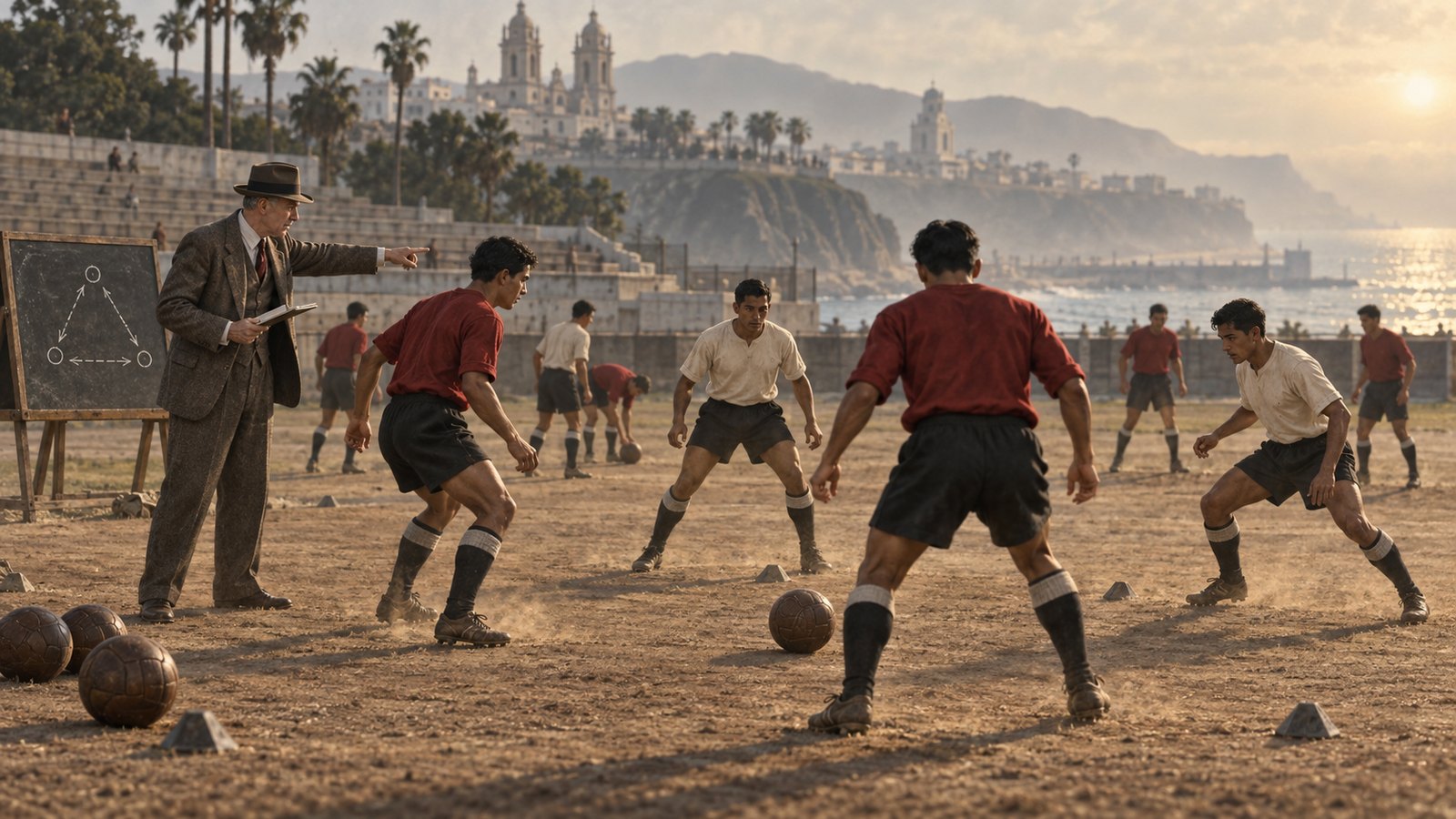
Peru’s scoring pattern suggests more than dependence on one moment. Fernández led the tournament with seven, but Alcalde scored five and Bielich supplied the second goal against Uruguay. The team scored in every match, led at half-time in three, and answered the only 0–0 interval by scoring three times against Chile. Its four victories were different problems solved by many of the same players.
The final journey ended after training
Greenwell moved again in 1940, this time to Colombia to work with the national side. He died in Bogotá two years later after suffering a heart attack while driving home from training. He was 58. His wife Doris and daughter Carmen had remained in Peru.
That ending can make the career look like a restless sequence of departures: Crook for Barcelona, Barcelona for rival Spanish clubs, Spain for Turkey, Peru for Colombia. A more useful reading follows the work itself. Greenwell spent decades translating football between places. He moved from winger to coach, from the inherited 2–3–5 to experiments with a ball-playing defender, and from long club tenures to a four-match international championship.
Lima provided the sharpest closing image. The 1939 Peru side did not need a modern mythology attached to it. Its achievement is concrete: four matches, four wins, 13 goals, a 40,000 crowd for the decider, and a first South American title. Behind the touchline stood a coach whose first football classroom had been a County Durham mining town.
Greenwell’s influence is best measured through those connected environments rather than through a claim that one man invented a club’s identity. He helped Barcelona develop a passing preference, won trophies with two Barcelona clubs, crossed an ocean under the pressure of war, and gave Peru a tournament plan that held for every match. The journey was extraordinary. The coaching craft inside it was patient, transferable and exact.
- BBC News: “Jack Greenwell: From Durham miner to Barcelona FC coach”
- FC Barcelona historical managers archive
- Rec.Sport.Soccer Statistics Foundation: South American Championship 1939 match record and rosters