
Total Football is often remembered as the beautiful idea that players could go anywhere. That memory is only half right. The Ajax and Netherlands version associated with Rinus Michels and Johan Cruyff was not loose freedom. It was a system of shared risk, where every rotation created a new responsibility and every lost ball tested whether the team still understood itself.
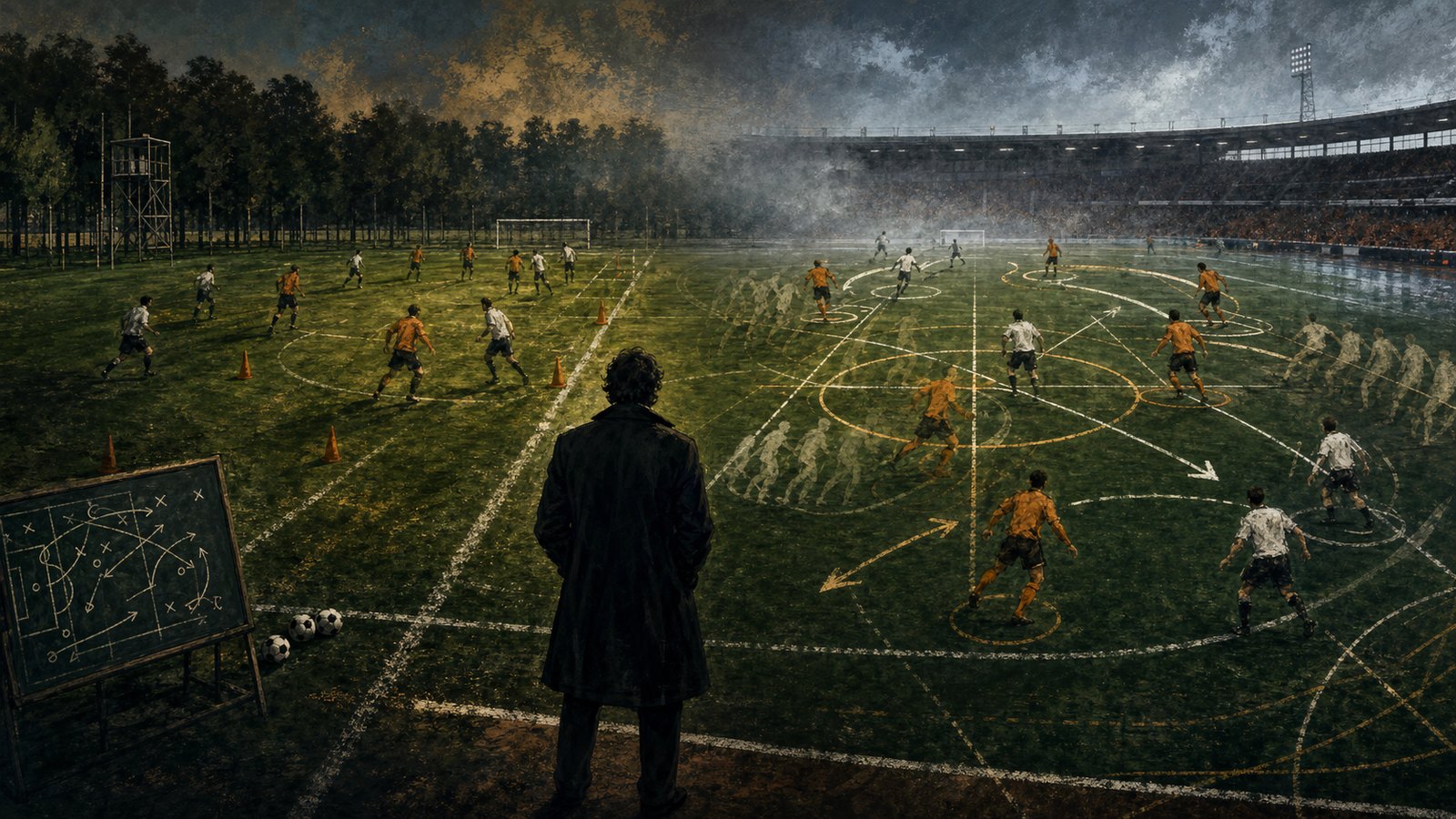
The phrase became famous because the mechanism was hard to hold
Total Football is now one of those phrases that sounds almost too clean: everyone attacks, everyone defends, every player rotates. The reality was much more demanding. Rinus Michels, Ajax and the Netherlands did not simply give football a poetic slogan. They built a positional system in which space mattered more than shirt numbers, pressing mattered as much as possession, and technical players had to understand the whole pitch rather than their own lane.
That distinction matters because the myth can make Total Football look like freedom. It was freedom inside a cage of responsibilities. If a full-back moved high, someone else had to protect the space. If a forward dropped, another runner had to stretch the line. If the ball was lost, the nearest players had to squeeze immediately so the rotation did not become a defensive invitation.
Ajax made rotation teachable
Ajax were the laboratory because the club could connect coaching, youth development and first-team expectation. Michels had Johan Cruyff, Johan Neeskens, Ruud Krol, Barry Hulshoff and others with the technical range to make positions feel temporary. But talent alone did not create the effect. The players trained to read each other’s movements until the switch of roles looked instinctive to outsiders.
The European Cup run from 1971 to 1973 gave the idea its authority. Ajax won three straight European Cups, and the sequence made the rest of Europe confront a new kind of superiority. The Dutch side were not merely dribbling past opponents. They were changing the geometry of matches. Opponents could prepare for a winger, then find the winger inside, the centre-forward elsewhere and a midfielder arriving in the space the defence had just abandoned.
Pressing was the safety net
The most misunderstood part of the system is the defensive one. Rotation without pressure is a way to become disorganized. Total Football worked because Ajax and then the Netherlands treated immediate pressure after losing the ball as the price of positional adventure. The team attacked with numbers because it believed it could compress the pitch quickly enough to stop transitions before they became races.
This made physical and mental demands that were ahead of their time. Players had to be fit enough to repeat sprints, brave enough to hold a high line, and intelligent enough to know when a teammate’s movement had changed their own job. The ball was important, but the invisible map was everything. A mistake was not just a misplaced pass. It could be a broken chain of coverage.
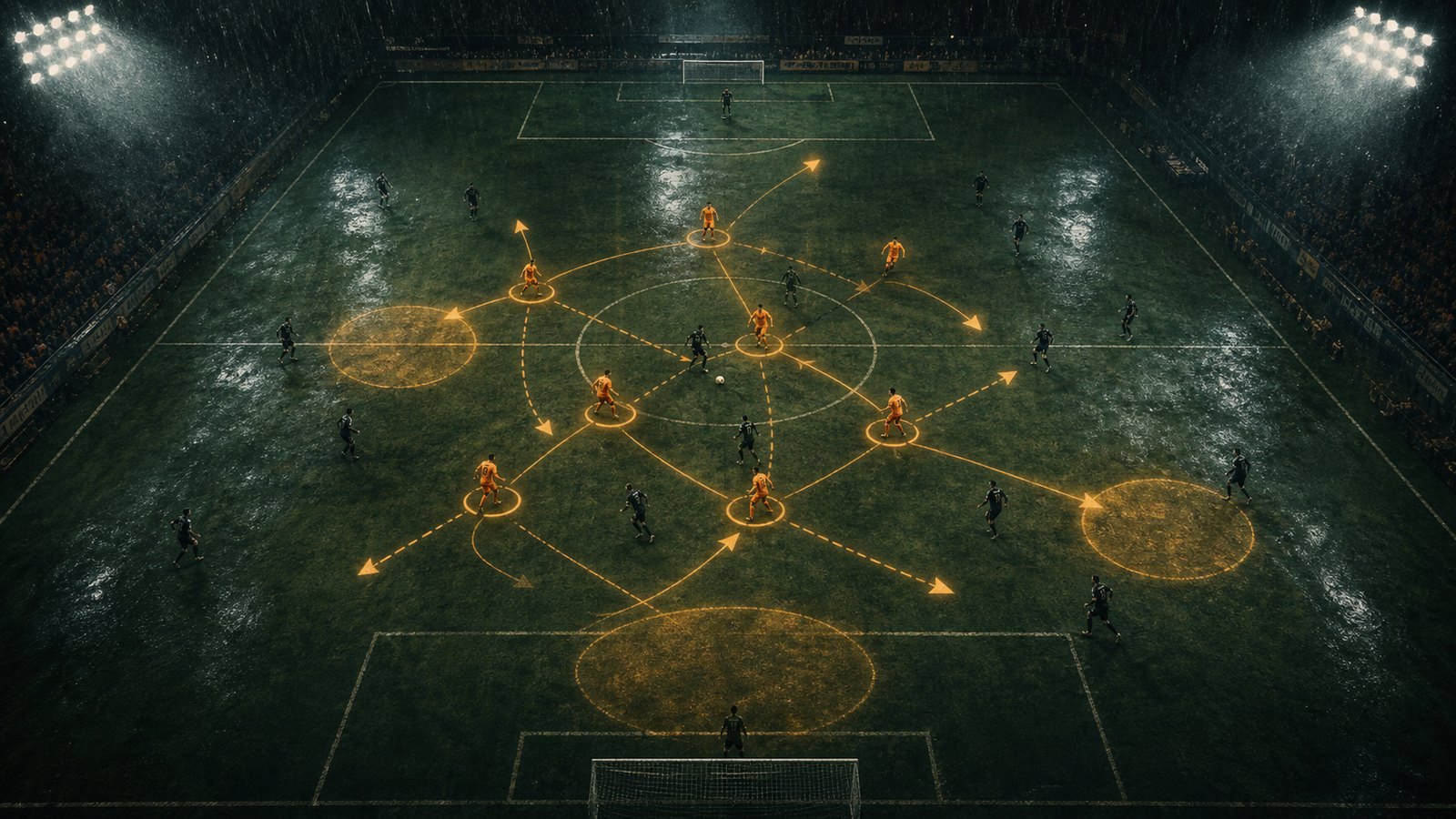
The Netherlands turned club language into World Cup theatre
At the 1974 World Cup, the Netherlands carried the Ajax language onto the global stage. Michels managed the national team, Cruyff became the visual symbol, and the orange shirts turned tactical complexity into something television could remember. The Dutch beat Argentina and Brazil in the second group stage and reached the final against West Germany, where they scored from the opening move before a German player had touched the ball.
That opening penalty is why the myth still glows. It seemed to say that a team could control the game before the opponent had entered it. Yet the final also showed the risk. West Germany recovered, adjusted and won 2-1. Total Football did not lose its meaning because the Netherlands lost the final. If anything, the defeat made the idea more durable: it proved the system was not a magic spell, but a high-wire method with consequences.
Its descendants copied principles, not the costume
The influence is visible in many later teams, but not as a simple photocopy. Arrigo Sacchi’s Milan, Barcelona under Cruyff and Guardiola, modern pressing sides and positional-play teams all took different lessons: compactness, coordinated pressure, role flexibility, the idea that the pitch can be controlled by spacing as much as tackling. Total Football became a family tree rather than a museum piece.
That is why the term can be misleading when used as praise for any attractive attacking side. The historical version was not just nice passing. It was a total demand on the players. The left-back, striker and midfielder all had to understand what the others were doing because the system only survived if the whole team moved like one argument.
The real revolution was responsibility
The great tactical revolutions usually change what a player is responsible for. Total Football did exactly that. It told footballers that their job was not fixed by where they started on the team sheet. Their job was fixed by the team’s shape at that second. That sounds obvious now because modern football has absorbed parts of the lesson. In the early 1970s, it was disruptive enough to make elite opponents look late to the future.
The beauty was real, but the beauty came from discipline. Total Football gave supporters motion, risk and imagination. Underneath, it gave coaches a harsher idea: if players can rotate, press and think collectively, the pitch becomes a living structure. If one link fails, the same structure can collapse. That tension is why the idea still feels alive.
Why the idea keeps being misquoted
Total Football is easy to admire and easy to misuse. Coaches and supporters often borrow the phrase when they mean attacking football with technical players, but the historical model was much stricter than that. The crucial point was not that players wandered wherever they liked. It was that the team maintained structure while players exchanged duties. A winger could appear inside because someone else understood the width. A defender could step out because the next line understood the cover.
That is why Cruyff’s brilliance and Michels’ coaching should not be separated. Cruyff gave the system its imagination and nerve, but the team needed collective habits for his freedom to have a platform. Without compactness and pressing, the same rotations would have looked reckless. Without technique, the compactness would have become sterile. Total Football lived in the difficult middle: disciplined enough to survive, imaginative enough to scare opponents into decisions they did not want to make.
The 1974 final defeat is part of the lesson rather than an exception to it. West Germany showed that a system can be visionary and still be beaten by a resilient, tactically intelligent opponent. The Dutch idea became legendary not because it guaranteed victory, but because it changed the questions everyone else had to answer. How much space can a team control? How many roles can one player understand? How quickly must a side repair itself after losing the ball? Those questions still shape elite football.
The physical picture was just as important as the tactical vocabulary. A high defensive line shrank the field, the midfield hunted loose touches, and attackers were expected to defend the next pass rather than admire their own movement. The system asked gifted players to do unglamorous work instantly. That is why its prettiness can be deceptive. The rotations looked elegant because the dirty seconds after possession was lost were handled with collective urgency.
Sources
- UEFA European Cup archive
- FIFA 1974 World Cup archive
- UEFA Rinus Michels profile
- Jonathan Wilson, Inverting the Pyramid