
Denmark’s 1992 European Championship win is often remembered as football’s great holiday story: a team supposedly called in from the beach, dropped into a tournament at the last moment, and somehow left Sweden with the trophy. The image is irresistible because it feels like a fairy tale. It is also too small. Denmark did receive a late invitation after Yugoslavia were excluded, but the title was not won by romance alone. It was won by a side that turned disruption into clarity.
The Danish squad entered the tournament without the usual runway of expectation. That mattered. A team with little time to build a grand attacking identity had to survive on repeatable habits: compact lines, quick decisions, hard running, and an understanding that the favorite’s burden belonged to someone else. Richard Møller Nielsen did not need to sell a fantasy. He needed a group of excellent players to accept a narrow set of jobs and perform them with almost no emotional waste.

The late invitation changed the psychology of the tournament
Denmark were not supposed to be there. Yugoslavia had qualified, but the political crisis and sanctions around the country’s breakup removed them from the finals. Denmark were called in as replacements, and that fact has shaped every retelling since. The problem with the simple version is that it turns the players into lucky tourists. Many of them were serious professionals in strong leagues. Peter Schmeichel was becoming one of Europe’s defining goalkeepers. Brian Laudrup gave the side carrying power and invention. Others understood the demands of tournament football even if the preparation was improvised.
The psychology still mattered. A replacement team can play with a strange freedom, but it can also look underprepared and emotionally scattered. Denmark avoided that trap by narrowing the game. They did not try to behave like the tournament’s natural protagonist. They accepted that long stretches would belong to others, then made those stretches survivable. The side’s identity came from restraint as much as inspiration.
Compactness gave Denmark a platform
The team’s defensive compactness was not glamorous, but it was the base of the upset. Denmark squeezed central space, protected the penalty area, and made opponents spend energy moving the ball around rather than through them. Schmeichel’s presence mattered because it allowed the block to defend with confidence, but the goalkeeper was not a one-man miracle. His saves were part of a broader structure that forced difficult shots, crowded second balls, and kept matches close long enough for Danish moments to matter.
This is where the beach-story myth becomes misleading. A side that merely drifts into a tournament does not manage games with that level of discipline. Denmark’s work without the ball made the competition feel uncomfortable for more celebrated teams. They did not need to dominate territory for ninety minutes. They needed to keep the match in a state where one transition, one set piece, or one mistake could change the balance.
The attack was selective, not accidental
Denmark’s attacking play is sometimes treated as opportunism, as if the goals arrived from nowhere. In reality, selective attacking was the natural partner to their defensive plan. Laudrup’s ability to carry the ball gave Denmark a way to escape pressure without always building slowly. Forward runners could attack the gaps left by teams pushing for control. Crosses and second phases became more dangerous because opponents were already frustrated by the lack of central access.
The final against Germany is remembered for the shock of the result, but it also showed Denmark’s emotional discipline. Germany had pedigree, tournament memory, and the expectation that elite sides eventually solve underdogs. Denmark scored, defended, found a second goal, and made the favorite chase certainty that never arrived. The match was not a tactical lecture in possession. It was a lesson in how a compact team can make time feel shorter for the opponent.
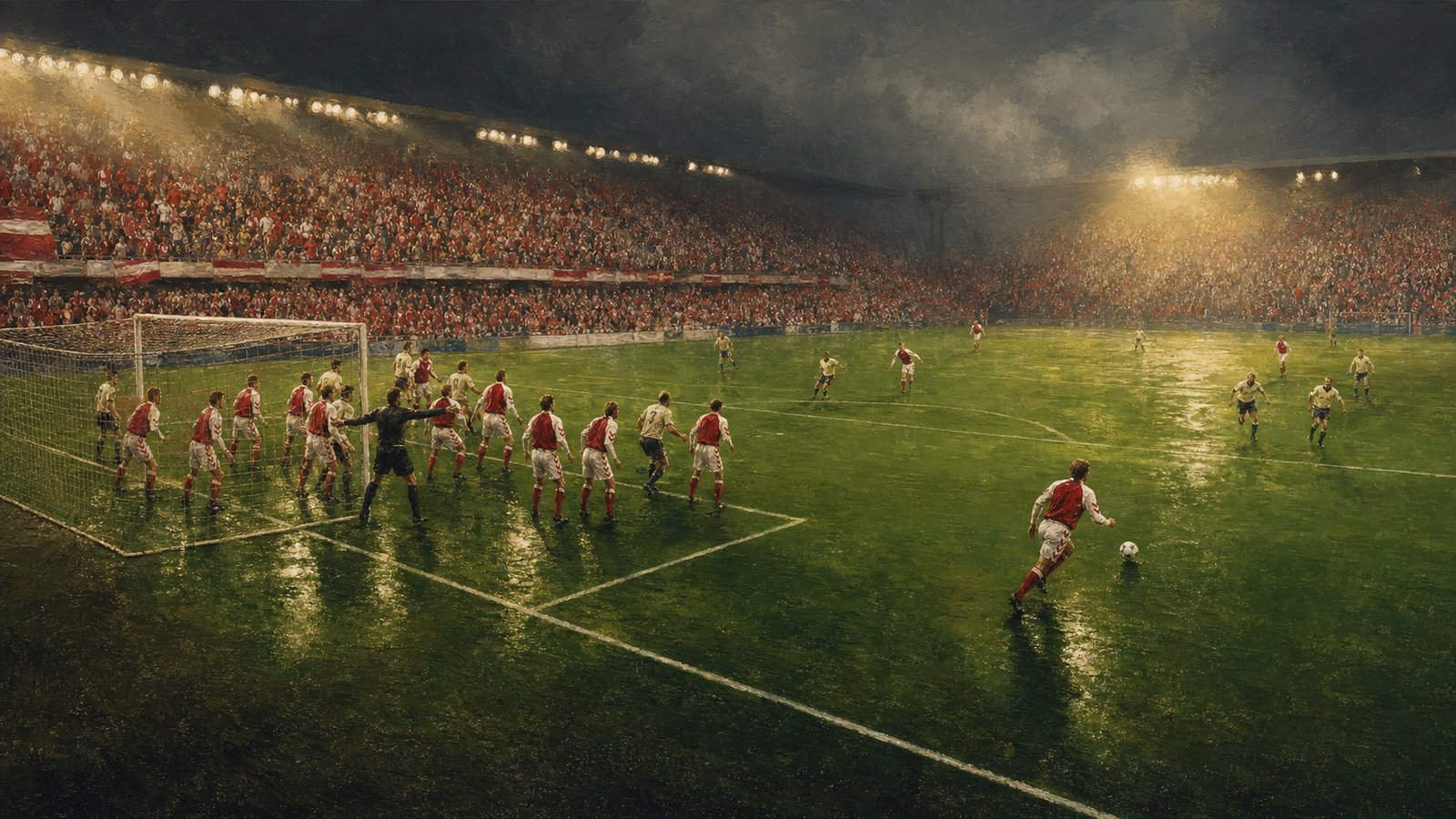
Schmeichel’s role was structural as well as spectacular
Schmeichel’s saves are essential to the story, but the more useful point is how his authority affected the players in front of him. A goalkeeper who dominates the area changes the emotional weather of a defensive team. Defenders can attack crosses with more conviction. Midfielders can hold their line knowing that not every loose ball means panic. Opponents begin to feel that routine chances must be perfect. That pressure can distort finishing, crossing, and decision-making.
In tournament football, that kind of certainty is priceless. Denmark were not asked to be the best team in Europe over a league season. They had to survive a handful of matches, absorb pressure without collapsing, and take chances when the bracket opened. A goalkeeper in that form shortens the distance between underdog and contender. He does not remove the need for structure; he makes the structure believable.
The victory exposed how tournaments differ from leagues
Denmark’s title remains powerful because it demonstrates the difference between being the strongest side and being the side best suited to a specific month. League football rewards depth, repetition, and long-term superiority. Tournament football rewards clarity, health, goalkeeping, set pieces, and the ability to live inside moments of stress. Denmark’s squad did not need to prove a universal theory of football. They needed to solve Sweden in June 1992.
That is why the win should not be filed only under luck. Luck opened the door. Organization kept Denmark in the room. The late invitation created the narrative, but the matches were still won by football actions: blocks shifting together, counters launched at the right second, a goalkeeper imposing himself, and players accepting that the ugliest five-minute spell might be the one that won the tournament.
The fairy tale survives because the mechanism was real
The best football myths survive when the mechanism underneath them is strong. Denmark 1992 has all the ingredients of a folk tale: the absent qualifier, the replacement team, the giant in the final, the sudden trophy. But the reason it remains more than trivia is that the football still makes sense. The team did not need a year of preparation to understand compactness. It did not need to outshine every opponent to make them uncomfortable. It did not need to be the favorite to behave like a side with a plan.
The late call-up will always be the hook, and it should be. Yet the deeper lesson is sharper. Denmark did not win Euro 1992 because football forgot to be serious. They won because a serious team accepted a smaller set of tasks than everyone expected and executed them at exactly the right time.
There is also a selection lesson in the story. Replacement status can strip away the temptation to over-explain a side. Denmark did not have to satisfy months of national projection about style, hierarchy, or destiny. The group could become practical very quickly: defend the box, keep the distances short, trust Schmeichel, let Laudrup and the runners carry the release, and treat every surviving minute as useful. That kind of reduction can be powerful in a tournament, especially when opponents arrive with more elaborate expectations and less patience.
In that sense, the title was not an argument that preparation is irrelevant. It was an argument that preparation and clarity are not the same thing. Denmark lacked one kind of preparation, but they found another kind of clarity. The story endures because it lets both ideas live together: the absurdity of the invitation and the seriousness of the football that followed.
Sources
UEFA tournament records; contemporary Euro 1992 match reports; Brian Laudrup interviews; Peter Schmeichel career accounts; Jonathan Wilson, Inverting the Pyramid.