
The first Galacticos era is usually told as a story of glamour. Real Madrid collected global stars, presidential ambition became transfer policy, and the Bernabéu turned into a stage where football and celebrity could barely be separated. That version is not wrong. It is simply incomplete. The Galacticos were not just expensive players gathered for applause. They were a model of how a club could turn the transfer market into a media engine, a commercial strategy, and eventually a sporting imbalance.
The phrase itself suggests spectacle: the biggest names, the brightest lights, the kind of shirt presentation that could feel like a state ceremony. Luís Figo, Zinedine Zidane, Ronaldo, and David Beckham did not arrive as ordinary reinforcements. Each transfer carried a message about power. Madrid were not merely buying footballers. They were buying attention, expanding a brand, and telling rivals that sporting prestige could be converted into commercial gravity and then back into more prestige.
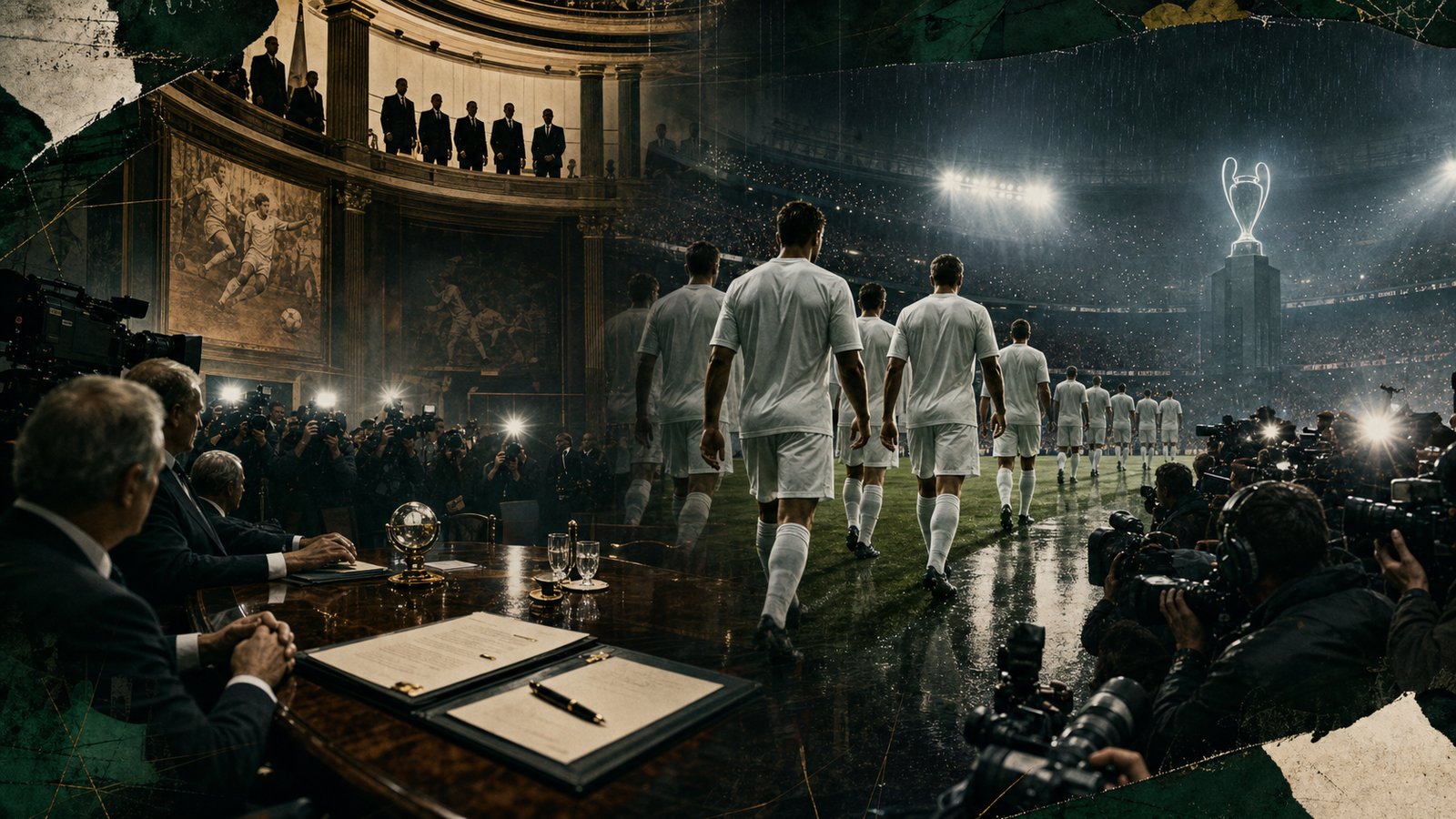
The model began with politics as much as tactics
Florentino Pérez’s rise to the presidency was tied to the promise of a spectacular transfer. Figo’s move from Barcelona in 2000 was more than a signing. It was a political act inside Spanish football, a statement that Madrid could turn a rival’s icon into the symbol of a new regime. The transfer’s emotional force helped define the project before any tactical pattern did. From the start, the Galacticos were about authority: over markets, narratives, and the idea of what a superclub could be.
That authority needed to be renewed. Zidane followed in 2001 for a world-record fee. Ronaldo arrived after the 2002 World Cup. Beckham came in 2003, bringing not only football quality but a global commercial aura that few players in history could match. Each signing made sense in isolation if the question was talent. Together, they created a more complicated question: could a team keep adding the most marketable attacking players and still preserve the less glamorous work that lets stars function?
The transfer market became a broadcast strategy
Modern football had always cared about famous players, but the Galacticos era sharpened the relationship between transfer and content. A signing was not only a squad decision. It was a summer event, a shirt-sales opportunity, a television image, a sponsor conversation, and an international tour headline. The club’s economic logic and sporting logic were supposed to reinforce each other. Greater fame would generate greater income; greater income would fund greater fame.
This was not foolish in a simple sense. Madrid won major trophies early in the cycle, and the best footballers were genuinely extraordinary. Zidane’s balance and imagination, Ronaldo’s penalty-box violence, Figo’s control, Beckham’s delivery: these were not empty brands. The danger was that commercial legibility could start selecting for the same type of value. Attackers, creators, and icons were easier to sell than ball-winners, full-back depth, or the defensive midfielders who make a glamorous front half feel secure.
The loss of balance was gradual, not instant
The era is sometimes mocked as if it was doomed from the first presentation. That is too easy. Great players can solve many problems, and for a time Madrid’s talent covered the seams. The side could overwhelm opponents with individual moments, Champions League aura, and the psychological pressure of facing a lineup that looked unreal on paper. But imbalance rarely announces itself with one disastrous match. It grows in the spaces between phases of play.
When an attack is loaded with stars, the defensive transition becomes more demanding. When midfield workers leave or decline, the glamorous players receive the ball in worse situations. When a squad becomes top-heavy, the manager’s choices narrow. Every superstar needs touches, rhythm, and status. The team still has to press, recover, cover the full-backs, defend set pieces, and survive nights when the ball does not move quickly enough. The Galacticos did not fail because stars cannot play together. They struggled because the whole squad ecology became harder to maintain.

Makélélé became the symbol of the missing work
Claude Makélélé’s departure in 2003 became the cleanest symbol because he represented the kind of football labor that does not sell the project from a balcony. He screened, recovered, balanced, and gave the attackers cleaner conditions. When players like that are present, the stars look freer. When they disappear, the cost is often misread as a sudden decline in attitude or magic. The more accurate reading is structural. Someone has to do the quiet work, and the Galacticos model increasingly struggled to value it at the same level as spectacle.
This does not mean one midfielder’s exit explains everything. Age, injuries, managerial changes, rivals, and the normal difficulty of sustaining a cycle all mattered. But Makélélé’s role helps explain why the story still works as a lesson. The most famous transfer strategy in the world can still be undermined by a role that looks ordinary until it is gone. Football teams are not collections of fame. They are systems of compensation.
The brand won even when the team wobbled
One reason the Galacticos remain fascinating is that the model did not simply fail. As a brand project, it changed expectations around elite clubs. The annual superstar pursuit became part of the calendar. Global tours, shirt presentations, image rights, and commercial storytelling became central to how superclubs imagined themselves. Even critics of the project ended up living in a football world it helped normalize.
That makes the sporting critique more interesting, not less. Madrid showed that attention could be manufactured with extraordinary skill. They also showed that attention is not the same as balance. A club can win the news cycle, dominate the imagination, and still find that the ball has to be recovered on a wet night when the opponent refuses to play the role of supporting actor.
The real legacy is a warning about squad ecology
The Galacticos were not a joke and not a pure triumph. They were a brilliant, unstable experiment in joining football excellence to global spectacle. The players were too good for the era to be dismissed as marketing. The imbalance was too clear for it to be celebrated without qualification. Its importance lies in that tension.
Every modern superclub still faces the Galacticos question in some form. How many stars can the structure carry? Which invisible roles are being neglected because they do not photograph as well? When does a transfer solve a football problem, and when does it mainly feed the machine that demands another transfer? The first Galacticos era matters because it made those questions glamorous enough for everyone to watch.
It also changed how failure is interpreted at the top of the sport. Once a club builds a team as a gallery of icons, a bad run becomes more than a bad run. It becomes a referendum on the entire idea. Every misplaced pass is folded into the debate about celebrity, every conceded counterattack becomes evidence that glamour has beaten work, and every summer window tempts the club to answer structural problems with a more spectacular name. That pressure can make correction harder. The more dazzling the project becomes, the more difficult it is to admit that the missing piece may be ordinary, defensive, and commercially quiet.
The Galacticos therefore sit in football history as both inspiration and caution. They proved that a club could make the transfer market feel like theatre on a global scale. They also proved that theatre still needs stagehands. Without the players who close space, absorb transitions, and give the artists better conditions, even the most expensive cast can start performing in the wrong play.
Sources
Sid Lowe, Spanish football reporting; UEFA Champions League records; Real Madrid historical records; contemporary transfer reports from 2000-2004; Jonathan Wilson, Inverting the Pyramid.