
When people describe the 1925 offside change, they usually make it sound like a simple scoring reform. The law was altered, the forward line found more room, and football suddenly became more entertaining. That is true enough as a starting point, but it misses the more interesting story: the rule change did not merely open space. It forced managers to decide who would own that space, who would protect it, and whether an English team could be organized as deliberately as a machine.
Herbert Chapman’s Arsenal became the most famous answer because the club treated the new law as an architectural problem. The old offside rule had required three opponents between attacker and goal. From 1925, two were enough. That small numerical change pulled the defensive line backward, stretched the distance between backs and forwards, and made the old centre-half’s job almost impossible if he continued to play as a roaming supplier. Chapman’s response was not a slogan. It was a redistribution of work.
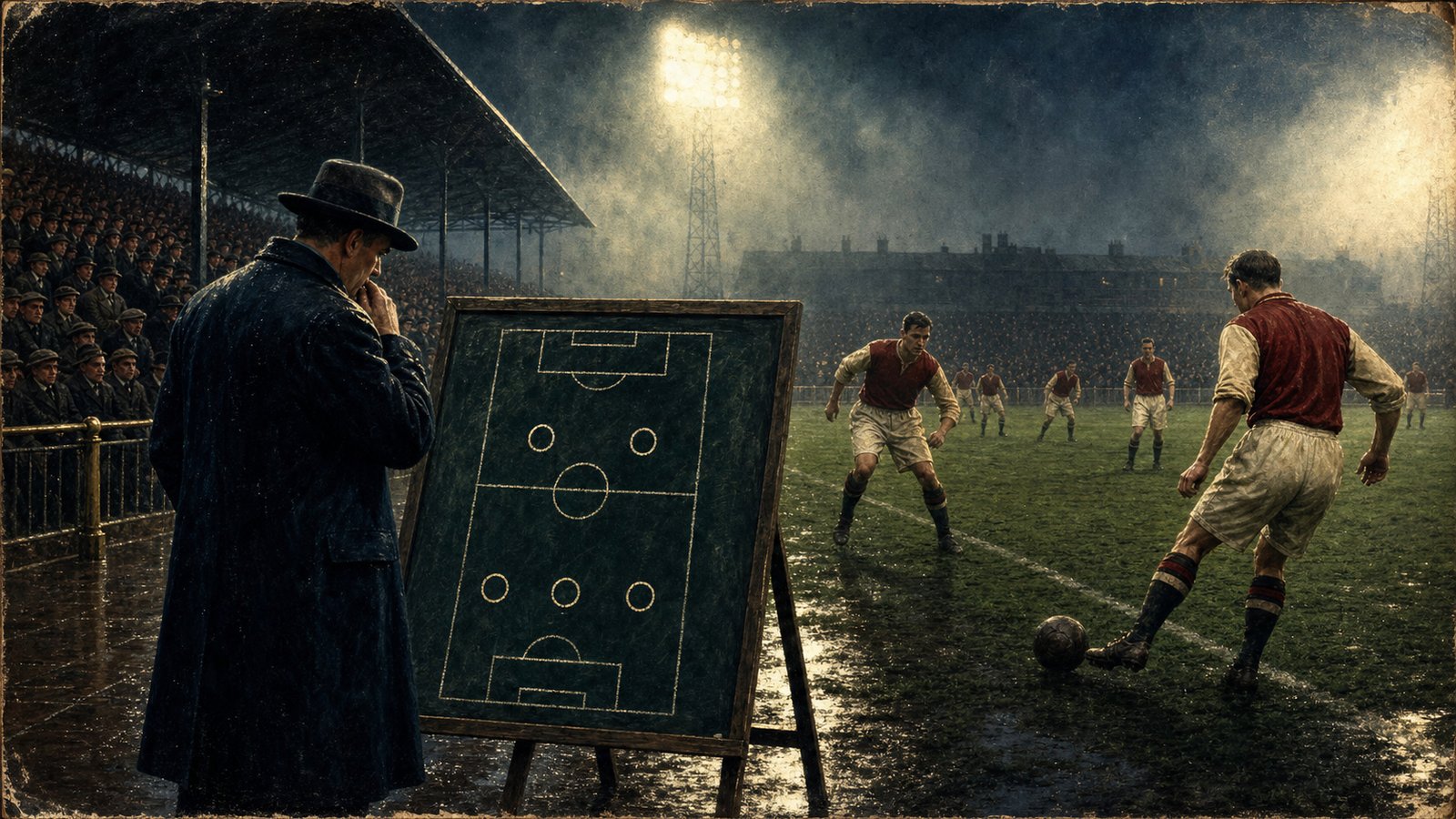
The law changed a number, but the pitch changed shape
Before the change, the centre-half had often been understood as a midfield pivot: part defender, part distributor, part screen. The forward line could be held in check by a higher defensive posture because attackers needed three opponents to remain onside. Once the law moved to two opponents, a forward could threaten the goal with far less defensive cover in front of him. This did not only produce more runs behind the back line. It created fear. Full-backs were less comfortable stepping up. Half-backs had to judge whether to press, track, or retreat. A single badly timed movement could leave the goalkeeper exposed.
The famous WM shape emerged from those pressures. In shorthand, the formation is drawn as three defenders, two half-backs, two inside-forwards, and three forwards. In practice, its importance was not the diagram itself but the specialized responsibilities behind it. The centre-half dropped closer to the full-backs and became a stopper against the centre-forward. The wing-halves had to connect and cover. The inside-forwards became more important as link players rather than simply extra attackers. The team’s old straight lines bent into something more modern.
Chapman did not invent organization, but he made it visible
Chapman’s reputation can become too neat if it is reduced to one tactical invention. Football was already changing. Clubs were experimenting, players were learning the new offside environment by painful repetition, and no single manager owned every idea. What made Arsenal significant was the coherence of the response. The team combined tactical reshaping with recruitment, training standards, scouting, and a public sense that the club was entering a new professional era.
The WM should be read less as a magic formation and more as a sign of managerial authority. Chapman’s Arsenal asked players to accept that the pitch contained zones of responsibility. If a defender stepped, another player covered. If the ball was won, the inside-forwards and wingers knew where the first pass might go. The machine metaphor worked because the team tried to make repeated actions feel pre-arranged, not improvised. In an English football culture that still prized individual courage and instinct, that mattered.
The centre-half became a different kind of footballer
The most telling shift was the centre-half. Under older assumptions, he could be the side’s organizer in the middle of the pitch, the man who broke up play and supplied the forwards. Under the WM, he often had to behave as a deeper marker. He met the opposing centre-forward with his body position already shaped by the danger behind him. This changed the type of player who could thrive there. A centre-half needed strength, anticipation, and the discipline to resist chasing the ball into areas that would leave the heart of the defense empty.
That trade-off produced criticism as well as success. The WM could look cautious. It could separate units. It could make football more about controlled counters than constant attacking flow. But that criticism is part of its historical value. The 1925 law had promised more goals and more adventure; one of its major consequences was also a more systematic defensive answer. Football modernity often arrives like that. A reform meant to help attackers produces a new generation of defensive specialists.
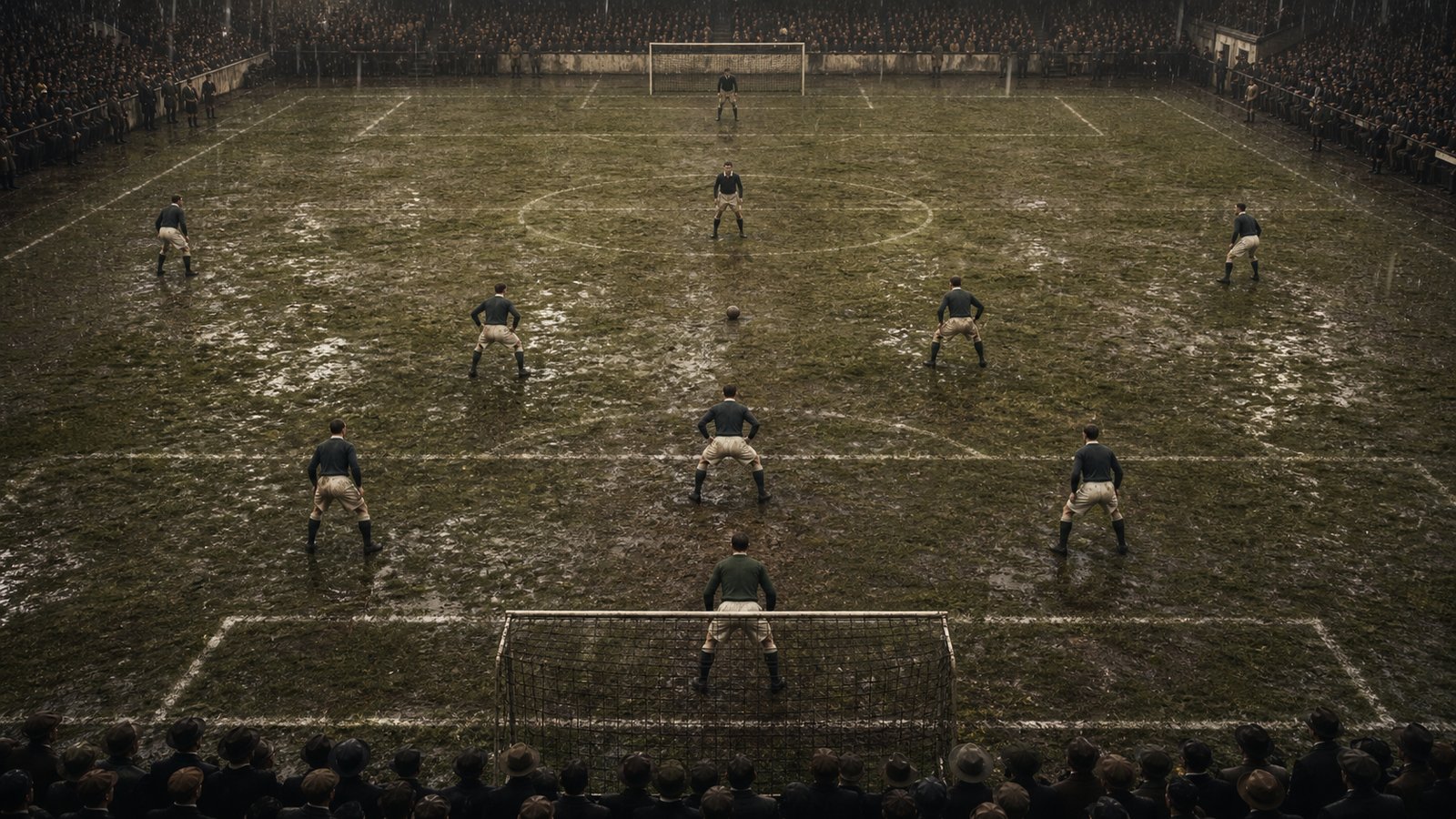
Arsenal turned the tactic into an institution
Arsenal’s rise in the early 1930s made the system feel inevitable in hindsight. The club’s league titles and status gave the WM a winning aura. Yet the success was not only tactical geometry. Arsenal had financial muscle, a growing stadium identity, and a manager who understood that modern clubs were public institutions as well as teams. The football made sense inside a larger project: better players, clearer roles, stronger routines, and a club image built around efficiency.
This is why Chapman’s story still resonates. He did not merely react to a rule. He helped normalize the idea that a club could be designed. The training ground, the dressing room, the scouting network, the formation board, and the Saturday performance were parts of the same argument. Supporters saw eleven players, but behind them stood a theory of how football should be managed.
The revolution was copied because it solved a real anxiety
The WM spread because it offered an answer to a problem every side recognized. Coaches could argue about details, but they could not ignore the new spaces. The three-back line gave teams a clearer way to protect the middle. The two half-backs and two inside-forwards created a layered midfield before the word carried its later tactical weight. Wingers still stretched the game, but counters could be launched with more structure. For clubs frightened by the speed of post-1925 football, the WM provided a map.
Like all maps, it simplified reality. Matches remained messy. Weather, pitches, refereeing, and individual nerve all shaped the outcome. But the formation changed the language of analysis. People could now talk about a side’s shape as a deliberate object. They could ask whether a player fit a role rather than merely whether he was brave, quick, or skilful. That vocabulary is one reason the WM belongs in the history of tactical revolutions rather than in a footnote about an old law.
The lesson is not that one shape solved football
The WM eventually aged. Later systems found ways to overload its seams, exploit the gap between units, and build attacks with different rhythms. That should not make Chapman’s Arsenal look primitive. It should make the achievement clearer. The system was a brilliant answer to a specific environment, and its limitations became visible only because football kept asking new questions.
The 1925 offside change did not simply create extra goals. It accelerated a professional argument about space, risk, and managerial control. Chapman’s Arsenal won because they treated that argument seriously. Their legacy is not a chalkboard diagram frozen in a museum. It is the idea that a rule change can force a club to rethink the entire machine.
Sources
Jonathan Wilson, Inverting the Pyramid; The Football Association laws history; Arsenal historical records; Brian Glanville, The Story of the World Cup; contemporary league records from the late 1920s and early 1930s.