
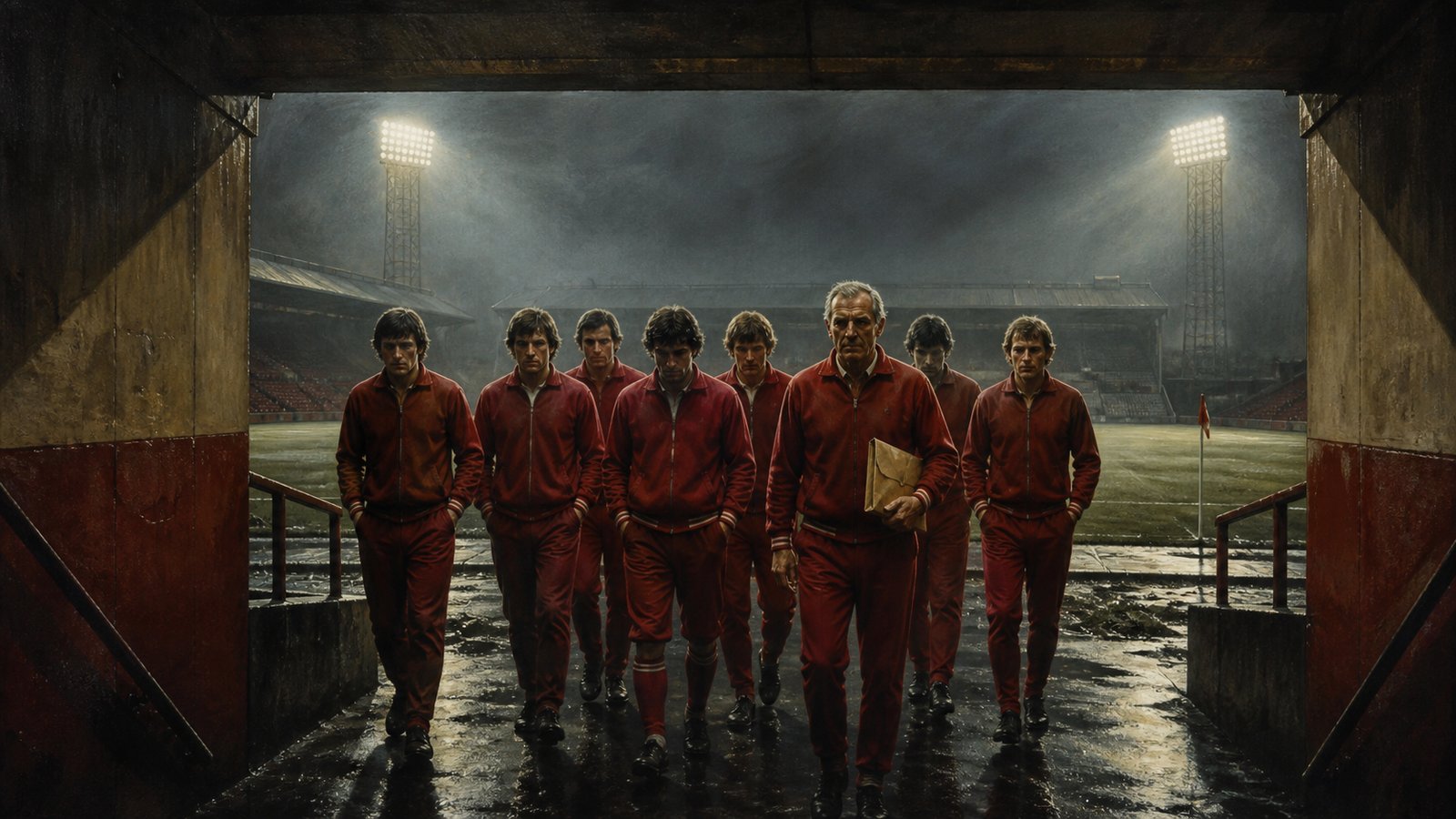
At Ashton Gate on Wednesday, 3 February 1982, the most important clock was not the stadium clock. Bristol City was due to cease trading at midday. Eight footballers still held contracts the rescue plan could not carry. Geoff Merrick, Chris Garland, Trevor Tainton, David Rodgers, Gerry Sweeney, Jimmy Mann, Peter Aitken and Julian Marshall faced a choice stripped of anything that normally makes a football decision feel voluntary: give up the agreements that protected their incomes, or watch the club disappear.
They agreed with minutes to spare. The clean version of the story calls them eight heroes who saved Bristol City. The fuller version is harder and more revealing. It begins with a top-flight club trying to protect valuable players, follows the cost of those promises through three relegation battles, and ends with working footballers absorbing losses created far above them. The club survived because eight signatures were removed. The people attached to those signatures had mortgages, children and careers that did not simply restart at another ground.
Top-flight security became a bill the club could not shrink
Bristol City had earned promotion to the First Division in 1976 under Alan Dicks. Two years later, a change in the rules around expired contracts altered the calculation for clubs and players. A footballer could leave when his deal ended, although the former club could still receive a fee. Gary Collier tested that opening. Dicks later recalled that Collier was offered £500 a week by Coventry City, more than Bristol City’s remaining players understood themselves to be earning.
The response was logical at the moment it was made. City offered security long enough to prevent important players simply walking away. Clive Whitehead accepted an eleven-year contract. Gerry Gow and Tom Ritchie signed for seven years. Dicks put their wages at about £450 a week and argued that this was not extravagant for an established First Division side. The contracts were meant to preserve a team and the transfer value inside it.

Relegation in 1980 changed what those promises meant. Attendances and income fell, but the contracts remained. Dicks was dismissed that September. Bob Houghton arrived after taking Malmö to a European Cup final, with Roy Hodgson as his assistant, yet City went down for a second consecutive season. A device built to keep a top-flight squad together had become a fixed expense during a rapid descent.
The numbers left one group holding the deadline
By January 1982 the reported figures described a club without room to wait: £850,000 of debt, £100,000 owed to the Inland Revenue and weekly losses of £4,000. Transfer instalments were still due to Newcastle United for Mick Harford and to Malmö for Jan Möller. Houghton left while the team was fighting relegation from the Third Division. The sporting problem and the accounting problem were now feeding each other.
Football had seen a club’s league life stop in mid-season before; Accrington Stanley’s 1962 resignation remained the obvious warning. Bristol City’s proposed escape was to let the existing company fail, create a new one under a new board and transfer the viable parts of the club into it. The long contracts of eight senior players could not come across. Unless those agreements ended, the replacement club could not begin on the terms its rescuers considered workable.
This is the mechanism that the word “sacrifice” can hide. The eight were not asked to contribute an equal share to a broad rescue. Their employment rights were singled out as the obstacle between the old company and the new one. Supporters, younger players and staff would lose their club if no deal emerged. That made every hour of negotiation carry a public moral weight that an ordinary contract discussion never has.
A scrap of paper became a week of pressure
Merrick remembered returning from a reserve match at Arsenal and finding Mann in the entrance at Ashton Gate. Mann was waving what Merrick called a “little tatty bit of notepaper.” A director had left it to be passed on. Eight names were written there, followed by an instruction to meet the board. An entire rescue strategy had first reached the affected players as a list.
More than a week of talks followed among the board, the Football Association, the Professional Footballers’ Association and the players. These were not remote names on a wage sheet. Five of the eight had played more than 200 games for City. Merrick, Tainton and Rodgers had spent their whole careers at the club. The contracts were reportedly worth between £20,000 and £25,000 a year—good professional wages, but not sums that made the loss harmless.

The pressure escaped the boardroom. Merrick said newspapers photographed players’ homes and portrayed them as wealthy causes of the crisis. Tainton recalled threats against families. The public choice was framed brutally: accept unemployment, or bear responsibility for everyone else losing the club. Jonathan Pearce, then working for BBC Radio Bristol, later compared it to being told to jump from a lifeboat so another person could take the place.
Two rejected offers led to a noon decision
The eight initially rejected a combined offer of £58,000. A later offer of £80,000 also failed. PFA secretary Gordon Taylor argued that players should not be sacrificed for years of mismanagement, while Merrick spoke about families, mortgages and the protection their contracts represented. The rescuing board then set its final boundary: if agreement was not reached by noon on 3 February, the club would fold.
The players accepted £10,000 each plus receipts from a testimonial between Ipswich Town and Southampton at Ashton Gate a month later. Later accounts differ in emphasis over how much compensation was ultimately secured and how freely the choice was made. Taylor said the total reached about £100,000, including a guaranteed £58,000, more than £20,000 connected to the sale of the ground and further testimonial money. Several players remembered the week chiefly through fear, pressure and the disappearance of expected income.
Both things can be true: the PFA extracted money from a desperate process, and the process still placed the cost of survival on eight employees with almost no useful alternative. Merrick said the club’s survival was wonderful and emotional, but also spoke of bitterness that the players had been treated as though bad management were their responsibility. Their agreement kept the institution alive without making the bargain fair.
Survival arrived before recovery
The signature did not rescue the season. Bristol City were relegated again, completing a fall through three divisions in three consecutive campaigns. Yet the first match after the deal brought 9,228 people to Ashton Gate for Fulham, the club’s largest home crowd of the season. Garland and Aitken watched among them. The response showed what had been preserved: not a league position, but the ability to gather again around the same team.

The personal aftermath was less easily restored. Merrick, who had played more than 350 times at the heart of City’s defence, never appeared for another Football League club. He finished with Gloucester City in 1983. Tainton said the lost contract combined with trouble in his outside business and pushed him into bankruptcy. He had two young children. The word “hero” did not pay either man the wages their cancelled agreements had promised.
City returned to the Third Division two years later. A plaque funded by supporters now stands outside Ashton Gate with the eight names, and the club marks 3 February as the day they saved it. The episode also helped shape later protections for football creditors. Its lasting force comes from the uncomfortable order of events: good intentions produced long contracts, relegation made them dangerous, mismanagement made them impossible, and eight players were asked to convert private security into public survival. Bristol City kept its future. The Ashton Gate Eight paid for part of it with futures of their own.
Sources
Bristol City FC club history; BBC Sport oral history of the Ashton Gate Eight; The Guardian historical feature on Bristol City’s 1982 rescue.