
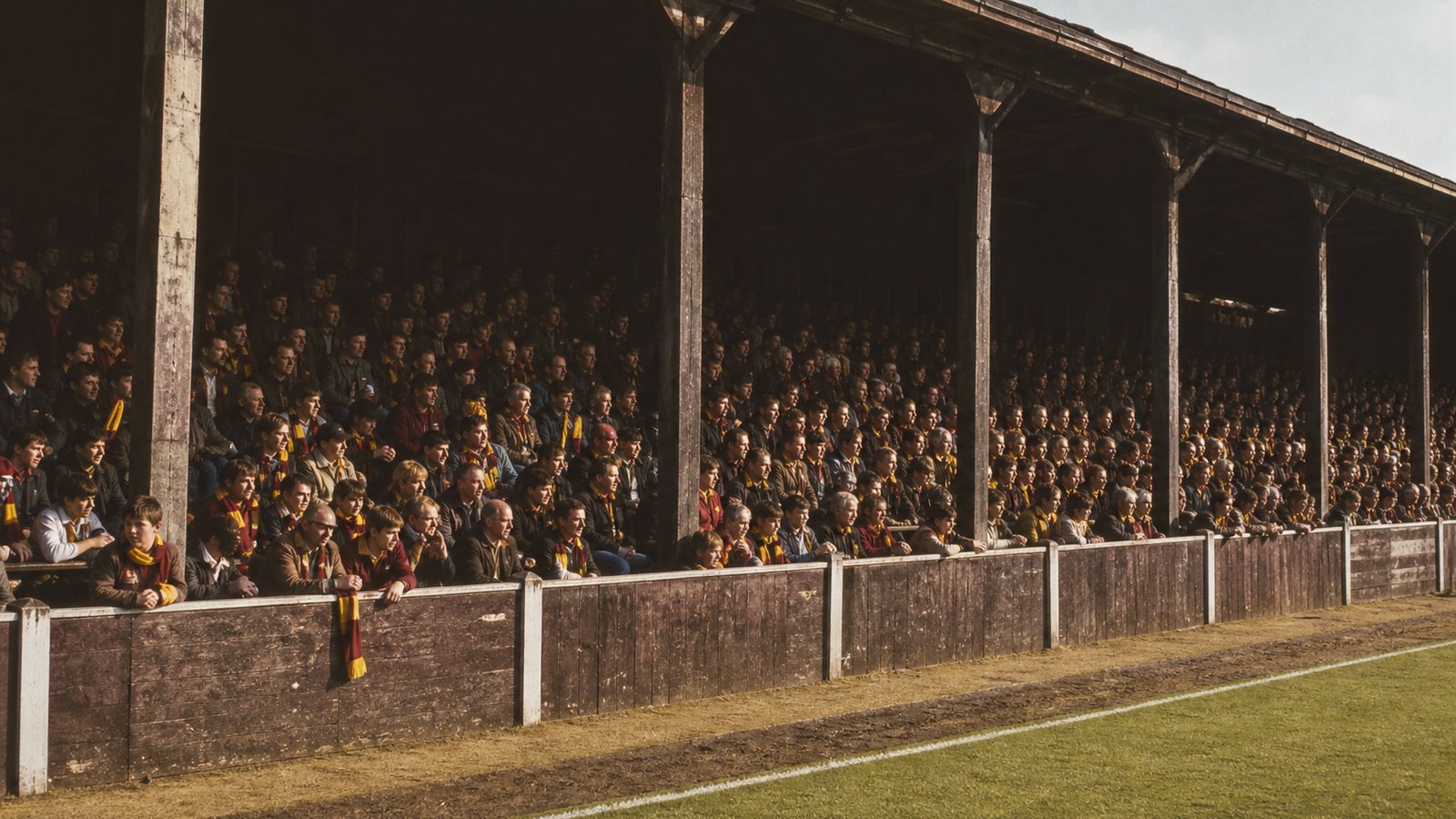
At about 3:40 on 11 May 1985, television commentator John Helm noticed a tiny glow in the wooden main stand at Valley Parade. Bradford City’s final league match of the season had begun as a celebration. The club had already secured promotion and captain Peter Jackson had received the Third Division trophy before kick-off. Four and a half minutes after that first glow, Helm later recalled, the stand had effectively disappeared.
Fifty-six people died: 54 Bradford supporters and two Lincoln City supporters. Hundreds were injured. The speed of the fire made the disaster feel sudden, but the official inquiry and later civil case exposed conditions built over years: an old timber stand, combustible rubbish beneath the seating, a written warning that went unanswered, poor access to extinguishers and escape routes that failed when seconds mattered.
The lasting football story is therefore not a match report and not a simple tale of an unforeseeable accident. Valley Parade showed how ordinary neglect could remain invisible during thousands of routine Saturdays, then become decisive in less time than a half-time team talk. The response changed the legal and practical treatment of sports grounds across Britain, while also leaving warnings that football did not fully absorb before Hillsborough.
A championship afternoon became an evacuation
Bradford’s match against Lincoln City drew more than 11,000 people to Valley Parade. The home side had won the Third Division title, its first league championship since 1929, and the mood was bright enough for Helm to remember the sunshine and happiness around the city four decades later. Lincoln had little at stake. The game itself offered no reason to expect danger.
Near the 40-minute mark, smoke appeared in Block G toward the rear of the main stand. Some spectators initially treated it as a small disturbance. Then flames reached the timber beneath the seats and the tarred roof above. Helm’s measured recollection—four and a half minutes from a tiny glow to the destruction of the stand—gives the afternoon its most frightening unit of time.
People moved in opposite directions. Some climbed over the low wall at the front and reached the pitch. Others tried to retreat through the back of the stand, where locked or restricted exits and turnstiles impeded escape. Dense smoke reduced visibility and breath. The fire brigade arrived within minutes of the call, but crews met a wall of flame while police, spectators and club staff were still pulling people clear.
The match never resumed. Players who had expected to carry a trophy instead searched for relatives, visited hospitals and attended funerals. Jackson later described sitting at home in his kit, unable to sleep. The score—0–0 when play stopped—became irrelevant.
The stand carried its warning beneath the seats
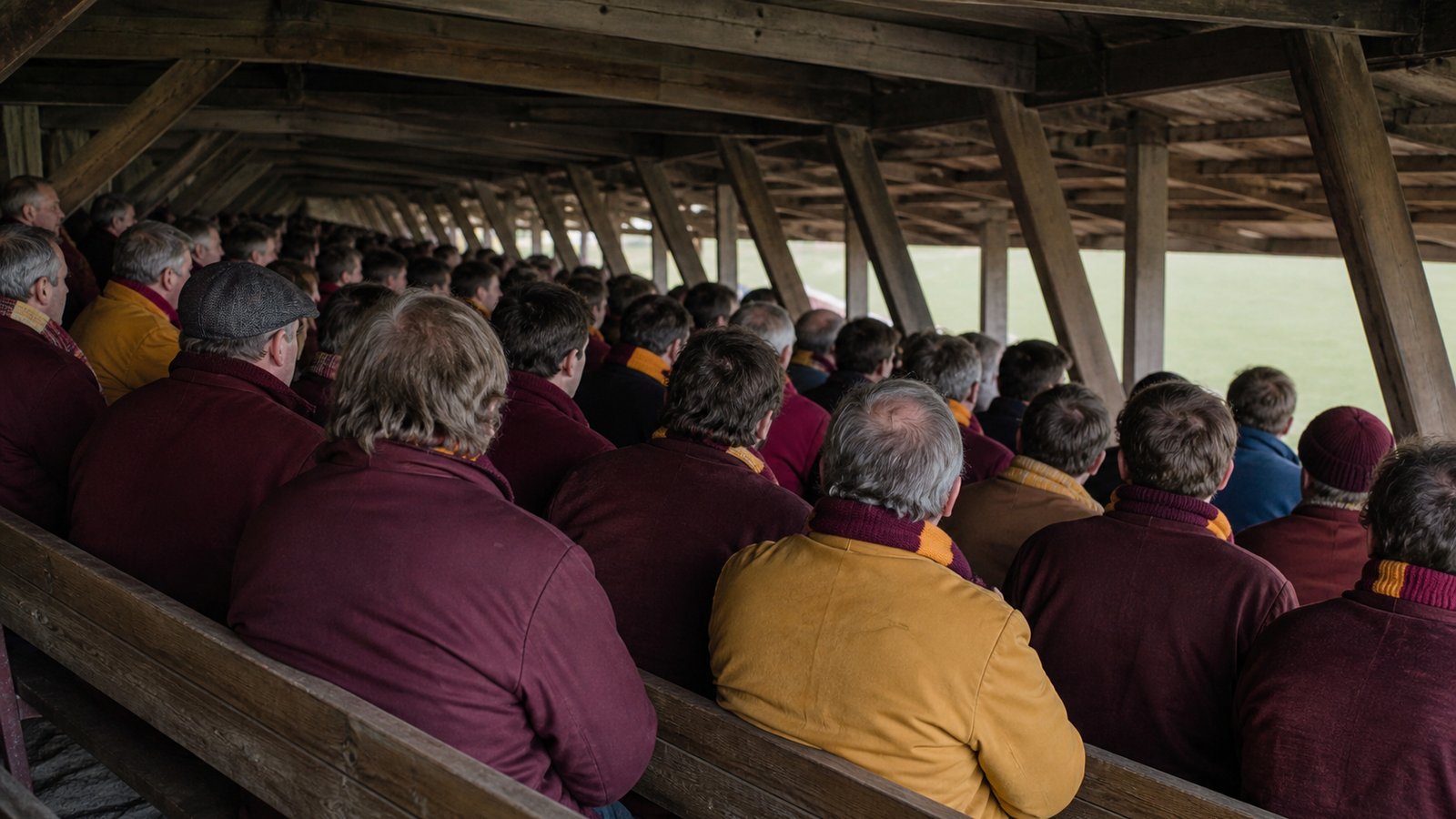
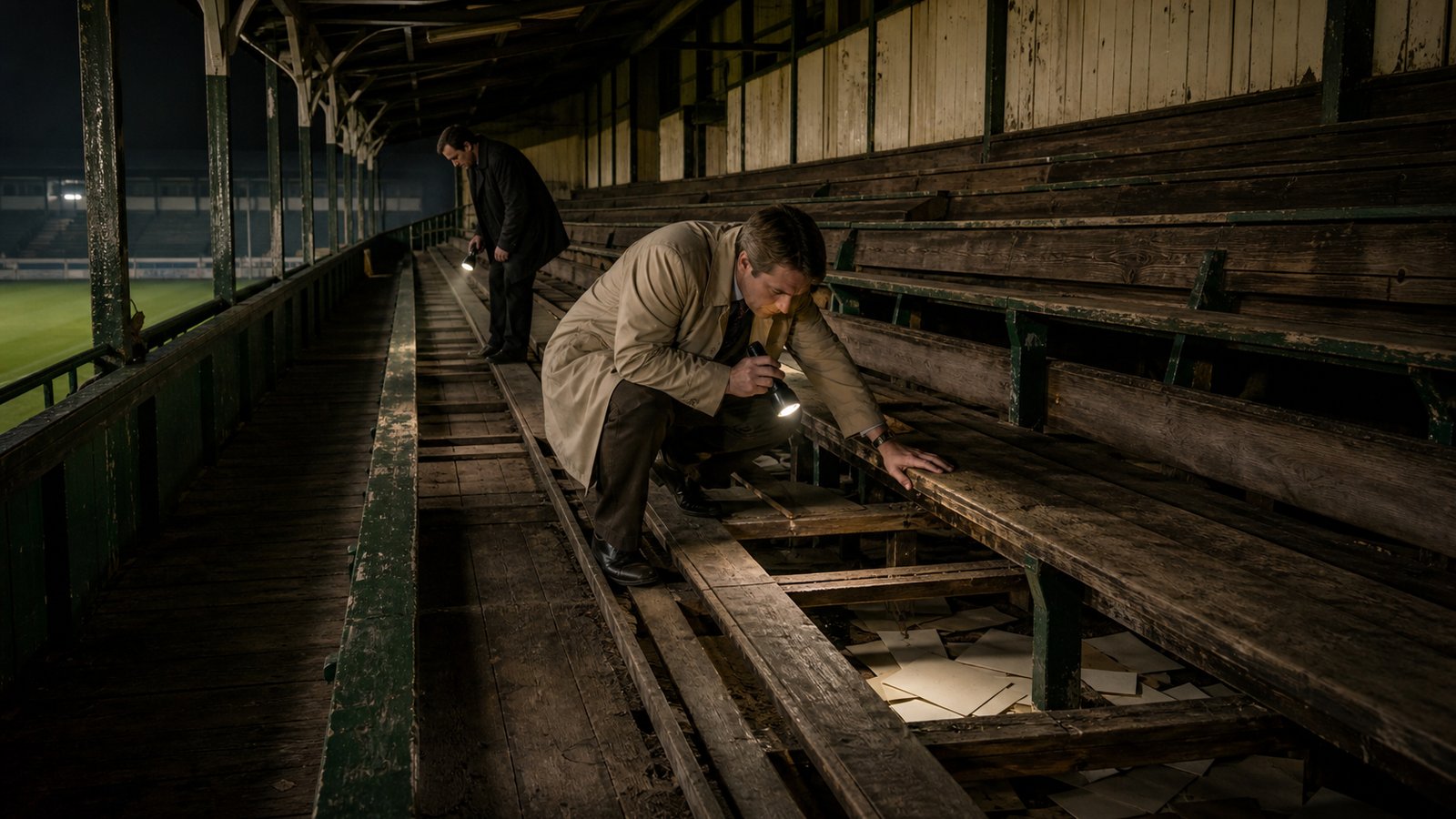
The main stand dated from 1908. Its wooden seats and roof structure belonged to another stadium age, but age alone did not explain the fire’s violence. Investigators found years of litter in the void below the seating. A police officer searching the remains reportedly discovered a local newspaper from 1968 among the debris.
West Yorkshire metropolitan county council had written to the club on 18 July 1984. The letter identified the timber construction as a fire hazard and specifically warned about combustible material beneath the seats. It said a carelessly discarded cigarette could start a fire. The club neither acted on the warning nor replied to it.
The official finding was that a discarded match, cigarette or pipe tobacco probably ignited debris below the stand. The inquiry did not find evidence of arson. Later arguments challenged the speed and scope of that inquiry, but Sir Oliver Popplewell continued to defend the accidental-cause finding. The most consequential evidence was not a dramatic hidden mechanism. It was the documented combination of fuel, timber and inaction.
There was another bitter detail. The wooden terracing was due to be replaced by concrete after the season, and steelwork for the job had already arrived. The Lincoln match was expected to be the stand’s last use in its old form. A hazard known for months survived until the final scheduled afternoon, then took 56 lives before planned work could begin.
Four minutes exposed football’s emergency assumptions
British grounds in the mid-1980s were often managed around disorder rather than evacuation. Extinguishers at Valley Parade were kept in the clubroom partly because of concern that supporters might use them as missiles. Rear access was restricted to prevent unpaid entry. Measures shaped by routine security concerns became obstacles in a fire.
The route onto the pitch saved many lives. Had a continuous high fence blocked the front of the stand, the death toll could have been worse. Popplewell later recommended that pitch fencing should contain gates wide enough for emergency escape. Yet football’s broader preference for controlling crowds through barriers remained powerful.
Police officers, spectators and staff dragged people onto the grass and smothered burning clothing; 22 spectators later received bravery awards. Their courage prevented an even larger loss, but it was compensating for too little time, too little equipment and unreliable escape routes. Valley Parade showed that a safe ground could not depend on extraordinary rescue.
Popplewell moved safety from advice toward law
The public inquiry chaired by Mr Justice Popplewell produced an interim report in 1985 and a final report in 1986. Its recommendations included extending safety-certificate requirements, preventing the construction of new wooden stands, improving fire precautions and ensuring that emergency exits could release crowds quickly.
Parliament followed with the Fire Safety and Safety of Places of Sport Act 1987. The law expanded the safety-certificate regime for covered stands at sports grounds and strengthened enforcement powers. It did not rebuild British football by itself, but it gave local authorities and ground operators clearer legal duties around stands that had previously escaped the strictest controls.
A 1987 civil judgment made responsibility more explicit. Sir Joseph Cantley found Bradford City two-thirds liable and the county council one-third liable. He described the club’s continuing negligence and the council’s continuing indifference after both had been alerted to the danger. Compensation claims from bereaved families, injured spectators and police officers could then proceed.
Valley Parade reopened in December 1986 after reconstruction. Bradford had played home matches at Huddersfield, Leeds and Odsal during the intervening 19 months. The rebuilt ground represented continuity for the club, but it also made the policy argument visible: stadium safety could no longer be treated as cosmetic maintenance delayed until convenient.

The reform still carried an unfinished warning
Popplewell’s work ranged beyond Bradford. On the same day, violence occurred at Birmingham City against Leeds United; 18 days later, 39 people died at Heysel. British football was confronting fire, crowd disorder and structural danger at once. The debates overlapped, and security measures often competed with escape needs.
The inquiry said pitch fences did not all have to be removed if they contained sufficient emergency gates. That compromise proved inadequate at Hillsborough in 1989, where supporters were crushed behind perimeter fencing. Bradford had demonstrated the life-saving value of access to the pitch, yet the lesson was filtered through an era still inclined to view supporters primarily as a crowd to control.
For a related example of disaster reshaping football policy across borders, the response to Heysel shows how punishment, stadium risk and European competition became entangled. Bradford’s legacy was more domestic and physical: what a stand was made from, what lay beneath it, who had authority to close it and whether thousands of people could leave it at once.
The memorial at Valley Parade names 56 people, including Lincoln supporters Bill Stacey and Jim West. Remembering them requires more than repeating the speed of the flames. The crucial chronology began before 11 May: a stand from 1908, rubbish accumulated over years, a council warning in July 1984, no effective response, and planned work left until after one final match. Four and a half minutes revealed the cost of that delay. The reforms mattered because they treated delay itself as a safety decision.
Sources
- BBC News — Bradford City fire remembered on the 40th anniversary
- BBC On This Day — Fans killed in Bradford stadium fire
- Bradford City AFC — In Memoriam
- The Guardian — The unheeded warnings that led to tragedy
- The Guardian archive — Hideous images linger after carnival day
- UK Legislation — Fire Safety and Safety of Places of Sport Act 1987