
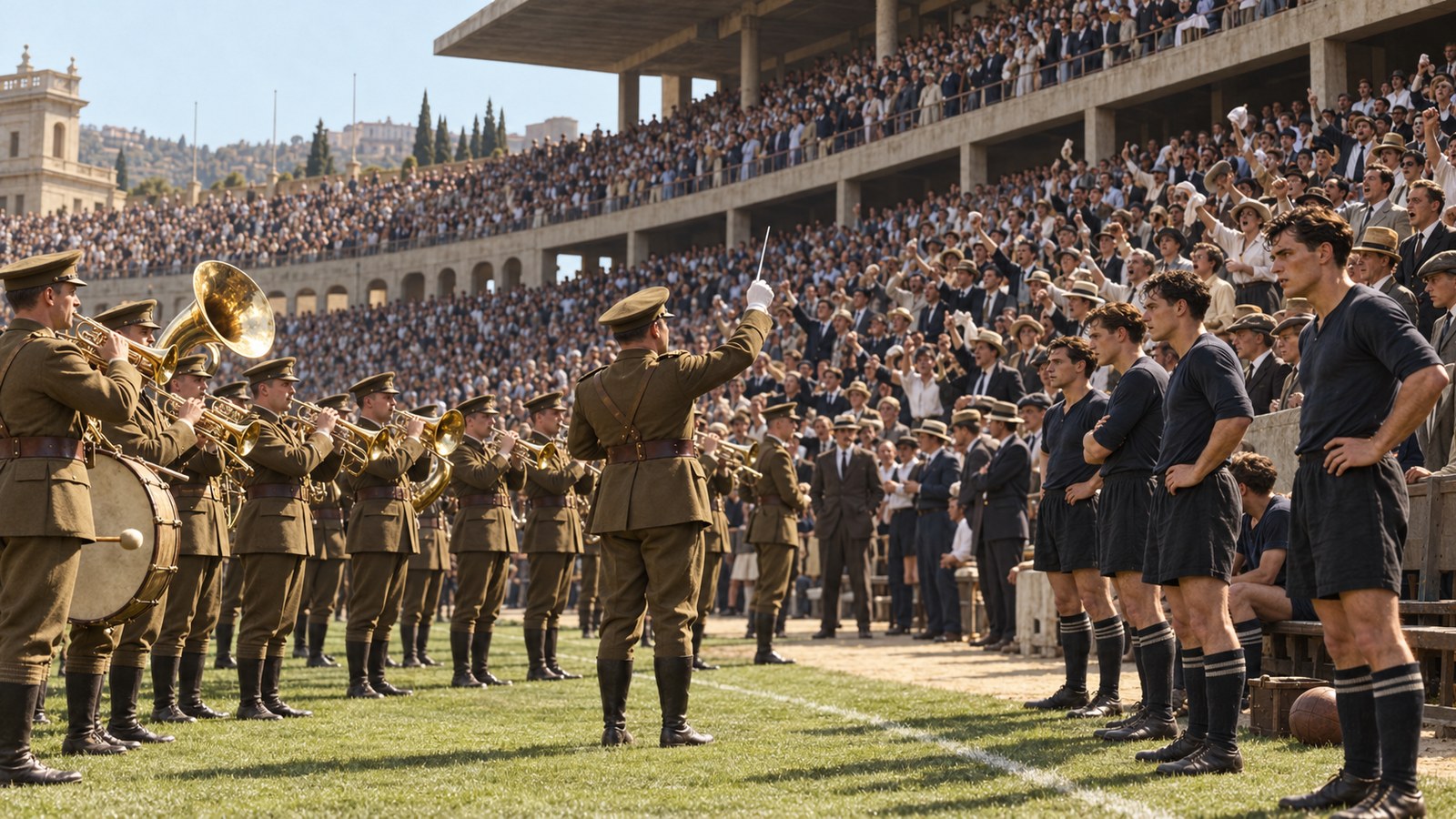
On 14 June 1925, a British Royal Marines band walked onto the grass at Les Corts before an exhibition match involving FC Barcelona. When the musicians played Spain’s national anthem, whistles and jeers descended from the terraces. When they followed it with “God Save the King,” applause replaced the noise.
The shift lasted only as long as two pieces of music. The consequences lasted months. Miguel Primo de Rivera’s dictatorship treated the crowd’s response as a political offence, closed Barcelona’s ground and forced club president Joan Gamper from office. An occasion arranged in tribute to the Orfeó Català choral society became a test of who could speak through a football crowd.
Barcelona did not yet possess the modern Camp Nou or the global audience that would later make “more than a club” famous. It had Les Corts, more than 10,000 members and a founder who had adopted Catalonia as his home. The state’s reaction revealed that the club was already being read as something larger than a team.
A tribute match put two anthems before the same crowd
The event was a match against Júpiter arranged as a tribute to the Orfeó Català. The visiting band supplied ceremonial music. This was not a league fixture whose meaning grew from the score. The defining action happened around the football, before play could absorb everyone’s attention.
Spanish accounts and FC Barcelona’s official history agree on the central contrast. Supporters jeered the Spanish anthem. The band then played the British anthem, and the crowd applauded. The second response made it difficult for the authorities to dismiss the first as impatience with ceremony or dislike of brass music. One anthem had been rejected and another accepted.
The setting gave that response force. Les Corts was a football ground, but a full terrace could make thousands of individual sounds arrive as one public judgement. Under a dictatorship alert to Catalan nationalism, the crowd had created an audible comparison without printing a manifesto or organising a march.
A football audience also made attribution difficult. Officials could identify the club, its president and the ground, but not one author behind the whistles. The sound belonged to many throats at once. Punishment therefore moved upward, from unidentifiable spectators to the institution that had assembled them.
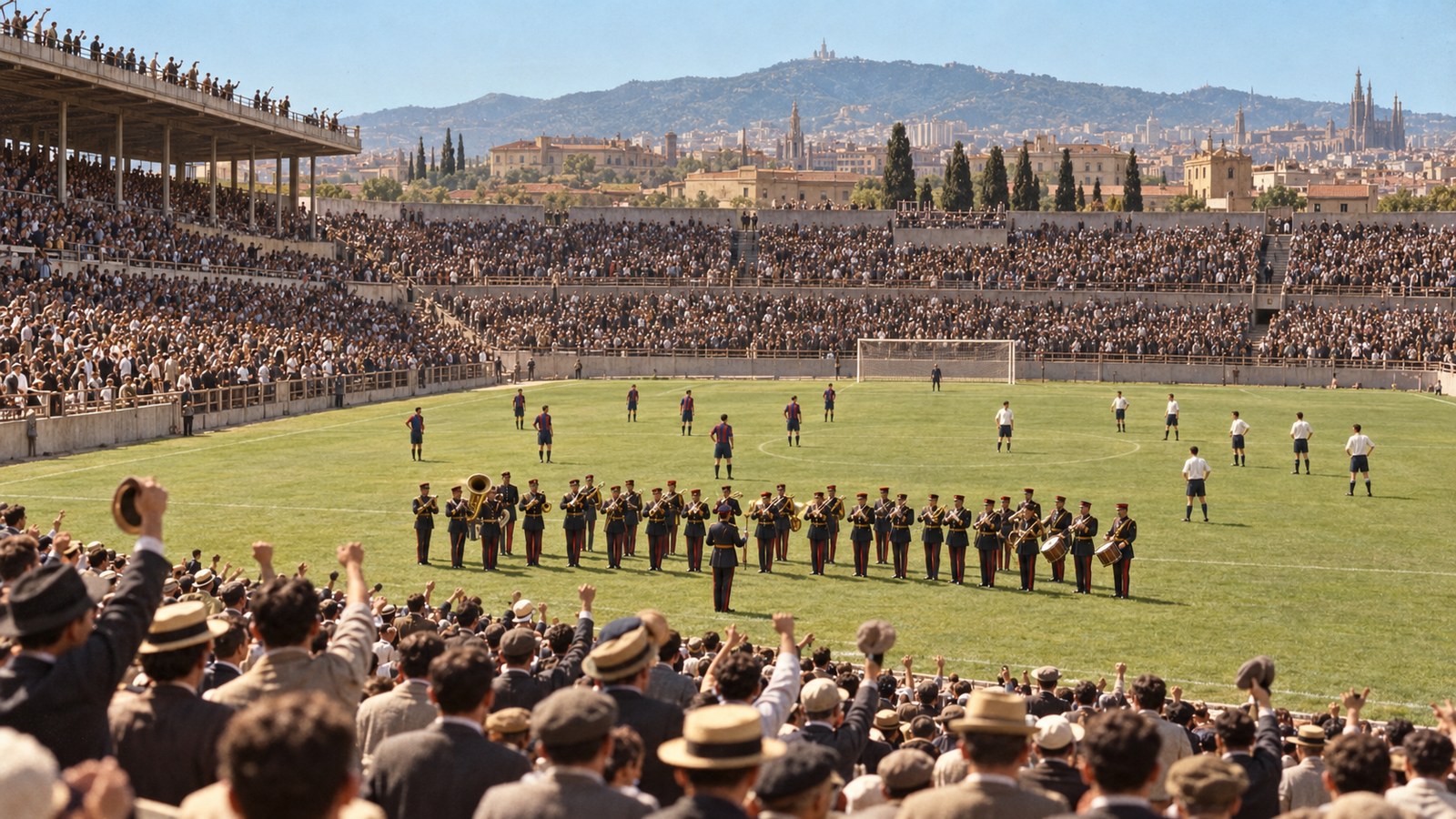
The exact sound cannot be recovered from still photographs. Its sequence can. A band played; whistles met one anthem; applause met the next. The political meaning came from the order.
Les Corts had given Barcelona room to become a mass club
Barcelona opened Les Corts in 1922 with an initial capacity of about 20,000. The move mattered because the club had outgrown earlier grounds. More seats meant more members could gather, and a larger gathering made the club visible as a civic institution rather than a small circle of football enthusiasts.
Joan Gamper had driven that growth over several presidencies. Born in Switzerland as Hans Gamper, he arrived in Barcelona near the end of the nineteenth century, helped establish the club in 1899 and used the Catalan form of his name. FC Barcelona’s own history describes his return to the presidency in June 1924 as an attempt to resolve internal tension before the club’s silver anniversary.
By the end of the 1922–23 season, membership had passed 10,000. The team of the era included figures such as Josep Samitier, Paulino Alcántara and goalkeeper Franz Platko. Success on the field and growth off it filled Les Corts with an audience able to express a collective mood.
That development is why the closure was more than the loss of a venue. The dictatorship restricted a place where the club’s expanding community could see itself assembled. The ground had supplied scale; the crowd’s response showed what scale could do.
The dictatorship answered sound with a six-month closure
The authorities accused Gamper of promoting Catalan nationalism. Barcelona’s official account says the Primo de Rivera dictatorship closed the club for six months. Other histories describe Les Corts itself being shut, with the ban later reduced before football returned. The common point is the severity: a pre-match crowd reaction brought an institutional punishment measured in months.
No goal, tackle or selection decision caused it. The sanction targeted the club because the authorities treated the terrace as politically connected to its leadership. Gamper had not conducted thousands of whistles with his hands, but his public association with Catalan identity made him the person through whom the state could discipline Barcelona.
The episode echoes a different act of institutional pressure in Vasco’s refusal to remove 12 players in 1924. In both cases, administrators demanded that a football organisation accept a boundary imposed from outside the match. Barcelona’s response was less formally defiant, but the cost still fell on the club’s ability to function.
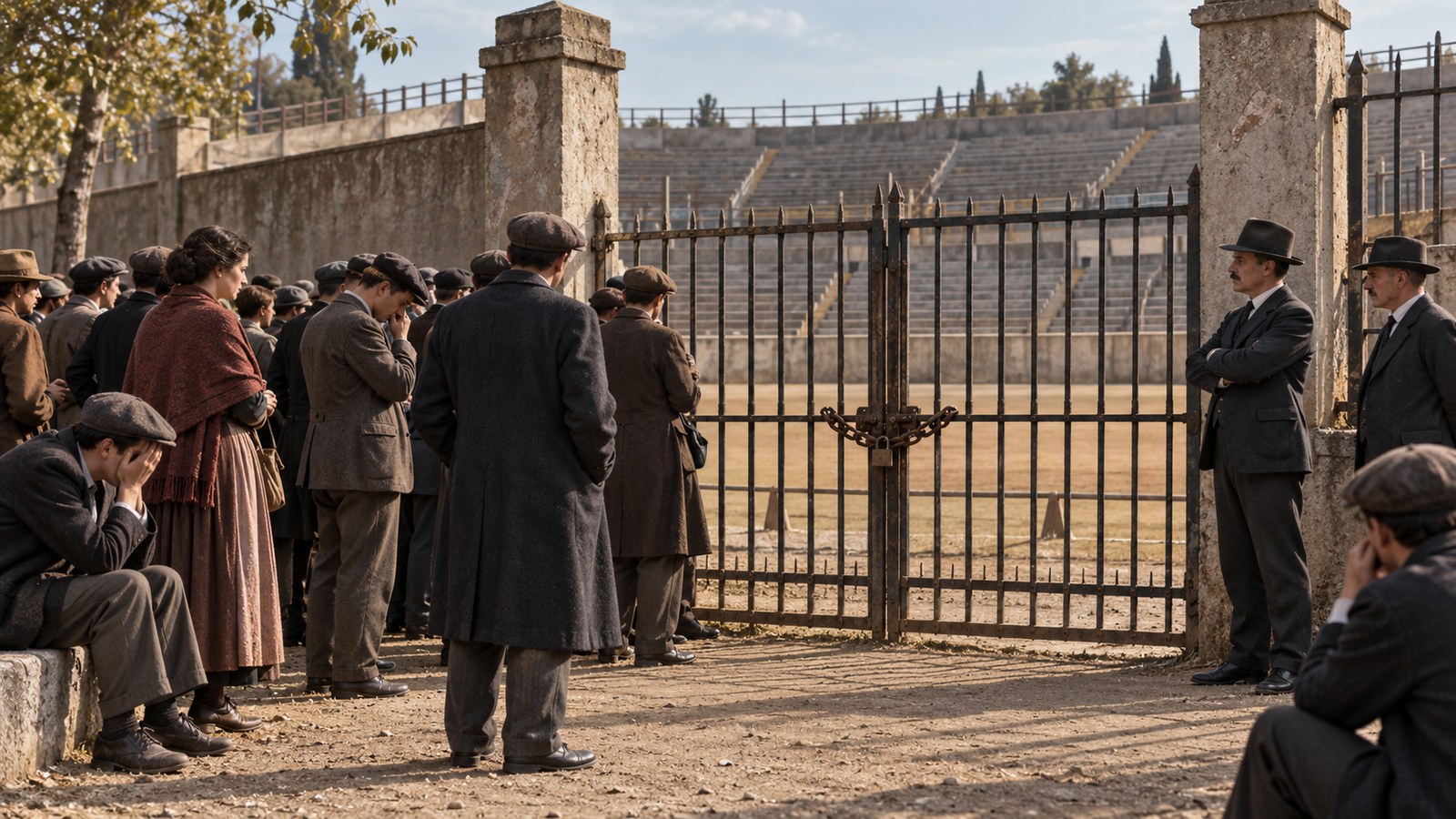
Closing a ground also changed daily reality. Fixtures, receipts, meetings and the rhythm of supporters gathering at Les Corts were interrupted. The punishment worked by separating a growing institution from its physical audience.
Joan Gamper’s final presidency ended under state pressure
On 10 July 1925, less than a month after the incident, Gamper was forced to resign. It was the end of his fifth and final period as president. He had repeatedly returned when the club faced financial or organisational trouble; this time, remaining in office had become part of the problem defined by the dictatorship.
Some summaries say Gamper was expelled from Spain, while FC Barcelona’s official history is more precise about the forced resignation and the end of his presidency. The safest conclusion is that he was pushed out of the club’s leadership and away from the public role through which he had helped bind Barcelona to Catalan civic life.
His biography made him an unusual target. Gamper was not born in Catalonia, yet he chose its language and local version of his name. That adoption challenged any simple claim that identity followed birthplace alone. The authorities could portray the jeering as organised nationalism; supporters could understand it as a response arising from the crowd itself.
The distinction did not protect him. State power preferred an identifiable president to thousands of anonymous voices. By removing Gamper, the dictatorship converted a collective sound into an individual consequence.
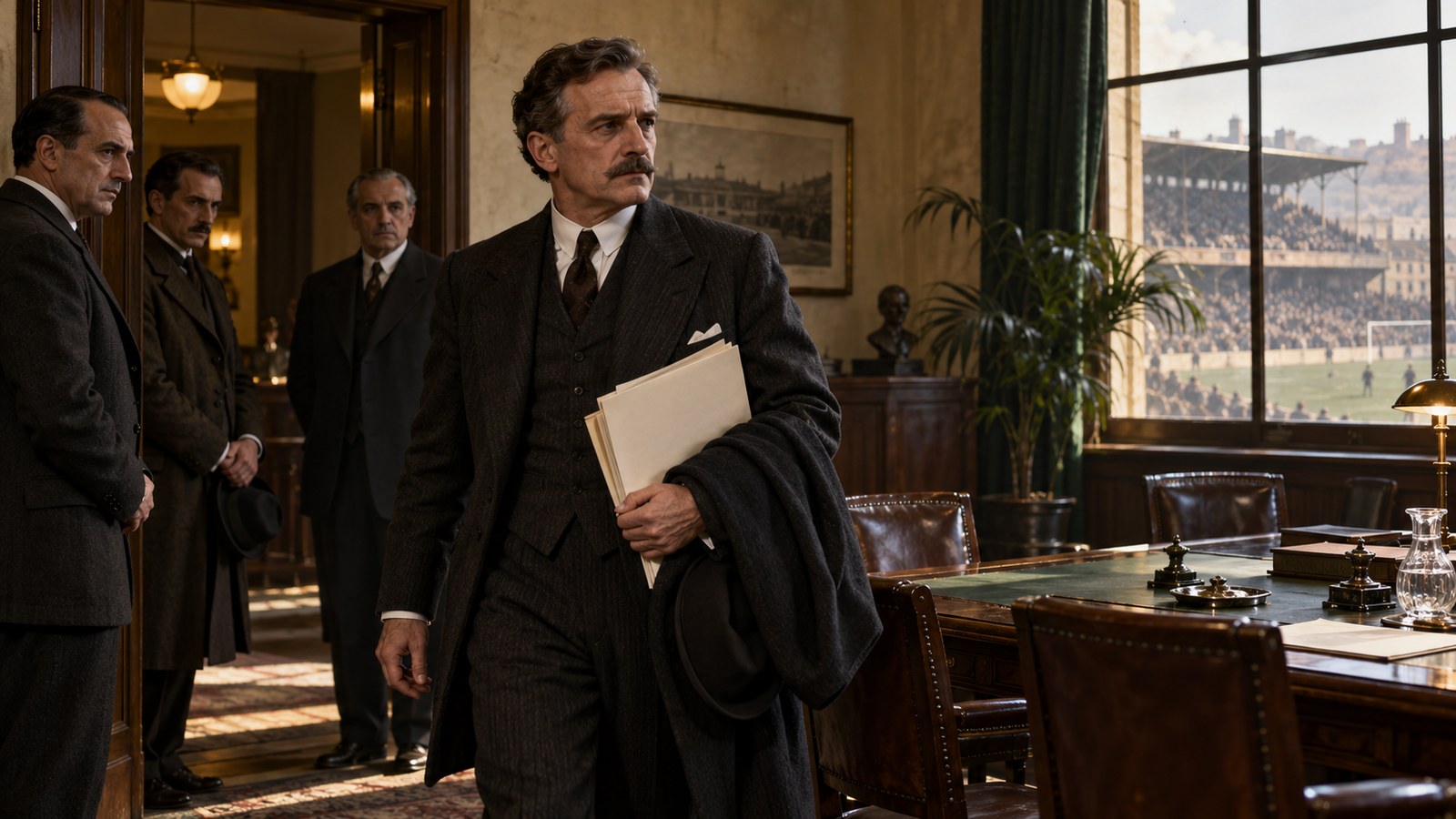
The boardroom scene made the sanction durable. The whistles had vanished as soon as the music ended, but the resignation placed their consequences in the club’s official record and removed the founder from daily leadership.
The closure clarified what a football ground could represent
Barcelona reopened and continued to grow. Les Corts was expanded several times, eventually holding far more than its original 20,000, before the club moved to the Camp Nou in 1957. The 1925 closure did not end the institution. It supplied an early, unmistakable example of why the institution attracted political attention.
Modern football often turns crowd size into a number about demand. At Les Corts, numbers became authority. A mass of supporters could make a ceremonial moment carry beyond the stadium, and the government understood the transmission immediately.
The same ground would later host famous teams and major matches. Yet its political memory rests on an event with no decisive pass. The crowd used volume, timing and contrast. The state replied through locks, dates and an enforced resignation.
Decades later, visiting support at the Camp Nou could still reveal how a stadium redistributes identity and control; Frankfurt’s vast travelling crowd in 2022 showed that the composition of the stands can become the story itself. In 1925, Barcelona’s own supporters demonstrated the older power of a terrace: it could make a political statement before the ball moved.
The whistles mattered because they were followed by applause. The closure mattered because a dictatorship believed that contrast threatened more than one ceremony. Les Corts had become a place where football gathered a public, and where a public could be heard.
Sources
FC Barcelona official history; Rab MacWilliam, Life in La Liga; Camp de Les Corts historical record; Joan Gamper biographical archive.