
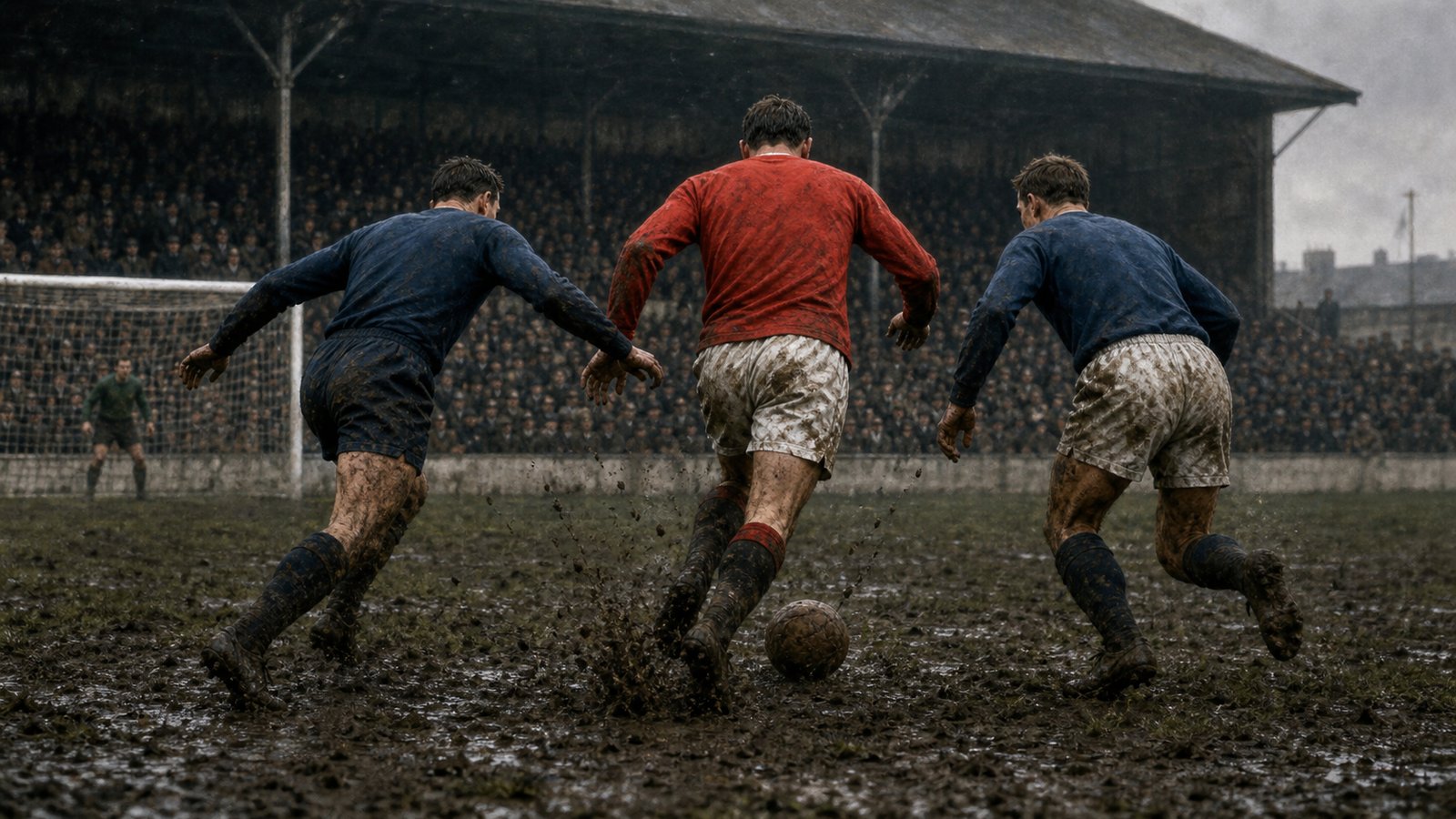
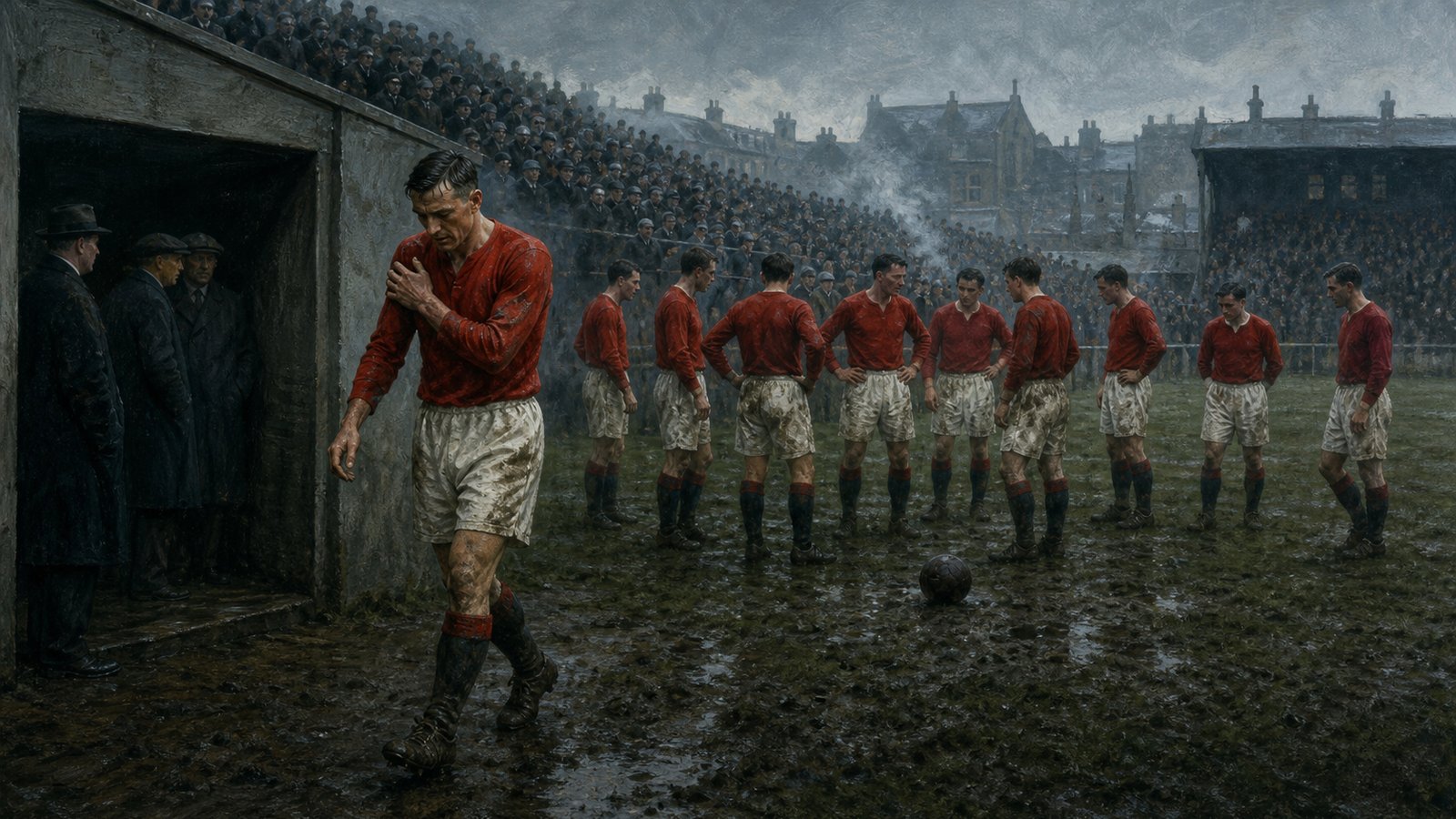
Derek Ufton was already on his way to hospital when Charlton Athletic’s afternoon began to look impossible. The captain had dislocated a shoulder less than twenty minutes into the Second Division match against Huddersfield Town at The Valley on 21 December 1957. Under the 1957 competition rules, substitutes were not permitted, so Charlton would play most of the game with ten men. By half-time they were 2–0 down.
Ufton’s father went with him in the ambulance. Before the anaesthetic, he told his son that Huddersfield now led 5–1. Ufton answered with a bleak joke: Charlton plainly could not manage without him. Back in south-east London, the men he had left behind were about to score six goals in less than half an hour. The detail that makes the match endure is not merely the final score. It is how quickly every sensible reading of the contest became obsolete.
A shoulder turned eleven against eleven into arithmetic
The match had opened without drama. Ufton later recalled that he was simply running beside Huddersfield centre-forward Stan Howard when they bumped and his shoulder came out. It was a recurring injury—he said one shoulder had dislocated thirteen times and the other seven—but this time he could not put it back into place. Charlton lost their centre-half and captain after roughly a quarter of an hour.
Huddersfield exploited the advantage in the ordinary way. Les Massie scored first and Alex Bain added a second before the interval. The visitors were managed by Bill Shankly and had an extra player, a two-goal lead and a muddy pitch on which a chasing side could waste energy. Some home supporters began leaving. Nothing about the situation required prophecy; it required only counting.
There had already been a warning against trusting a lead in this fixture. On the opening day of the 1957–58 season, Charlton had gone 3–0 ahead at Huddersfield before the home side recovered to draw 3–3. The December reversal would be larger, faster and pointed in the opposite direction, but the first meeting gave both benches a recent memory of control evaporating between the same opponents. Even so, a draw from three behind with eleven players offered no realistic blueprint for winning from four behind with ten.
At half-time Charlton manager Jimmy Trotter moved Johnny Summers from the left wing into the centre. The instruction was direct: find him. Summers, a naturally left-footed attacker, emerged for the second half in a different role and soon scored with his right foot. Two minutes after the restart, Charlton had their first sign that the contest might still move.
The score reached 5–1 after the supposed response
Summers’s first goal did not begin a smooth recovery. Bain scored his second, Bill McGarry converted a penalty, and Bob Ledger struck just after the hour. Huddersfield were 5–1 ahead against ten men. The official chronology matters because memory tends to compress a comeback into one uninterrupted wave. Charlton had already tried to respond and had been punished three more times.
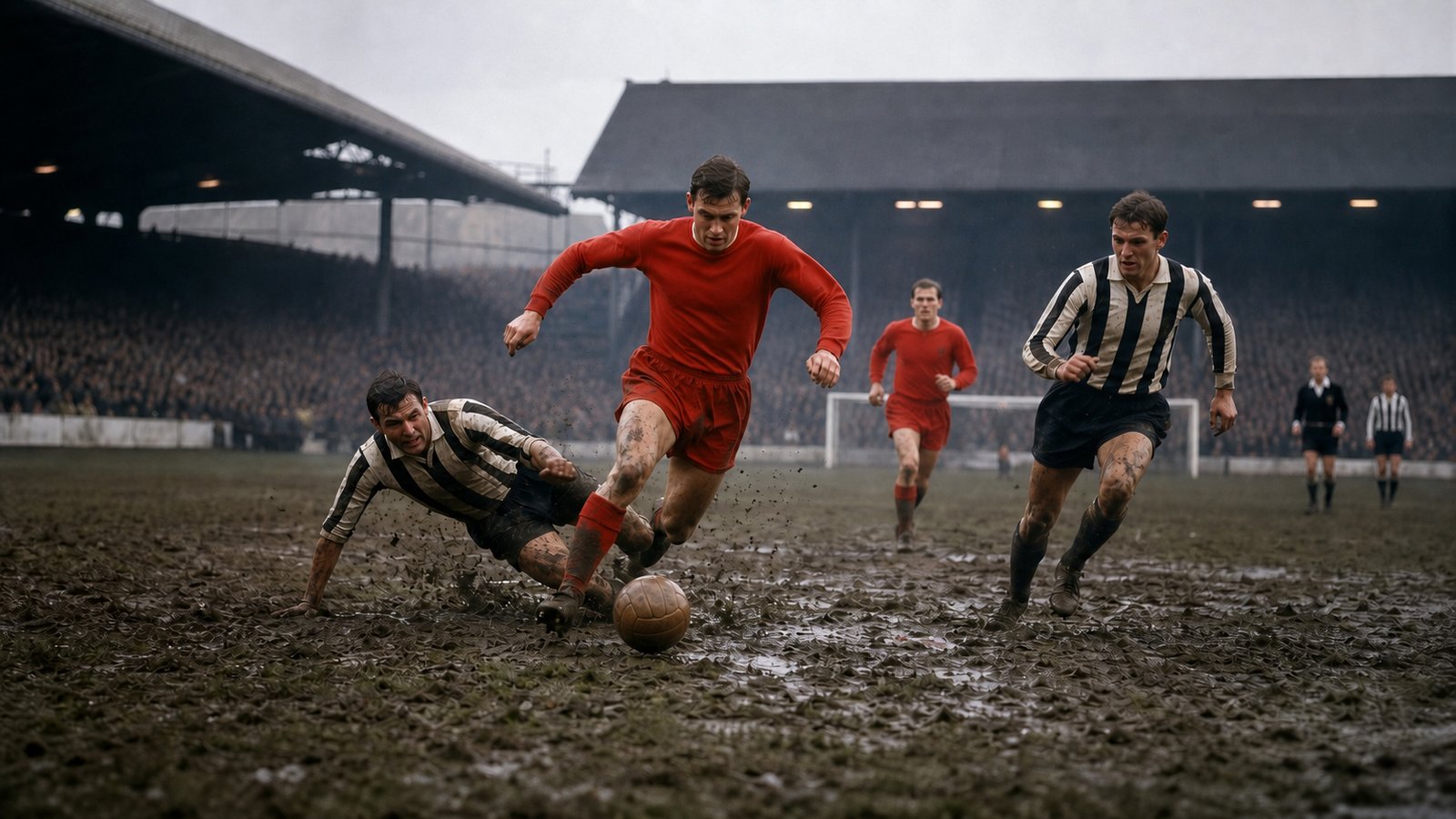
The next two minutes altered the pressure. Johnny “Buck” Ryan scored in the 63rd minute, then Summers made it 5–3 in the 64th. Huddersfield still possessed the lead and the extra man, but the geometry had changed. A contemporary Huddersfield report observed that Summers’s move into the middle forced defenders to turn in the mud. Their wider defensive positions had offered control while Charlton attacked conventionally; a direct runner now reached the gaps before they could close.
This was not elegant possession patiently wearing down a block. The pitch was treacherous, Charlton were short-handed, and the match had become a sequence of races, second balls and hurried decisions. Summers completed his hat-trick in the 73rd minute. Five minutes later he scored again for 5–5. In the 81st minute, his fifth goal put Charlton ahead for the first time.
Five shots made Summers the centre of the storm
The old match report preserved an uncomfortable corrective to the polished legend: it judged that only two of Summers’s five scoring shots were struck cleanly. One was mishit, another benefited from the goalkeeper’s error, and another took a deflection. That does not shrink the performance. It locates it inside the actual match, where mud, exhaustion and defenders turning under pressure mattered as much as pure finishing.
Summers had five shots and all five went in. He also supplied the pass for one of Ryan’s goals. His change of position concentrated Charlton’s attacks on the place where Huddersfield were least comfortable, while his right foot—normally the weaker one—kept producing the decisive touches. The feat belonged to an individual, but the opening came from a collective refusal to preserve energy or accept the arithmetic.
The crowd became part of the pressure. The recorded attendance was around 12,500, though many had gone when the score reached 5–1. Those who remained watched five Charlton goals arrive between Ryan’s first and Summers’s fifth. A match that had seemed too unpromising for television suddenly contained more action than any summary could comfortably hold.
Huddersfield equalised—and still lost
The comeback was not complete at 6–5. Stan Howard scored for Huddersfield in the 86th minute, restoring equality and giving the visitors a possible escape from a collapse that had taken barely twenty minutes. At 6–6, both teams had already supplied enough reversal for the afternoon to become famous.
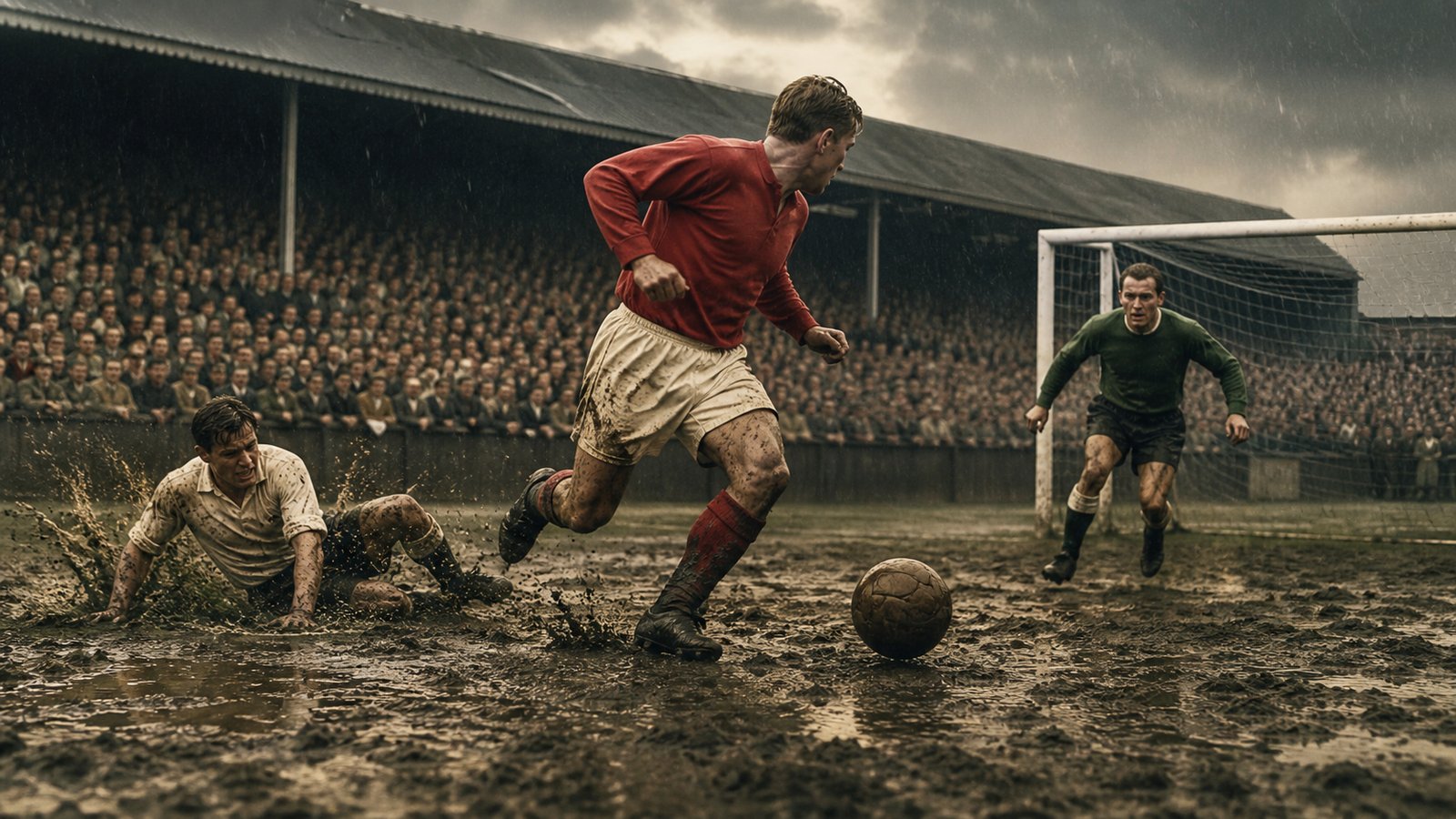
The last action made it stranger. A throw-in was taken roughly forty yards from Huddersfield’s goal. The ball crossed the field without obvious danger. Defender Tony Conwell lost his footing in the mud, leaving Ryan to run through. Goalkeeper Sandy Kennon came out; Ryan’s shot rose from the attempted save and dropped into the empty net. Charlton had won 7–6 with a last-minute goal.
The Huddersfield Daily Examiner’s account called it the club’s “most successful failure.” Its reporter argued that 6–6 would have been just, yet also identified the tactical problem: the attacking instincts that had built Huddersfield’s lead left room once Summers moved centrally and ran directly. The visitors had scored six away from home, held a four-goal advantage after the hour and still left with nothing.
The match was almost invisible beyond The Valley
No television camera recorded the comeback. The Sports Journalists’ Association recounts that commentator Kenneth Wolstenholme had originally been assigned to the match, only for the broadcaster to choose another fixture because Charlton against Huddersfield did not appear exciting enough. A fast car later carried Summers to the BBC studio. The event reached viewers through the exhausted scorer rather than through pictures of his goals.
Newspaper coverage also had to chase the score. One reporter filed early copy while Charlton were still two goals behind. The national reaction grew after the result became clear, while the full contemporary Huddersfield report preserved the slipping defender, the muddy turns and the unease of a side unable to identify the precise moment control vanished.
The scoreline can look like an artefact from a reckless era, but its mechanism is more specific. An injury removed Charlton’s captain. Huddersfield used the extra man to build what should have been a terminal lead. Trotter then concentrated the reduced side around one direct attacker, and the surface punished defenders asked to reverse direction. Even after five successive Charlton goals, Huddersfield found an equaliser. Ryan’s final run was required to make the comeback a victory.
Sources
Charlton Athletic, Remembering the Greatest Comeback of All Time
Huddersfield Daily Examiner, contemporary match report reproduced by Yorkshire Live
Sports Journalists’ Association, Great Footballing Comebacks: Charlton Score Four and Win 7–6
The Guardian, From 5–1 Down to Winning 7–6 in 20 Minutes
English football match records, used for chronology cross-checking