

At Stamford Bridge on 3 July 1886, the young man who would become a Victorian football pioneer needed ten seconds to make himself measurable. Arthur Wharton covered 100 yards in that time under championship conditions, a performance later celebrated as an official world record. The stopwatch offered a clean verdict: distance, time, winner. The rest of his sporting life would be harder to record. Football had no national league yet, match reports described him through the prejudice of the age, and the distinction between gentleman amateur and paid professional shaped who could belong.
Wharton’s career is often compressed into a label: England’s first Black professional footballer. The label matters, but it can hide the athlete inside it. He was a goalkeeper with an eccentric starting position, a winger when required, a champion sprinter, and later a professional cricketer. His route from Jamestown in Ghana to Darlington, Preston, Rotherham and Sheffield shows a game acquiring leagues, contracts and hierarchies while one extraordinary sportsman kept crossing their boundaries.
The stopwatch at Stamford Bridge
Arthur “Kwame” Wharton was born in Jamestown on 28 October 1865. His father, Henry, was a Grenadian-Scottish minister and missionary; his mother, Annie Florence Egyriba, came from Ghanaian Fante royalty. In 1883, Wharton travelled to England to train as a missionary at Cleveland College in Darlington. The intended vocation did not hold him for long. Darlington revealed an athlete whose range was unusually broad even in an era when sports commonly shared competitors.
Running produced his first national distinction. At the Amateur Athletic Association championship in London, Wharton ran 100 yards in ten seconds. The Arthur Wharton Foundation dates the race precisely to 3 July 1886 and says the record stood for more than 30 years. The Premier League’s account also identifies him as the first Black AAA champion and notes the Prince Hassan Cup awarded for the sprint. This was no vague story of somebody being “fast for a goalkeeper.” It was a championship performance with a clock attached.
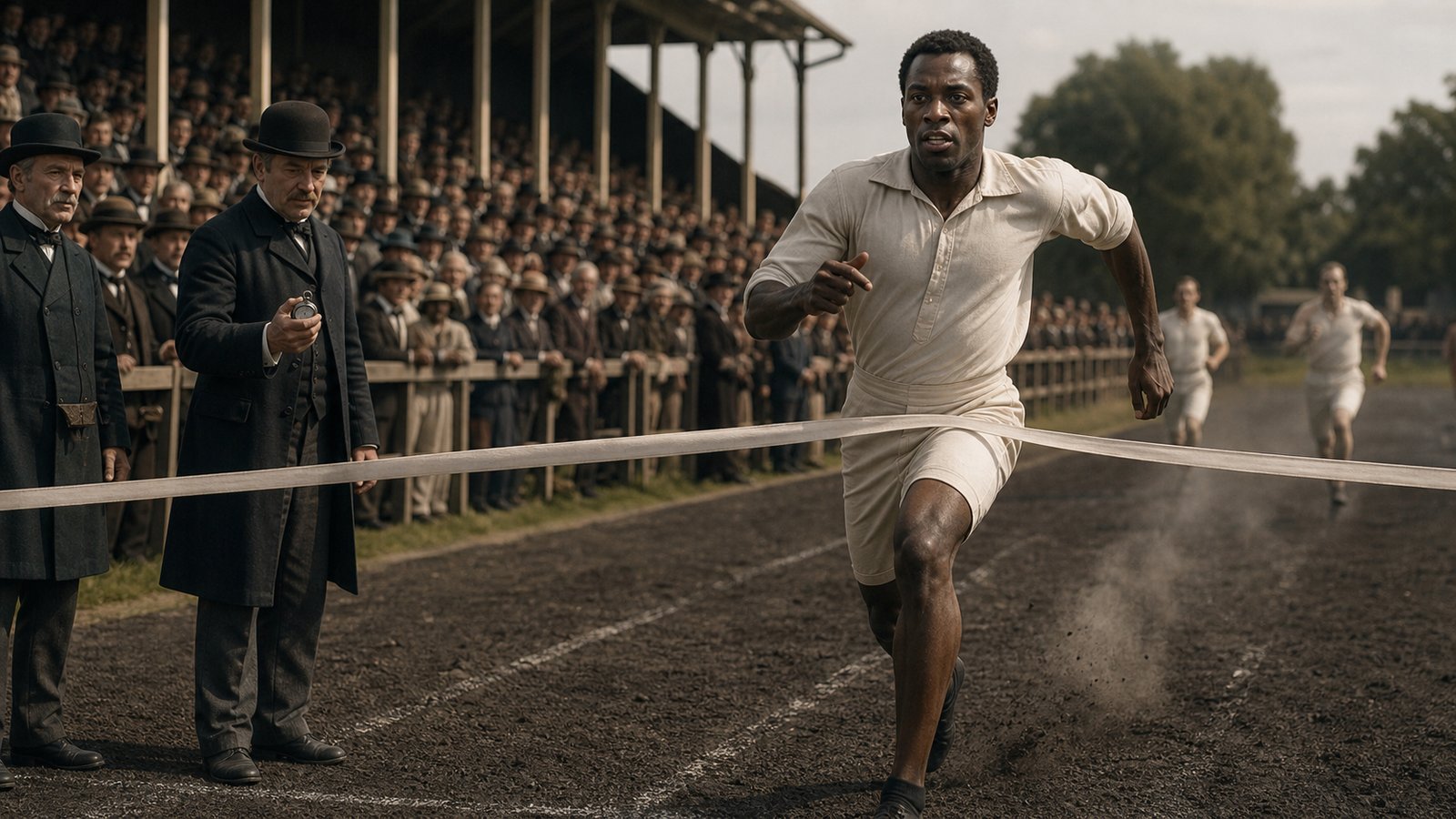
The image of the sprinter matters because later descriptions of Wharton in goal make more sense beside it. His goalkeeping was not simply reactive. It used the same explosive acceleration that had taken him through the finish at Stamford Bridge.
A goalkeeper waiting beside his post
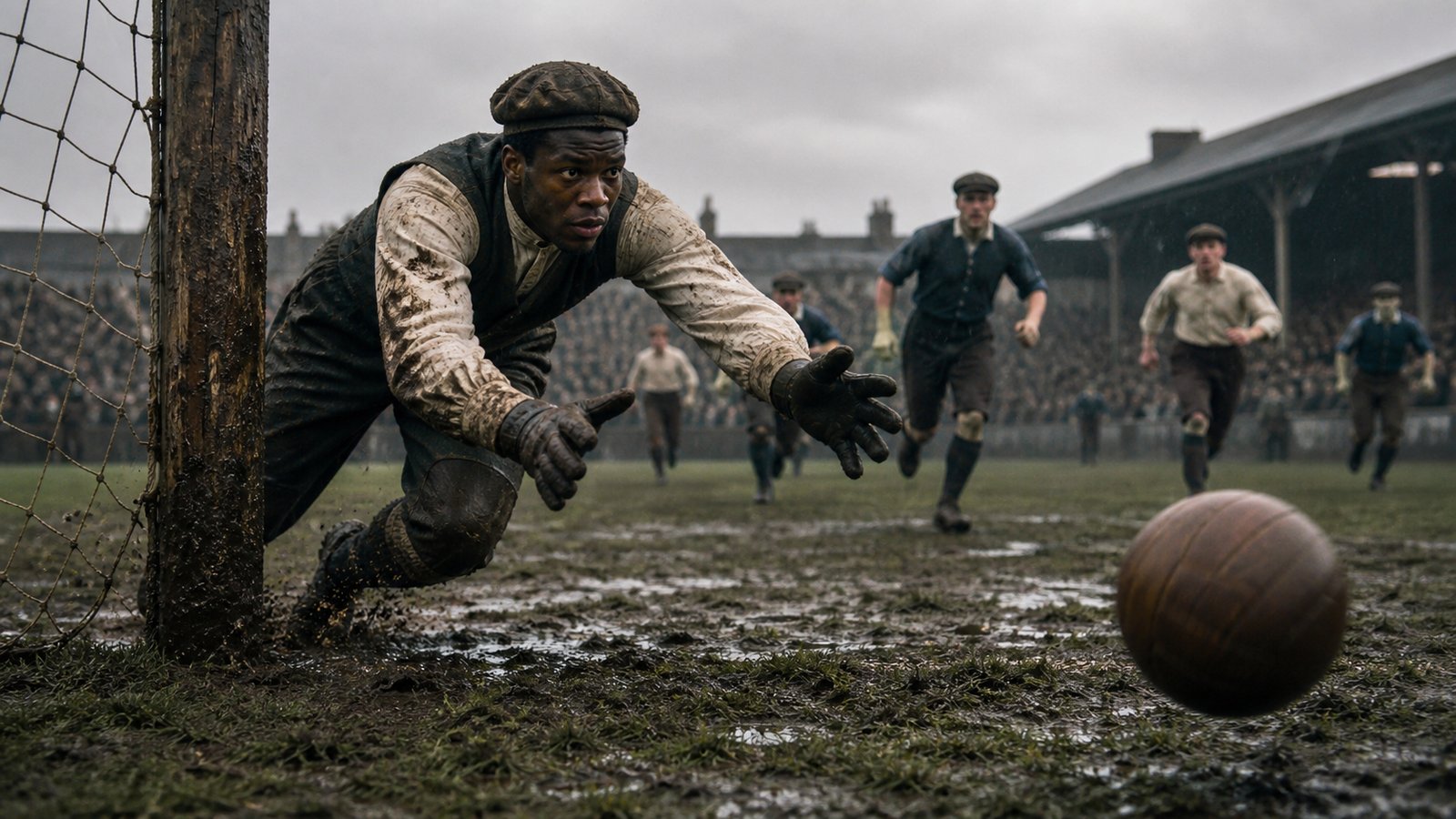
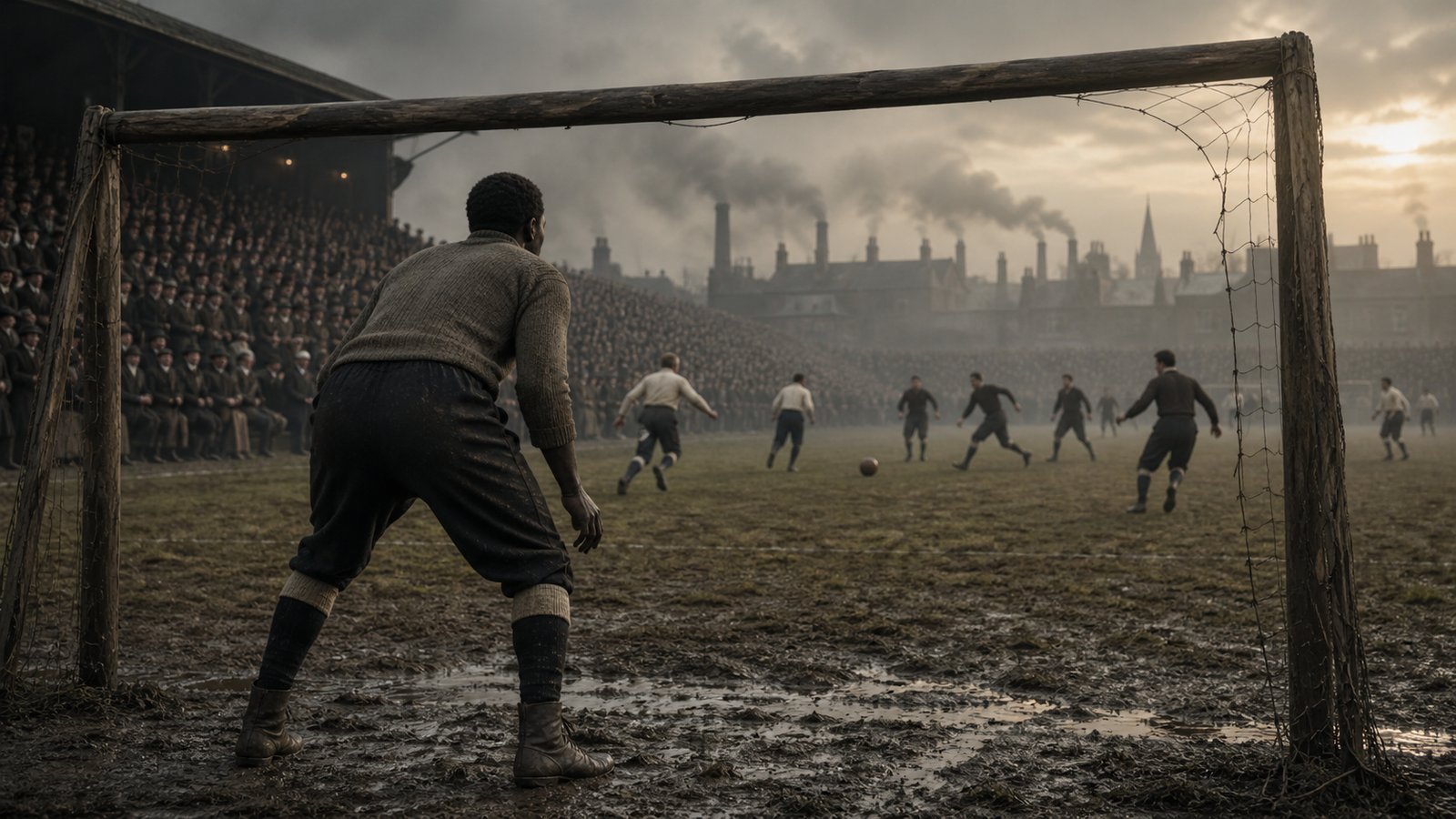
Wharton began playing for Darlington as a goalkeeper. The Premier League’s historical profile preserves a striking description of his method: he could crouch near the side of the goal, then rush out when danger developed. Contemporary praise collected around words such as “magnificent,” “invincible” and “superb.” Behind those adjectives was a physical idea. Rather than remain planted centrally, he gave himself room to attack the ball.
Goalkeeping in the mid-1880s looked different from the specialist craft seen today. Penalty kicks did not yet exist, substitutions were decades away, and equipment offered little protection. A quick goalkeeper who could cover ground and also play on the wing was valuable in a game still settling its positions. Wharton’s unusual stance may sound reckless to a modern reader, yet it converted his sprinting gift into a football action: wait, read the danger, explode.
He was selected for a prestigious Newcastle and District side during the 1885–86 season. That recognition came before a national league table could frame his week-to-week performance. Reputation moved through cup ties, representative matches and reports. His next club placed him inside the strongest emerging team in England.
Preston before there was a league table
Wharton joined Preston North End while still an amateur and contributed as the club reached the FA Cup semi-finals in 1886–87. This was the Preston side approaching the great “Invincibles” period, but the Football League would not begin until 1888. Wharton’s spell therefore belongs to a transitional football world: increasingly organised, heavily competitive and drawing crowds, but not yet arranged around the national season that now makes careers easy to count.
That timing complicates his legacy. There is no neat block of league appearances from Darlington or Preston to display beside the sprint record. His football survives in selections, cup progress and contemporary testimony. In 1888 he stepped away from the game to concentrate on running. A year later he returned, and that return changed the legal and social category under which he played.
Rotherham changed his sporting category
Wharton joined Rotherham Town in 1889 as a professional. Payment made the move historically decisive. Andrew Watson, who captained Scotland in 1881, is an essential earlier Black figure in British football, but Wharton is widely recognised as the first Black professional in England. The distinction is not a contest between pioneers. It shows how rapidly football’s categories were changing, and why precise language matters.
Professional status also meant that sport was work. Wharton later played for Stalybridge Rovers, Ashton North End and Stockport County, while cricket occupied his summers. The Premier League profile records that he played cricket professionally from 1889 and signed for Stalybridge Cricket Club in 1896. His livelihood was assembled across seasons and disciplines. Cycling and rugby also belonged to his sporting record.
That range resists the modern assumption that a landmark player must have followed a single, protected career track. Wharton made his way through a labour market that was still forming around football. A contract could recognise his value without removing the racism around him. Talent opened dressing-room doors, but it did not guarantee that newspapers, institutions or later histories would describe him fairly.
Three appearances inside the First Division
In 1894, Sheffield United signed Wharton as cover for William “Fatty” Foulke, the club’s established goalkeeper. Wharton made three appearances in the 1894–95 season. One came against Sunderland in the First Division, placing him in the top tier of the new league structure. The number is small; the threshold crossed by it is not.
Those appearances also reveal the strange contrast at the centre of Wharton’s career. The fastest man in championship conditions sat behind one of the period’s best-known goalkeepers. A pioneer can be historically first and professionally second choice at the same time. Sheffield United did not provide a grand, uninterrupted ascent. It provided three matches, a top-flight record, and another stage in a mobile sporting life.
Wharton eventually finished his football career with Second Division Stockport County in 1901–02. His path was longer than the famous Sheffield statistic suggests, yet it never produced the stable fame his achievements deserved. For another story about a goalkeeper whose public meaning grew far beyond one match, The Ghost Goal’s account of Bert Trautmann’s 1956 FA Cup final shows how football memory can fix itself around a single unforgettable image. Wharton had several such images, but they were scattered across different sports.
The headstone that arrived 67 years later
After football, Wharton worked as a miner in Yorkshire and remained involved in cricket. His athletic reputation lingered in local memory; the Premier League profile quotes an eyewitness saying that even in his fifties “he could catch pigeons.” The line carries the old sprinter into later life, still defined by sudden speed.
The ending was harsher. Wharton died in 1930 at Springwell Sanatorium in Balby and was buried in an unmarked grave at Edlington Cemetery. Sixty-seven years passed before a campaign led by Football Unites Racism Divides secured a headstone in May 1997. The National Football Museum inducted him into its Hall of Fame in 2003, and a statue now stands at St George’s Park.
Recognition did not restore the opportunities or security denied during his lifetime. It did, however, change what football chooses to count. Ten seconds at Stamford Bridge, an FA Cup semi-final run, a professional contract at Rotherham, and three Sheffield United appearances are not disconnected curiosities. Together they show a Black athlete present at the moment English football was turning from scattered contests into an organised profession.
Wharton’s story is strongest when the pioneering label leads back to the sporting details rather than replacing them. He was first because he was there when a category opened. He remains compelling because of how he played: crouched near a post, prepared to turn a goalkeeper’s wait into a sprinter’s race.
Sources
Premier League; Arthur Wharton Foundation; National Lottery Heritage Fund; Sheffield United historical archive.