
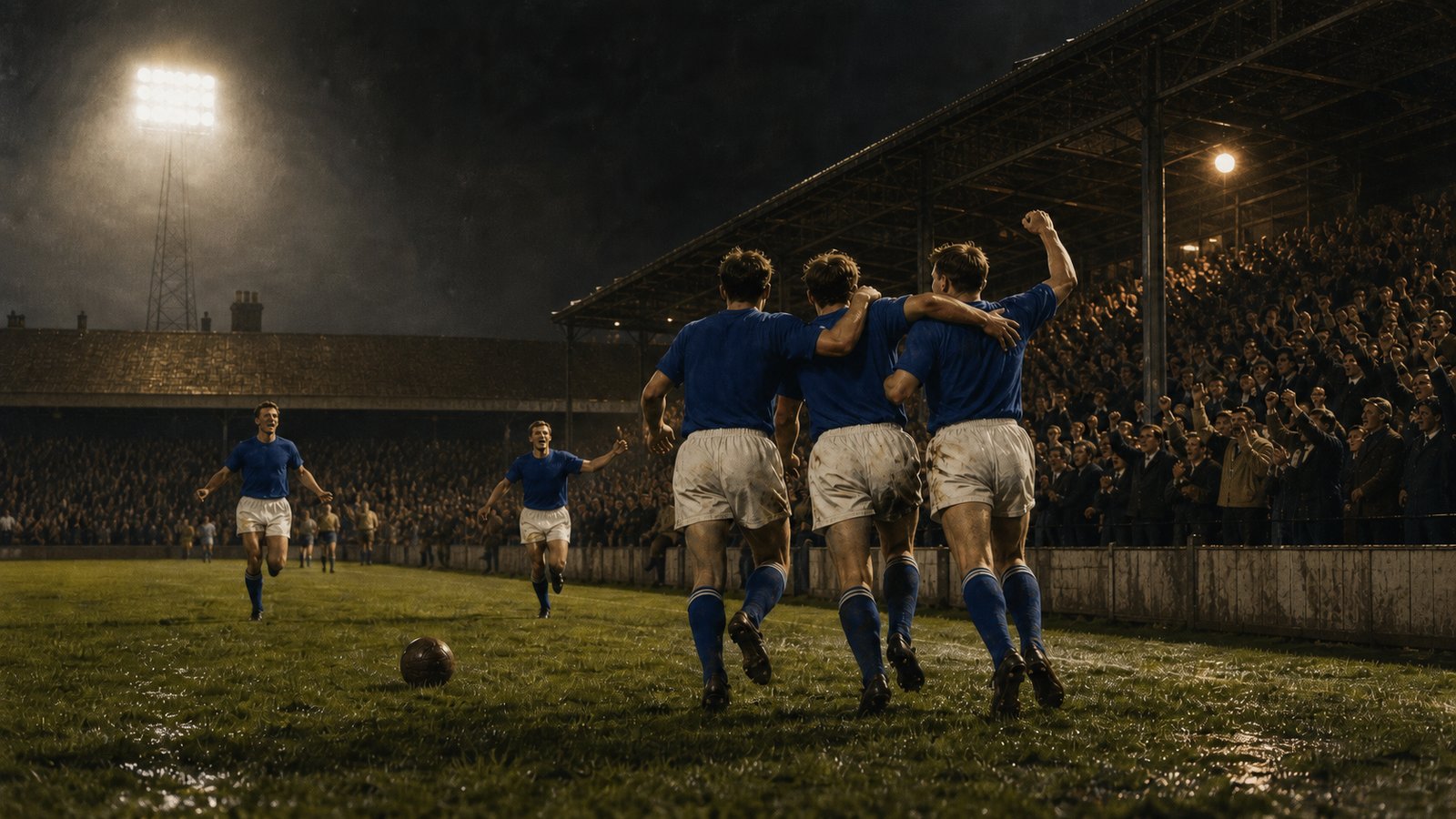
Portman Road had never staged a First Division season when Ipswich Town began the 1961–62 campaign. The club had just climbed from the Second Division, and its first afternoon among England’s elite ended with a goalless draw at Bolton. Three days later Burnley beat Ipswich 4-3. Manchester City then won 4-2 in Suffolk. Nothing in those first eight days looked like the opening of a championship procession.
What followed was stranger and more revealing than a simple underdog tale. Alf Ramsey’s team kept absorbing reverses, then answering them with clusters of goals and long runs at home. Ipswich never acquired the smooth statistical profile of an obvious champion. Burnley scored more. Several established clubs conceded fewer. Yet the newcomers reached the decisive weeks with their nerve intact, their two leading scorers still productive, and Portman Road functioning as the most reliable point of their season.
Portman Road’s First Top-Flight Autumn
Ipswich’s first league victory arrived against the same Burnley side that had beaten them at Turf Moor. On 30 August, Ray Crawford scored twice in a 6-2 win. It was a sharp reversal: a promoted club that had conceded eight goals in its previous two matches suddenly dismantled one of the title favourites. By the end of September, Ipswich had climbed to sixth.
The home ground quickly established the rhythm of the challenge. Blackburn Rovers were beaten 2-1 before 24,928 spectators. Birmingham City lost 4-1. On 7 October, a crowd of 28,059 watched Ipswich beat West Ham United 4-2, with Ted Phillips and Crawford each scoring twice. Two weeks later Tottenham Hotspur arrived as reigning league and FA Cup champions. Spurs led twice through Cliff Jones, but Crawford’s second-half pair gave Ipswich a 3-2 victory.
These were not isolated shocks. Nottingham Forest, Manchester United and Chelsea all left Portman Road defeated before Christmas. United lost 4-1; Chelsea lost 5-2 after Crawford scored a hat-trick. The contrast with the road was vivid. Everton beat Ipswich 5-2 in September, Aston Villa won 3-0 in December, and Manchester City produced another 3-0 defeat on a frozen pre-Christmas pitch. Ipswich could look ordinary away from home and overwhelming in Suffolk within the same fortnight. That unevenness made the season difficult to read, but it also meant a bad trip rarely became a lasting collapse.
Two Strikers, Two Different Threats
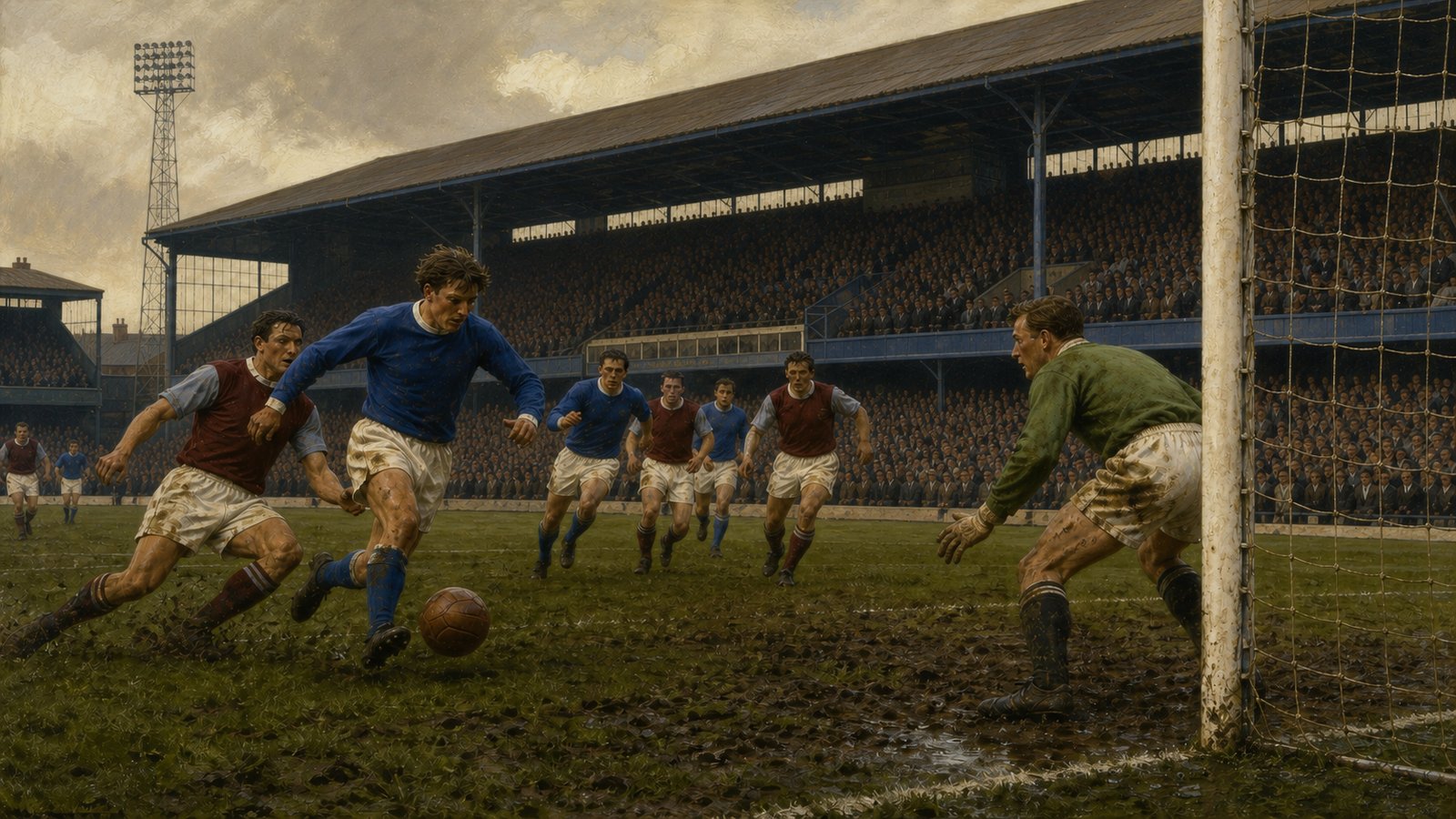
Ramsey’s attack had a useful division of labour. Crawford supplied movement and repeated finishes; Phillips brought extraordinary power. By the end of the league season Crawford had scored 33 goals, level with West Bromwich Albion’s Derek Kevan as the division’s leading scorer. Phillips added 28 league goals. Together they accounted for 61 of Ipswich’s 93 league goals.
The numbers mattered because this was a 42-match championship decided under the two-points-for-a-win system. Ipswich did not need to erase every defensive mistake. A side capable of scoring three, four or five at Portman Road could recover points in matches that became loose. The season’s home results included 6-2, 5-2, three separate 4-2 wins and two 4-1 wins. Even when opponents found space, they often had to survive another Ipswich attack almost immediately.
The supporting cast supplied more than background work. Doug Moran scored on both sides of Crawford in a 3-1 win at West Bromwich Albion. Jimmy Leadbetter helped connect the left side and returned from injury during the winter. Roy Stephenson and Andy Nelson contributed to a team that could change where the next run or shot came from. The promoted side’s advantage was not mystery; it was that established opponents repeatedly failed to control several direct threats at once.
March Put Burnley Under Pressure
At the end of January, Ipswich stood fourth, four points behind Burnley, who had two matches in hand. The apparent gap concealed a change in the calendar. Ipswich had already exited both domestic cups, so its remaining work was concentrated in the league. February began with a 4-2 home win over Everton and a 2-1 victory at Fulham. A 2-2 draw at West Ham closed the month without defeat.
March made the challenge real. Sheffield United came to Portman Road on a 16-match unbeaten run and lost 4-0. Sheffield Wednesday led after seven minutes six days later, but Crawford equalised and Stephenson scored with two minutes left. At White Hart Lane on 14 March, Ipswich beat Tottenham 3-1 in front of more than 50,000 spectators. Crawford scored twice, Phillips once, and Ipswich became the first side for three seasons to beat Spurs home and away.
Draws against Blackpool and Nottingham Forest slowed the run without breaking it. Ipswich then won 2-0 at Leicester City and 3-2 at home to Wolverhampton Wanderers, Moran scoring the winner with two minutes remaining. Across February and March, the team went unbeaten in ten league matches. It ended March two points above Burnley, although Burnley still held four games in hand. Ipswich had created a peculiar title race: the lead belonged to Suffolk, while the theoretical advantage belonged elsewhere.
A 5-0 Defeat Failed to Set the Direction
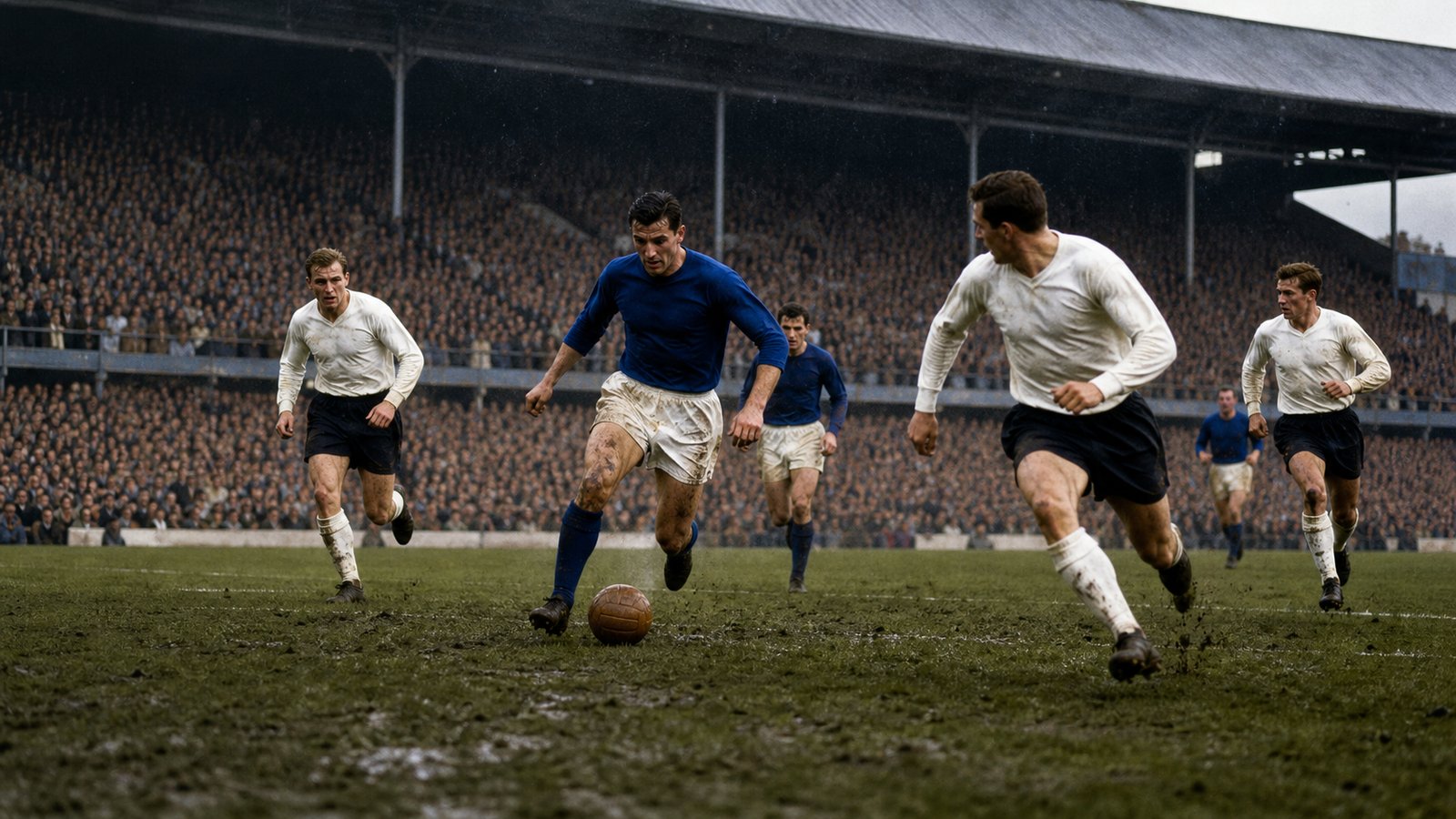
On 7 April, Manchester United beat Ipswich 5-0 at Old Trafford. Albert Quixall scored three. For a newly promoted team trying to hold first place, the score looked like the moment reality had arrived. Ipswich responded by beating Arsenal 3-0 at home one week later. That recovery captured the season better than either result by itself.
Burnley’s games in hand were valuable only if converted into points. During April their schedule tightened and their form dipped. Ipswich continued to place results on the board. The Arsenal match drew 30,649, the club’s highest home attendance of the season. Crawford, Moran and Phillips scored. The next assignment was Chelsea at Stamford Bridge on 21 April.
Chelsea were fighting relegation and took the lead, but Ipswich won 3-1. Crawford scored twice and Moran added the other. Two days later Ipswich played its final league match, at home to Aston Villa. Phillips scored two penalties in a 2-0 win. The newcomers had completed their 42 fixtures with 24 wins, eight draws and ten defeats. They had 56 points and could do nothing except wait.
The Wait Was Part of the Victory
Burnley still had a route past them. But a 1-1 draw with Chelsea on 23 April damaged that path, and subsequent results left Ipswich beyond reach. Ramsey’s side finished three points clear. Burnley’s goal average was better and its total of 101 goals exceeded Ipswich’s 93, yet the championship belonged to the club playing its first top-flight season.
The achievement has a clean headline, but the route was full of rough edges: a 5-0 loss in April, ten league defeats overall, and repeated away setbacks. Ipswich won because the response to those setbacks was unusually quick. The team protected its home sequence, kept two high-volume scorers available, and built an unbeaten run precisely when the title race narrowed. Its final record was less a portrait of invulnerability than evidence of recovery repeated over nine months.
There was also a consequence beyond the trophy. Ipswich entered the European Cup for the first time the following season, defeating Floriana before losing to eventual champions AC Milan. Ramsey left in 1963 to manage England. The methods and authority visible in Suffolk would soon be tested on a different scale.
Ipswich’s championship belongs beside later promoted-team breakthroughs such as Kaiserslautern’s 1998 Bundesliga title, but its shape remains unique in English football. The club entered a division it had never known, lost heavily enough to appear exposed, and still finished first. The surprise was sustained not by a single famous afternoon, but by the refusal to let one bad afternoon decide the next one.
Sources
Ipswich Town Football Club history and honours; Football Club History Database; RSSSF English league records; contemporary reports from The Guardian, The Observer and regional newspapers as catalogued in the season record.